
ROOF-340 · Lesson 11 of 12 · 20 min
Practice exam and review
▶ Video coming soon A video version of this lesson is on the way.
Dana's dry run was on Sunday, November 15, in the Ridgecap office, with the blinds down and the phones in a box by the door. Luca, Rory and Keisha each had a pencil, a calculator of the kind the exam allowed, scrap paper and 100 questions that Dana had written over the years. Nobody else had seen them. She set a timer for three hours, said "Go," and sat at the reception desk with a coffee. Luca finished with forty minutes left, went back over his flagged questions, and handed in his sheet with ten minutes to spare. He scored 72 out of 100, just over the line. Rory, who had seven months in the trade, scored 52 and was delighted. Keisha scored 66.
The score was the least useful thing about the day. What mattered was what Luca did with it in the next two months. This lesson shows how to use practice tests: how to mark them, how to keep an error log, how to tell what kind of mistake each one was, and how to turn the results into the last part of the study plan. It ends with a short practice set from the whole program.
Marking a practice test
Mark the test the same day, while the reasoning is fresh. For every question, write down three things: right or wrong, how sure you were (sure, unsure, guessed), and, for every wrong or unsure answer, why. Questions answered correctly by guessing are not marks you can count on; they belong with the wrong ones in the review.
Then sort the results by area of the exam. A total score hides the pattern; a score by area shows it.
| Area | Questions | Luca correct | Luca in 100 |
|---|---|---|---|
| Safety, tools and organizing | 20 | 15 | 75 |
| Tear-off and deck | 14 | 10 | 71 |
| Low slope | 30 | 25 | 83 |
| Steep slope | 16 | 9 | 56 |
| Waterproofing and details | 8 | 4 | 50 |
| Inspection and repair | 12 | 9 | 75 |
| Total | 100 | 72 | 72 |
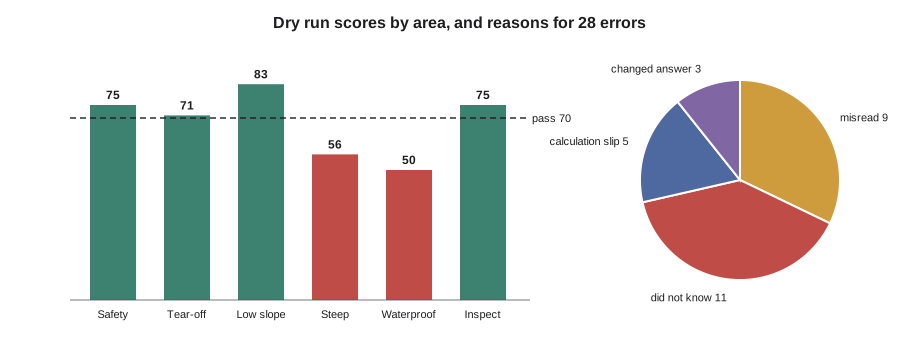
Luca's low-slope score was strong, as expected. Steep slope and waterproofing were his weak areas, and they had improved since his first practice set but not enough. Common skills, which he had expected to ace, was only in the low seventies, and almost all of the lost marks there were safety questions he had read too quickly.
The error log
An error log is a notebook or spreadsheet with one line for every question missed or guessed: the topic, what you answered, the correct answer, the reason, and what you will do about it. Over a few practice sets, it shows patterns that a score cannot. Dana sorts errors into four kinds, because each has a different cure:
| Kind of error | What it looks like | The cure |
|---|---|---|
| Did not know | The fact or method was never learned, or forgotten | Study the topic; make cards; re-test in a few days |
| Misread | Knew the answer but missed a word such as not, first or except | Slow down on the stem; underline key words; answer in your head first |
| Calculation slip | Right method, wrong arithmetic, wrong unit or rounding | Write units at each step; estimate first; check the answer is sensible |
| Changed a right answer | First answer was right; changed it on review without new information | Change an answer only when you find a definite reason |
Worked problem
Reading the error log
Luca missed 28 questions on the dry run. His log shows 11 he did not know, 9 he misread, 5 calculation slips and 3 changed answers. What share of his lost marks could he recover without learning anything new?
Show solution
- Errors not caused by missing knowledge = 9 + 5 + 3 = 17.
- Share = 17 ÷ 28 = 0.61, about 61 in 100.
- If he recovered half of those, he would gain about 8 marks: 72 + 8 = 80 of 100.
Answer: About 61 in 100 of his lost marks came from reading, arithmetic and second-guessing, not from gaps in knowledge. That is the fastest place to gain marks.
Changing answers
Should a candidate go back and change answers? The research on multiple-choice tests is fairly consistent: when people change answers for a reason, such as noticing a word they missed or recalling a fact later in the exam, they more often change from wrong to right than from right to wrong. What does not help is changing an answer because of a vague feeling, or because three answers in a row were the same letter. Dana's rule: change it if you can say why; leave it if you cannot.
Turning results into the last weeks of the plan
With seven or eight weeks left, the plan in lesson 2 is adjusted. Hours move again toward weak areas, but the strong areas keep a short weekly review so they do not fade. Misreading is practiced directly: sets of twenty questions done slowly, saying each key word aloud. Calculation slips are practiced with a timed drill of the formula sheet twice a week. And a second full-length practice test goes into the calendar about a week before the exam, with new questions, not the dry run again.
Luca moved five hours from low slope to waterproofing, added a weekly hour of steep-slope sketches with Keisha, and made a rule for himself: on every question with the word not or except, he would write the word on his scrap paper before choosing an answer.
If you do not pass
Some good roofers do not pass the first time. It is not the end of anything. Ridgecap lets a candidate rewrite its completion test after a month of further study and repeat any part of the practical test that was not passed; NRCA allows one retake of a performance exam. The approach is the same as after a practice test: find the areas and the kinds of error, adjust the plan, and practice under exam conditions again.
A practice set from the whole program
Here are twenty short questions from across the program, in the order of the exam's activities. Cover the right-hand column, answer each one, then check. Where you miss one, the lesson in this course that reviews it is the place to start.
| Question | Answer |
|---|---|
| Which fall protection method is preferred where it can be installed? | Guardrails |
| How far from the edge must a warning line be on a low-slope roof? | 6 ft |
| A ladder reaches 8 units up a wall. How far out is its base? | 2 units |
| What should be done first when a torch-applied repair is needed beside a wood curb? | Plan flameless work at the curb under the hot work permit |
| Which modifier gives modified bitumen its flexibility in the cold? | SBS |
| Where is the equiviscous temperature measured? | At the point of application |
| A roll is 1 unit wide and 10 units long with 0.1 side laps and 0.15 end laps. What is its net coverage? | 0.9 × 9.85 = 8.87 units² |
| How are TPO seams joined? | Hot-air welding |
| What does a good peeled test weld do? | Tears the sheet beside the weld |
| A 50-unit seam has fasteners every 0.5 units. How many fasteners? | 101 |
| What is the pitch factor for 12 in 12? | 1.414 |
| What is laid first at the eave of a shingle roof? | Drip edge |
| Why are nails kept out of the center of a valley? | The valley carries the most water and nail holes would leak |
| Which steep-slope covering is interlaid with felt between courses? | Wood shakes |
| A slate is 20 units long with a 3-unit headlap. What is the exposure? | 8.5 units |
| From where is base flashing height measured? | The finished roof surface |
| Why is a cricket built at about twice the field slope? | Its valleys are flatter than either surface |
| What does damp-proofing not resist? | Water under hydrostatic pressure |
| What must happen to every core cut taken in a moisture survey? | It is repaired the same day and recorded |
| Which costs less per year: 90,000 dollars for 30 years or 60,000 dollars for 15 years? | 90,000 for 30 years: 3,000 a year against 4,000 |
The full 20-question course exam that follows this course is written in the same style, with four options for each question.
Notes on the practice set
A few of the twenty practice questions above are worth a second look, because they are built the way real exam questions are built.
- Question 4 is a sequence question. Several things must happen at a wood curb, but the first is the decision that makes the rest safe: plan flameless work under the hot work permit. An option that names a later step, such as priming or cutting out old material, is a distractor.
- Question 7 is a net coverage question. The gross area of the roll is 10 units², and an answer of 10 is the trap. Subtract the side lap from the width and the end lap from the length before multiplying.
- Question 10 is a fastener count. Fifty divided by 0.5 gives 100 spaces, and the answer is 101 because a row has one more fastener than it has spaces.
- Question 16 tests a definition that matters on every re-roof: flashing height is measured from the finished roof. An answer measured from the deck will look right to anyone who has not thought about the new insulation.
- Question 20 compares cost per year, not first cost. The cheaper option costs more each year because it lasts half as long.
An exam-day checklist
Dana gives every candidate the same checklist a week before the exam:
- Confirmation read; location found; travel time known, with half an hour to spare.
- Government photo identification, and anything else the confirmation requires.
- An approved calculator, if the confirmation allows one, with a fresh battery; no phone, smart watch or notes in the room.
- A good night's sleep, breakfast, and water if it is allowed.
- A pace plan written down: about 1.8 minutes a question, with a target of about 65 questions answered at the two-hour mark.
- A first pass that answers every question it can and flags the rest, then a second pass for the flagged ones, then a final check that every question has an answer.
- On a paper exam, a check every ten questions that the answer number matches the question number.
Most of these look too obvious to need writing down. Dana writes them down because every one of them has gone wrong for somebody in her groups, from a candidate who left his identification in his truck to one who skipped a question on a paper answer sheet and spent the last twenty minutes erasing.
The last two weeks
Luca's plan for the last two weeks before the test had no new topics in it. He did his flash cards every evening, worked one timed set of twenty-five questions every second day, drilled the formula sheet twice a week, and read through his error log, looking only at the lines marked misread. Dana's second practice test, with new questions, was planned for the first week of January. His goal for it was not a higher score but fewer misreads.
"If I get a question wrong because I didn't know it, fine," he told Rory. "There's a lot to know. If I get it wrong because I didn't read it, that's on me."
Writing your own questions
One of the best ways to study is to write questions. Writing a good multiple-choice question forces a candidate to know the fact exactly, and writing three good distractors forces them to know the mistakes people make about it. Dana has each member of her group write five questions a week on their weakest area, swap them, and answer each other's. The questions are rarely as good as the real exam's, but the writing is the point. Luca's first questions on waterproofing were all definitions. By December they were about situations: a foundation wall below the water table, a plaza deck over a parking garage, a planter on a roof, and what each one needed.
Common mistakes
MistakeLooking only at the total score.
InsteadScore each area, and log the reason for every error.
MistakeCounting lucky guesses as known.
InsteadReview guessed answers with the wrong ones.
MistakeRetaking the same practice test to watch the score rise.
InsteadUse new questions for each full practice test.
MistakeChanging answers on a hunch.
InsteadChange an answer only when you can say why.
MistakeTreating a failed attempt as proof you cannot pass.
InsteadUse the result to target study, and write again.
Summary and key terms
- Mark practice tests the same day; record right or wrong, confidence and the reason for each error.
- Score by area of the exam to find weak areas.
- Sort errors into did not know, misread, calculation slip and changed answer; each has its own cure.
- Many lost marks come from reading and arithmetic, not missing knowledge.
- Change answers only for a reason; adjust the plan and take a second full practice test with new questions.
- A failed attempt is a guide to the next one.
- Dry run
- A full practice test under the same conditions as the real exam.
- Error log
- A record of missed and guessed questions, with reasons and actions.
- Confidence rating
- A note of how sure the candidate was of each answer.
- Misread
- An error caused by missing a key word or detail in the question.
- Calculation slip
- An error in arithmetic, units or rounding with the right method.
- Score by area
- Practice results broken down by the exam's activities.
Practice problems
Work each problem on paper first, then reveal the answer to check.
A candidate gets 24 of 30 low-slope questions right. What is that in 100?
Show answer
24 ÷ 30 = 0.80, 80 in 100.
Of 40 lost marks, 18 were misreads. What share is that?
Show answer
18 ÷ 40 = 0.45, 45 in 100.
Which kind of error is cured by writing units at each step?
Show answer
Calculation slips.
When should a practice test be marked?
Show answer
The same day.
What should a candidate do with an answer they want to change on a hunch?
Show answer
Leave it unless they can say why it is wrong.
Lesson quiz · 5 questions
Score 60% or more to complete this lesson.
Create a free account to save your progress, take quizzes and earn a certificate.