
ROOF-340 · Lesson 7 of 12 · 26 min
Review: single-ply membranes
▶ Video coming soon A video version of this lesson is on the way.
For single-ply, Dana brought in a guest. Owen Kraus, the lead welder on Crew 3, came to the Sunday practice test a little early with a hand welder, a roller, a probe and a few strips of TPO and PVC, and spent half an hour before the test making test welds on the lunchroom table while the group watched. He peeled each one apart with pliers and showed them what a good weld looks like when it fails: the sheet tears beside the weld, and the scrim shows. "If it peels clean at the seam, it was never a weld," he said. "It was two pieces of plastic touching."
Single-ply membranes are a large and growing share of the low-slope questions. This lesson reviews ROOF-220: the three membrane types, tested assemblies and wind zones, mechanically attached, fully adhered and ballasted systems, hot-air welding, taped EPDM seams, flashings and quality control.
Three membranes, two families
Single-ply membranes fall into two families. Thermosets, mainly EPDM, are cured rubber: once made, they cannot be melted, so their seams are made with tape or adhesive. Thermoplastics, TPO and PVC, soften with heat and harden again as they cool, so their seams are welded with hot air into one piece. That single fact answers many exam questions about seams, repairs and aging.
| EPDM | TPO | PVC | |
|---|---|---|---|
| Family | Thermoset rubber | Thermoplastic | Thermoplastic with plasticizers |
| Seams | Primer and seam tape, or adhesive | Hot-air welded | Hot-air welded |
| Usual color | Black (white available) | White | White or gray |
| Strengths | Long record, flexible in cold, tolerant of movement | Reflective, weldable, economical | Weldable, resists grease, oils and many chemicals |
| Watch for | Damage by petroleum products; seam workmanship | Aging makes old sheet harder to weld; clean and prepare | Must be separated from asphalt and some foams; plasticizer loss |
| Standard | ASTM D4637 | ASTM D6878 | ASTM D4434 |
Membranes come reinforced with a scrim or unreinforced, and in thicknesses given in mils: 45, 60 and 80 mil are common. Thicker sheets last longer and resist punctures better, but the scrim and its coverage, the thickness over the scrim, matter as much as the total.
Tested assemblies and wind zones
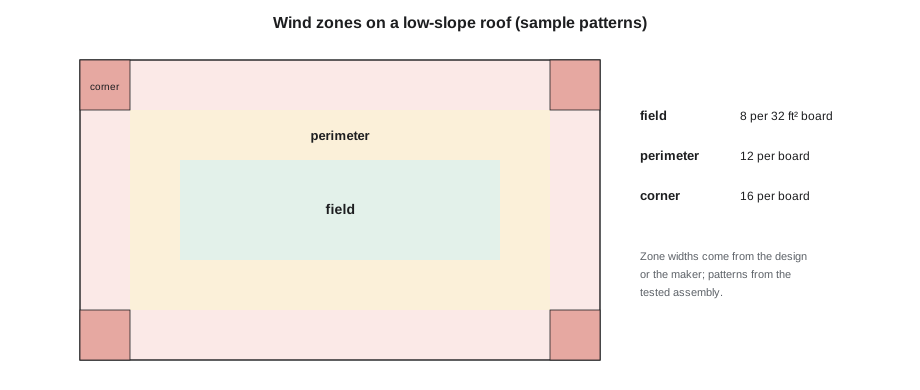
A single-ply roof is attached as a tested assembly: the deck, the boards, the fasteners or adhesive, the membrane and the pattern together. In the US, assemblies carry ratings from testing to FM and UL standards and must resist the wind loads calculated from ASCE 7 for the building, and the roof that is built must match the assembly that was tested. Because wind pulls hardest at the corners and the perimeter, the attachment is increased there: more fasteners, closer seams, narrower sheets, or more adhesive. The widths of the perimeter and corner zones depend on the building's height and dimensions and are given in the design or the maker's requirements.
Mechanically attached systems
In a mechanically attached system, the insulation is fastened down and the membrane is fastened along its edges, inside the side laps, with screws and plates or bars; the next sheet overlaps the fasteners and is welded over them. Fastener spacing along the lap and the width of the sheets set how many fasteners hold each square meter. Fasteners must penetrate a steel deck by the maker's minimum, and they must not be overdriven so that the plate cups or underdriven so that it rocks.
Worked problem
Fasteners in a seam
A mechanically attached TPO sheet runs 100 ft along a seam, with fasteners every 12 in in the lap. How many fasteners are in that seam?
Show solution
- Spaces = 100 ÷ 1 = 100.
- Fasteners = spaces + 1 = 101.
Answer: 101 fasteners. Forgetting the fastener at the start of the run is a classic one-off error, on the job and on the exam.
Worked problem
Insulation fasteners by zone
Insulation boards 4 × 8 ft (32 ft²) are fastened with 8 fasteners each in the field, 12 in the perimeter and 16 in the corners. A roof has 6,450 ft² of field, 1,600 ft² of perimeter and 320 ft² of corners. How many fasteners are needed? (Sample pattern.)
Show solution
- Field = 6,450 ÷ 32 × 8 = 1,612.5.
- Perimeter = 1,600 ÷ 32 × 12 = 600.0.
- Corners = 320 ÷ 32 × 16 = 160.0.
- Total = 1,612.5 + 600.0 + 160.0 = 2,372.5, so 2,373.
Answer: About 2,375 fasteners and plates, plus a few in 100 for waste.
Fully adhered systems
In a fully adhered system, the boards are fastened or adhered and the membrane is glued to them over its whole area, with contact bonding adhesive (applied to both surfaces and allowed to flash off until it is tacky but does not string) or with water-based or low-rise foam adhesives as the maker allows. Adhered roofs resist wind well and show less flutter, but they depend on weather: adhesives have minimum temperatures, and dew can form on cold, freshly coated surfaces, so crews watch the dew point and stop when the margin gets small.
Worked problem
Adhesive quantity
Contact adhesive covers about 60 ft² per gallon of combined coverage (both surfaces). How many 5 gal pails are needed for 4,300 ft² of membrane?
Show solution
- Gallons = 4,300 ÷ 60 = 71.7 gal.
- Pails = 71.7 ÷ 5 = 14.3, so 15 pails.
Answer: Fifteen pails, before any allowance for waste or rough surfaces. Coverage rates are typical; the maker's data sheet governs.
Ballasted systems
In a ballasted system, the membrane is loose-laid over the insulation and held down by weight: river stone or pavers. Industry standard practice in North America follows ANSI/SPRI RP-4, which sets three systems by building height and wind speed, with more ballast or pavers at the perimeter and corners. Typical stone is about 10 lb/ft² for the lighter system and heavier for the others. Ballast is heavy, so the structure must be checked, and the membrane must be protected from the stone and from scour at drains and edges.
Worked problem
Weight of ballast
A ballasted roof of 13,000 ft² carries stone at 10 lb/ft². How much stone is on the roof?
Show solution
- Weight = 13,000 × 10 = 130,000 lb = 65 tons.
Answer: About 65 tons. When this ballast is removed for a re-roof, it must be lowered and stored safely, and when it is replaced, the structure must be able to carry it.
Hot-air welding
TPO and PVC seams are welded with hot air from a hand welder or an automatic machine. The weld depends on three settings that work together: temperature, speed and pressure. They change with the weather, the sheet and its age, so every crew makes test welds each morning, again after lunch and whenever conditions or machines change, then cuts strips across them and peels them to check. A good weld fails by tearing the sheet beside the weld, not by peeling at the seam. Welds are at least 1-1/2 in wide where the maker requires that minimum, and every seam is probed with a blunt probe after it cools, about 30 minutes or as the maker says, to find voids.
Common welding defects are cold welds (too little heat or too much speed), burned or scorched welds (too much heat or too slow), wrinkles and fish-mouths at T-joints, and contaminated welds where dirt or old weathered surface kept the sheet from fusing. Aged TPO and dirty PVC must be cleaned with the maker's cleaner before welding repairs.
EPDM taped seams
EPDM seams are made with primer and seam tape. The lap is cleaned and primed, the primer is allowed to flash off, the tape is applied to one side and the other sheet is laid on it and rolled firmly across the seam, then T-joints and seam intersections are covered with pressure-sensitive covers. The common failures are poor priming, primer that was still wet, wrinkles, and seams not rolled hard enough. Old EPDM must be cleaned of its weathered surface before new tape will stick.
Flashings and details
Single-ply flashings are made with the same material as the field, or with the maker's accessories: pre-molded pipe boots, inside and outside corners, curb wraps and drain kits. Base flashings go at least 8 in above the roof surface, are secured at the base where the maker requires a row of fasteners or a termination bar to resist the membrane pulling away from the wall, and are terminated at the top and covered with a counterflashing. Unreinforced membrane is used where it must stretch around corners and boots; reinforced membrane where it must carry load.
Quality control
Quality control for single-ply roofs includes the morning test welds and probe results recorded daily, inspections at the hold points in the specification, test cuts only where the maker allows them, cut-off of the daily work with a temporary tie-in that keeps water out overnight, and the maker's inspection before the warranty is issued. Electronic leak detection, which finds holes by passing a small current across the membrane, is often used on adhered and protected roofs.
Exam-style questions explained
Question. A TPO seam probed the day after welding has a 6 in long void at a T-joint. What is the right repair? (A) Fill it with sealant; (B) clean the area, then weld a patch of the same membrane over the T-joint, rounding its corners, and probe it; (C) tape it; (D) leave it, because T-joints always have voids. Answer: B. Thermoplastic repairs are welded patches with rounded corners; sealant is not a repair.
Question. An EPDM seam is peeling a year after installation, and the tape is clean on one side. What is the likeliest cause? (A) The primer was not applied, or the tape was laid before it flashed off, on that side; (B) the sheet was too thick; (C) the seam was welded; (D) the roof was black. Answer: A. Clean tape on one sheet means it never bonded to that sheet.
Question. Which is the correct way to install a mechanically attached sheet at a perimeter zone? (A) The same pattern as the field; (B) a narrower sheet or closer fastener spacing, as the tested assembly requires; (C) adhesive only; (D) no fasteners, because the edge metal holds it. Answer: B. Perimeter and corner zones need more securement.
Question. Why is PVC chosen over TPO near a restaurant's kitchen exhaust? (A) PVC resists grease and animal fats better; (B) PVC is cheaper; (C) TPO cannot be welded; (D) PVC is darker. Answer: A. Grease attacks many membranes; PVC is the usual choice, with walkway and grease protection at the fan.
Cleaning and preparing for welds and tape
Most single-ply seam failures come down to preparation. Dirt, dust, release agents, oxidized surfaces and moisture all prevent a weld or a tape bond. New TPO and PVC are wiped with the maker's cleaner where the laps are dirty; aged sheet is scrubbed with the maker's weathered-membrane cleaner until the fresh surface shows. EPDM is cleaned and primed with the maker's primer, using the applicator the maker specifies, and the primer is allowed to dry until it does not transfer to a dry finger. Dew is wiped off and the surface allowed to dry before welding or taping. On every system, the crew uses only the maker's products, because cleaners, primers and tapes from different makers may not be compatible.
Walkways and protection
Single-ply roofs are easily punctured by dropped tools, screws and foot traffic around equipment. Walkway pads made for the membrane, welded or adhered as the maker requires, are installed from the access point to each piece of equipment that needs service, and around units where technicians kneel. During construction, finished areas are protected with boards where other trades work, and crews pick up screws and metal filings at the end of every day.
Temporary tie-ins and the end of the day
Every single-ply roof under construction must be watertight at the end of the day. Where new membrane meets old roof or bare deck, the crew builds a temporary tie-in, sealing the new membrane to the old surface with the maker's temporary sealing method so water cannot run under the new work overnight. The tie-in is cut out and replaced with a permanent splice the next morning. Loose sheets are weighted or fastened, open seams are welded or taped, and tools and debris are cleared so wind cannot drag them across the roof. Exam questions on daily cut-off usually ask what must be done before leaving: the answer always includes making the roof watertight.
Common mistakes
MistakeTaping a TPO seam or welding EPDM.
InsteadThermoplastics are welded; thermosets are taped or glued.
MistakeSkipping the afternoon test weld because the morning one passed.
InsteadWeather and sheet temperature change; test again after breaks and changes.
MistakeLaying PVC directly on old asphalt.
InsteadSeparate PVC from asphalt and incompatible foams with the maker's slip sheet or cover board.
MistakeCounting fasteners as length ÷ spacing.
InsteadAdd one for the start of the run.
MistakeAdhering membrane when the dew point is close to the surface temperature.
InsteadWatch the margin and stop before condensation forms on the adhesive.
Summary and key terms
- EPDM is a thermoset with taped seams; TPO and PVC are thermoplastics with welded seams.
- The installed roof must match the tested assembly; attachment increases in perimeter and corner zones.
- Mechanically attached sheets are fastened in the laps; fasteners = spaces + 1.
- Fully adhered roofs depend on adhesive coverage, temperature and the dew point.
- Ballasted roofs follow RP-4 and need a structural check.
- Make test welds each morning and afternoon, peel and probe, and record the results; flash with the maker's accessories.
- Thermoset
- A material that is cured and cannot be melted again, such as EPDM.
- Thermoplastic
- A material that softens with heat and can be welded, such as TPO and PVC.
- Scrim
- The reinforcing fabric inside a reinforced membrane.
- Test weld
- A sample weld made and peeled to check welder settings before welding seams.
- Contact adhesive
- An adhesive applied to both surfaces and allowed to become tacky before they are joined.
- Loose-laid
- Laid without attachment over its area, held down by ballast or by fastening at the edges.
Practice problems
Work each problem on paper first, then reveal the answer to check.
A seam is 150 ft long with fasteners every 6 in. How many fasteners?
Show answer
150 ÷ 0.5 = 300 spaces + 1 = 301.
How much adhesive at 60 ft²/gal is needed for 2,700 ft²?
Show answer
2,700 ÷ 60 = 45 gal.
Which membrane is chosen for a restaurant roof with grease from exhaust fans?
Show answer
PVC, which resists grease and oils.
How does a good test weld fail when peeled?
Show answer
The sheet tears beside the weld; it does not peel apart at the seam.
What is the weight of stone at 10 lb/ft² on 8,600 ft²?
Show answer
86,000 lb, 43 tons.
Lesson quiz · 5 questions
Score 60% or more to complete this lesson.
Create a free account to save your progress, take quizzes and earn a certificate.