
ROOF-320 · Lesson 9 of 12 · 22 min
Metal flashings and sheet metal work
▶ Video coming soon A video version of this lesson is on the way.
Theo's session on the last Thursday in October, the week Rory finished with Crew 3, was the one he had been waiting for: time on the brake. Theo had a length of prefinished steel coil, a pattern for the new Parkdale coping drawn on the bench in chalk, and a box of offcuts of every metal Ridgecap uses. He handed Rory a piece of copper and a piece of galvanized steel, the same thickness, and asked him to bend each one over the edge of the bench by hand. The copper folded easily and stayed where it was put. The steel sprang back. "Every metal has its own manners," Theo said. "How it bends, how it moves when it gets hot, what it does when it touches another metal, and how long it lasts in the rain. You choose the metal first and the detail second."
This lesson covers the sheet metal used for roof flashings: the common metals and their thicknesses, how they corrode and how dissimilar metals react, how much they move with temperature, the joints, hems, cleats and fasteners that hold metal flashings together, and how flashings are laid out and bent in the shop. SMW-320 covers architectural sheet metal in more depth for sheet metal workers; this lesson takes the roofer's view.
Metals for flashing
Five metals do most of the work on roofs in Ohio.
- Galvanized steel: steel sheet coated with zinc, which corrodes slowly in place of the steel. Cheap, strong and easy to work, but the zinc wears away in time, faster at cut edges, scratches and where water sits. Used for cleats, concealed flashings and painted work.
- Prefinished (pre-painted) steel: galvanized or zinc-aluminum coated steel with a factory paint finish, usually a long-life polymer. The most common metal for copings, edges and counterflashings on commercial roofs. Comes in many colors to match the building.
- Aluminum: light, does not rust, and comes plain, anodized or prefinished. Soft and moves a lot with temperature. Common for gutters, edges and termination bars. Must be kept away from wet concrete, mortar and some treated lumber.
- Copper: long-lasting, easy to bend and solder, and weathers to a brown and then green patina. Expensive. Used for heritage work, valleys, quality residential flashing and through-wall flashing. Its runoff stains and attacks other metals below it.
- Stainless steel: very durable and strong, used for termination bars, clamps, fasteners, through-wall flashings and corrosive environments. Harder to bend and to solder than copper.
| Metal | Common flashing thickness | Notes |
|---|---|---|
| Galvanized steel | 24 to 22 gauge (0.0276 to 0.0336 in) | Thicker for copings and cleats |
| Prefinished steel | 24 to 22 gauge (0.0276 to 0.0336 in) | Check paint system and warranty |
| Aluminum | 0.032 to 0.040 in | Thicker for wide faces and copings |
| Copper | 16 to 20 oz (0.0216 to 0.027 in) | Sold by weight per square foot |
| Stainless steel | 26 to 24 gauge (0.0187 to 0.025 in) | Type 304 common; 316 near salt |
Sheet metal gauge is an old system in which a higher number means thinner metal, and the same gauge number means different thicknesses for steel, galvanized steel and stainless steel. Copper is sold by the weight of a square foot, so 16 oz copper is about 0.0216 in thick. When in doubt, use the decimal thickness, and check it with a micrometer.
Corrosion and dissimilar metals
When two different metals touch in the presence of water, they form a small battery: one metal, the less noble one, corrodes faster, and the other is protected. This is galvanic corrosion. On a roof the usual offenders are:
- Copper touching or draining onto galvanized steel, aluminum or zinc. Copper runoff carries copper ions that eat holes in the other metals downstream, even without touching them.
- Steel fasteners in copper or stainless flashings, which rust away quickly; and copper or brass fasteners in aluminum.
- Aluminum in contact with wet concrete, mortar or some treated lumber, which attack it.
The rules are simple: use fasteners of the same metal as the flashing, or a more noble one such as stainless steel; never let copper drain onto other metals; separate dissimilar metals with a membrane, a coating or a non-conductive spacer; and match the metal of cleats to the metal they hold. At St. Brendan's, Martin's report on the galvanized valleys that failed in 2025 suspected that runoff from the copper flashings above them had helped to rot them.
Thermal movement
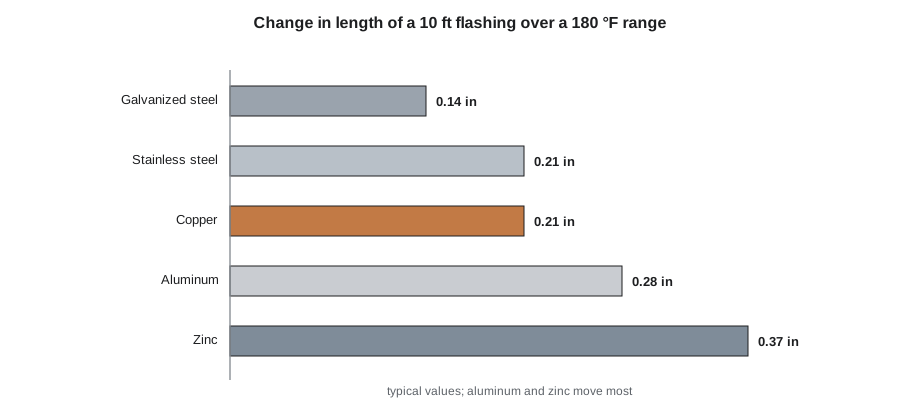
All metals expand when warmed and shrink when cooled, and metal on a roof sees a large range: a dark metal coping can reach well over 160 °F in summer sun and fall below −15 °F on a clear winter night. The change in length is the original length times the metal's coefficient of expansion times the temperature change.
| Metal | Expansion per degree | Change in a 10 ft length over 180 °F |
|---|---|---|
| Galvanized steel | about 6.7 millionths per °F | 0.14 in |
| Stainless steel (304) | about 9.6 millionths per °F | 0.21 in |
| Copper | about 9.8 millionths per °F | 0.21 in |
| Aluminum | about 12.9 millionths per °F | 0.28 in |
| Zinc | about 17.3 millionths per °F | 0.37 in |
Worked problem
Movement in a coping run
Theo is making the new Parkdale coping in prefinished steel, in 10 ft lengths. The coping may reach 160 °F in summer and −20 °F in winter. It will be installed late in November at about 40 °F. How much does each length grow and shrink from its installed length, and is a 1/4 in gap at each joint enough? What would happen with aluminum?
Show solution
- Length = 120 in; steel coefficient = 0.0000067 per °F.
- Growth to 160 °F: 120 × 0.0000067 × (160 − 40) = 120 × 0.0000067 × 120 = 0.096 in.
- Shrinkage to −20 °F: 120 × 0.0000067 × (40 − (−20)) = 120 × 0.0000067 × 60 = 0.048 in.
- A 1/4 in (0.25 in) gap closes to 0.25 − 0.096 = 0.154 in in summer and opens to 0.25 + 0.048 = 0.298 in in winter: enough, and the cover plate stays over it.
- Aluminum at 0.0000129: growth 120 × 0.0000129 × 120 = 0.186 in, shrinkage 120 × 0.0000129 × 60 = 0.093 in. The gap would close to about 1/16 in in summer.
Answer: The steel coping moves about 3/32 in one way and 3/64 in the other, which a 1/4 in gap handles easily. Aluminum would move almost twice as much, so in aluminum Theo would use a wider gap or shorter lengths, and he would never seal the joint solid.
Long runs of flashing that are fastened tight at both ends and in between buckle in the heat, tear their fasteners loose in the cold, and break sealant joints. The answer is to fasten flashings with cleats that let them slide, to keep individual lengths short, and to put a movement joint wherever a run is long.
Joints, hems and cleats
Sheet metal flashings are joined and held in a few standard ways.
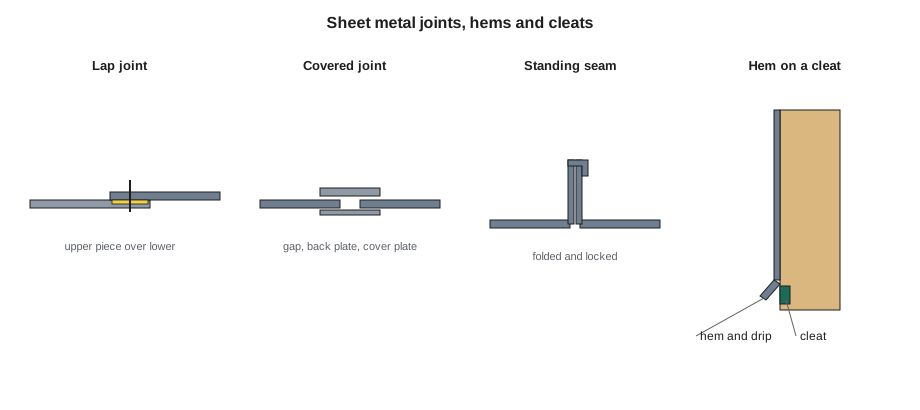
- Lap joint: one piece laps over the next, in the direction of water flow, by at least 4 in for flashings, often with a sealant tape or bead inside the lap and fasteners through it. Simple, but a sealed and fastened lap cannot move.
- Cover plate and back plate joint: the two pieces are set with a gap between them, a back plate under the gap and a cover plate over it, sealed to the back plate but not fastened through the gap, so each length can move. The standard joint for copings and edges.
- Standing seam: two edges turned up, folded together and locked, used for metal roofing panels and some copper work; it moves freely along its length.
- Flat lock seam: edges folded into each other and flattened, then soldered, used on copper and on low-slope metal; watertight but not free to move unless the field is broken into small panels.
- S-lock and drive cleat: folded connectors that join flat pieces end to end, used more in ductwork than on roofs.
A hem is an edge folded back on itself. Hems stiffen an edge, remove the sharp cut edge so it does not cut people or membrane, and form the drip that throws water clear. Exposed edges of flashings should be hemmed, typically by about 1/2 in. A cleat is a strip of metal fastened to the structure that the flashing hooks onto, so the flashing is held without fasteners through its face and can slide. Continuous cleats hold the bottom edges of fascias and copings against the wind; clip cleats, short pieces spaced along a run, hold flashings that need to move. Cleats are usually one gauge heavier than the metal they hold, and of the same metal.
Fasteners
- Match the fastener to the metal: stainless steel or coated fasteners for galvanized and prefinished steel; stainless or aluminum for aluminum; copper, bronze or stainless for copper.
- Fasten through the flanges that are covered, not through exposed faces, wherever possible.
- Use neoprene or EPDM sealing washers on exposed screws, and do not overdrive them so the washer splits.
- Keep fasteners clear of the bends, at least 1/2 in in from cut edges, and at the spacing the tested system or the specification gives.
Laying out and bending in the shop
Flashings are bent from flat sheet on a brake. Before cutting, the shop needs the developed width, or girth, of each piece: the total of all its flat faces plus allowances for hems and locks. A brake bend in thin sheet metal uses up very little length, so for roof flashings the girth is usually taken as the sum of the outside dimensions plus the hems, and a test piece is bent to check it before cutting a whole coil.
Worked problem
The girth of a coping
The new Parkdale coping covers a parapet 10 in wide and slopes 1 in 8 toward the roof. Its outside face drops 3 in over the wall, its inside face drops 4 in, and each face ends with a 1/2 in hem and a 1/2 in drip kick. What is the girth of the coping, and how many pieces can be cut across a 48 in wide coil?
Show solution
- Top width along the slope = 10 × √(1 + (1/8)²) = 10 × 1.0078 = 10.08 in.
- Faces = 3 + 4 = 7 in.
- Hems and kicks = 2 × (0.5 + 0.5) = 2 in.
- Girth = 10.08 + 7 + 2 = 19.08 in, about 19-1/8 in.
- Pieces across a 48 in coil = 48 ÷ 19.125 = 2.51, so 2 pieces, with about 9-3/4 in left over for cleats.
Answer: About 19-1/8 in of girth; two copings across each coil width, and the strip left over becomes cleats. Theo bent one test piece and checked it on a scrap of the parapet before cutting the rest.
Prefinished metal is bent with its paint on the outside of the bend where possible, with clean brake jaws so the finish is not scratched, and the protective film is left on until installation. Cut edges are hemmed or turned under so the bare steel is out of the weather.
Soldered joints
Copper, and to a lesser extent stainless steel and galvanized steel, can be joined by soldering, which makes a joint that is fully watertight and does not depend on sealant. Soldered seams are used on copper valleys, crickets, pans, flat-lock roofs and the corners of copings and counterflashings, where a lapped and sealed joint would be the weak point. The surfaces are cleaned bright, tinned with a thin coat of solder, fitted, and then sweated together with a soldering iron or torch, with flux to clean the metal as it heats. The flux residue is washed off afterwards, because it is corrosive. Stainless steel needs a special acid flux and more heat; prefinished steel cannot be soldered without removing the paint, so it is riveted and sealed instead.
Soldering means flame or hot irons near the roof, so it falls under the hot work rules from ROOF-210: a permit, fire extinguisher, no work over combustible decks without protection, and a fire watch after. In Ridgecap's shop, as much soldering as possible is done on the bench, with the finished one-piece corners and crickets carried up to the roof.
- Clean the metal bright and tin both surfaces before fitting.
- Use the solder and flux the metal maker recommends; lead-free solders are increasingly specified.
- Wash off flux residue after soldering.
- Solder in the shop where possible, and follow hot work rules on the roof.
Common mistakes
MistakeUsing steel screws in copper flashing.
InsteadUse copper, bronze or stainless fasteners in copper.
MistakeLetting copper drain onto a galvanized or aluminum gutter.
InsteadKeep copper runoff off other metals, or use copper throughout.
MistakeFastening a long run of aluminum tight at every joint.
InsteadUse cleats, shorter lengths and covered movement joints.
MistakeLeaving cut edges raw and sharp.
InsteadHem exposed edges, typically about 1/2 in.
MistakeCutting a whole coil to a calculated girth without a test bend.
InsteadBend one piece and check it on the job before cutting the rest.
Summary and key terms
- Galvanized and prefinished steel, aluminum, copper and stainless steel are the common flashing metals, each with typical thicknesses.
- Gauge numbers differ between metals; copper is specified by weight; decimal thickness avoids confusion.
- Dissimilar metals in contact, or copper runoff, cause galvanic corrosion; match fasteners and cleats to the flashing.
- Metal flashings move a fraction of an inch per 10 ft; aluminum and zinc move most.
- Lap, covered, standing seam and flat lock joints, hems and cleats let flashings shed water and move.
- Shop work starts with the girth of each piece and a test bend.
- Galvanic corrosion
- Corrosion of the less noble of two different metals in contact in the presence of water.
- Gauge
- A traditional number for sheet metal thickness; higher numbers are thinner.
- Hem
- An edge of sheet metal folded back on itself.
- Cleat
- A metal strip or clip fastened to the structure that a flashing hooks onto.
- Girth
- The total flat width of sheet metal needed to form a flashing.
- Brake
- A shop machine for bending sheet metal along a straight line.
- Prefinished metal
- Sheet metal with a factory-applied paint coating.
- Patina
- The weathered surface layer that forms on copper.
Practice problems
Work each problem on paper first, then reveal the answer to check.
Which metal's runoff attacks galvanized steel and aluminum?
Show answer
Copper.
How much does a 10 ft aluminum flashing grow for a 90 °F rise?
Show answer
120 × 0.0000129 × 90 = 0.14 in.
What fastener should be used in aluminum flashing?
Show answer
Stainless steel or aluminum.
A flashing has faces of 4, 3 and 2 in and one 1/2 in hem. What is its girth?
Show answer
4 + 3 + 2 + 0.5 = 9.5 in.
Why are cleats used instead of face fasteners?
Show answer
They hold the flashing without holes in its face and let it slide.
Lesson quiz · 5 questions
Score 60% or more to complete this lesson.
Create a free account to save your progress, take quizzes and earn a certificate.