
PWR-420 · Lesson 9 of 12 · 22 min
Training and qualifying operators
▶ Video coming soon A video version of this lesson is on the way.
Tamar Ellingsen had arrived at Cantwell on September 8 with a boiler operation course behind her and almost no plant experience. By November 12 she had logged about 390 hours toward her Ohio high pressure boiler operator license, worked her first solo day shift and written her own log (PWR-110 to PWR-240). Pilar had trained her for much of that time, without ever thinking of it as a program. Grazyna asked her to write the program down. "Tamar learned well because Lorne and you are good at it," she said. "The next trainee might get a shift engineer who isn't. A training program is how a plant stops depending on luck."
This lesson covers the legal requirements for certifying operators in each country and the plant's own duty to make them competent on its equipment. It describes how a systematic training program is designed, from task analysis and learning objectives to on-the-job training, qualification checks, drills and simulators, and how it is kept up through continuing training and records. It finishes with the qualification matrix, a simple tool that shows at a glance who can do what.
Certificates and competence
Ohio's boiler rules require high pressure boilers to be operated by licensed high pressure boiler operators or stationary steam engineers, licensed by the state after an examination and the documented operating experience described in OAC 1301:3-5-10 (PWR-310). Experience must be verified in writing by a person licensed to operate the equipment, which at Cantwell means the shift engineers and Grazyna sign each trainee's hours. A license shows that its holder knows the theory and the law and has the required experience; it does not show that they know a particular plant. That knowledge is the plant's responsibility.
The gap between a certificate and competence is filled by the plant's own training. Competence means the ability to do a job to the required standard, combining knowledge (what and why), skills (how), and judgment (when). It is shown by doing, under observation, not by attending a course.
Other laws add specific training duties. OSHA standards require training in hazard communication for hazardous chemicals, lockout and tagout (1910.147), permit-required confined spaces (1910.146), fall protection, respirators where used, electrical safety for workers exposed to electrical hazards, and the plant's emergency action plan, and some require the training to be certified or documented. Records of that training must be kept.
A systematic approach to training
Large plants and the nuclear industry use a systematic approach to training (SAT), often summarized as ADDIE: analysis, design, development, implementation and evaluation. A small plant can apply the same logic on a smaller scale.
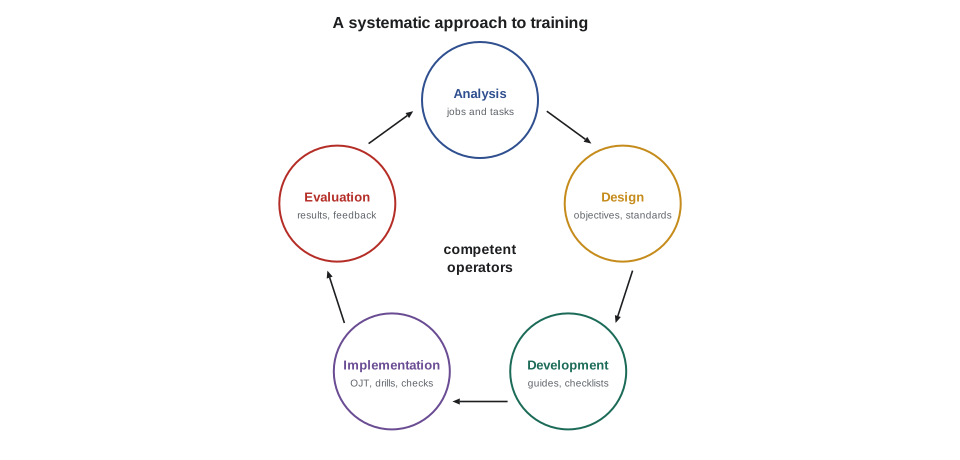
- Analysis lists the jobs in the plant and the tasks each involves, and rates each task by how often it is done, how difficult it is and how serious an error would be. Tasks that are rare, difficult or high-consequence need the most training.
- Design writes learning objectives for each task: what the trainee must be able to do, under what conditions, to what standard. "Start a feed pump in accordance with the procedure, confirming suction pressure, seal flush and discharge pressure before loading" is an objective; "understand feed pumps" is not.
- Development produces the materials: system descriptions, procedures, on-the-job training guides, checklists, drills, test questions and practical demonstrations.
- Implementation delivers the training through reading, classroom sessions, on-the-job training, simulator or tabletop exercises and drills.
- Evaluation checks whether it worked: trainee performance, qualification results, feedback, and the plant's own record of errors, events and near misses. What it finds goes back into the analysis.
On-the-job training
Most operator learning happens on shift, alongside an experienced operator. Unstructured, it depends on who the trainee works with and what happens to occur. Structured on-the-job training (OJT) uses a guide for each system or task that lists what the trainee should see, learn and practice, and a qualified trainer who signs each item when the trainee has shown it. A good OJT guide for Cantwell's feedwater system, for example, would take the trainee from tracing the system on the P&ID and in the field, through the purpose and limits of each component, to normal starts, stops and changeovers, abnormal conditions such as low suction pressure and cavitation, and the emergency response to loss of feedwater.
A good trainer explains why, not only how, lets the trainee do the task while watching, corrects mistakes on the spot, and asks questions that make the trainee think: "What would you see if the DA level transmitter failed high?" Trainers need training too, both in the technical content and in how to coach, and not every good operator is a good trainer.
Qualification
Qualification is the formal decision that a person can perform a task or hold a position unsupervised. It usually requires completion of the OJT guide, a written or oral check of knowledge, a practical demonstration or walk-through in which the candidate explains and simulates the task in the field, and a sign-off by the chief engineer or a designated qualifier. Qualifications for positions, such as board operator or shift engineer, combine many task qualifications with an interview or board.
Worked problem
A walk-through check
Before Tamar was allowed to take the boiler room alone on her first solo day shift, Pilar gave her a walk-through check on the response to a low drum level alarm on boiler 2. What should the check include?
Show solution
- The candidate explains, at the boiler, what the alarm means and what could cause it: feedwater control failure, feed pump trouble, a tube leak, a transmitter fault or a sudden load change with shrink.
- She shows how she would confirm the level: comparing the DCS reading with the gauge glass and the second transmitter, and blowing down the gauge glass if in doubt.
- She describes her actions in order: take manual control of feedwater if the control has failed, check feed pump discharge pressure, reduce firing if level keeps falling, and know the point at which the low-water cutout should trip.
- She states what she must not do: add feedwater to a boiler whose level has fallen out of sight of the glass without first securing the fire, because of the risk to overheated tubes.
- She says whom she would call and when, and what she would log.
Answer: Pilar signed the check after Tamar answered every point and two follow-up questions about the auxiliary low-water cutout. The check took twenty minutes. Its record, with the date and Pilar's signature, joined Tamar's training file, and the same check is now written into the program so that every trainee gets it.
Qualifications should expire. A person who has not done a rare task for years may have forgotten it, and plants change. Many plants requalify operators on critical tasks every two or three years, through a walk-through, a drill or a simulator session, and require requalification after a long absence or a major plant change.
Drills, simulators and continuing training
Emergencies are rare, so the response to them cannot be learned from experience alone. Drills rehearse the response to specific events, such as a loss of feedwater, a boiler flame failure, a gas leak, a fire, a chemical spill or a utility outage, and tabletop exercises talk a team through a scenario. Cantwell's fall emergency exercise on October 14 (PWR-110) and the utility outage on September 20, which Pilar handled for real (PWR-240), are the kind of events the drill program prepares for. Large plants, including Keswold, use simulators of their control systems, on which operators can practice startups, trips and upsets that they might never see in years of normal operation.
Continuing training keeps qualified people current: reviews of procedures and plant changes, lessons learned from the plant's own incidents and from others in the industry, refresher training required by law, and periodic requalification. A short session at the start of each shift rotation on a recent event or a rarely used procedure costs little and works well.
The qualification matrix
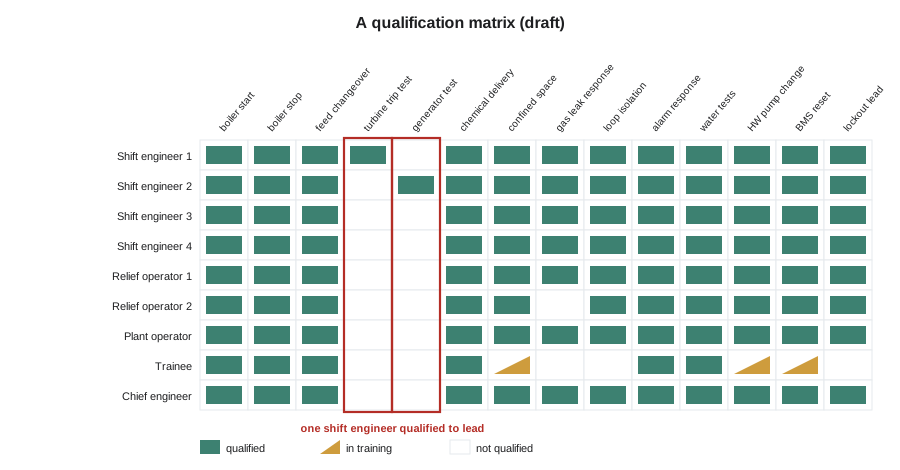
A qualification matrix lists the people on one axis and the qualified tasks or positions on the other, and shows for each cell whether the person is qualified, in training or not qualified, and when each qualification expires. It shows at a glance whether every shift has the people it needs, where the gaps are, and where a single person holds a qualification nobody else has.
Worked problem
Reading the matrix
Cantwell's draft matrix lists 9 people and 14 qualified tasks, a total of 126 cells. 103 cells show a current qualification. What is the coverage, how many gaps are there, and what matters more than the total?
Show solution
- \[\text{Coverage} = \frac{103}{9 \times 14} = \frac{103}{126} \approx 0.82\]
- \[\text{Gaps} = 126 - 103 = 23\]
Answer: Coverage is about 82 in 100, with 23 gaps, but the total is less important than where the gaps fall. The matrix showed that only Lorne was qualified to lead the standby feed pump turbine's monthly trip test and only Pilar the standby generator's monthly load test, and that the trainee and one relief operator were not yet qualified on gas leak response. Those three gaps went to the top of the 2027 training plan; most of the others belong to the trainee and will close as she progresses.
Records and the regulator
Training records show what each person was trained in, when, by whom, and how competence was confirmed. They protect the worker, whose qualifications are documented when they move to another plant; the employer, who can show regulators and courts that its workers were trained; and the plant, which can see who needs what. Records should include certificates and licenses held and their renewal dates, OJT guides with sign-offs, qualification checks, drills attended, legally required training, and requalifications.
A state boiler inspector may ask to see the licenses of the operators on duty, and an incident investigation will always ask what training the people involved had received. Ohio requires a trainee's experience to be verified in writing, so the plant's own hour records need to be accurate and current, and the shift engineers who sign them must be licensed to operate the equipment.
"I can tell a well-run plant from its training files," Grazyna said. "Not because files make people competent, but because a plant that keeps them has thought about what competence means."
Training the trainers
Shift engineers become trainers by default, because trainees work on their shifts. A plant that wants consistent results gives its trainers a short program of their own: how to use the OJT guides, how to explain the reasons behind a step, how to ask questions that test understanding rather than memory, how to give feedback that the trainee can use, and how to judge when a trainee is ready for a walk-through. The trainers also need time: a shift engineer who must train while also running a busy shift alone will train badly. Cantwell's plan for 2027 schedules trainees on shifts where the plant is quieter at first, and rotates them among the shift engineers so that each trainee sees different styles and each shift engineer shares the load.
Measuring whether training works
Training is often judged by the hours delivered, which says nothing about whether anyone learned. A more useful approach looks at four levels: reaction (did the trainees find it useful?), learning (did they pass the knowledge and walk-through checks?), behavior (do they do the task correctly on shift, weeks later?), and results (have errors, events and near misses involving that task fallen?). The first two are easy to measure and the last two matter most. A shift engineer's observation of a trainee doing a real changeover months after qualification, and the plant's event records, are the evidence for the higher levels.
Training also needs a budget line, which is easy to cut. Grazyna's 2027 budget carries about 40 hours of training a year for each of the nine people on the matrix, roughly 360 hours in all, covering refresher training required by law, requalification walk-throughs, drills and the course fees for Pilar's and Okonkwo's certificate studies. She presented it to the owner as the cost of keeping the plant's license to operate, which in a registered plant is literally true.
A training program also has to survive the people who wrote it. Pilar's draft keeps every OJT guide, walk-through check and drill scenario in one binder in the control room and in the plant's document system, each with a revision date and an owner, so that a guide is updated when the equipment or procedure it describes changes. The binder is reviewed each year at the same time as the emergency plan, and any guide that no longer matches the plant is withdrawn until it is corrected.
Common mistakes
MistakeTreating a certificate or license as proof of competence on the plant's equipment.
InsteadTrain and qualify each person on the plant's own systems.
MistakeWriting vague learning objectives such as understand the system.
InsteadState what the trainee must do, under what conditions, to what standard.
MistakeLetting on-the-job training depend on who happens to be on shift.
InsteadUse structured OJT guides with qualified trainers and sign-offs.
MistakeQualifying people for life.
InsteadRequalify on critical tasks periodically and after absences or changes.
MistakeRelying on real emergencies to train emergency response.
InsteadRun drills, tabletop exercises and, where available, simulator sessions.
MistakeCounting total coverage on the qualification matrix.
InsteadLook for single points of dependence and gaps in critical tasks.
Summary and key terms
- Ohio requires licensed operators, with trainee experience verified in writing by licensed persons; the plant must ensure they know its equipment.
- Competence combines knowledge, skill and judgment and is shown by doing, under observation.
- A systematic approach to training analyzes tasks, designs objectives, develops materials, implements training and evaluates results.
- Structured OJT guides, walk-through checks and formal sign-offs turn experience into qualification; qualifications should expire.
- Drills, tabletop exercises and simulators prepare crews for rare events; continuing training keeps them current.
- A qualification matrix shows gaps and single points of dependence; training records support the worker, the employer and the regulator.
- Competence
- The ability to do a job to the required standard, combining knowledge, skill and judgment.
- Systematic approach to training
- A training method of analysis, design, development, implementation and evaluation.
- Learning objective
- A statement of what a trainee must be able to do, under what conditions, to what standard.
- On-the-job training
- Structured training on shift with a qualified trainer and a guide.
- Qualification
- The formal decision that a person can perform a task or position unsupervised.
- Walk-through
- A practical check in which a candidate explains and simulates a task in the field.
- Qualification matrix
- A table showing who is qualified for which tasks and when qualifications expire.
- Tabletop exercise
- A discussion-based rehearsal of the response to a scenario.
Practice problems
Work each problem on paper first, then reveal the answer to check.
A matrix has 8 people and 12 tasks with 80 qualified cells. Coverage and gaps?
Show answer
About 0.83; 16 gaps.
What are the five phases of ADDIE?
Show answer
Analysis, design, development, implementation, evaluation.
Why should qualifications on rare tasks expire?
Show answer
Skills fade without practice and plants change.
Which tasks need the most training effort in a task analysis?
Show answer
Those that are rare, difficult or high-consequence.
Lesson quiz · 5 questions
Score 60% or more to complete this lesson.
Create a free account to save your progress, take quizzes and earn a certificate.