
PWR-420 · Lesson 8 of 12 · 20 min
Leading operating crews
▶ Video coming soon A video version of this lesson is on the way.
On October 17 Lorne Fitzwilliam called in sick, and Pilar took charge of the day shift. Within six hours she had dealt with a seniors' residence customer reporting no heat because of a stuck control valve, Okonkwo's cut hand, which needed first aid, and a hot work permit for a contractor on the deaerator platform (PWR-240). Nothing went wrong, and at the end of the day she was exhausted. When she and Grazyna talked it through weeks later, Grazyna asked her only one question: "Which of those three things did you decide, and which did you let decide for you?"
This lesson is about leading the people who run a plant. It describes the role of the shift engineer or shift supervisor, the standards of conduct of operations that good plants share, and the human performance tools that reduce error. It covers shift handover, communication, decision making under pressure, delegation, fatigue and shift work, and the leader's legal duties for health and safety. It ends with the everyday work of leadership: setting expectations, giving feedback, handling conflict and treating people fairly.
The shift leader's role
In a plant that runs around the clock, the shift engineer or shift supervisor is in charge of the plant for twelve hours at a time, often with no manager on site. The role combines three jobs: operator of the plant, responsible for its safe and efficient running; supervisor of the crew, responsible for their work, safety and conduct; and link between the shift and everyone else, including the chief engineer, maintenance, contractors, customers, the utility and regulators. A new shift leader usually finds the second and third jobs harder than the first.
US law places the main duty on the employer: OSHA's general duty clause requires a workplace free from recognized hazards likely to cause death or serious harm, and OSHA's standards require specific training, procedures and protective equipment. In practice the employer meets those duties through its supervisors, and OSHA and the courts look at what supervisors knew and did. Pilar, as a shift engineer directing others, carries the employer's duties on her shift, and her actions and omissions are the company's in the eyes of an inspector.
Conduct of operations
Conduct of operations is a term from the nuclear and process industries for the standards that govern how a plant is operated day to day. The details differ, but well-run plants share the same principles:
- The control room is for operating. Access is controlled, distractions are limited, and the board operator's attention is protected.
- Procedures are used. Operators follow written procedures for infrequent, complex or high-risk tasks, keep them current, and stop when a procedure does not match the plant.
- The plant status is always known. Logs, equipment status boards, lockout registers, bypass registers and temporary change records are kept current, so that anyone taking over knows what is running, what is isolated, what is bypassed and why.
- Rounds are real. Field rounds look, listen, smell and feel, and record readings against limits, and abnormal readings are acted on, not merely written down.
- Alarms are answered. Every alarm is acknowledged and its cause understood; standing alarms are a defect to be fixed, which was the point of Pilar's October alarm review (PWR-240).
- Authority is clear. Everyone knows who is in charge of the plant, and only that person authorizes changes to plant configuration.
- Conservative decisions are expected. When in doubt, the plant is put in a safe condition first and the problem understood second; nobody is criticized for a conservative decision made in good faith.
Shift handover
Many serious incidents have followed a poor shift handover, in which the incoming crew did not learn of an isolation, a bypassed trip, a temporary change or a developing problem. A good handover is structured, so that nothing important depends on memory; two-way, so that the incoming person asks questions and confirms understanding; written and spoken, with the log and status boards as the record and the conversation as the explanation; and unhurried, held before the outgoing crew leaves, with time to walk the plant if needed.
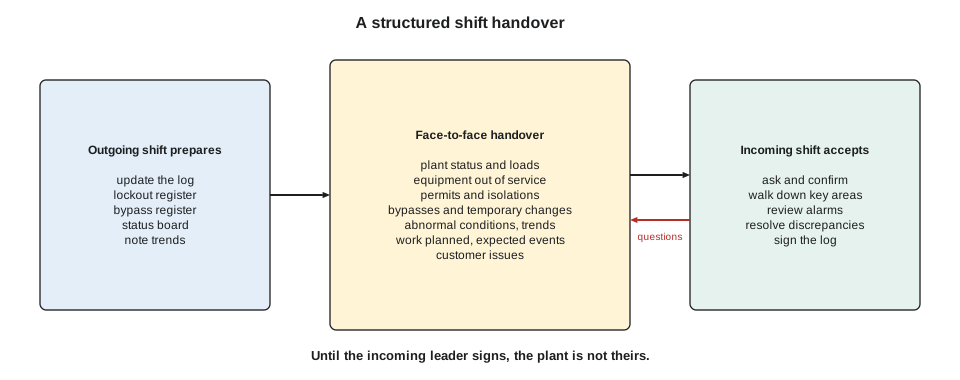
At Cantwell the handover follows a printed checklist on the back of the log sheet: boilers on line and their loads, equipment out of service, lockouts and permits, bypasses and temporary changes, abnormal readings and trends, customer issues, work planned for the next shift, and anything the chief engineer has asked to be watched. The incoming shift engineer signs the log only after reading it, asking questions and, at the start of a night shift, walking the boiler room. Grazyna's rule is simple: "Until you sign, it is not your plant."
Worked problem
A handover that nearly failed
At a night handover, the outgoing engineer mentions that boiler 3's auxiliary low-water cutout was tested that afternoon and is back in service. The log says the same. The lockout register still shows a tag on the cutout's test valve. What should the incoming engineer do?
Show solution
- Notice the discrepancy between the spoken word, the log and the register.
- Ask the outgoing engineer to explain it before accepting the shift.
- Check the valve position in the field, with the outgoing engineer if possible.
- If the valve is open and the tag simply was not removed, have the person who applied it remove it through the lockout procedure and correct the register; if the valve is closed, the cutout is out of service, so treat it as a bypassed protective device and fix it before accepting.
Answer: A discrepancy between records is a warning, not a clerical problem. The incoming engineer should not accept the plant until it is resolved, because the cutout protects against the most dangerous boiler failure there is. In this case the valve was open and the tag had been left on by mistake, but the check took ten minutes and closed a gap that could have mattered.
Human performance tools
People make errors: slips and lapses when attention wanders during familiar tasks, mistakes when they apply the wrong rule or reason from wrong information, and violations when they deliberately depart from a rule, usually with good intentions. Plants cannot eliminate error, but they can make it less likely and catch it before it matters. The human performance tools used across high-hazard industries include:
- Pre-job briefings that review the task, its hazards, the critical steps, the expected results and what could go wrong, before anyone starts.
- Self-checking, often taught as STAR: stop, think, act, review. Before a critical action, the operator pauses, confirms the right component, acts, and confirms the result.
- Peer checking, in which a second qualified person independently confirms a critical action before or as it is done.
- Three-way communication: the sender gives the instruction, the receiver repeats it back, and the sender confirms that it is correct.
- Procedure use and place-keeping, marking each step as it is completed so that an interruption does not lead to a skipped or repeated step.
- Questioning attitude and stop when unsure: anyone who does not understand a condition or an instruction stops and asks.
- Post-job reviews that capture what went well and what should change.
These tools are most valuable at critical steps, where an error would cause immediate harm that cannot be undone, such as opening a valve to a live line, starting a pump into a closed discharge, or switching a high-voltage breaker. A good leader identifies the critical steps in a job and insists on the tools there, rather than demanding them for every routine action until they become empty ritual.
Decisions under pressure
The October 17 shift was a good example of how events arrive: several at once, each urgent to someone. A shift leader's first task is to keep the plant safe, and the second is to keep the picture clear. Useful habits include: pausing long enough to understand the situation before acting; prioritizing by risk to people first, then plant, environment and customers; delegating tasks with clear instructions and a time to report back; keeping a written timeline in an abnormal event; and calling for help early, from the chief engineer, maintenance or emergency services, rather than late.
Grazyna's question was about the hot work permit. The contractor had arrived with a schedule and a supervisor in a hurry, and Pilar had signed the permit while also dealing with the cut hand. Looking back, she had made the right checks, but she had let the contractor's schedule set the pace. "The plant's schedule beats the contractor's every time," Grazyna said. "If you need half an hour before you can sign a permit properly, they wait half an hour. They'll respect you more for it."
Delegation
A shift leader cannot do everything, and should not try. Good delegation gives the task to a person who is qualified for it, explains the purpose and the expected result, states any limits (what not to do, when to stop and call), agrees when to report back, and then follows up. Delegation is also how crew members learn: Okonkwo's growing confidence on night shifts, and Tamar's first solo day shift on November 10 (PWR-120), came from shift engineers who handed them real tasks with clear limits and checked the results.
Fatigue and shift work
Twelve-hour rotating shifts, like Cantwell's two days, two nights and four off, are popular with crews because they give long breaks, but they bring real fatigue risk, especially on the second night and in the early morning hours when human alertness is lowest. Fatigue degrades attention, memory and judgment in ways similar to alcohol, and tired people are poor judges of their own state. Managing it is a shared responsibility: the employer designs reasonable schedules, limits overtime and consecutive shifts and provides rest facilities; the leader watches for signs of fatigue, assigns critical tasks thoughtfully and avoids scheduling them in the small hours where possible; and each worker arrives rested and reports when they are not.
US federal law sets no maximum hours for adult workers, though the Fair Labor Standards Act requires overtime pay for non-exempt employees beyond 40 hours a week, and a collective agreement may set its own terms. Cantwell limits consecutive shifts and total hours in its own policy, and overtime to cover sickness, like Lorne's on October 17, is tracked so that no one works too many consecutive hours.
Setting expectations and giving feedback
Crews do what their leaders pay attention to. A leader who walks the plant, reads the log carefully, asks about the readings, praises a good catch on a round and corrects a sloppy lockout immediately sets the standard more effectively than any memo. Expectations should be clear and written where it matters, such as in conduct of operations standards and procedures, and applied consistently to everyone, including the leader.
Feedback works best when it is timely, specific and about behavior rather than personality: "You logged the stack temperature but didn't compare it with yesterday's" rather than "you're careless." Positive feedback, given just as specifically, is at least as important. Formal performance reviews should hold no surprises if feedback has been given all year.
Conflict, fairness and respect
Conflict is normal in any crew: over overtime, assignments, methods and personalities. Left alone it festers; handled early it usually resolves. A leader listens to each side privately, separates facts from feelings, focuses on the work and the plant's standards, and agrees a way forward. Some conflict should be welcomed: a crew member who challenges a decision on safety grounds is doing what the conduct of operations principles ask, and should be heard, not punished.
US employers must not discriminate or allow harassment on protected grounds under federal civil rights laws and Ohio's own law, and OSHA and other laws prohibit retaliation against a worker who raises a safety concern or reports an injury. Supervisors must know the company's policy, act on complaints and never retaliate.
Discipline, where it is needed, should follow the plant's policy and, where there is one, the collective agreement: consistent, documented, proportionate, and focused on correcting behavior. Most plants now distinguish between honest errors, which call for coaching and better systems; at-risk behavior, where someone drifted from a rule without seeing the risk, which calls for coaching and removing the reasons for drift; and reckless disregard, which calls for discipline. This approach, often called a just culture, encourages people to report their errors and near misses, because they are not punished for honest mistakes.
"The crew will forgive you a wrong decision," Grazyna said. "They won't forgive you an unfair one. Be the same person on every shift, with every person, and they'll follow you through anything."
Common mistakes
MistakeAccepting a shift before resolving discrepancies in the log and registers.
InsteadResolve every discrepancy before signing for the plant.
MistakeLetting a contractor's schedule set the pace of permit approval.
InsteadTake the time needed; the plant's safety sets the schedule.
MistakeDemanding human performance tools for every routine action.
InsteadFocus them on critical steps, where errors cause irreversible harm.
MistakeDelegating without limits or a time to report back.
InsteadState the purpose, limits and report-back time, then follow up.
MistakeScheduling critical tasks in the early morning hours by habit.
InsteadPlan critical work for times of higher alertness where possible.
MistakePunishing honest errors.
InsteadCoach honest errors, address at-risk drift, and discipline only reckless disregard.
Summary and key terms
- A shift leader operates the plant, supervises the crew and links the shift to others, carrying the employer's OSHA duties on the shift.
- Conduct of operations standards cover control room discipline, procedure use, plant status, rounds, alarms, authority and conservative decisions.
- Handover is structured, two-way, written and spoken, and complete before the incoming leader accepts the plant.
- Human performance tools, pre-job briefs, self and peer checks, three-way communication and place-keeping, are most valuable at critical steps.
- Under pressure, pause, prioritize, delegate clearly, keep a timeline and call for help early; manage fatigue on rotating shifts.
- Clear expectations, specific feedback, early conflict resolution and a just culture build a crew that reports problems and follows its leaders.
- Conduct of operations
- The standards that govern how a plant is operated day to day.
- Shift handover
- The structured transfer of plant status and responsibility between shifts.
- Critical step
- An action where an error would cause immediate, irreversible harm.
- Three-way communication
- An instruction, its repeat-back and the sender's confirmation.
- Peer check
- Independent confirmation of a critical action by a second qualified person.
- Place-keeping
- Marking procedure steps as completed to avoid skipped or repeated steps.
- Just culture
- An approach that distinguishes honest error, at-risk behavior and reckless disregard.
- Competent person
- A person qualified by knowledge, training and experience to organize work and aware of its hazards.
Practice problems
Work each problem on paper first, then reveal the answer to check.
Name three items a shift handover must cover.
Show answer
Any three of: equipment out of service, lockouts and permits, bypasses and temporary changes, abnormal conditions and trends, work planned.
What does STAR stand for?
Show answer
Stop, think, act, review.
A worker skipped a step without realizing the risk. Under a just culture, what response fits?
Show answer
Coaching and removing the reasons for the drift.
When are alertness and performance usually lowest on night shift?
Show answer
In the early morning hours.
Lesson quiz · 5 questions
Score 60% or more to complete this lesson.
Create a free account to save your progress, take quizzes and earn a certificate.