
PWR-420 · Lesson 10 of 12 · 22 min
Emergency planning for large plants
▶ Video coming soon A video version of this lesson is on the way.
On September 20 the utility supply to Cantwell failed for 47 minutes. Pilar was in charge: the standby generator picked up the essential bus in eight seconds, the steam turbine feed pump carried the boiler drums, and the plant kept steam on the district system throughout (PWR-240). Afterwards she wrote a short report, and the plant replaced the UPS batteries that week. Grazyna kept the report in her emergency plan binder. "That was the plan working," she said. "Now let's look at the parts of the plan we have never had to use."
This lesson describes how a large plant plans for emergencies: identifying the hazards and scenarios, writing the emergency response plan, organizing the response with an incident command structure, coordinating with fire services and the community, and keeping critical services running when supply, fuel or equipment fail. It works through fuel and generator endurance for a winter emergency, and covers drills, the standards and laws that apply in each country, and recovery after the event.
What can go wrong
Emergency planning starts with a hazard and vulnerability assessment: a list of the events that could affect the plant, how likely each is, and what each would do to people, the plant, the environment and the customers. For a district energy plant like Cantwell the list includes fire, natural gas leak or explosion, boiler or pressure vessel failure, steam or hot water release in a tunnel or vault, chemical spill or exposure, injury or medical emergency, loss of utility power, loss of gas supply, loss of water supply, severe weather (ice storm, extreme cold, flooding), cyber attack on the control system, a security threat, and a major failure in a customer building. Keswold adds a turbine or generator fire, transformer fire, hydrogen or oil fire, and the loss of steam supply to Marrowby, whose ammonia refrigeration plant brings its own off-site hazards (PWR-340).
Each scenario is examined for its credible worst case and its likely case, the warning time, the resources needed and the people affected. The scenarios with high consequence get detailed plans; others are covered by general procedures for evacuation, shelter and notification.
The emergency response plan
A plant's emergency response plan (ERP) sets out who does what when something goes wrong. A good plan is short enough to use in an emergency, with detail in appendices, and covers:
- Roles and authority: who takes charge, at each hour of the day, and who takes over as more senior people arrive.
- Alarm and notification: how an emergency is raised, who is called inside and outside the plant, in what order, with current phone numbers.
- Response procedures for each major scenario, such as gas leak, fire, steam release, chemical spill, loss of power and loss of fuel.
- Evacuation and shelter: alarms, routes, muster points, head counts, and arrangements for visitors and contractors.
- Emergency equipment: fire extinguishers and systems, spill kits, breathing apparatus, gas detectors, first aid and AED, and their locations and inspection records.
- External coordination with the fire department, police, ambulance, the gas and electric utilities, the regulator and the municipality.
- Communication with customers, neighbors, the owner and the media.
- Recovery: securing the site, preserving evidence, investigating and restoring service (PWR-340).
- Training, drills, review and revision, with the date of the last update on the cover.
In the US, OSHA requires an emergency action plan (1910.38), written if the employer has more than 10 employees, covering reporting, evacuation, accounting for employees, rescue and medical duties, and a fire prevention plan (1910.39). Employers whose employees respond to hazardous substance releases must meet the emergency response requirements of the HAZWOPER standard (1910.120(q)). Facilities with extremely hazardous substances above threshold quantities must take part in local emergency planning under EPCRA, and RMP facilities such as Marrowby must have an emergency response program and coordinate it with local responders (PWR-340). NFPA 1600 sets out a framework for disaster and emergency management and business continuity programs.
Incident command
In an emergency, confusion about who is in charge costs time and lives. Most plants use a simplified version of the incident command system (ICS), which is used by fire departments and emergency agencies across North America. ICS gives every incident one incident commander (IC), who sets objectives and is responsible for the whole response, and adds functions as the incident grows: operations (doing the work of the response), planning (tracking the situation and resources), logistics (supplies, equipment, food, relief crews) and finance and administration, with a safety officer, a liaison officer and a public information officer reporting to the IC.
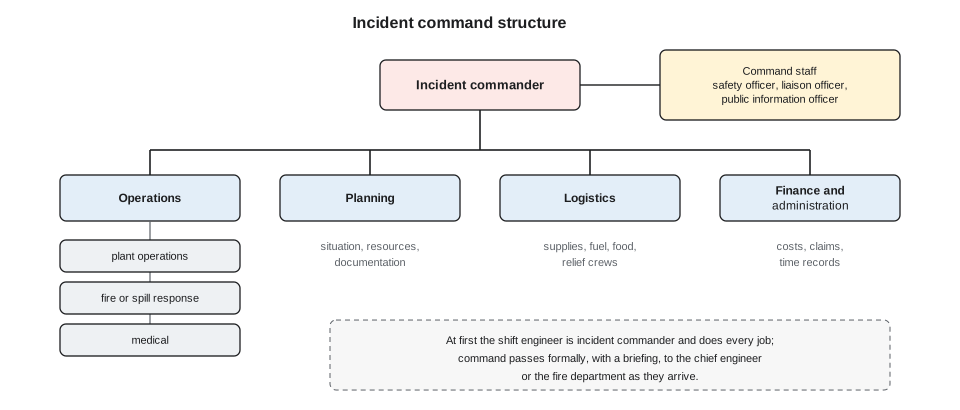
At the start of an incident at Cantwell, the shift engineer is the incident commander and performs most functions personally. As the chief engineer arrives, or the fire department takes charge of a fire or hazardous materials incident, command is transferred formally, with a briefing: what has happened, what has been done, what resources are on scene, who is accounted for, and what the plant needs. When the fire department is in command, the plant's people do not stop being important: they become the technical specialists who know which valve isolates the gas, which breaker kills the MCC, and where the hazards are. A plant should give arriving firefighters a short pre-incident plan with site drawings, isolation points, hazardous materials locations and access routes, prepared with the fire department in advance.
Keeping critical services running
A district energy plant has customers who depend on it: Cantwell supplies 26 buildings (PWR-310), including a seniors' residence where a loss of heat in winter would be an emergency in its own right. For such plants, emergency planning includes continuity of service, which means having enough backup capacity, fuel and staff to keep supplying critical loads through credible failures, and plans for what to do when that is not possible.
Cantwell's continuity arrangements, built up over years, include three steam boilers where two can carry the winter load; burners that can fire light oil from the backup tank if the gas supply fails; a standby diesel generator on an essential bus; a steam turbine-driven feed pump that does not need electricity; a UPS for the controls; and a priority list of customers for load shedding. The plan must also answer how long each arrangement can last, which is where the numbers come in.
Worked problem
How long will the oil last?
If the gas supply fails on a cold night, Cantwell can fire its boilers on light oil from the 5,300 gal backup tank. Assume two boilers are needed at half their full-fire input to carry the essential winter load. Full-fire input is 33.6 MMBtu/h per boiler. Light oil has a heating value of about 138,500 Btu/gal (typical), and about 90 in 100 of the tank volume is usable. How many hours will the oil last?
Show solution
- \[Q_{load} = 2 \times 0.5 \times 33.6 = 33.6 \text{ MMBtu/h}\]
- \[\dot V_{oil} = \frac{33.6 \times 10^6}{138{,}500} \approx 243 \text{ gal/h}\]
- \[t = \frac{0.9 \times 5{,}300}{243} \approx 19.7 \text{ h}\]
Answer: The tank lasts about 20 hours at that load. That is long enough to ride through most gas interruptions, but a prolonged one in a cold spell would need deliveries to begin within the first day. The emergency plan therefore names an oil supplier with an emergency delivery agreement and a backup supplier, and the shift engineer's checklist includes calling the supplier as soon as the plant switches to oil, not when the tank is low.
Worked problem
And the generator?
The standby generator's 530 gal base tank supplies 27.7 gal/h at full load (400 kW). During the September 20 outage it carried about 260 kW. Assuming fuel use varies roughly as one quarter of the full-load rate plus three quarters in proportion to load (a typical approximation for diesel sets), how long would the base tank last at full load and at 260 kW?
Show solution
- \[t_{full} = \frac{530}{27.7} \approx 19 \text{ h}\]
- \[\dot V_{260} \approx 27.7 \times \left(0.25 + 0.75 \times \frac{260}{400}\right) \approx 20.4 \text{ gal/h}, \qquad t \approx \frac{530}{20.4} \approx 26 \text{ h}\]
Answer: The generator's tank and the boilers' oil tank give similar endurance, about a day, which is no accident: Grazyna sized the plan around a 24-hour target for self-sufficiency before resupply. The calculation also shows why the fuel in both tanks must be kept full, tested and in good condition: a tank half empty at the start of an ice storm halves the plant's endurance.
Extreme weather and long events
Some emergencies last days, not hours: an ice storm that brings down power lines across a region, a cold snap that stretches the gas system, a flood. Long events stress people as much as equipment. The plan should cover staffing for extended operation, with call-in lists, relief rotations, accommodation and food, and should recognize that staff have families affected by the same event. It should also cover communication with customers, especially vulnerable ones like the seniors' residence, and with the city's emergency operations center, which in a regional emergency may set priorities for fuel and power restoration.
Ohio's counties have emergency management agencies and local emergency planning committees that coordinate planning for hazards and response; plants that supply critical services, like hospitals and residences, benefit from being known to them before an event, not during it.
Drills and exercises
A plan that has never been exercised is a theory. Plants use several kinds of exercise: drills of a single response, such as an evacuation or a gas leak response; tabletop exercises, in which the team talks through a scenario and checks the plan; functional exercises, which test one function, such as notification or command, in real time; and full-scale exercises with outside agencies. Each exercise should have objectives, an observer who records what happened, and a debrief that produces actions.
Cantwell holds an evacuation drill twice a year and a tabletop exercise each fall. The fall exercise on October 14 (PWR-110) was a tabletop in the control room: a gas leak at the burner front of boiler 2 during the day shift, with each person saying aloud what they would do and in what order. Its debrief found that nobody had been named to meet the fire department at the gate, and the plan was changed. Grazyna wants the 2027 program to add a tabletop exercise on a prolonged gas supply failure in January and a joint walk-through with the fire department, which has not visited since its last captain for the district retired.
Recovery
When the immediate emergency is over, recovery begins. The site is made safe and secured; evidence is preserved for the investigation (PWR-340); regulators are notified as the law requires; damaged equipment is inspected before it is returned to service, with pressure equipment repaired only under the jurisdiction's rules; people affected are supported, including through an employee assistance program after a serious event; and the plan is reviewed in the light of what happened. A short after-action report, like Pilar's after September 20, captures what worked and what did not while memories are fresh.
"Most of emergency planning is boring," Grazyna said. "Checking phone numbers, filling oil tanks, testing the generator, walking the fire captain round. It's supposed to be boring. The exciting part is the day you need it, and on that day you want everything boring to have been done."
Security and cyber emergencies
Emergency plans now cover deliberate acts as well as accidents. A plant's physical security plan controls access to the site, the control room and critical equipment, and sets out what staff do if they find an intruder, a suspicious package or a threat. A cyber incident plan covers what to do if the control system behaves strangely or is known to be compromised: who decides to disconnect it from outside networks, how the plant is run in local or manual control while the system is investigated, where clean backups of the configuration are kept, and whom to call, including the control system supplier and, where appropriate, the national cyber security agency. Cantwell's practice of opening remote sessions only from the plant end (PWR-240) is a preventive measure; the plan must also cover the day prevention fails.
Keeping the contact list alive
The single most common defect in emergency plans is an out-of-date contact list. People change jobs, phone numbers change, suppliers are replaced and the fire department's non-emergency number moves. Grazyna's rule is that the contact list is checked every quarter by calling each number, and after every staff or contract change, and that the version in the control room carries the date of its last check on the first page. The same discipline applies to the customer priority list for load shedding: the seniors' residence and any other customer with vulnerable occupants are confirmed each autumn, before the heating season, with a named contact who can be reached at night.
Common mistakes
MistakeWriting an emergency plan so long that nobody can use it in an emergency.
InsteadKeep the plan short, with details in appendices and checklists.
MistakeLeaving command unclear when senior staff or the fire department arrive.
InsteadTransfer command formally, with a briefing.
MistakeAssuming backup fuel lasts indefinitely.
InsteadCalculate endurance and arrange resupply before it is needed.
MistakeCalling the fuel supplier only when the tank is low.
InsteadCall as soon as the plant switches to backup fuel.
MistakeRunning drills without a debrief or actions.
InsteadObserve, debrief and act on every exercise.
MistakeIgnoring staff needs in a long event.
InsteadPlan for relief rotations, food, rest and family concerns.
Summary and key terms
- Emergency planning starts with a hazard and vulnerability assessment of credible scenarios and their consequences.
- The ERP defines roles, notification, scenario procedures, evacuation, equipment, coordination, communication, recovery and review.
- OSHA 1910.38 and 1910.39, HAZWOPER, EPCRA and RMP coordination, and NFPA 1600 apply in the US.
- The incident command system gives one commander and expands with operations, planning, logistics and finance; command is transferred formally.
- Continuity of critical services depends on redundancy, backup fuel and power, and endurance calculations with resupply arrangements.
- Drills and exercises with debriefs keep the plan real; recovery includes securing the site, investigation, inspection and support for people.
- Hazard and vulnerability assessment
- A review of the events that could affect a plant, their likelihood and consequences.
- Emergency response plan
- The document that sets out who does what in an emergency.
- Incident command system
- A standard structure for managing an emergency response under one commander.
- Incident commander
- The person responsible for the whole response to an incident.
- Pre-incident plan
- Information prepared in advance for responders about a site and its hazards.
- Continuity of service
- The ability to keep supplying critical loads through credible failures.
- Tabletop exercise
- A discussion-based rehearsal of the response to a scenario.
- After-action report
- A short report after an event or exercise on what worked and what did not.
Practice problems
Work each problem on paper first, then reveal the answer to check.
An oil tank holds 2,600 gal, 90 in 100 usable, and the plant burns 130 gal/h. Endurance?
Show answer
18 h.
Who is the incident commander at the start of an incident at night?
Show answer
The shift engineer in charge.
Name the four ICS sections.
Show answer
Operations, planning, logistics, finance and administration.
A generator burns 16 gal/h at full load. Using the quarter-plus-proportional approximation, what at half load?
Show answer
About 10 gal/h.
Lesson quiz · 5 questions
Score 60% or more to complete this lesson.
Create a free account to save your progress, take quizzes and earn a certificate.