
PWR-420 · Lesson 11 of 12 · 22 min
Plant audits and regulatory inspections
▶ Video coming soon A video version of this lesson is on the way.
Cantwell's fall safety walk on November 12 found eleven things to fix, from a rope tied around a gas valve handle to a loose bracket on the roof ladder, and the walk group ranked them and set deadlines that afternoon (PWR-110). Five were closed the same day. Grazyna had asked Pilar to own the follow-up, and that request led to a larger conversation. "The walk is one kind of check," Grazyna said. "Inspectors, insurers, auditors and customers check us too, and each of them looks for something different. You need to know what each one wants, and how to make the plant ready for all of them without stopping work."
This lesson describes the kinds of audit and inspection a plant faces: internal inspections and audits, management system audits, insurer and customer audits, and the regulatory inspections of pressure equipment, operating engineers, occupational health and safety, electrical safety and the environment. It explains how an audit is planned and carried out, how evidence is sampled and findings graded, how corrective actions are managed and verified, and how a plant prepares for and responds to a regulator's visit.
Inspections and audits
An inspection checks the physical condition of equipment and the workplace against requirements: a boiler's internal condition, a fire extinguisher's tag, a guard on a coupling. An audit checks whether a system works: whether permits are issued correctly, whether training records are complete, whether management of change is followed, whether corrective actions are closed. The two complement each other. A plant can pass every inspection and still have a weak permit system that will one day let a worker into an energized enclosure; it can have perfect paperwork and a dangerous leak in the tunnel.
Plants face several kinds of check:
- Workplace inspections by the plant's own people, such as daily rounds, weekly checks, the monthly joint health and safety committee inspection, and walks like the one on November 12.
- Internal audits of the plant's own systems, done by trained people who are independent of the work being audited.
- Management system audits against standards such as ISO 45001 for occupational health and safety, ISO 14001 for environmental management, ISO 55001 for asset management or ISO 50001 for energy management, by the organization's own auditors or by a certification body.
- Insurer inspections and surveys, of boilers and pressure vessels and of the plant's fire and loss prevention arrangements.
- Customer and supplier audits, such as Marrowby's audit of Keswold as its steam supplier (PWR-340).
- Regulatory inspections by the agencies that enforce the law.
The audit process
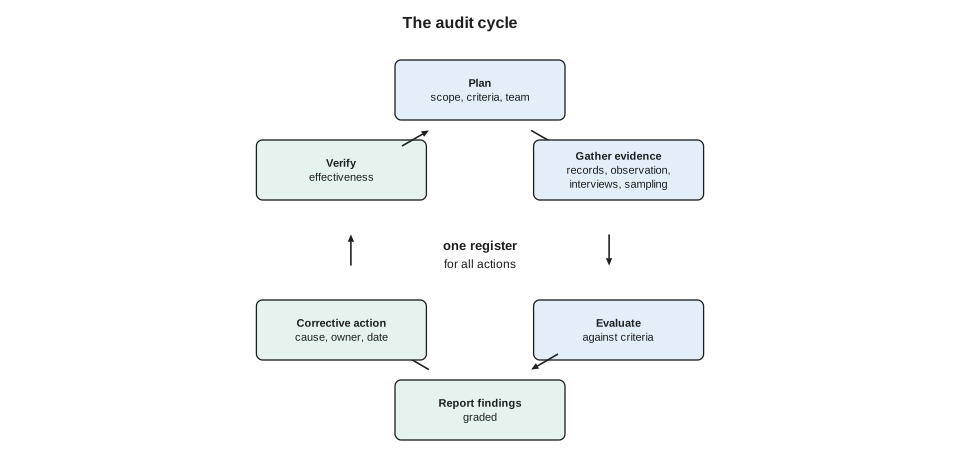
Audit practice is described in ISO 19011, *Guidelines for auditing management systems*, and most audit programs follow its outline. An audit has a defined scope (what is audited: a process, an area, a period), criteria (what it is audited against: a regulation, a standard, a procedure, a permit condition), and an audit team that is competent and independent of the activity. The audit is planned, with the documents to be reviewed, the people to interview and the records to sample, and announced so that the right people are available.
During the audit, the team gathers objective evidence: records, observations and interviews that can be verified. A procedure that says permits are signed by the shift engineer is not evidence that they are; a sample of signed permits is. Interviews ask people to explain and show what they do, rather than what the procedure says, and the auditor compares the two. At the end, the team holds a closing meeting to present its findings, so that there are no surprises in the written report.
Sampling
An auditor rarely checks every record. Sampling selects a manageable number of records, chosen so that the sample represents the whole population: across shifts, months and people, including periods of unusual activity such as outages. If the sample shows a problem, the auditor may extend it to see how widespread the problem is. The result is a judgment about the system, not a precise statistic, but it is far more informative than looking only at the records someone chooses to show.
Worked problem
Sampling the work permits
For an internal audit of Cantwell's permit-to-work system, Pilar sampled 20 of the 240 permits issued between May and October, choosing at least two from each month and from each shift engineer, and including the boiler 3 outage. Three of the 20 had a defect: one hot work permit had no fire watch signature at closure, one confined space permit had no recorded gas test time, and one isolation list was missing a drain valve that had been locked. What fraction of the sample was defective, and what should she conclude?
Show solution
- \[\frac{20}{240} \approx 0.083 \text{ of the permits sampled}\]
- \[\frac{3}{20} = 0.15 \text{ defective, or 15 in 100}\]
Answer: About one in seven sampled permits had a defect, all in the closing or recording steps rather than in the hazard controls applied during the work. That is a pattern, not three isolated errors, and it points to a system cause: the permit form's closure section was on the back of the sheet and easily missed. The finding went to the November operations meeting with a proposal to redesign the form, and the audit will resample after three months to check the effect.
Grading findings
Most audit programs grade findings, for example:
- Major nonconformity: a requirement is not met at all, or a failure could lead to serious harm or a breach of the law. It needs prompt action and verification.
- Minor nonconformity: a requirement is partly met, or an isolated lapse occurred. It needs action within an agreed time.
- Observation or opportunity for improvement: no requirement is breached, but something could be better or is at risk of becoming a nonconformity.
- Good practice: something worth recognizing and sharing.
Graded findings help the plant prioritize, and they are how a certification body decides whether to grant or keep a certificate. Within the plant, the same risk matrix used for the safety walk (PWR-110) can rank physical findings, while system findings are graded by how far the system falls short.
Corrective action
A finding is only useful if it leads to action that fixes its cause. A good corrective action process records each finding, assigns an owner and a due date, asks what caused it (for system findings, using the root cause methods of PWR-340), chooses an action that addresses the cause rather than the symptom, tracks the action to completion, and verifies effectiveness later. Fixing the three defective permits would correct the symptoms; redesigning the form and retraining the shift engineers addresses the cause; resampling in three months verifies the effect.
Many plants track all their actions, from audits, inspections, incident investigations, safety walks and regulator orders, in one register reviewed at the monthly operations meeting. Overdue actions are reported upward. A register in which actions stay open for years, or are closed without being done, is a finding in its own right.
Worked problem
Tracking the safety walk
Of the eleven findings from the November 12 walk, five were closed on the day: the rope on the gas valve, the pallet in front of the emergency switch, the unlatched panel door, the oily rags and the eyewash test. The remaining six have deadlines of a week or a month (PWR-110). What fraction were closed on the day, and what should the register show for the others?
Show solution
- \[\frac{5}{11} \approx 0.45\]
Answer: Just under half were closed on the day. The register should show each of the other six with its owner, deadline and work order number: the cracked gauge glass guard, the loose coupling guard and the ladder bracket within a week, and the missing valve insulation, the lights and the certificate copies within a month. The rope on the gas valve has a second action, a proper valve guard, which is not closed until the guard is fitted. Pilar reports the register's status at each operations meeting until every line is closed.
Regulatory inspections
Several regulators inspect a plant like Cantwell or Keswold in Ohio:
- Ohio's Division of Industrial Compliance boiler inspectors, and the insurance companies' special inspectors who report to the state, inspect boilers and pressure vessels at the intervals of the state's rules (PWR-340) and check that operators hold the licenses the rules require.
- OSHA enforces federal occupational safety and health standards in Ohio's private sector through compliance safety and health officers, who inspect after complaints, referrals, serious injuries and as part of planned programs, and may issue citations with penalties.
- Local building and electrical officials enforce the codes adopted for electrical installations and building work.
- Ohio EPA and the local air agency inspect compliance with air permits (lesson 5), the city enforces its pretreatment program, and the local health department may check cooling tower programs where a local rule applies.
- The fire department inspects under the Ohio Fire Code, including fire protection equipment and hazardous materials storage.
Each regulator has legal powers of entry and inspection, can require documents, take samples and photographs, interview workers and issue orders to comply. Each also has its own priorities. The operating engineer inspector cares about certificates, attendance and the log; the boiler inspector about the condition of pressure equipment and its records; the labor inspector about hazards to workers, training and the joint committee; the environmental officer about permits, records and releases. Knowing what each looks for lets a plant keep the right evidence ready.
Responding to an inspection
The plant's response to an inspection should follow a short written procedure. Check the inspector's credentials and ask the purpose and scope of the visit. Call the chief engineer or the designated contact. For an OSHA inspection, the officer holds an opening conference; the employer may have a representative accompany the walkaround, and an authorized employee representative, such as the union or a member of the plant safety committee, may also accompany it. Accompany the inspector at all times, answer questions factually and do not guess. Provide documents asked for and keep a list. Take duplicate photographs or samples. Correct simple hazards on the spot if possible, and say so. At the closing conference, ask for a summary of the concerns and possible citations.
An OSHA citation must be posted at or near the place of the violation for three working days or until it is corrected, whichever is later. The employer has 15 working days to contest a citation, its penalty or its abatement date, and must otherwise correct the hazard by the abatement date and certify that it has done so. A state boiler inspector's requirements are recorded on the inspection report and must be met before a certificate is issued or renewed. Every citation and requirement goes into the corrective action register.
Two attitudes help. The first is openness: regulators are far more lenient with a plant that has found and is fixing its own problems than with one that hides them, and an action register showing self-identified findings being closed is the best evidence a plant can offer. The second is consistency: a plant that is ready for an inspection on any day, because its records are kept as the work is done, never needs to prepare.
Being ready
Grazyna keeps an inspection readiness checklist, reviewed monthly: certificates of registration and inspection current and displayed; operators' certificates current, with copies on file; the log complete; the corrective action register current with no overdue items; training records current; the emergency plan dated within the year; environmental records and reports current; and the last report from each regulator and insurer, with the status of its findings. The out-of-date certificate copies found on the November 12 walk were exactly the kind of small gap the checklist is meant to catch.
"An audit should never be the first time you look at something," she said. "If the auditor finds it before we do, we weren't looking."
The joint committee and the safety walk
Federal OSHA does not require safety committees in private workplaces, but many employers have them, and some states do require them. Cantwell's plant safety committee, on which Pilar has served for several years, inspects some part of the plant every month so that all of it is covered at least once a year, and its recommendations go to Grazyna, who answers them in writing. The November 12 walk was a fuller version of that practice with Grazyna and Lorne present. A plant engineer who becomes chief will be on the other side of those recommendations, and the written replies are one of the duties that the inspection readiness checklist tracks.
Self-assessment and benchmarking
Between external audits, a plant can assess itself against the standards it is audited to, using the auditors' own checklists. A self-assessment done honestly, ideally by people from another part of the organization or from a friendly plant, finds most of what an external auditor would find. Benchmarking against other plants, through industry associations, insurers or informal exchanges, shows whether the plant's indicators are good or merely familiar. Grazyna and Anselm Rasmusen have exchanged their plants' safety walk checklists, and each found items on the other's list that their own had missed.
Common mistakes
MistakeTreating a procedure as evidence that the work is done that way.
InsteadSample records and observe work to obtain objective evidence.
MistakeSampling only the records someone chooses to show.
InsteadChoose a representative sample across shifts, months and people.
MistakeFixing the symptom of a finding.
InsteadFind and address the cause, then verify effectiveness.
MistakeClosing actions in the register before they are done.
InsteadClose only when the action is complete and verified.
MistakeGuessing in answer to an inspector's question.
InsteadAnswer factually and find out what you do not know.
MistakePreparing for inspections only when they are announced.
InsteadKeep records current so the plant is ready every day.
Summary and key terms
- Inspections check physical condition; audits check whether systems work; both are needed.
- Plants face their own inspections and audits, management system audits, insurer and customer audits, and regulatory inspections.
- Audits have scope, criteria and an independent team, gather objective evidence by representative sampling, and report graded findings.
- Corrective actions address causes, have owners and dates, are tracked in one register and are verified for effectiveness.
- Ohio regulators include the state boiler program and insurers' special inspectors, OSHA, local code officials, Ohio EPA, the city and the fire department.
- Respond to inspections with a written procedure, factual answers, records of what was provided, and prompt compliance with orders.
- Inspection
- A check of physical condition against requirements.
- Audit
- A systematic check of whether a management system meets its criteria and works.
- Audit criteria
- The requirements against which an audit is conducted.
- Objective evidence
- Records, observations and statements that can be verified.
- Sampling
- Selecting a representative set of records or activities to examine.
- Nonconformity
- A failure to meet a requirement.
- Corrective action
- Action to remove the cause of a nonconformity and prevent recurrence.
- Verification of effectiveness
- A later check that a corrective action worked.
Practice problems
Work each problem on paper first, then reveal the answer to check.
An auditor samples 25 of 300 lockout records and finds 2 defects. Defective fraction of the sample?
Show answer
0.08, or 8 in 100.
Which standard gives guidelines for auditing management systems?
Show answer
ISO 19011.
How long does an employer have to contest an OSHA citation?
Show answer
15 working days.
What turns a fixed symptom into a corrective action?
Show answer
Addressing the cause and verifying effectiveness.
Lesson quiz · 5 questions
Score 60% or more to complete this lesson.
Create a free account to save your progress, take quizzes and earn a certificate.