
PWR-420 · Lesson 12 of 12 · 24 min
Exam strategy for a second class engineer license
▶ Video coming soon A video version of this lesson is on the way.
Pilar's plan, sketched with Grazyna on the last page of her study notebook, is to sit the examinations for a national Second Class power engineer license in 2027, after her course finishes. Ohio does not issue anything above the stationary steam engineer license she already holds, so this license is a professional credential, not a legal requirement, but it is the one Grazyna wants her assistant chief to have, and it is recognized by employers and by some jurisdictions that license engineers by class. Grazyna had passed graded engineer examinations years earlier in another state, and she still remembered the first one.
This lesson describes the routes to advanced stationary engineer licenses in the US: state and city licenses graded by class, and the national standards that some employers and jurisdictions use. It sets out a study plan and a method for essay and multiple-choice papers, works a time budget, and finishes with a set of mixed problems drawn from the plant systems, instrumentation and management material of this course.
Advanced licenses in the US
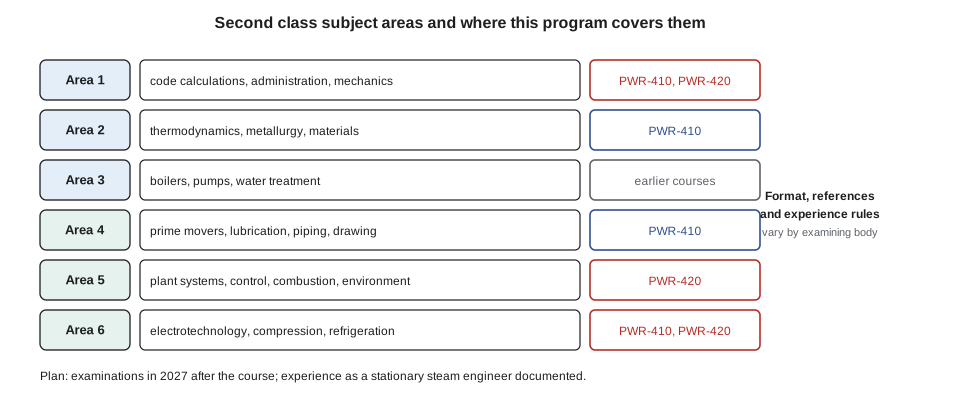
There is no single national system of stationary engineer licensing in the US. Some states and cities license engineers in grades, often first, second and third class, tied to the size of plant they may take charge of, as Massachusetts does under its general laws; some, like Ohio, have one or two operating licenses; and many have none. The National Institute for the Uniform Licensing of Power Engineers (NIULPE) publishes standards for grades from fifth class up to chief engineer and examines candidates against them; its licenses are used by some employers and accepted by some jurisdictions. A typical second class syllabus, whichever body sets it, covers the same ground as the Canadian Second Class papers:
| Paper | Main subjects |
|---|---|
| 2A1 | ASME Section I and VIII calculations, industrial administration, applied mechanics |
| 2A2 | Thermodynamics, metallurgy and testing of materials |
| 2A3 | Boilers, pumps and water treatment |
| 2B1 | Heat engines and prime movers, lubrication, piping, mechanical drawing |
| 2B2 | Power plant systems, control instrumentation, fuels and combustion, environmental protection |
| 2B3 | Electrotechnology, air and gas compression, industrial and commercial refrigeration |
Formats vary. Some examinations are multiple-choice, some essay or problem-based, some include an oral examination before a board, and many require a minimum period of experience at the grade below, documented by a licensed engineer. Candidates must obtain the current syllabus, format, reference rules and experience requirements from the body that will examine them, because they differ and they change. The study method below suits any of them.
The experience requirement for an advanced license is usually a period, often a year or more, as a licensed engineer at the grade below, sometimes in a plant of a given size or with engines or turbines above a given power, documented by a licensed engineer. Pilar's years as a stationary steam engineer at Cantwell, with its 75 hp turbine-driven feed pump and three high pressure boilers, are the kind of experience such standards ask for, and Grazyna will sign the record.
Most examining bodies publish the references a candidate may bring, often a formula handbook, steam tables and code extracts, and the rules on calculators and notes in the references. Knowing those references well is part of the preparation: on a problem paper, the candidate who can find the right table in thirty seconds has five more minutes for the calculation.
A study plan
Second Class study is a long project, usually a year or more alongside full-time shift work. Grazyna's advice to Pilar was the same advice she had followed herself:
- Work from the syllabus. List every topic in each paper, rate your knowledge of each from one to three, and plan time in proportion to the gaps, not to your interests.
- Study in blocks with a deadline. Assign each paper a block of weeks, with a practice paper at the end of each block.
- Do problems, not reading. Reading feels like progress; solving problems is progress. Work every example in the course, then the exercises, then past-style papers, with the allowed references only.
- Use the plant. Every topic in 2B2 and 2B3 exists somewhere at Cantwell or Keswold. Trace it in the field, read its drawings, ask the people who maintain it.
- Keep an error log. Record every mistake you make in practice, why you made it and what you will do differently. Review it before each examination.
- Protect sleep and shifts. Twelve-hour rotations and study compete; schedule study on days off and the first day of a rotation, not after the second night shift.
Writing essay and problem papers
Essay and problem papers reward a candidate who shows the examiner what they know. A good answer to a calculation question states the given data and what is required, draws a sketch if it helps, writes the formula in symbols before substituting, carries units through every line, and boxes the answer with its units. A marker can award part marks for a correct method with an arithmetic slip; they cannot award anything for a correct number with no working. A good answer to a descriptive question is organized: a sentence that answers the question, then the points in a logical order, each explained, with a labeled sketch where a sketch says it faster.
The choice of questions matters on a paper that offers a choice. Read all the questions first, mark the ones you can answer best and any that are mandatory, and decide which you will answer before you write. Answer your strongest question first, to build confidence and bank marks. If a question goes badly, leave space and move on; return if time allows. Never attempt more questions than the paper asks for in the hope of extra marks: on papers of that kind, usually only the first ones attempted are marked.
Worked problem
A time budget
Suppose an essay paper allows 3½ hours for five questions, and Pilar wants 15 minutes for reading and choosing at the start and 15 minutes for checking at the end, and a multiple-choice paper has 100 questions in 3½ hours with 20 minutes kept for review. How much time does each question get?
Show solution
- \[\text{Essay: } \frac{210 - 15 - 15}{5} = 36 \text{ min per question}\]
- \[\text{Multiple-choice: } \frac{210 - 20}{100} = 1.9 \text{ min per question}\]
Answer: Thirty-six minutes per essay question is generous for a descriptive answer and tight for a long code calculation, which is why the choice of questions matters. Under two minutes per multiple-choice question means that a calculation taking five minutes must be skipped on the first pass and returned to. Pilar wrote both numbers on the inside cover of her notebook and timed every practice paper against them.
Writing multiple-choice papers
Multiple-choice papers test breadth and speed. Read the stem fully, including words such as not, except, most and first, and try to answer before looking at the options. Eliminate options that are clearly wrong; two of the four can often be dismissed quickly. For a calculation, estimate the answer first: options usually include the results of common errors, such as gauge instead of absolute pressure, a missing square root of three, or a reversed ratio, and an estimate helps spot them. Answer every question, because there is normally no penalty for a wrong answer, and mark the uncertain ones for review. Change an answer on review only for a clear reason.
Mixed problems
The examinations do not label their questions by course. A question on a feed pump trip might need the SIS calculation of lesson 2, the reliability measures of lesson 6 and the cost of steam of lesson 7 together. The worked problems below mix the material of this course in the way an examination might.
Worked problem
A trip, its cost and its testing
A feed pump low suction pressure trip has a final element with λ_DU = 2 × 10⁻⁶ per hour, tested every six months, and a transmitter and logic contributing 1.2 × 10⁻³ together. Find its PFD avg and SIL. Each spurious trip of the pump costs about 2 hours of reduced output at 8,800 lb of steam per hour of lost production, valued at the full cost of steam of about 12.34 dollars per 1,000 lb. What does one spurious trip cost?
Show solution
- \[PFD_{final} = \frac{2 \times 10^{-6} \times 4{,}380}{2} = 4.38 \times 10^{-3}\]
- \[PFD = 4.38 \times 10^{-3} + 1.2 \times 10^{-3} = 5.58 \times 10^{-3} \quad \text{(SIL 2)}\]
- \[\text{Cost} = 2 \times 8.8 \times 12.34 \approx 217 \text{ dollars}\]
Answer: The function meets SIL 2. Each spurious trip costs only about 220 dollars in lost production, but the real cost is the upset to the customers and the risk of a second failure during the recovery, which is why spurious trip rates belong in the safety requirements specification.
Worked problem
Two systems in series
The boiler feed system needs both the deaerator (availability 0.998) and at least one of two feed pumps (each with availability 0.995, independent). What is the availability of the feed system?
Show solution
- \[A_{pumps} = 1 - (1 - 0.995)^2 = 0.999975\]
- \[A_{system} = 0.998 \times 0.999975 \approx 0.99798\]
Answer: The single deaerator dominates the system's unavailability, by a factor of about eighty over the pump pair. That is a common result: redundancy where it already exists adds little, and the single components in series set the limit. It is also why the deaerator level instrumentation got so much attention in the MOC review.
The last weeks
In the last month before an examination, stop learning new material and consolidate: work timed practice papers under examination conditions, review the error log, and practice finding things in the allowed references. In the last week, sleep well, arrange shifts so that the examination does not follow a night, and confirm the time, place, identification and references required. On the day, arrive early, read the instructions, and follow the time budget.
"It's not a test of how clever you are," Grazyna told Pilar. "It's a test of whether you've done the work. You've done most of it already, on shift, for nine years. The papers just ask you to write it down."
Using the plant as a textbook
The plant systems and electrical parts of a second class syllabus describe things that exist at Cantwell or Keswold, and the best preparation for them is to find each one and learn it in the field. Pilar's list for the autumn and winter included: tracing the three-element level loops of all three boilers from transmitter to valve, and reading their configuration with Wendeline on her next service visit; reading the BMS logic diagrams for boiler 2; walking Keswold's 13.8 kV switchgear and protection panels with Liesl; going through the arc flash study's assumptions with the engineer who wrote it; tracing every water stream out of Cantwell to its discharge point; reading the air permit line by line; and sitting in on one of Fenella's weekly scheduling meetings. Each item on the list connects to a lesson in this course and to questions on the examinations.
Studying together
Okonkwo is studying for his stationary steam engineer examination at the same time, and Grazyna encouraged the two of them to study together on the evenings their shifts allow. Teaching is the best test of understanding: Pilar explaining a SIL calculation to Okonkwo finds out quickly whether she really understands it, and Okonkwo's questions about thermodynamics, fresh from PWR-310, keep her sharp on the theory. A small study group with a fixed evening, a set of problems for each meeting and a rule that everyone brings one question they could not answer is worth more than many hours of solitary reading.
Oral examinations and interviews
Some jurisdictions and employers add an oral examination or interview for senior certificates, licenses and positions, in which a panel asks the candidate to explain how they would handle a situation: a boiler low-water event, a contractor injury, a regulator's order, a conflict on shift. Oral questions test judgment more than recall. The best preparation is to talk through scenarios aloud, with a mentor playing the examiner, and to answer in a structured way: what is happening, what is the risk, what would you do first, whom would you call, and what would you check afterwards. The answers come from the material of this course, applied to the plant you know.
On the morning of an examination, the habits of a good shift apply. Read the instructions as carefully as a procedure, plan the time as carefully as a job, check each answer as carefully as a lockout, and when something is unclear, stop and think before acting. Grazyna's last piece of advice was the one she gives every trainee before a solo shift: if you find yourself rushing, slow down, because rushing is where the mistakes come from.
Common mistakes
MistakeSpending study time in proportion to interest instead of gaps.
InsteadRate every syllabus topic and plan time to close the gaps.
MistakeReading the course without doing problems.
InsteadWork examples, exercises and timed practice papers.
MistakeWriting only a final number in a calculation answer.
InsteadShow the formula, substitution, units and boxed answer for part marks.
MistakeAttempting a sixth essay question for extra marks.
InsteadChoose five before writing; only the first five attempted are marked.
MistakeSpending five minutes on one multiple-choice calculation on the first pass.
InsteadSkip long questions, mark them, and return after answering the rest.
MistakeScheduling an examination after a night shift.
InsteadArrange shifts so that you write the examination rested.
Summary and key terms
- US advanced licenses come from states and cities that license by class and from national standards such as NIULPE's; formats and requirements vary.
- Candidates must obtain the current syllabus, format, references and experience rules from the examining body.
- Study from the syllabus, in blocks, by doing problems, using the plant and keeping an error log.
- Essay answers show formula, substitution and units; choose questions before writing and answer the strongest first.
- Multiple-choice papers need a time budget, elimination, estimation and a review pass.
- Examination questions mix topics, so practice mixed problems under timed conditions.
- NIULPE
- The National Institute for the Uniform Licensing of Power Engineers, which publishes graded standards and examines candidates.
- Graded license
- A license issued by class, such as first, second or third class, tied to plant size.
- Qualifying experience
- The documented operating experience required before a license is issued.
- Syllabus
- The published list of subjects an examination covers.
- Error log
- A record of mistakes made in practice and how to avoid them.
- Time budget
- A plan for the time allowed per question in an examination.
Practice problems
Work each problem on paper first, then reveal the answer to check.
A paper allows 210 minutes for five questions with 20 minutes reserved. Minutes per question?
Show answer
38.
Which subject area of a second class syllabus covers control instrumentation and environmental protection?
Show answer
Plant systems, control instrumentation, fuels and combustion, and environmental protection (2B2 in the Canadian scheme).
What does Ohio issue above the stationary steam engineer license?
Show answer
Nothing; it is the state's highest operating license.
Two pumps in parallel each have availability 0.99. Pair availability?
Show answer
0.9999.
Lesson quiz · 5 questions
Score 60% or more to complete this lesson.
Create a free account to save your progress, take quizzes and earn a certificate.