
PWR-410 · Lesson 9 of 12 · 23 min
Cogeneration economics
▶ Video coming soon A video version of this lesson is on the way.
Grazyna's combined heat and power study had been on the 2027 capital list since the summer. She had a maker's preliminary data for a gas engine generator of about 2,000 kW, PWR-330's estimates of the heat it could recover, and a request from the owner for a recommendation by the spring. At the ninth session she gave Pilar the job of building the economic model. "The thermodynamics is the easy part," she said. "Engines like this make power and heat; that is settled. Whether they make money depends on prices we do not control, and whether they cut emissions depends on a grid we do not run. Build the model so we can see both."
This lesson covers the economics of cogeneration: the energy balance that sets the value of a CHP plant, the spark spread, operating hours and costs, the time value of money with net present value and internal rate of return, sensitivity analysis, interconnection and regulatory considerations, and the effect on emissions.
The CHP energy balance
A CHP plant's value comes from the fuel it saves compared with buying electricity and making the same heat in boilers. The preliminary figures for Cantwell's engine, from PWR-330, were:
| Item | Value (preliminary, typical maker data) |
|---|---|
| Electrical output | 2,000 kW |
| Exhaust heat to steam (exhaust boiler and economizer) | 817 kW (about 2,770 lb/h of steam) |
| Jacket water and oil cooler heat to district hot water | 1,000 kW |
| Overall efficiency on the lower heating value | about 0.80 |
| Fuel input, LHV | (2,000 + 817 + 1,000) ÷ 0.80 = 4,771 kW (16.28 MMBtu/h) |
| Fuel input, HHV (× 1,030 ÷ 931) | 18.01 MMBtu/h |
| Electrical efficiency | 0.419 LHV, 0.378 HHV |
The useful heat, 1,817 kW, replaces heat that Cantwell's boilers would otherwise make. At a boiler efficiency of 0.816 on the HHV, that heat would have needed 6.200 ÷ 0.816 = 7.598 MMBtu/h of gas. The engine burns 18.01 MMBtu/h, so the net extra gas for making 2,000 kW of electricity is 18.01 − 7.60 = 10.41 MMBtu/h. That is the heart of the economics: each kilowatt-hour of electricity costs only the extra gas, about 5,207 Btu of gas per kWh, far less than the 9,000 Btu or so of gas per kWh that a separate gas-fired power plant would need at an efficiency of about 0.38 on the HHV.
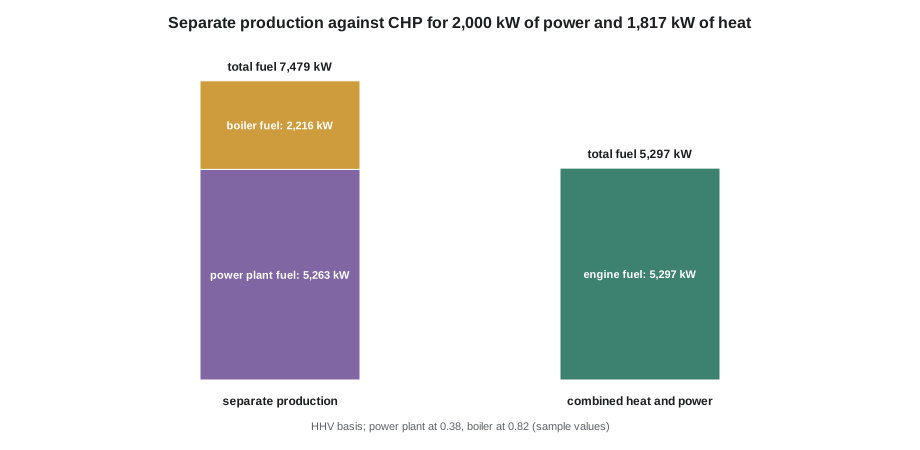
This only works when the heat is used. A CHP plant must be sized to the heat load, not to the electrical load, and its value depends on how many hours a year that heat load is there. Cantwell's district hot water and steam loads never fall to zero, because of domestic hot water and process steam in the customer buildings, and the weather-independent load of lesson 8, about 111,000 MMBtu of gas a year, is roughly 3.7 MW of average boiler input, comfortably more than the engine's useful heat even in the warmest weeks. An engine of this size can therefore run near full output almost all year, apart from maintenance. The study assumes 7,000 hours a year (typical for a baseload engine allowing for maintenance and outages).
Spark spread and annual savings
The spark spread is the value of a unit of electricity less the cost of the fuel needed to make it. For CHP it is calculated with the net extra fuel, after the heat credit:
Worked problem
Annual savings for the engine
At sample prices of 0.11 dollars per kWh for electricity and 6.00 dollars per MMBtu for gas, and a maintenance cost of 0.025 dollars per kWh generated (typical for an engine maintenance contract including overhauls), find the annual electricity value, the net extra gas cost, the maintenance cost and the net annual savings for 7,000 hours a year.
Show solution
- \[\text{electricity} = 2{,}000 \times 7{,}000 = 14.0 \text{ GWh} \times 0.11 = 1{,}540{,}000 \text{ dollars}\]
- \[\text{extra gas} = 10.41 \times 7{,}000 = 72{,}890 \text{ MMBtu} \times 6.00 = 437{,}400 \text{ dollars}\]
- \[\text{maintenance} = 14.0 \times 10^6 \times 0.025 = 350{,}000 \text{ dollars}\]
- \[\text{net savings} = 1{,}540{,}000 - 437{,}400 - 350{,}000 = 752{,}600 \text{ dollars a year}\]
Answer: About 753,000 dollars a year. The spark spread is 110 − 5.21 × 6.00 = 78.8 dollars per MWh before maintenance, or about 53.8 after it.
The electricity price used must be the price the plant would actually avoid, which is not the average price on the bill. Large customers pay for energy, for peak demand, for transmission and distribution, and for various regulatory charges, some of which are avoided by generating on site and some of which are not. If the engine is out of service at the time of the monthly peak, the demand charge may not be avoided that month at all; a utility may also impose standby charges for being ready to supply the load when the engine is down. A sound study uses the utility's actual tariff, hour by hour, not an average.
The time value of money
A dollar saved in ten years is worth less than a dollar saved now, because money now can be invested. Discounting converts future amounts to their present value at a chosen discount rate r, which reflects the owner's cost of capital and the project's risk:
The second formula gives the present value of a uniform annual amount A for n years. The net present value (NPV) of a project is the present value of all its savings less the present value of its costs; a positive NPV means the project earns more than the discount rate. The internal rate of return (IRR) is the discount rate at which the NPV is zero, found by trial. Simple payback, the capital cost divided by the annual savings, ignores both the time value of money and the savings after the payback period, so it is useful for screening but not for decisions between projects of different lives.
Worked problem
Net present value and internal rate of return
The installed cost of the engine plant, including the exhaust boiler, heat exchangers, switchgear, controls, building work and engineering, is estimated at 2,400 dollars per kW (a typical planning figure), or 4.8 million dollars. With the net savings above, find the simple payback, the NPV at 7 in 100 over 20 years, and the IRR.
Show solution
- \[\text{payback} = \frac{4{,}800{,}000}{752{,}600} = 6.4 \text{ years}\]
- \[\frac{1 - 1.07^{-20}}{0.07} = 10.594 \;\Rightarrow\; NPV = 752{,}600 \times 10.594 - 4{,}800{,}000 = 3.17 \text{ million dollars}\]
- \[IRR \approx 0.147 \quad (\text{the rate at which } 752{,}600 \times \text{annuity factor} = 4{,}800{,}000)\]
Answer: At these sample prices the project looks reasonable: a payback of about six years and a return of about 15 in 100.
Sensitivity analysis
The NPV depends on prices that will change over twenty years. A sensitivity analysis changes one assumption at a time to see which ones matter most; a scenario analysis changes several together to represent a plausible future. For CHP, the spark spread dominates: the result is far more sensitive to the electricity and gas prices than to the capital cost.
| Case | Net savings, dollars a year | Simple payback, years | NPV at 7 in 100, 20 years, million dollars |
|---|---|---|---|
| Base: 0.11 dollars/kWh, 6.00 dollars/MMBtu | 752,600 | 6.4 | 3.17 |
| Electricity 0.08 dollars/kWh | 332,600 | 14.4 | −1.28 |
| Gas 7.50 dollars/MMBtu | 643,300 | 7.5 | 2.01 |
A fall of 3 cents in the avoided electricity price turns the NPV negative; a rise of 1.50 dollars per MMBtu in gas cuts it by more than a third. Running hours matter almost as much as prices: if the heat load or reliability allowed only 5,000 hours a year, the savings would fall in proportion and the payback would stretch toward nine years. A good study shows these results as a chart, so that the owner can see at what prices the project stops paying.
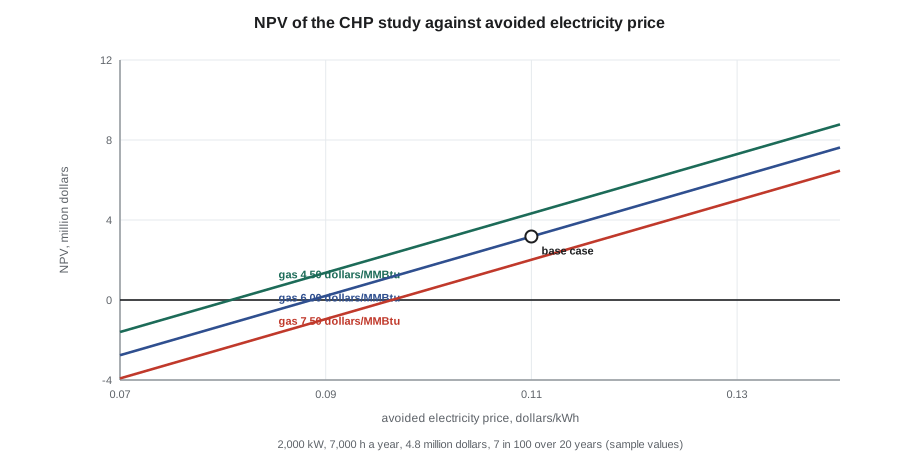
The cash flows in a full study are not uniform. Engine maintenance includes major overhauls every few years of running, which may be paid as they occur rather than as a level rate; prices may be escalated; and the capital may be financed by debt. Taxes and incentives also change the result. Federal tax credits for combined heat and power, and state and utility incentives, may apply. These rules change often, and a feasibility study should have them checked by the owner's tax and financial advisers at the time.
Interconnection and regulation
A CHP plant that runs in parallel with the utility needs an interconnection agreement. In Ohio, interconnection of customer generators to a distribution utility is governed by the Public Utilities Commission of Ohio's interconnection rules, and the utility will study the effect of the generator on its system, including fault levels, protection and voltage, before approving it. The plant needs protection that disconnects it from the grid if the grid fails, so it does not energize lines that utility crews believe are dead: anti-islanding protection, together with under- and over-voltage and frequency relays and a utility-approved interconnection breaker. A plant that meets the PURPA efficiency standards of lesson 7 can be certified as a qualifying facility; the engine's figures give (2,000 + 0.5 × 1,817) ÷ 4,771 = 0.61 on the LHV, with thermal output 0.48 of the total, well above the standards. The engine would also need a permit to install and operate from Ohio EPA, because it is a new combustion source subject to federal engine emission standards.
Many owners now ask for CHP to provide resilience: the ability to keep the plant and its customers supplied during a grid outage. That requires black-start capability, controls to separate from the grid and carry the plant's own load, and protection settings for both modes. Cantwell's existing standby generator already covers the essential bus; a CHP engine designed for island operation could cover more of the plant, and possibly critical customers such as the seniors' residence, but at extra cost that the study would have to justify.
Emissions
A CHP plant burns more gas on site than the boilers it partly replaces, so its own emissions rise. Whether total emissions fall depends on the emissions of the electricity it displaces from the grid.
Worked problem
Does the engine reduce emissions?
The net extra gas is 72,890 MMBtu a year, at about 53.06 kg of CO₂ per MMBtu. The engine generates 14.0 GWh a year. Find the extra on-site CO₂ and the grid emission factor at which the engine breaks even.
Show solution
- \[72{,}890 \times 53.06 = 3{,}870 \text{ t CO}_2 \text{ a year}\]
- \[\text{break-even} = \frac{3{,}870}{14{,}000} = 0.28 \text{ t/MWh}\]
Answer: If the grid electricity displaced emits more than about 0.28 t of CO₂ per MWh, the engine reduces total emissions; if less, it increases them. The grid serving Ohio still draws a large share of its power from fossil fuels, and its average and marginal emission factors are typically well above that figure, so in Ohio gas-fired CHP usually reduces total emissions today. As the grid decarbonizes, the advantage shrinks, and Grazyna noted that the study should compare the engine with heat pumps and with hydrogen-ready or renewable-gas options.
Carbon pricing affects the result in some states but not, at present, in Ohio, where there is no state carbon price on natural gas. Federal greenhouse gas reporting rules for facilities have been under review, as PWR-330 noted, and owners increasingly set their own emissions targets, which may weigh as much in the decision as the economics. The study must use the rules and corporate commitments in force when the decision is made.
Pilar's model, when she presented it, had one page of results and four pages of assumptions. Grazyna approved. "That is the right proportion," she said. "Nobody will argue with your arithmetic. They will argue with your prices, your hours and your grid. Make sure they can see them."
Common mistakes
MistakeValuing CHP electricity at the average price on the bill.
InsteadUse the actual avoided tariff components, hour by hour, and allow for standby and demand charges.
MistakeSizing a CHP plant to the electrical load.
InsteadSize it to the heat load that is reliably present, so the heat is used.
MistakeCharging all the engine's fuel to the electricity.
InsteadCredit the boiler fuel the useful heat displaces; only the net extra gas makes the power.
MistakeRelying on simple payback to choose between projects.
InsteadUse NPV or IRR with a sensitivity analysis; payback ignores later savings and the time value of money.
MistakeAssuming CHP always reduces emissions.
InsteadIt does so only if the displaced grid electricity emits more than the break-even factor.
Summary and key terms
- CHP saves fuel only when its heat is used; size it to the reliable heat load.
- The net extra fuel for CHP power is the engine fuel less the boiler fuel the heat displaces.
- Spark spread is the avoided electricity price less the net extra fuel cost per kWh.
- NPV discounts all cash flows at the owner's rate; IRR is the rate that makes NPV zero.
- Electricity price, gas price and running hours dominate the result; test them in a sensitivity analysis.
- Interconnection rules, air permits, carbon pricing and the grid's emissions all affect the decision.
- Combined heat and power
- Producing electricity and useful heat from one fuel input; also called cogeneration.
- Spark spread
- The value of electricity less the cost of the fuel needed to generate it.
- Net present value
- The present value of a project's savings less the present value of its costs.
- Internal rate of return
- The discount rate at which a project's net present value is zero.
- Discount rate
- The rate used to convert future cash flows to present values.
- Standby charge
- A utility charge for keeping capacity ready to serve a load normally supplied by on-site generation.
- Anti-islanding protection
- Protection that disconnects a generator from the grid when the grid supply is lost.
- Sensitivity analysis
- Testing how a result changes when one assumption is changed at a time.
Practice problems
Work each problem on paper first, then reveal the answer to check.
An engine burns 13.65 MMBtu/h of gas (HHV) and recovers 5.12 MMBtu/h of useful heat that would otherwise come from a 0.80-efficient boiler. Find the net extra gas.
Show answer
13.65 − 6.40 = 7.25 MMBtu/h.
Find the present value of 100,000 dollars a year for 15 years at 8 in 100.
Show answer
100,000 × 8.559 = 855,900 dollars.
A project costs 2.0 million dollars and saves 300,000 dollars a year for 20 years. Find its NPV at 7 in 100.
Show answer
300,000 × 10.594 − 2,000,000 = 1.18 million dollars.
Extra gas of 47,400 MMBtu a year at 53.06 kg/MMBtu is burned to make 9,000 MWh. Find the break-even grid factor.
Show answer
2,515 t ÷ 9,000 MWh = 0.28 t/MWh.
Lesson quiz · 5 questions
Score 60% or more to complete this lesson.
Create a free account to save your progress, take quizzes and earn a certificate.