
PWR-410 · Lesson 4 of 12 · 29 min
Refrigeration and heat pump cycles
▶ Video coming soon A video version of this lesson is on the way.
Cantwell's water-cooled screw chiller, the one PWR-230 described in its machinery room behind the control room, runs all year: it cools the control room, the electrical rooms and the offices, and in summer it works hard. Pilar had logged its readings on hundreds of rounds without ever working out its cycle. Grazyna gave her the maker's data sheet and the chiller's last service report and asked her to do three things before the session: find its coefficient of performance from the data sheet, compare it with the Carnot limit, and work out what the cooling tower on the pump gallery roof actually has to reject.
This lesson covers the reversed Carnot cycle as the limit for refrigerators and heat pumps, the vapor-compression cycle and its analysis on the pressure-enthalpy diagram, performance ratings, multistage and cascade systems, gas refrigeration cycles, absorption chillers and heat pumps, and the refrigerants used today.
Refrigerators, heat pumps and the second law
A refrigerator removes heat Q_L from a cold space and rejects heat Q_H to warmer surroundings, using a work input W. A heat pump is the same machine viewed from the other end: its purpose is to deliver Q_H to a warm space. By the first law, Q_H = Q_L + W. Performance is expressed as a coefficient of performance (COP), the useful heat divided by the work:
The COP can be, and usually is, greater than one, because the machine moves heat rather than making it. The upper limit is set by the reversed Carnot cycle working between the cold temperature T_L and the hot temperature T_H, both absolute:
The temperature lift, T_H − T_L, controls everything. Halving the lift roughly doubles the possible COP. This is why chillers are rated at stated water temperatures, why raising the chilled water set point or lowering the condenser water temperature saves energy, and why heat pumps work best with a warm source such as ground water, sewage or waste heat.
Worked problem
The Carnot limit for Cantwell's chiller
The chiller's refrigerant evaporates at about 40 °F and condenses at about 97 °F. Find the Carnot COP as a refrigerator, and compare it with the chiller's actual rating of 82.5 tons of cooling for 62 kW of compressor input.
Show solution
- \[COP_{Carnot} = \frac{499.67}{556.67 - 499.67} = 8.77\]
- \[COP_{actual} = \frac{82.5 \times 3.517}{62} = \frac{290}{62} = 4.68 \approx 4.7\]
- \[\eta_{II} = \frac{4.68}{8.77} = 0.53\]
Answer: The chiller achieves a little over half of the Carnot COP between its refrigerant temperatures, a second-law efficiency typical of a good screw chiller. Against the water temperatures it serves, which are further apart, its second-law efficiency is higher still.
The vapor-compression cycle
Almost all refrigeration and air-conditioning plant uses the vapor-compression cycle. In the ideal cycle, saturated vapor leaving the evaporator (state 1) is compressed isentropically to the condenser pressure (state 2), condensed at constant pressure to saturated liquid (state 3), and throttled through an expansion valve to the evaporator pressure (state 4), entering the evaporator as a cold, low-quality mixture that boils as it absorbs heat. The throttling is at constant enthalpy, h₄ = h₃, which is the one irreversible step that the ideal cycle accepts in place of an expansion turbine; the work an expander could recover from a liquid is small and not worth the machine.
The cycle is analyzed on a pressure-enthalpy (p-h) diagram, on which the evaporation and condensation are horizontal lines, the throttling is a vertical line, and the compression follows a line of constant entropy. Every quantity of interest is a horizontal distance:
The refrigerating effect q_L is the heat absorbed per kilogram or pound of refrigerant circulated. The refrigerant mass flow needed for a given capacity is the capacity divided by the refrigerating effect, and the compressor's swept volume follows from that mass flow and the specific volume of the suction gas.
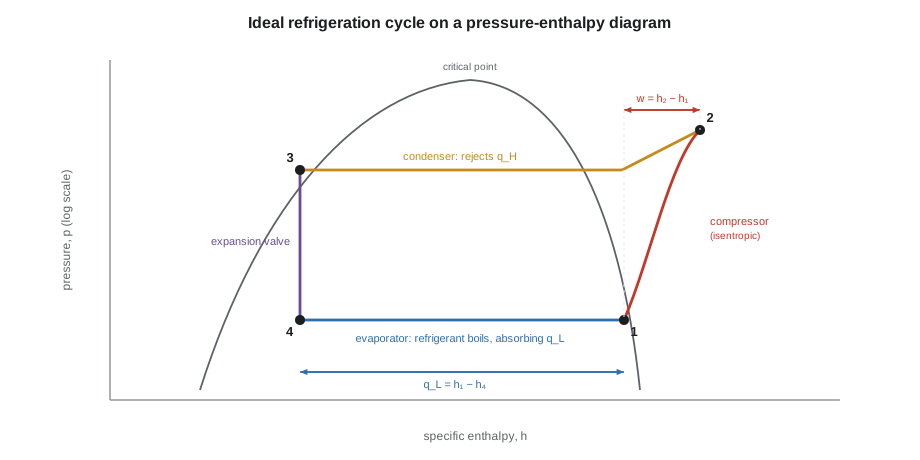
Refrigerant properties come from tables or software for each refrigerant, and US tables use a different enthalpy reference point from SI tables, so values from the two cannot be mixed; there is no single formulation like IAPWS-IF97 for all refrigerants. Examination problems normally give the enthalpies needed, and that is how the example below is set out: the values are rounded and given for the problem.
Worked problem
Cantwell's chiller as an ideal cycle
The chiller uses R-134a. For an ideal cycle between 40 °F evaporating and 97 °F condensing, take as given: h₁ = 108 Btu/lb (saturated vapor leaving the evaporator), h₂ = 118 Btu/lb (after isentropic compression), h₃ = h₄ = 45 Btu/lb (saturated liquid leaving the condenser). For 82.5 tons of cooling, find the refrigerating effect, the ideal COP, the refrigerant flow, the ideal compressor power and the heat rejected.
Show solution
- \[q_L = 108 - 45 = 63 \text{ Btu/lb}, \qquad w = 118 - 108 = 10 \text{ Btu/lb}, \qquad COP = \frac{63}{10} = 6.3\]
- \[\dot m = \frac{82.5 \times 12{,}000}{63} = 15{,}710 \text{ lb/h}, \qquad P = 15{,}710 \times 10 = 157{,}100 \text{ Btu/h} = 46.0 \text{ kW}\]
- \[Q_H = 990{,}000 + 62 \times 3{,}412 = 1{,}201{,}500 \text{ Btu/h} \approx 100 \text{ tons of heat rejection (actual)}\]
Answer: The ideal cycle needs 46.0 kW; the real chiller takes 62 kW, so the compressor, its motor and drive together achieve about 46.0 ÷ 62 = 0.74 of the ideal. The cooling tower must reject the cooling load plus the compressor input, about 1.2 million Btu/h, which is the 100-ton rating PWR-230 gave for the tower on the pump gallery roof.
Real cycles depart from the ideal in several ways. The vapor leaving the evaporator is superheated a few degrees to protect the compressor from liquid; the liquid leaving the condenser is subcooled a few degrees, which increases the refrigerating effect and keeps the expansion valve fed with solid liquid; there are pressure drops in the lines and heat exchangers; and the compression is not isentropic. A liquid-suction heat exchanger that subcools the liquid with the suction gas improves the COP for some refrigerants and lowers it for others.
Ratings and part-load performance
Chillers and air conditioners are rated in several ways. In SI, cooling capacity is stated in kilowatts. In North American practice, the ton of refrigeration is still used: 12,000 Btu/h, or 3.517 kW, originally the cooling from melting a short ton of ice in a day. Large chillers are often rated in kW per ton, the electrical input per ton of cooling, where lower is better; Cantwell's chiller, at 62 kW for 82.5 tons, runs at about 0.75 kW per ton at its rating point. The energy efficiency ratio (EER), used for air conditioners, is the cooling in Btu/h divided by the electrical input in watts; 3.412 times the COP gives the EER, so a COP of 4.7 is an EER of about 16.
Because chillers spend most of their hours at part load, ratings also include a part-load value. AHRI Standard 550/590 defines an integrated part-load value (IPLV) for standard conditions and a non-standard version for project conditions, weighting the efficiency at 100, 75, 50 and 25 in 100 of capacity. Screw and centrifugal chillers with variable-speed drives often have much better part-load than full-load efficiency, because at part load the condenser water is usually colder and the lift is smaller. Energy codes, such as ASHRAE 90.1, set minimum full-load and part-load efficiencies for new chillers.
| Measure | Definition | Cantwell chiller at rating |
|---|---|---|
| COP | Cooling ÷ input, both in the same units | 4.7 |
| kW per ton | Electrical input per ton of cooling | 0.75 |
| EER | Cooling in Btu/h ÷ input in watts | about 16 |
| Ton of refrigeration | 12,000 Btu/h = 3.517 kW | 82.5 tons = 290 kW |
Multistage and cascade systems
When the lift is large, as in low-temperature freezing or industrial process refrigeration, a single stage of compression becomes inefficient: the discharge temperature is high, the compressor's volumetric efficiency falls, and the throttling loss grows because more of the liquid flashes to vapor in the expansion valve. Two remedies are common. Multistage compression with flash intercooling compresses in two stages, and between them a flash tank at an intermediate pressure separates the vapor flashed from the liquid, which is sent straight to the second stage; the liquid continues, colder, to the low-stage evaporator. This reduces both the compression work and the flash loss. Cascade systems use two separate refrigeration circuits, often with different refrigerants, linked by a heat exchanger in which the low-temperature circuit's condenser is the high-temperature circuit's evaporator. Cascades are used where no single refrigerant suits the whole temperature range, for example carbon dioxide in the low stage and ammonia in the high stage of a large freezer.
Transcritical carbon dioxide (R-744) systems are now common in supermarkets and in heat pumps for hot water. Carbon dioxide's critical temperature is only about 88 °F, so in warm weather it cannot condense; instead it is cooled as a dense supercritical gas in a gas cooler, and the high-side pressure is controlled for best COP. The high gas-cooler temperatures make it well suited to heat pumps delivering water at 150 to 195 °F (typical).
Gas refrigeration cycles
The reversed Brayton cycle uses a gas, usually air, that does not change phase: the gas is compressed, cooled at high pressure, expanded in a turbine to a very low temperature, and warmed as it absorbs heat from the refrigerated space. Its COP is much lower than a vapor-compression cycle's at ordinary temperatures, because heat is absorbed and rejected over a range of temperatures rather than at constant temperature, but it has two uses where that does not matter: aircraft cabin cooling, where compressed air from the engines is already available and the equipment must be light, and cryogenic processes such as the liquefaction of gases, where modified gas cycles with regeneration reach very low temperatures.
Absorption chillers
An absorption chiller replaces the compressor with a thermal process. In the common lithium bromide-water machine, water is the refrigerant: it evaporates at a very low pressure in the evaporator, chilling the water in the tubes, and the vapor is absorbed into a concentrated lithium bromide solution in the absorber. The dilute solution is pumped to a generator, where heat from steam, hot water or exhaust gas boils the water back out; the water vapor is condensed and returned to the evaporator, and the concentrated solution returns to the absorber. The only mechanical work is the small solution pump.
Absorption chillers are rated by a thermal COP, the cooling divided by the heat input. Single-effect machines reach about 0.7, and double-effect machines, which use the heat twice in two generators at different pressures, reach about 1.2 to 1.4 (typical); they need steam at about 15 psig and 115 psig respectively (typical). The COP is low compared with an electric chiller's, but the energy is heat that may otherwise be wasted. Combined with a CHP engine, absorption cooling makes trigeneration: power, heat and cooling from one fuel input.
Worked problem
Trigeneration at Cantwell
Grazyna's preliminary CHP figures included about 2,770 lb/h of steam, about 817 kW, from the engine's exhaust boiler. If, in summer, that steam drove a single-effect absorption chiller with a COP of 0.7, how much cooling would it provide?
Show solution
- \[Q_L = 0.7 \times 817 = 572 \text{ kW} = \frac{572}{3.517} = 163 \text{ tons}\]
Answer: About 572 kW, nearly twice the capacity of the existing chiller. Cantwell's own cooling load is small, so this would make sense only if a customer building needed summer cooling; Grazyna noted it as a question for the study, not a recommendation.
Ammonia-water absorption systems, in which ammonia is the refrigerant and water the absorbent, can reach temperatures below freezing and are used in industrial refrigeration and some gas-fired heat pumps. Lithium bromide machines need careful operation: if the solution becomes too concentrated, or too cold, it crystallizes and blocks the solution heat exchanger, and the machine must be shut down and dissolved out. Air leaks into the vacuum vessels stop the machine working, so absorption chillers have purge units that remove noncondensable gases.
Heat pumps for heating
A heat pump for heating delivers Q_H = Q_L + W, so its COP is always one more than its COP as a refrigerator. Its value depends on the energy it displaces. A heat pump with a COP of 3 delivers three units of heat for each unit of electricity; a gas boiler delivers about 0.82 units of heat for each unit of gas. Whether the heat pump saves money depends on the ratio of the electricity and gas prices, and whether it reduces emissions depends on how the electricity is generated.
Worked problem
A heat pump against a boiler
A heat pump with a COP of 3.0 would supply 1,706,000 Btu/h (500 kW) of heat to a district hot water loop, in place of a gas boiler of 0.82 efficiency. At sample prices of 0.11 dollars per kWh for electricity and 6.00 dollars per MMBtu for gas, compare the hourly energy cost.
Show solution
- \[\text{electricity} = \frac{1{,}706{,}000}{3.0 \times 3{,}412} = 166.7 \text{ kW} \;\Rightarrow\; 166.7 \times 0.11 = 18.33 \text{ dollars/h}\]
- \[\text{gas} = \frac{1.706}{0.82} = 2.080 \text{ MMBtu/h} \;\Rightarrow\; 2.080 \times 6.00 = 12.48 \text{ dollars/h}\]
Answer: At these sample prices the boiler is cheaper to run. The heat pump would need a COP of about 5.4 (ca) or 4.4 (us) to match it, which is possible only with a warm source and a low delivery temperature; lowering the district loop temperature is therefore part of any district heat pump study.
Large heat pumps are increasingly used in district energy systems, drawing heat from sewage, rivers, lakes, data centers or industrial waste heat. A heat pump lifting water from 50 °F to 158 °F has a Carnot COP of 617.67 ÷ 108 = 5.7, and a real machine might reach about half of that, around 2.9 (typical). Lower district supply temperatures, of the kind used in newer fourth-generation district heating systems, make heat pumps far more attractive.
Refrigerants
The choice of refrigerant balances thermodynamic properties, safety and environmental effects. ASHRAE Standard 34 classifies refrigerants by toxicity (A lower, B higher) and flammability (1 no flame propagation, 2L lower flammability, 2, 3 higher). R-134a is A1; ammonia (R-717) is B2L; propane (R-290) is A3; many newer low-global-warming-potential refrigerants, such as R-1234ze(E) and R-32, are A2L. Machinery room safety, as PWR-230 described for Cantwell's chiller room, follows from the class and quantity of refrigerant, under ASHRAE Standard 15, the safety standard for refrigeration systems.
Chlorofluorocarbons were phased out under the Montreal Protocol because they destroy stratospheric ozone, and the hydrofluorocarbons that replaced them, such as R-134a, are now being phased down under the protocol's Kigali Amendment because they are powerful greenhouse gases. In the United States, the phase-down is carried out under the American Innovation and Manufacturing (AIM) Act and the EPA's rules under it. New chillers are increasingly supplied with low-global-warming-potential refrigerants, and existing R-134a machines such as Cantwell's can be run to the end of their lives with good leak control and recovery.
Pilar's notes from the session ended with the cooling tower. She had always thought of its 352 kW as the chiller's load; now she saw that it was the chiller's load plus every kilowatt the compressor used, and that each kilowatt saved at the compressor was saved twice, once at the meter and once in the tower's fan and water use.
Common mistakes
MistakeUsing Celsius or Fahrenheit temperatures in the Carnot COP.
InsteadUse kelvins or degrees Rankine; the lift is a difference, but T_L or T_H on top must be absolute.
MistakeSizing heat rejection equal to the cooling load.
InsteadThe condenser or tower rejects the cooling load plus the compressor input.
MistakeMixing refrigerant enthalpies from tables with different reference states.
InsteadUse one table or program throughout; only enthalpy differences matter.
MistakeComparing absorption and electric chillers by COP alone.
InsteadAbsorption COP is heat-based; compare by cost and the value of the heat source.
MistakeAssuming a heat pump with COP above one always beats a boiler.
InsteadIt depends on the ratio of electricity and fuel prices and on the grid's emissions.
Summary and key terms
- COP_R = Q_L ÷ W and COP_HP = COP_R + 1; the Carnot limits are T_L ÷ lift and T_H ÷ lift.
- The vapor-compression cycle is analyzed on the p-h diagram: q_L = h₁ − h₄, w = h₂ − h₁, h₄ = h₃.
- Heat rejected equals cooling plus compressor input; Cantwell's tower rejects 290 + 62 = 352 kW.
- One ton of refrigeration is 12,000 Btu/h or 3.517 kW; kW per ton, EER and IPLV are common ratings.
- Multistage, cascade and transcritical CO₂ systems handle large lifts; absorption chillers run on heat.
- Refrigerants are classed for toxicity and flammability; HFCs are being phased down under the Kigali Amendment.
- Coefficient of performance
- Useful heat moved or delivered divided by the work input.
- Lift
- The difference between the condensing and evaporating temperatures of a refrigeration cycle.
- Refrigerating effect
- The heat absorbed in the evaporator per unit mass of refrigerant circulated.
- Ton of refrigeration
- A cooling rate of 12,000 Btu/h, or 3.517 kW.
- Integrated part-load value
- A weighted chiller efficiency at several part loads, defined by AHRI 550/590.
- Cascade system
- Two refrigeration circuits linked by a heat exchanger, each covering part of the temperature range.
- Absorption chiller
- A chiller in which a heat-driven absorption and generation process replaces the compressor.
- Trigeneration
- Producing power, heat and cooling from one fuel input, usually with an absorption chiller.
Practice problems
Work each problem on paper first, then reveal the answer to check.
Find the Carnot COP of a refrigerator between 14 °F and 86 °F.
Show answer
473.67 ÷ 72 = 6.58.
A chiller makes 300 tons of cooling with 210 kW input. Find its kW per ton and its COP.
Show answer
0.70 kW per ton; COP = 1,055 ÷ 210 = 5.02.
For an ideal cycle with h₁ = 106, h₂ = 119 and h₃ = 47 Btu/lb, find the COP and the flow for 10 tons.
Show answer
COP = 59 ÷ 13 = 4.54; flow = 120,000 ÷ 59 = 2,034 lb/h.
A heat pump has a COP of 3.5 as a heater. What is its COP as a refrigerator?
Show answer
2.5.
Lesson quiz · 5 questions
Score 60% or more to complete this lesson.
Create a free account to save your progress, take quizzes and earn a certificate.