
PWR-410 · Lesson 8 of 12 · 27 min
Energy audits and efficiency projects
▶ Video coming soon A video version of this lesson is on the way.
Cantwell's owner had asked Grazyna for an energy audit of the plant before the 2027 capital plan was settled, and she had decided that Pilar would lead it, with Okonkwo's help on nights. The eighth session was the planning meeting. Grazyna put three folders on the table: the 2025 gas and electricity bills, the work orders from the autumn's steam trap and compressed air surveys, and PWR-220's economizer estimate for boiler 2. "An audit is not a list of good ideas," she said. "It is a measured account of where the energy goes, a set of costed measures, and a way to prove afterwards that the savings happened."
This lesson describes the levels of energy audit and the standards that define them, how to build a plant energy balance from bills and measurements, how to find and value measures such as trap repairs, leak repairs, insulation, economizers and combustion control, how measures interact, how savings are measured and verified against a weather-adjusted baseline, and how audit results become projects.
Levels of energy audit
ASHRAE Standard 211, Standard for Commercial Building Energy Audits, first published in 2018 and reaffirmed in 2023, defines three levels of audit that are widely used for plants as well as buildings:
- Level 1, the walk-through: a review of a year or more of utility bills, a benchmark against similar facilities, a site walk, and a list of low-cost and no-cost measures with rough savings, plus a list of capital measures worth studying further.
- Level 2, the energy survey and analysis: an end-use breakdown of the energy, measurements where needed, and engineering calculations of savings and costs for each measure, with interactions taken into account.
- Level 3, the detailed analysis of capital-intensive modifications: monitoring over time, detailed modeling, and cost estimates good enough for an investment decision.
For industrial plants, ISO 50002, Energy audits, sets requirements for planning, conducting and reporting audits of any type of facility, and it fits with ISO 50001, the standard for energy management systems. The US Department of Energy publishes free tools for assessing steam, process heating, compressed air, pump and fan systems, such as its MEASUR software, and its industrial programs promote energy management in plants; gas and electric utilities in Ohio offer audit and incentive programs for large users. Cantwell's audit would be a Level 2, with Level 3 studies to follow for the economizer and the combined heat and power plant.
The plant energy balance
The audit begins with what the plant buys. Cantwell's 2025 bills gave the starting figures: about 360,000 MMBtu of natural gas and, from the electricity bills, about 3.9 million kWh, the power for the pumps, fans, compressors, chiller, lighting and controls. Then the audit traces where that energy goes, using meters where they exist and calculations where they do not.
Worked problem
Cantwell's purchased energy
At sample prices of 6.00 dollars per MMBtu for gas and 0.11 dollars per kWh for electricity, find the 2025 energy cost and the share of each.
Show solution
- \[\text{gas} = 360{,}000 \times 6.00 = 2{,}160{,}000 \text{ dollars}\]
- \[\text{electricity} = 3.9 \times 10^6 \times 0.11 = 429{,}000 \text{ dollars}\]
- \[\text{gas share} = \frac{2.160}{2.589} = 0.83\]
Answer: Gas is about four fifths of the bill, so the audit's first priority is the steam and hot water systems; but electricity is billed partly on peak demand, so measures that cut the peak, such as variable-speed drives on pumps, can be worth more than their energy savings alone suggest.
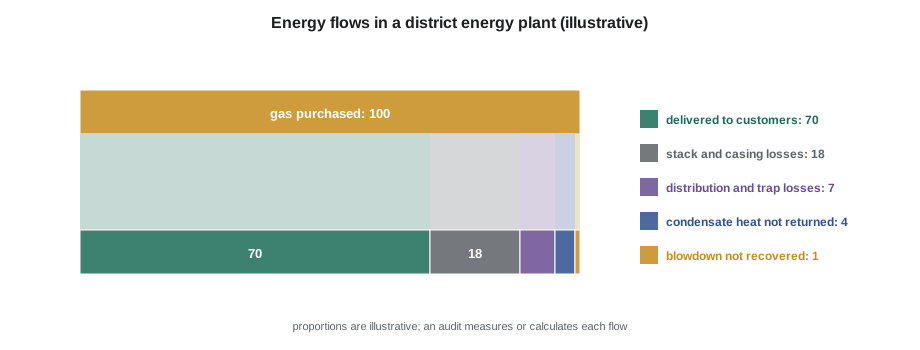
A plant balance follows the energy from the gas meter through the boilers, where the stack and radiation losses of PWR-330 leave; through the distribution system, where steam trap losses, radiation from pipes and vaults, and leaks leave; through the blowdown, which is partly recovered in the flash tank; to the customer buildings and back as condensate, some of which is lost and must be replaced with treated make-up water. Each loss is estimated, and the estimates are checked against the total: the sum of the deliveries and the losses must equal the purchases within the uncertainty of the meters. A balance that does not close is itself a finding. It usually means a meter is wrong or a loss has been missed.
Finding and valuing measures
A measure's value is its energy saving multiplied by the cost of that energy at the point of saving. Steam saved in a customer's building is worth more than the gas in it, because making and delivering the steam costs fuel, water, chemicals and pumping power. A common first step is therefore a unit cost of steam:
Worked problem
The cost of a metric ton of Cantwell steam
Each pound of steam needs 1,006 Btu from feedwater at 221 °F (PWR-210), and the boilers are about 0.816 efficient. Add 0.60 dollars per 1,000 lb for water, treatment chemicals and power. Find the cost of steam at the sample gas price.
Show solution
- \[\text{fuel} = \frac{1{,}006}{0.816} = 1{,}233 \text{ Btu/lb} = 1.233 \text{ MMBtu per 1,000 lb}\]
- \[\text{cost} = 1.233 \times 6.00 + 0.60 = 8.00 \text{ dollars per 1,000 lb}\]
Answer: About 8 dollars per 1,000 lb. Condensate that is not returned costs more again, because the water, its treatment and its heat must all be replaced.
With that figure, the findings of the autumn surveys can be valued.
Worked problem
Steam traps, compressed air and a bare pipe
(a) Lorne's October trap survey found three traps blowing on the distribution mains. Each has a 1/8 in orifice, which by Napier's formula (lesson 6) passes 104 lb/h fully open; the audit assumes a failed trap passes a third of that (a common audit assumption). (b) Fenella's ultrasonic survey in September found leaks wasting about 41,000 kWh a year of compressor energy. (c) A 20 ft length of bare steam pipe in vault 4, found in October, loses about 940 Btu/h per foot (typical for the size and temperature). Value each per year, with continuous operation for (a) and (c).
Show solution
- \[(a)\;\; \frac{104}{3} = 34.6 \text{ lb/h} \times 8{,}760 = 303{,}400 \text{ lb/yr} \times 8.00 = 2{,}430 \text{ dollars each, } 7{,}280 \text{ for three}\]
- \[(b)\;\; 41{,}000 \times 0.11 = 4{,}510 \text{ dollars}\]
- \[(c)\;\; 20 \times 940 \times 8{,}760 \div 816{,}000 = 201.8 \text{ MMBtu of gas} \times 6.00 = 1{,}210 \text{ dollars}\]
Answer: Each is small, but each costs little to fix, and together they repay a trap and leak survey program many times over. The repairs and the insulation were already done; the audit's recommendation is to make the surveys routine, twice a year for traps and in spring and fall for air, as the 2027 PM schedule already proposed.
Larger measures need more careful estimates. PWR-220 estimated that an economizer on boiler 2 would recover about 484,000 Btu/h from the flue gas, worth about 31,000 dollars a year at sample prices. PWR-330 showed that oxygen trim saves about 0.3 points of boiler efficiency for each point of oxygen removed from the flue gas at Cantwell's stack temperatures. Other candidates on Pilar's list were variable-speed drives on the remaining constant-speed pumps and fans, condensate return improvements at two customer buildings, a review of how many boilers are kept hot on standby, combustion air preheat from the boiler room ceiling, and the CHP plant, which lesson 9 evaluates.
Interactions between measures
Savings from measures on the same system are not additive. An economizer recovers heat from the flue gas; if oxygen trim first reduces the excess air, there is less flue gas, the stack temperature changes, and the economizer saves somewhat less. Reducing the steam demand in the distribution system also reduces the savings available from the boilers, because less steam is made. The correct method is to apply the measures in sequence, each one to the energy use left after the ones before it:
Worked problem
Oxygen trim and an economizer together
If oxygen trim on boiler 2 saves 1.2 in 100 of its gas and an economizer saves 1.6 in 100, what is the combined saving?
Show solution
- \[1 - (1 - 0.012)(1 - 0.016) = 1 - 0.9722 = 0.0278 \quad (\text{not } 0.028)\]
Answer: The difference is small here, but for larger measures, or several in a row, adding the savings can overstate them noticeably. A Level 2 audit must account for the interactions and state the order in which the measures were applied.
Baselines and weather adjustment
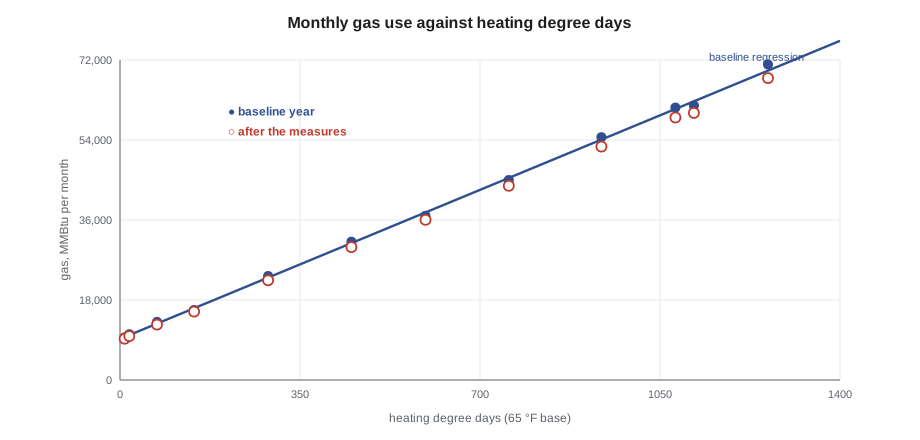
To show that savings happened, the plant's energy use after the measures must be compared with what it would have used without them under the same conditions. A heating plant's gas use depends mostly on the weather, so the baseline is a regression of monthly gas use against heating degree days (HDD), the sum over the days of the month of the amount by which the mean daily temperature fell below a base temperature, usually 65 °F.
The intercept, 111,000 MMBtu a year, is the weather-independent load: domestic hot water and process steam in the customer buildings, distribution and standby losses. The slope is the extra gas for each degree day. With a typical year of about 5,200 degree days for central Ohio (typical), the equation gives 360,000 MMBtu, matching 2025.
Worked problem
Measured savings
After the measures are installed, a year with 4,790 degree days uses 329,500 MMBtu. Find the savings, adjusted for weather, and the carbon dioxide avoided at 53.06 kg per MMBtu.
Show solution
- \[\text{baseline} = 111{,}000 + 47.9 \times 4{,}790 = 340{,}440 \text{ MMBtu}\]
- \[\text{savings} = 340{,}440 - 329{,}500 = 10{,}940 \text{ MMBtu} \;\; (3.2 \text{ in } 100)\]
- \[\text{CO}_2 = 10{,}940 \times 53.06 = 580 \text{ t}\]
Answer: Comparing the bills alone would have shown a saving of 30,500 MMBtu, most of it from a mild winter. The weather-adjusted figure, 10,940 MMBtu, is the one the measures earned.
This approach is described in the International Performance Measurement and Verification Protocol (IPMVP), published by the Efficiency Valuation Organization, which defines four options: A, retrofit isolation with key parameters measured and others estimated; B, retrofit isolation with all parameters measured; C, whole-facility measurement against a regression baseline, as here; and D, calibrated simulation. Incentive programs and energy performance contracts usually require one of them. A regression baseline must be checked for its statistical quality, and adjusted, as a non-routine adjustment, for changes that are not measures, such as a new customer building connected to the system.
From audit to project
An audit report ranks the measures for decision. Each is described with its savings in energy and money, its cost, its simple payback (cost divided by annual savings), its life, and, for capital measures, a net present value or internal rate of return, as lesson 9 explains. Measures are often grouped: low-cost measures done immediately from the maintenance budget; measures with paybacks of a few years for the next capital plan; and long-payback or strategic measures, such as decarbonization projects, for further study. Non-energy benefits belong in the report too: an economizer may reduce stack temperature and noise, a variable-speed drive reduces water hammer and wear, and steam trap repairs reduce condensate line damage.
| Measure | Annual savings, dollars (sample prices) | Cost, dollars (estimate) | Simple payback, years |
|---|---|---|---|
| Twice-yearly trap survey and repairs | 7,280 | 3,000 a year | under 1 |
| Compressed air leak program | 4,510 | 1,500 a year | under 1 |
| Insulate bare pipe in vault 4 (done in October) | 1,210 | 1,500 | 1.2 |
| Economizer on boiler 2 | 31,000 | 180,000 | 5.8 |
| CHP feasibility (lesson 9) | to be studied | to be studied | Level 3 study |
Finally, an audit is only worth what is done with it. ISO 50001 and similar energy management systems keep the audit from becoming a one-time report: an energy policy, an energy manager or team, energy performance indicators tracked every month, targets, and regular review. For Cantwell, Pilar proposed three indicators for the monthly operations meeting: gas used per metric ton of steam sent out, corrected for the weather-independent load; compressor kilowatt-hours per day; and the fraction of condensate returned.
Common mistakes
MistakeValuing saved steam at the price of gas.
InsteadUse the full cost of making and delivering steam, including efficiency, water and chemicals.
MistakeAdding savings from several measures on the same system.
InsteadApply them in sequence; savings interact.
MistakeReporting the change in the bills as the savings.
InsteadCompare with a weather-adjusted baseline, as in IPMVP option C.
MistakeIgnoring electrical demand charges.
InsteadMeasures that cut peak demand may save more than their energy alone.
MistakeTreating the audit report as the end of the work.
InsteadTrack energy indicators monthly and review them, as an energy management system requires.
Summary and key terms
- ASHRAE 211 defines Level 1, 2 and 3 audits; ISO 50002 covers audits of any facility and fits ISO 50001.
- Start from purchased energy and trace it through the plant; a balance that does not close is a finding.
- Value measures at the full cost of the energy saved at that point, such as the unit cost of steam.
- Combined savings are 1 − (1 − s₁)(1 − s₂)…, not the sum.
- Measure savings against a regression baseline on degree days; IPMVP defines options A to D.
- Rank measures by payback and life, include non-energy benefits, and follow up with monthly indicators.
- Energy audit
- A systematic review of how a facility uses energy, with measures to reduce use and cost.
- Level 2 audit
- An energy survey and analysis with end-use breakdown and calculated savings and costs for each measure.
- Unit cost of steam
- The full cost of producing and delivering a unit of steam, including fuel, water, chemicals and power.
- Heating degree day
- A measure of heating demand: the amount by which the daily mean temperature falls below a base temperature.
- Baseline
- The energy use expected without the measures, usually a regression against weather and production.
- IPMVP
- The International Performance Measurement and Verification Protocol, which defines methods for proving savings.
- Simple payback
- The cost of a measure divided by its annual savings.
- Energy performance indicator
- A measure of energy performance, such as gas per metric ton of steam, tracked over time.
Practice problems
Work each problem on paper first, then reveal the answer to check.
A trap fails fully open, passing 45 lb/h of steam that costs 8.50 dollars per 1,000 lb. Find the annual cost.
Show answer
45 × 8,760 ÷ 1,000 × 8.50 = 3,351 dollars.
Three measures save 2, 3 and 4 in 100 of a boiler's gas. Find the combined saving.
Show answer
1 − 0.98 × 0.97 × 0.96 = 0.0874.
With a baseline of 111,000 + 47.9 HDD MMBtu, find the expected use in a year of 5,600 HDD.
Show answer
379,240 MMBtu.
A measure costs 45,000 dollars and saves 12,000 dollars a year. Find its simple payback.
Show answer
3.75 years.
Lesson quiz · 5 questions
Score 60% or more to complete this lesson.
Create a free account to save your progress, take quizzes and earn a certificate.