
PWR-310 · Lesson 9 of 12 · 28 min
Fluid mechanics in piping
▶ Video coming soon A video version of this lesson is on the way.
On Thursday, August 20, 2026, Grazyna Wolanski passed Okonkwo Demarest a letter from the owner of the seniors' residence, one of Cantwell's district hot water customers. The residence was planning a new wing for 2028 and wanted to know whether its existing branch from the district loop could carry more water. The branch is 3 in Schedule 40 steel pipe, about 590 ft each way, carrying about 95 gpm at design. "The consulting engineers will do the real study," Grazyna said, "but I want our own number first, so I know whether theirs is sensible. Work out the pressure drop now and at 119 gpm."
This lesson gives Okonkwo the tools. It covers fluid properties and hydrostatic pressure, the continuity equation, Bernoulli's equation and its use in flow meters, laminar and turbulent flow and the Reynolds number, friction losses by the Darcy-Weisbach equation, losses in fittings, the pump power needed to overcome them, and net positive suction head.
Fluid properties
Density, ρ, is mass per unit volume. Water is about 62.3 lb/ft³ at room temperature and falls as it warms: about 60.7 lb/ft³ at 176 °F and 59.8 lb/ft³ at 212 °F. Specific gravity is a liquid's density relative to water. Viscosity is a fluid's resistance to shearing, its internal friction. The dynamic viscosity μ falls sharply as water warms, to about a third of its room temperature value at 176 °F, which is why hot water flows through a pipe more easily than cold. The kinematic viscosity is ν = μ ÷ ρ, in ft²/s; for water at 176 °F it is about 3.9 × 10⁻⁶ ft²/s.
Hydrostatic pressure
In a liquid at rest, pressure increases with depth. The pressure difference between two points a height h apart is:
so that a column of cold water 1 ft high exerts 0.433 psi, and 2.31 ft of water exerts 1 psi. Pressure acts equally in all directions at a point and does not depend on the shape of the container, only on depth. Pressure is often expressed as head, the height of a column of the liquid that would produce it, h = 144p ÷ ρ in feet, because pumps raise head, not pressure: a pump that develops 100 ft of head does so whatever the liquid, but the pressure that head represents depends on the density.
Worked problem
Pressure at the top of the residence
The highest heating coils in the seniors' residence are 100 ft above the plant's pump suction. The loop water is at 176 °F (ρ = 60.67 lb/ft³). How much higher is the static pressure at the pump than at the top of the building?
Show solution
- \[\Delta p = \frac{60.67 \times 100}{144} = 42.1 \text{ psi}\]
Answer: About 42.1 psi. The loop's pressurization must hold the top of the building well above atmospheric, and above the water's saturation pressure, so that the hot water cannot flash to steam at the high point. At 176 °F the saturation pressure is only about 6.8 psia, but on a loop running at 248 °F it would be about 28.8 psia.
Continuity
In steady flow, the mass entering a pipe each second leaves it each second. For a liquid, whose density does not change, the volume flow is therefore the same at every section, and velocity varies inversely with area:
Halving a pipe's diameter quarters its area and quadruples the velocity. The seniors' residence branch, 3 in Schedule 40 with an inside diameter of 3.068 in, has an area of 0.0513 ft², so 95 gpm (0.212 ft³/s) moves at 4.12 ft/s. The same flow forced through 2 in pipe (2.067 in inside) would move at 9.08 ft/s.
Bernoulli's equation
For an ideal fluid flowing steadily without friction, the energy per unit mass is the same at every point along a streamline. Written in heads, the Bernoulli equation is:
The three terms are the pressure head, the velocity head and the elevation head. Where a fluid speeds up, its pressure falls; where it slows down, pressure recovers. It is the steady flow energy equation of lesson 4 for a fluid with no heat, no work and no change in internal energy. For real flow, a head loss term h_L is added to the right-hand side, and a pump adds head on the left.
Bernoulli's equation explains the venturi meter and the orifice plate: a restriction speeds the flow up, the pressure drops at the throat, and the measured pressure difference gives the velocity. Since the velocity head varies with velocity squared, flow is proportional to the square root of the differential pressure, the square-root relationship met in PWR-240.
Worked problem
A venturi on the make-up water line
A venturi meter on the make-up water line narrows from a 4.026 in pipe to a 2.4 in throat. Cold water (ρ = 62.3 lb/ft³) flows at 160 gpm. Ignoring losses, what differential pressure does it produce?
Show solution
- Velocities by continuity, with 160 gpm = 0.3565 ft³/s:
- \[V_1 = 4.03 \text{ ft/s}, \qquad V_2 = 11.35 \text{ ft/s}\]
- Bernoulli at equal height:
- \[p_1 - p_2 = \frac{\rho (V_2^2 - V_1^2)}{2 g_c \times 144} = \frac{62.3 (11.35^2 - 4.03^2)}{2 \times 32.2 \times 144} = 0.76 \text{ psi}\]
Answer: About 0.76 psi, or about 21 in of water. A real venturi recovers most of this downstream; an orifice plate producing the same differential loses much more of it permanently.
Laminar and turbulent flow
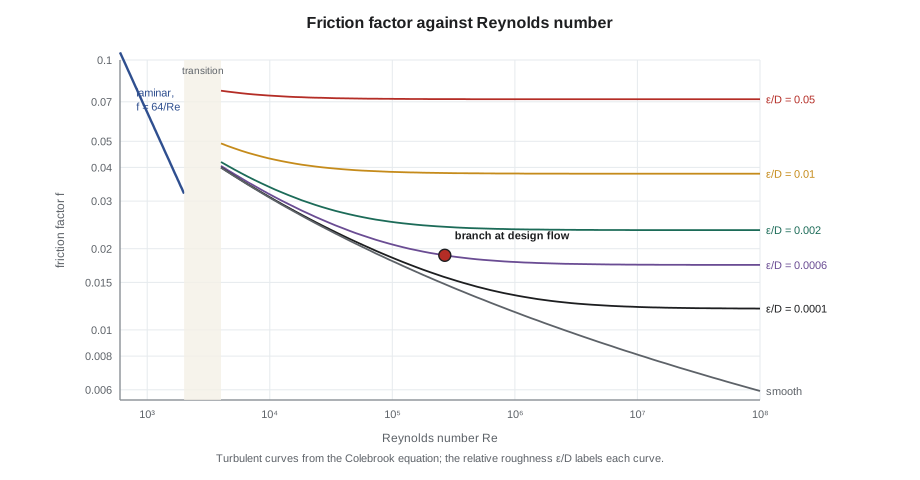
At low velocities a fluid flows in smooth layers that slide over each other: laminar flow. At higher velocities the flow breaks into eddies that mix it across the pipe: turbulent flow. Which occurs depends on the Reynolds number, a dimensionless ratio of inertia to viscous forces:
In pipes, flow is laminar below a Reynolds number of about 2,000 and fully turbulent above about 4,000, with an unsteady transition between. Water and steam in plant piping are almost always turbulent; laminar flow occurs mainly with viscous oils and in very small passages. Turbulence matters because it raises friction losses and heat transfer alike.
Friction losses: the Darcy-Weisbach equation
Friction between the moving fluid and the pipe wall, and within the fluid itself, converts pressure energy into heat along the pipe. The Darcy-Weisbach equation gives the head lost in a straight pipe of length L and inside diameter D:
The friction factor f depends on the Reynolds number and on the pipe's relative roughness, ε ÷ D, the height of the wall's roughness relative to its diameter. For laminar flow f = 64 ÷ Re exactly. For turbulent flow it is read from the Moody chart or calculated from the Colebrook equation; the explicit Swamee-Jain approximation is accurate to within about 1 in 100 for most plant cases:
Commercial steel pipe has a roughness of about 0.00015 ft when new; it roughens with corrosion and scale over the years, which slowly raises the friction factor and the pumping head of an old system.
Losses in fittings and valves
Every elbow, tee, valve, strainer and change of section disturbs the flow and loses head. These minor losses, which are not always minor, are expressed as a resistance coefficient K multiplied by the velocity head:
Typical values are about 0.3 for a long-radius elbow, 0.2 for an open gate valve, 1 for a tee taken through the branch, 3 to 10 for a globe valve and 1.0 for the exit into a tank. A control valve or a dirty strainer can be much higher. The K values for all the fittings in a run are added and applied to the velocity head; in short, heavily fitted runs they can exceed the straight-pipe friction.
Worked problem
The seniors' residence branch at design flow
The branch carries 95 gpm of water at 176 °F (ρ = 60.67 lb/ft³, ν = 3.9 × 10⁻⁶ ft²/s) through 1,180 ft of 3 in pipe (D = 3.068 in, ε = 0.00015 ft) in supply and return together, with fittings and valves totaling K = 12. Find the Reynolds number, friction factor and total pressure drop.
Show solution
- Velocity, from continuity: V = 4.12 ft/s. Reynolds number, with D = 0.2557 ft:
- \[Re = \frac{4.12 \times 0.2557}{3.9 \times 10^{-6}} = 268{,}000\]
- Turbulent. Relative roughness 0.00015 ÷ 0.2557 = 0.00059; Swamee-Jain gives:
- \[f = 0.0190\]
- Friction head:
- \[h_f = 0.0190 \times \frac{1{,}180}{0.2557} \times \frac{4.12^2}{2 \times 32.2} = 23.1 \text{ ft}\]
- Fittings:
- \[h_m = 12 \times \frac{4.12^2}{2 \times 32.2} = 3.2 \text{ ft}\]
- Total, as pressure:
- \[26.3 \text{ ft} \times \frac{60.67}{144} = 11.1 \text{ psi}\]
Answer: The branch needs about 26.3 ft of head, or 11.1 psi of differential between the supply and return mains at its take-off, at design flow.
Because head loss varies roughly with the square of velocity, a quick estimate for a new flow scales the old loss by the square of the flow ratio. The friction factor falls slightly as the Reynolds number rises, so the exact increase is a little less than the square law suggests, closer to the 1.85 power for turbulent flow in steel pipe.
Worked problem
The same branch at the new flow
Estimate the pressure drop at 119 gpm, first by the square law and then by recalculating.
Show solution
- Square law:
- \[11.1 \times \left(\frac{119}{95}\right)^2 = 17.4 \text{ psi}\]
- Recalculated: V = 5.16 ft/s, Re = 336,000, f = 0.0187, h_f = 35.7 ft, h_m = 5.0 ft, total 40.7 ft:
- \[40.7 \times \frac{60.67}{144} = 17.2 \text{ psi}\]
Answer: About 17.2 psi, half as much again as now, for a quarter more flow. The square law came within 2 in 100.
Pump power
A pump adds head to the fluid. The power delivered to the fluid, the hydraulic power or water power, is:
The shaft power the motor must supply is the hydraulic power divided by the pump efficiency, and the electrical input is the shaft power divided by the motor efficiency. Pump efficiencies at the best efficiency point range from about 0.5 for small pumps to over 0.85 for large ones.
Worked problem
Hot water circulating pump 2
Hot water circulating pump 2 delivers 630 gpm at 100 ft head with water at 176 °F (specific gravity 0.973). Its efficiency at that duty is 0.78. Find the hydraulic and shaft power.
Show solution
- \[P_h = \frac{630 \times 100 \times 0.973}{3{,}960} = 15.5 \text{ hp}\]
- \[P_s = \frac{15.5}{0.78} = 19.8 \text{ hp}\]
Answer: About 19.8 hp at the shaft. The pump's 40 hp motor is sized for the right-hand end of its curve, the higher flow it reaches when the drive runs at full speed with the loop's valves wide open, not for this duty point.
Net positive suction head
A liquid flashes to vapor wherever its pressure falls to its vapor pressure. At a pump's inlet the pressure drops further as the liquid accelerates into the impeller eye, so the net positive suction head available, NPSHa, must exceed the NPSH required by the pump, NPSHr, with a margin. In heads:
where z_s is the height of the liquid surface above the pump inlet and h_fs the friction in the suction line. For a deaerator, the liquid is at its saturation temperature, so the surface pressure equals the vapor pressure and the two terms cancel. Only the static height, less the suction friction, protects the pump. With 30 ft of water above the feed pumps and 2.6 ft of suction friction, NPSHa is 27.4 ft against an NPSHr of 10.5 ft, as PWR-230 found. That is why deaerators are mounted high above their feed pumps.
Okonkwo's estimate
Okonkwo gave Grazyna a single page: 11.1 psi across the branch now, about 17.2 psi at 119 gpm, and a note that the loop's differential pressure at the residence's take-off, about 15 psi on a cold day, would not be enough without either a booster pump in the residence or a larger branch. Grazyna sent the page to the consulting engineers with the loop's operating data. Their preliminary study, she told him later, put the new branch requirement within half a psi of his figure.
Common mistakes
MistakeUsing the cold-water density and viscosity for hot water.
InsteadTake ρ and μ at the operating temperature; hot water is lighter and much less viscous.
MistakeApplying f = 64 ÷ Re to turbulent flow.
InsteadThat formula is for laminar flow only; use the Moody chart, Colebrook or Swamee-Jain above Re ≈ 4,000.
MistakeForgetting the fittings in a short run.
InsteadAdd the K values and apply them to the velocity head; in heavily fitted runs they can exceed the straight-pipe friction.
MistakeCounting deaerator pressure as suction margin.
InsteadFor a saturated liquid the surface pressure equals the vapor pressure; only height less friction counts.
MistakeConfusing hydraulic power with motor input.
InsteadDivide hydraulic power by pump efficiency for shaft power, and by motor efficiency again for electrical input.
Summary and key terms
- Pressure in a liquid rises with depth, Δp = ρgh; pumps and pipe losses are measured in head.
- Continuity: Q = AV, so velocity rises as area falls.
- Bernoulli: pressure, velocity and elevation heads trade off along a streamline; flow meters use it.
- The Reynolds number decides laminar (below about 2,000) or turbulent (above about 4,000) flow.
- Darcy-Weisbach, h_f = f(L/D)(V²/2g), with f from Moody or Swamee-Jain, gives pipe friction; fittings add KV²/2g.
- Hydraulic power is ρgQH; NPSHa must exceed NPSHr, and for a deaerator only height less friction counts.
- Head
- Energy per unit weight of fluid, expressed as the height of a column of that fluid.
- Continuity equation
- In steady flow of a liquid, Q = AV is the same at every section.
- Bernoulli's equation
- The statement that pressure, velocity and elevation heads add to a constant along a streamline in ideal flow.
- Reynolds number
- The dimensionless ratio ρVD ÷ μ that predicts whether pipe flow is laminar or turbulent.
- Friction factor
- The dimensionless coefficient f in the Darcy-Weisbach equation.
- Relative roughness
- The ratio of a pipe wall's roughness height to its inside diameter.
- Minor loss
- Head lost in a fitting, valve or change of section, expressed as K times the velocity head.
- NPSH available
- The suction head at a pump inlet above the liquid's vapor pressure.
Practice problems
Work each problem on paper first, then reveal the answer to check.
What pressure does a 40 ft column of cold water exert?
Show answer
40 × 0.433 = 17.3 psi.
Water flows at 6 ft/s in a 4 in pipe that narrows to 2 in. What is the velocity in the small pipe?
Show answer
Four times the area ratio: 24 ft/s.
Find the Reynolds number for water at 5 ft/s in a 2 in pipe with ν = 1.1 × 10⁻⁵ ft²/s.
Show answer
5 × (2/12) ÷ 1.1 × 10⁻⁵ = 75,800; turbulent.
A pump delivers 300 gpm against 150 ft of head with cold water. Its efficiency is 0.70. Find the shaft power.
Show answer
300 × 150 ÷ 3,960 ÷ 0.70 = 16.2 hp.
Lesson quiz · 5 questions
Score 60% or more to complete this lesson.
Create a free account to save your progress, take quizzes and earn a certificate.