
PWR-310 · Lesson 7 of 12 · 28 min
Gas laws and compressed gases
▶ Video coming soon A video version of this lesson is on the way.
On the night of Monday, October 12, 2026, Columbus Day, the plant was quiet. Many of the downtown office buildings on the steam system were closed, the load was light, and Desmond Kirwan and Okonkwo Demarest had the control room to themselves. At about 02:00 Desmond asked Okonkwo to time the lead instrument air compressor through a few of its load and unload cycles. The compressor loads at 100 psig and unloads at 110 psig, filling a receiver of about 70 ft³ (about 520 gallons), and on a night with almost nothing using air the timing would say how much air the plant was losing to leaks. The ultrasonic survey in September had found and fixed four leaks; Desmond wanted to know whether the repairs had held.
Answering his question needs the gas laws. This lesson covers the laws of Boyle and Charles and the general gas law, the characteristic gas equation and the gas constant, standard conditions and the correction of gas volumes, mixtures of gases and Dalton's law of partial pressures, the compression of air and the temperatures and work involved, and the safe handling of gas stored in cylinders.
The ideal gas
In a gas the molecules are far apart and move freely, colliding with each other and with the walls of their container. The pressure on the walls is the total effect of those collisions, and the temperature is a measure of the molecules' average kinetic energy. An ideal gas is one in which the molecules themselves take up no volume and exert no forces on each other except in collisions. Air, nitrogen, oxygen, natural gas and flue gases behave almost exactly like ideal gases at the pressures and temperatures found in a heating plant, so the simple laws below give accurate answers. Steam does not, which is why steam needs tables.
All the gas laws need absolute pressure and absolute temperature. A gas law calculation done with gauge pressure or degrees Celsius or Fahrenheit gives a wrong answer every time, and the examiners know it.
Boyle, Charles and the general gas law
- Boyle's law: at constant temperature, the volume of a fixed mass of gas is inversely proportional to its absolute pressure, p₁V₁ = p₂V₂. Halve the volume and the pressure doubles.
- Charles' law: at constant pressure, the volume of a fixed mass of gas is proportional to its absolute temperature, V₁ ÷ T₁ = V₂ ÷ T₂.
- Gay-Lussac's law (sometimes called the pressure law): at constant volume, the absolute pressure is proportional to the absolute temperature, p₁ ÷ T₁ = p₂ ÷ T₂.
The three combine into the general gas law for a fixed mass of gas:
Worked problem
A receiver warming in the afternoon sun
A sealed air receiver is charged to 110 psig at 77 °F. With its outlet closed, it warms to 113 °F. Atmospheric pressure is 14.7 psia. What does its gauge now read?
Show solution
- Absolute values: p₁ = 124.7 psia, T₁ = 536.67 °R, T₂ = 572.67 °R. At constant volume:
- \[p_2 = p_1 \frac{T_2}{T_1} = 124.7 \times \frac{572.67}{536.67} = 133.1 \text{ psia}\]
- Back to gauge:
- \[133.1 - 14.7 = 118 \text{ psig}\]
Answer: About 118 psig, a rise of 8 psi. Had the calculation been done in gauge pressure and degrees Fahrenheit, it would have predicted 161 psig, which is wildly wrong.
The characteristic gas equation
The general gas law says that pV ÷ T is constant for a fixed mass of gas. The constant is proportional to the mass, and the result is the characteristic gas equation:
where R is the specific gas constant of the particular gas, in ft·lbf/lb·°R when p is in lbf/ft² (psia × 144), V in ft³, m in lb and T in °R. Each gas has its own R, found by dividing the universal gas constant, R_u = 1,545 ft·lbf/lbmol·°R, by the gas's molar mass. For air, with a molar mass of about 28.97 lb/lbmol, R = 53.35 ft·lbf/lb·°R. For methane, molar mass 16.04, R = 96.3 ft·lbf/lb·°R.
The same equation gives a gas's density, ρ = m ÷ V = p ÷ RT. It also shows that the gas constant is the difference between the two specific heats of lesson 4, R = c_p − c_v.
Worked problem
How much air is in the receiver?
The 70 ft³ receiver is charged from 100 to 110 psig at 77 °F. How many pounds of air are added, and how much free air is that at 14.7 psia and 68 °F, where air's density is about 0.0749 lb/ft³?
Show solution
- The mass added depends only on the change in pressure, since V and T are the same:
- \[\Delta m = \frac{\Delta p\, V}{RT} = \frac{10 \times 144 \times 70}{53.35 \times 536.67} = 3.52 \text{ lb}\]
- As free air:
- \[\frac{3.52}{0.0749} = 47.0 \text{ ft}^3\]
Answer: Each load cycle puts about 47 ft³ of free air into the receiver.
Standard conditions and gas meters
Because a gas's volume depends so strongly on its pressure and temperature, a volume means nothing without them. Gas quantities are therefore quoted at agreed standard conditions and corrected to them from the actual conditions where they were measured.
In the United States, natural gas is bought and measured in cubic feet at standard conditions, usually 14.73 psia and 60 °F, the basis of the heating values on a utility bill. Compressed air is quoted in standard cubic feet per minute (scfm), with the standard varying between manufacturers, or as actual cubic feet per minute (acfm) at inlet conditions, so the basis must always be checked. A gas meter registers the actual volume passing through it at line pressure and temperature, and the utility's billing system, or a volume corrector at the meter, converts it to standard conditions with the general gas law.
Worked problem
Correcting a meter reading
Cantwell's gas meter registers 1,000 ft³ of gas flowing at 2 psig and 46 °F, with the barometer at 14.6 psia. What is the volume at standard conditions, 14.73 psia and 60 °F?
Show solution
- Absolute values: p₁ = 16.6 psia, T₁ = 505.67 °R; p₂ = 14.73 psia, T₂ = 519.67 °R.
- \[V_2 = V_1 \frac{p_1}{p_2} \frac{T_2}{T_1} = 1{,}000 \times \frac{16.6}{14.73} \times \frac{519.67}{505.67} = 1{,}158 \text{ ft}^3\]
Answer: About 16 in 100 more gas than the meter's dial shows. An efficiency test that took the uncorrected meter volume would credit the boiler with burning 16 in 100 less fuel than it really did, and report an efficiency that was too good by the same amount.
Avogadro, moles and gas mixtures
Avogadro's principle states that equal volumes of all ideal gases at the same pressure and temperature contain the same number of molecules. One pound-mole of any ideal gas therefore occupies the same volume: 359 ft³ at 32 °F and 14.696 psia, or about 378.6 ft³ at 60 °F and 14.73 psia. That fact makes combustion calculations by volume simple, as lesson 10 shows: a volume ratio of gases is a ratio of their moles.
In a mixture of gases, each gas behaves as though it alone filled the whole volume. Dalton's law of partial pressures says that the total pressure is the sum of the partial pressures of the individual gases, and each partial pressure is the total pressure times that gas's fraction of the moles, or of the volume:
Dalton's law explains two things an operator sees every day. Water vapor in compressed air condenses in the receiver and aftercooler because compressing the air raises the partial pressure of its water vapor, and once that partial pressure exceeds the saturation pressure at the air's temperature the excess condenses; that is why receivers have drains and instrument air needs a dryer. And the water vapor in flue gas starts to condense on any surface colder than the saturation temperature at the vapor's partial pressure, the flue gas dew point, which lesson 10 calculates.
Compressing air
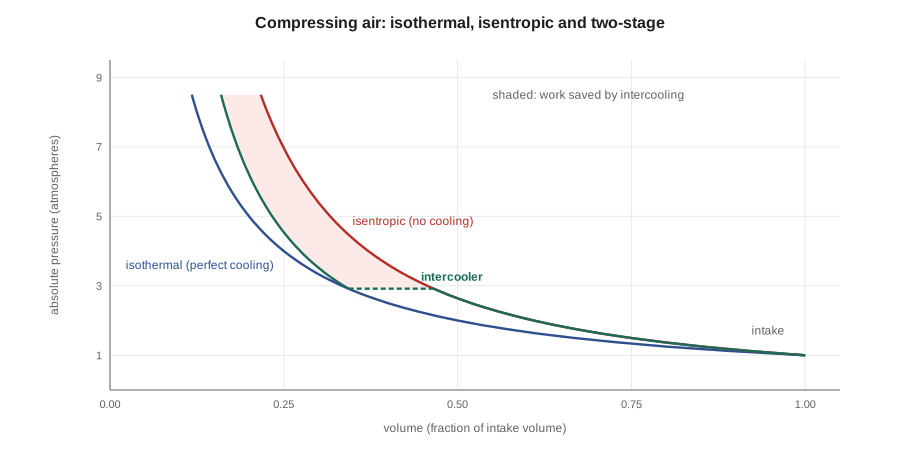
Lesson 4 showed that a gas compressed with perfect cooling follows the isothermal line and one compressed with no cooling follows the isentropic line. The temperature after an isentropic compression from absolute pressure p₁ to p₂ is:
with γ = 1.4 for air, so the index is 0.286. The work per unit mass for the two ideal cases is:
Worked problem
How hot does the air get?
Air at 14.7 psia and 68 °F is compressed isentropically to 124.7 psia in one stage. Find the discharge temperature and the work per pound, and compare with isothermal compression.
Show solution
- Pressure ratio 124.7 ÷ 14.7 = 8.48. Discharge temperature:
- \[T_2 = 527.67 \times 8.48^{0.286} = 972.0 \text{ °R} = 512 \text{ °F}\]
- Isentropic work, with J = 778.17:
- \[w = \frac{3.5 \times 53.35 \times 527.67 \times (8.48^{0.286} - 1)}{778.17} = 107 \text{ Btu/lb}\]
- Isothermal work:
- \[w = \frac{53.35 \times 527.67 \times \ln 8.48}{778.17} = 77 \text{ Btu/lb}\]
Answer: Uncooled single-stage compression would deliver air at about 512 °F and need 38 in 100 more work than the isothermal ideal. With two stages and an intercooler between them that returns the air to 68 °F, each stage's pressure ratio is √8.48 = 2.91 and the discharge temperature of each is only about 256 °F.
Cantwell's oil-flooded rotary screw compressors take a different route to the same goal. Oil injected into the rotors absorbs the heat of compression as it is produced, so the air leaves the air end at a moderate temperature, roughly 175 to 205 °F, and the oil is cooled and separated before the air goes to the aftercooler. Reciprocating compressors use stages, intercoolers and aftercoolers. In every type, high discharge temperature is a warning sign: it cooks lubricating oil into carbon, and carbon deposits in the discharge of a hot compressor are a known fire and explosion hazard.
Compressed gas cylinders
A plant keeps gases in cylinders: nitrogen for purging and blanketing, calibration gases for analyzers, oxygen and acetylene for cutting, refrigerants and carbon dioxide. A cylinder holds a large quantity of gas in a small volume at high pressure, and the gas laws give the quantity.
Worked problem
Free gas in a nitrogen cylinder
A nitrogen cylinder has an internal volume of 1.55 ft³ and is filled to 2,200 psig at room temperature. Estimate the volume of nitrogen it can deliver at atmospheric pressure, 14.7 psia, at the same temperature.
Show solution
- By Boyle's law, with absolute pressures:
- \[V_2 = 1.55 \times \frac{2{,}214.7}{14.7} = 234 \text{ ft}^3\]
Answer: About 234 ft³, although a little less can actually be drawn, since the cylinder is left with some pressure and nitrogen at that pressure deviates slightly from an ideal gas. The gas laws treat real gases as ideal; at high pressures a **compressibility factor**, Z, corrects pV = ZmRT, and for nitrogen near room temperature it stays within a few in 100 of 1.0 up to these pressures.
The energy stored in a full cylinder is large, and a cylinder whose valve is knocked off becomes a projectile. Cylinders are stored upright and chained or strapped, with valve protection caps on when they are not in use, away from heat, and with full and empty cylinders separated. Oxygen is kept apart from fuel gases and from oil and grease, because oil in contact with high-pressure oxygen can ignite. Regulators are matched to the gas, and cylinder valves are opened slowly.
Inert gases carry a quieter hazard. Nitrogen, argon and carbon dioxide displace the oxygen in a confined space without any warning smell or sensation, and a person breathing an oxygen-depleted atmosphere can collapse within a few breaths. A drum or vessel that has been purged or blanketed with nitrogen is a confined space with a lethal atmosphere until it has been ventilated and tested, and entry follows the plant's confined space procedure without exception.
The leak test
Okonkwo timed five cycles between 02:05 and 02:20. The compressor ran loaded for about 32 seconds and unloaded for about 85 seconds each time. In the unloaded period the plant drew the receiver down from 110 to 100 psig, using the 47 ft³ of free air the gas laws gave, so the plant's demand was about 47 ÷ 85 × 60 = 33 cfm of free air. In the loaded period the compressor supplied that demand and refilled the receiver: 47 ÷ 32 × 60 = 88 cfm of net fill, plus 33 cfm of demand, came to about 121 cfm, matching the compressor's rating and confirming the method. On a quiet holiday night, with only the control valves and analyzers drawing air, most of the 33 cfm was likely leakage.
Desmond compared the figure with the same test from the spring, before the September survey and repairs, and found the demand had fallen by well over a third. He logged both results and added the timing test to the night shift's monthly round, so that a new leak would show up as a shorter unloaded period long before anyone heard it.
Common mistakes
MistakeUsing gauge pressure or degrees Celsius or Fahrenheit in a gas law.
InsteadConvert to absolute pressure and absolute temperature before substituting.
MistakeComparing gas volumes measured at different conditions.
InsteadCorrect every volume to the same standard conditions with the general gas law.
MistakeExpecting a receiver's mass of air to depend on its gauge reading alone.
InsteadThe mass depends on absolute pressure, volume and temperature: m = pV ÷ RT.
MistakeThinking water in a receiver drain means a broken dryer.
InsteadCompression raises the partial pressure of water vapor, so condensate forms in receivers and aftercoolers normally; the dryer treats the air after them.
MistakeTreating nitrogen as harmless because it is not toxic.
InsteadNitrogen displaces oxygen; purged or blanketed vessels are confined spaces with lethal atmospheres until ventilated and tested.
Summary and key terms
- Boyle's, Charles' and Gay-Lussac's laws combine into p₁V₁ ÷ T₁ = p₂V₂ ÷ T₂, always in absolute units.
- The characteristic equation pV = mRT links mass to pressure, volume and temperature; R = R_u ÷ molar mass.
- Gas volumes are corrected to standard conditions before they are compared or billed.
- Dalton's law: total pressure is the sum of the partial pressures; it explains condensate in air systems and flue gas dew point.
- Isentropic compression gives T₂ ÷ T₁ = (p₂ ÷ p₁)^0.286 for air; staging and intercooling save work and lower discharge temperature.
- Cylinders store large energy; secure them, keep oxygen away from oil, and treat inert-gas atmospheres as lethal.
- Boyle's law
- At constant temperature, the absolute pressure of a fixed mass of gas is inversely proportional to its volume.
- Charles' law
- At constant pressure, the volume of a fixed mass of gas is proportional to its absolute temperature.
- Specific gas constant
- The constant R in pV = mRT for a particular gas, equal to the universal gas constant divided by the molar mass.
- Standard conditions
- An agreed reference pressure and temperature to which gas volumes are corrected.
- Partial pressure
- The pressure one gas in a mixture would exert if it alone filled the whole volume.
- Free air delivery
- The volume flow a compressor delivers, expressed at its inlet conditions.
- Compressibility factor
- The factor Z that corrects the ideal gas equation for a real gas, pV = ZmRT.
Practice problems
Work each problem on paper first, then reveal the answer to check.
Air at 15 psia in 20 ft³ is compressed at constant temperature to 5 ft³. Find its final pressure.
Show answer
p₂ = 15 × 20 ÷ 5 = 60 psia.
A gas at 70 °F is heated at constant pressure until its volume doubles. What is its final temperature?
Show answer
T₂ = 2 × 529.67 = 1,059.3 °R = 600 °F.
Find the mass of air in a 50 ft³ tank at 90 psia and 80 °F.
Show answer
m = 90 × 144 × 50 ÷ (53.35 × 539.67) = 22.5 lb.
Find the density of methane at 14.73 psia and 60 °F. (R = 96.3 ft·lbf/lb·°R)
Show answer
ρ = 14.73 × 144 ÷ (96.3 × 519.67) = 0.0424 lb/ft³.
Lesson quiz · 5 questions
Score 60% or more to complete this lesson.
Create a free account to save your progress, take quizzes and earn a certificate.