
PWR-310 · Lesson 4 of 12 · 30 min
Thermodynamic properties and processes
▶ Video coming soon A video version of this lesson is on the way.
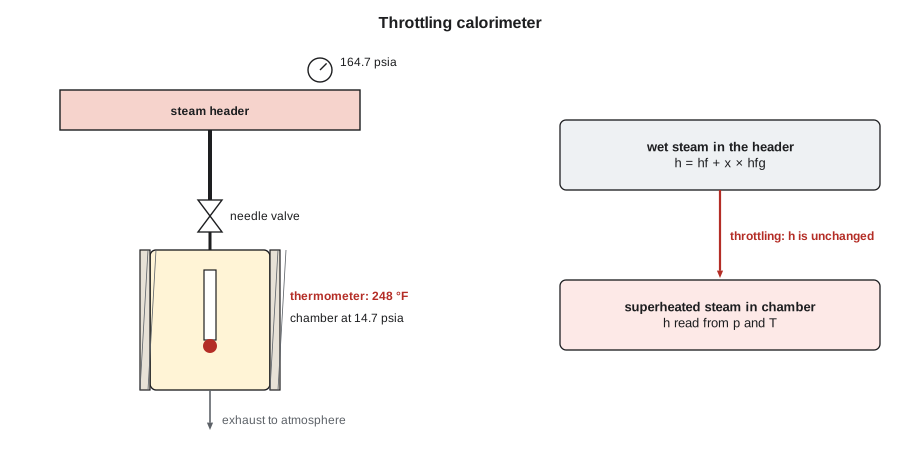
Late on the night of Wednesday, August 26, 2026, back on his usual night shift, Okonkwo Demarest helped the night shift engineer, Desmond Kirwan, with a job Desmond does once a summer: checking the quality of the steam leaving boiler 1 with a throttling calorimeter. A small sample line from the steam header feeds a needle valve; the steam expands through it into an insulated chamber open to atmosphere, and a thermometer reads the temperature in the chamber. Desmond explained it in one sentence: "Throttling doesn't change the enthalpy, so if you know the enthalpy after the valve, you know it before." Okonkwo wrote that down, then asked what it meant.
This lesson answers him. It sets out the language of thermodynamics at third class level: systems and properties, the forms of energy, the first law for closed and open systems, enthalpy and entropy, the standard processes and the work they do, and the second law with its limit on how much heat any engine can turn into work. Lessons 5 to 8 apply all of it to steam, gases and heat transfer.
Systems, properties and states
Thermodynamics studies energy crossing the boundary of a system. A closed system has a fixed mass: no matter crosses its boundary, though heat and work can. Steam trapped in a cylinder behind a piston, or air in a sealed receiver, is a closed system. An open system, or control volume, has mass flowing in and out: a turbine, a pump, a boiler, a heat exchanger or a throttling valve. Almost every piece of plant equipment is analyzed as an open system in steady flow, with the same mass flowing in and out each second and nothing changing with time inside.
The condition of the substance is its state, fixed by its properties. Some properties depend on the amount of substance, such as volume and energy; dividing them by mass gives specific properties, which do not. The properties used most are:
- Pressure, p, always absolute in thermodynamic formulas: absolute pressure is gauge pressure plus atmospheric pressure.
- Temperature, T, absolute (kelvin or degrees Rankine) wherever it multiplies or divides; differences can be in either scale.
- Specific volume, v, the volume per unit mass, the reciprocal of density.
- Specific internal energy, u, the energy stored in the molecules' motion and bonds.
- Specific enthalpy, h = u + pv, explained below.
- Specific entropy, s, also explained below.
For a pure substance in a single phase, any two independent properties fix the state, and every other property follows from tables, charts or equations. For a wet mixture of water and steam, pressure and temperature are not independent, because each fixes the other on the saturation line; a second property such as the dryness fraction is needed. This two-property rule is what makes the steam tables and the Mollier diagram of lesson 6 work.
Energy, heat and work
Energy crosses a system's boundary in two ways only. Heat, Q, is energy transferred because of a temperature difference. Work, W, is energy transferred by any other means: a moving piston, a turning shaft, an electric current. Neither is a property; a system contains energy, not heat or work. The sign convention used in most Canadian and American textbooks takes heat added to the system as positive and work done by the system as positive.
In US customary units, heat is in British thermal units and work in foot-pounds-force; the two are linked by Joule's equivalent, 778.17 ft·lbf per Btu. Specific energies are in Btu/lb. Power is in horsepower (550 ft·lbf/s, or 2,545 Btu/h) or kilowatts (3,412 Btu/h). Forgetting the 778 when work in ft·lbf meets heat in Btu is one of the commonest examination errors.
The first law for a closed system
The first law of thermodynamics is conservation of energy. For a closed system, the heat added equals the increase in internal energy plus the work done:
If air is heated in a rigid tank, no boundary moves, W = 0, and all the heat raises the internal energy and the temperature. If the same air is heated behind a piston that moves to keep the pressure constant, part of the heat leaves again as work on the piston, and more heat is needed for the same temperature rise. That difference is why gases have two specific heats: c_v at constant volume and c_p at constant pressure. For air, c_v is about 0.171 Btu/lb·°F and c_p about 0.240 Btu/lb·°F; their difference is the gas constant R, and their ratio γ = c_p ÷ c_v is about 1.4.
Enthalpy and the steady flow energy equation
When a fluid flows into an open system, it carries its internal energy with it, and it must also be pushed in against the pressure ahead of it. The work needed to push each kilogram (or pound) in is pv, the flow work. Internal energy and flow work always travel together in a flowing stream, so they are combined into a single property, enthalpy:
For an open system in steady flow, the first law becomes the steady flow energy equation. Per unit mass flowing, with velocity V and height z at inlet 1 and outlet 2:
In US units g_c = 32.174 lbm·ft/lbf·s² and J = 778.17 ft·lbf/Btu convert the kinetic and potential energy terms to Btu/lb. For nearly all plant equipment they are small compared with the enthalpy change and are dropped, leaving q − w = h₂ − h₁. Applied to each component, that one equation does most of the work in this course:
- Boiler or heat exchanger: no work, so the heat added is the enthalpy rise, q = h₂ − h₁.
- Turbine: nearly adiabatic, so the work out is the enthalpy drop, w = h₁ − h₂.
- Pump or compressor: the work in is the enthalpy rise.
- Nozzle: no heat or work, so the enthalpy drop becomes kinetic energy, V₂ = √(2Δh) with Δh in J/kg.
- Throttling valve: no heat, no work and negligible change in velocity, so h₂ = h₁. Enthalpy is the same on both sides of the valve.
That last line is Desmond's sentence. A throttling process is irreversible and the pressure falls, but the enthalpy does not change. A pressure reducing valve, a steam trap discharging, a leaking valve seat and a calorimeter's needle valve are all throttling processes.
Worked problem
Velocity leaving a turbine nozzle
Steam expands through a turbine nozzle with an enthalpy drop of 43 Btu/lb, entering at negligible velocity. Find the velocity leaving the nozzle.
Show solution
- Energy equation with q = w = 0; in US units V = 223.8√Δh with Δh in Btu/lb:
- \[V_2 = 223.8\sqrt{43} = 1{,}468 \text{ ft/s}\]
Answer: About 1,470 ft/s. A modest enthalpy drop produces a jet faster than sound in air, which is how a single-stage impulse turbine like Cantwell's backup feed pump drive gets its power.
Entropy
Entropy is the property that measures how far energy has spread out and lost its ability to do work. A small, reversible transfer of heat dQ at absolute temperature T changes a system's entropy by dS = dQ ÷ T. For a liquid heated at constant pressure with constant specific heat, that integrates to:
Entropy matters to an operator for two reasons. First, in a reversible adiabatic process, an ideal expansion or compression with no friction and no heat transfer, entropy stays constant; such a process is called isentropic, and it is the ideal against which turbines, pumps and compressors are measured. Second, every real process, with friction, throttling, mixing or heat transfer through a finite temperature difference, increases the total entropy of everything involved. The increase measures the work that has been lost for good.
Worked problem
Entropy gained by the feedwater
Water is heated from 68 °F to 221 °F before it reaches the deaerator outlet. Find its increase in specific entropy, with c = 1.0 Btu/lb·°F.
Show solution
- Absolute temperatures: 527.67 °R and 680.67 °R.
- \[\Delta s = 1.0 \ln\frac{680.67}{527.67} = 0.255 \text{ Btu/lb·°R}\]
Answer: About 0.255 Btu/lb·°R. The steam tables give the entropy of saturated water at 221 °F as about 0.325 Btu/lb·°R, measured from a zero at the triple point near 32 °F; the difference between the two answers is the entropy the water already had at 68 °F.
The standard processes
Gases and vapors in a cylinder, a compressor or an expansion are described by a few idealized processes, each a curve on a pressure-volume diagram. The area under the curve is the work done by or on the gas.
| Process | What is constant | Relation | Work done by the gas |
|---|---|---|---|
| Constant volume (isochoric) | v | p ÷ T constant | Zero |
| Constant pressure (isobaric) | p | v ÷ T constant | p(V₂ − V₁) |
| Isothermal | T | pV constant | p₁V₁ ln(V₂ ÷ V₁) |
| Isentropic (reversible adiabatic) | s; no heat transfer | pV<sup>γ</sup> constant | (p₁V₁ − p₂V₂) ÷ (γ − 1) |
| Polytropic | pVⁿ constant | pVⁿ constant, n usually between 1 and γ | (p₁V₁ − p₂V₂) ÷ (n − 1) |
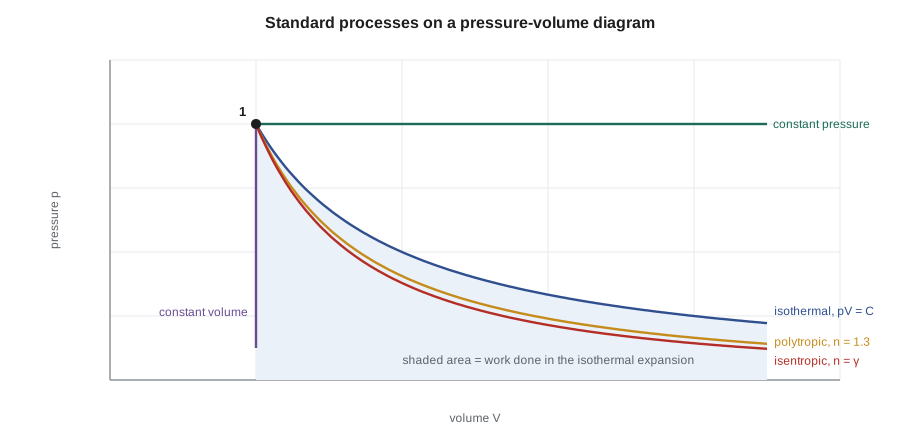
Real compressions lie between the isothermal and the isentropic. A compressor with good cooling of the gas during compression approaches the isothermal line and needs the least work; one with no cooling follows the isentropic line, needs more work and delivers hotter gas. Lesson 7 returns to air compressors.
Worked problem
Work to compress air polytropically
A compressor takes in 3.5 ft³ of air at 14.7 psia and compresses it polytropically with n = 1.3 to 115 psia. Find the final volume and the work done on the air.
Show solution
- Final volume:
- \[V_2 = V_1\left(\frac{p_1}{p_2}\right)^{1/n} = 3.5\left(\frac{14.7}{115}\right)^{1/1.3} = 0.719 \text{ ft}^3\]
- Work done on the gas, with pressures in lbf/ft²:
- \[W = \frac{(115)(144)(0.719) - (14.7)(144)(3.5)}{0.3} = 15{,}000 \text{ ft·lbf}\]
- In heat units:
- \[\frac{15{,}000}{778.17} = 19.3 \text{ Btu}\]
Answer: About 15,000 ft·lbf, or 19.3 Btu, for each 3.5 ft³ drawn in. The air leaves near 390 °F if it started at 68 °F, by T₂ = T₁(p₂ ÷ p₁)<sup>(n−1)/n</sup>, which is why compressors have intercoolers and aftercoolers.
The second law
The first law says energy is conserved; the second law says which way it flows. Heat flows by itself only from hot to cold. No engine working in a cycle can turn all the heat it receives into work; some must be rejected to a colder sink. The best possible efficiency of any engine working between a hot source at absolute temperature T_H and a cold sink at T_C is the Carnot efficiency:
No real engine reaches it, but it sets the direction for improvement: raise the temperature at which heat is added, and lower the temperature at which it is rejected. Every feature of a modern power cycle, from superheaters and reheaters to deep condenser vacuum and feedwater heating, follows from that sentence. Lesson 5 applies it to the Rankine cycle.
Worked problem
The ceiling for an engine on Cantwell steam
What is the highest efficiency any engine could reach using heat from saturated steam at 366 °F and rejecting it to surroundings at 77 °F?
Show solution
- Absolute temperatures: 825.67 °R and 536.67 °R.
- \[\eta = 1 - \frac{536.67}{825.67} = 0.350\]
Answer: About 35 in 100. Even a perfect engine could turn only about a third of that heat into work; the rest must go to the surroundings. Real machines between those temperatures reach well under that.
The calorimeter reading
Back at the sample point, Desmond opened the needle valve fully and let the calorimeter warm through for a quarter of an hour before reading it, because a cold chamber condenses some of the sample and reads low. Then he read the thermometer and the boiler pressure, and handed the numbers to Okonkwo.
Worked problem
Dryness of the boiler 1 steam
The header is at 164.7 psia (150 psig). At that pressure the steam tables give h_f = 338.6 Btu/lb and h_fg = 857.4 Btu/lb. The calorimeter chamber is at atmospheric pressure, 14.7 psia, and reads 248 °F, where the superheated steam's enthalpy is 1,167.9 Btu/lb. Find the dryness fraction of the steam in the header.
Show solution
- Throttling keeps enthalpy constant, so the header steam also has h = 1,167.9 Btu/lb. For wet steam:
- \[h = h_f + x\, h_{fg}\]
- Solve for the dryness fraction:
- \[x = \frac{1{,}167.9 - 338.6}{857.4} = 0.967\]
Answer: The steam is 96.7 in 100 dry: each kilogram (or pound) carries about 33 g (or 0.033 lb) of water. That is wetter than a well-performing packaged watertube boiler usually delivers, and Desmond logged it for the chief engineer with a note to recheck at a steadier load and to look at the drum level and the water chemistry.
The calorimeter works only while the throttled steam is superheated in the chamber. Very wet steam, below about 94 to 95 in 100 dry at this pressure, would still be wet after throttling to atmosphere, the thermometer would read the saturation temperature, 100 °C or 212 °F, and the reading would say nothing. A separating calorimeter, which removes and measures the water first, is used for wetter steam, and the two are sometimes combined.
Two days later, with boiler 1 steady at mid load and the drum level controller's set point back at its normal mark, the check gave 0.98. Grazyna Wolanski read the log the next morning and set Okonkwo a question for his next study session: what dryness would he expect from a drum with its level carried too high, and why?
Common mistakes
MistakeUsing gauge pressure or degrees Celsius or Fahrenheit in a gas law or the Carnot formula.
InsteadUse absolute pressure and absolute temperature, kelvin or degrees Rankine, wherever a value multiplies or divides.
MistakeAssuming temperature stays constant through a throttling valve.
InsteadEnthalpy stays constant; steam usually gains superheat and an ideal gas keeps its temperature, but a wet vapor's temperature falls with its pressure.
MistakeTreating heat and work as properties a system contains.
InsteadA system contains energy; heat and work are energy crossing the boundary.
MistakeMixing ft·lbf and Btu without the conversion factor.
InsteadOne Btu is 778.17 ft·lbf; convert before adding work and heat.
MistakeReading a cold calorimeter.
InsteadLet the calorimeter run until its reading is steady; a cold chamber condenses some of the sample and gives a false low dryness.
Summary and key terms
- A closed system has a fixed mass; an open system in steady flow has equal flows in and out. Most plant equipment is analyzed as an open system.
- Two independent properties fix the state of a pure substance; for wet steam, pressure and dryness are a common pair.
- The first law for a closed system is Q = ΔU + W; for steady flow it reduces to q − w = h₂ − h₁ for most equipment.
- Enthalpy h = u + pv is the property that tracks energy in a flowing stream; throttling keeps it constant.
- Isentropic processes are the ideal for turbines, pumps and compressors; real processes increase total entropy.
- Gas processes follow pVⁿ constant; work is the area under the p-V curve.
- The Carnot efficiency 1 − T_C ÷ T_H limits every heat engine.
- Closed system
- A region of fixed mass through whose boundary heat and work can pass but matter cannot.
- Steady flow
- Flow in which the mass flow and the properties at each point do not change with time.
- Enthalpy
- The sum of internal energy and flow work, h = u + pv, per unit mass.
- Entropy
- A property measuring how far energy has spread; it is constant in a reversible adiabatic process and increases in any real process.
- Isentropic
- At constant entropy; describes an ideal, reversible adiabatic process.
- Polytropic process
- A process following pVⁿ = constant for some fixed index n.
- Throttling
- An expansion through a restriction with no heat or work transfer, in which enthalpy stays constant.
- Dryness fraction
- The mass of dry steam in each unit mass of a wet steam mixture.
Practice problems
Work each problem on paper first, then reveal the answer to check.
A rigid tank holds 4 lb of air. How much heat raises it from 68 °F to 140 °F? (c_v = 0.171 Btu/lb·°F)
Show answer
Q = 4 × 0.171 × 72 = 49.2 Btu; no work is done.
A turbine takes steam at h = 1,380 Btu/lb and exhausts it at h = 1,080 Btu/lb, with negligible heat loss. What work does it produce per pound?
Show answer
w = 1,380 − 1,080 = 300 Btu/lb.
Air expands isothermally from 2 ft³ at 90 psia to 8 ft³. Find the work done in ft·lbf.
Show answer
W = 90 × 144 × 2 × ln 4 = 35,900 ft·lbf.
What is the Carnot efficiency between 1,000 °F and 100 °F?
Show answer
1 − 559.67 ÷ 1,459.67 = 0.617.
Lesson quiz · 5 questions
Score 60% or more to complete this lesson.
Create a free account to save your progress, take quizzes and earn a certificate.