
PWR-310 · Lesson 1 of 12 · 35 min
Algebra, trigonometry and plant formulas
▶ Video coming soon A video version of this lesson is on the way.
On Tuesday, August 4, 2026, Okonkwo Demarest started the summer the way relief operators at the Cantwell Energy Center usually do: on day shift, covering vacations. He normally works nights. He has held his Ohio high pressure boiler operator license since the spring of 2025 and has run Cantwell's boilers ever since, well past the 2,000 hours on a steam boiler of more than 15 psi that is one of the experience routes to a stationary steam engineer license. In July he enrolled in a 125-hour steam boiler and steam turbine operation course, because the stationary steam engineer examination goes well past what the boilers alone had taught him, and he plans to sit that examination in the spring of 2027. At the end of his first day shift of the month, the chief engineer, Grazyna Wolanski, sat down with him at the control room desk with his course binder and a pad of squared paper. "The math formula questions are where people lose the license," she said. "Every one of them sits on a few pages of algebra and trigonometry. If those are automatic, the thermodynamics is easy. If they are not, nothing else will be."
This lesson is those few pages. It reviews the algebra that every plant formula relies on: rearranging formulas, solving pairs of equations, quadratic equations, powers, roots, logarithms and exponentials. It then covers the areas and volumes an engineer calculates every week, and the trigonometry of right-angled and other triangles that turns up in pipe offsets, sling angles, forces and alternating current. Later lessons assume all of it.
Why the mathematics matters at this level
Ohio's stationary steam engineer examination is a closed-book, multiple-choice paper, and its content outline sets aside a block of questions for math formulas, on top of the steam turbine, boiler design and combustion questions that also need calculation. Graded engineer licenses in other states and cities, and the stationary engineer apprenticeship examinations, test the same material. The answers offered are usually close together, and the wrong ones are often the results of common slips: a formula rearranged the wrong way, gauge pressure used instead of absolute, a diameter used where a radius was needed. A candidate who estimates or guesses will be caught by exactly those distractors.
The same algebra matters on shift. An engineer who can rearrange a heat balance can work out a feedwater flow from two thermometers and a steam meter, check a contractor's figure before signing a work order, or tell at a glance that a reported number is impossible. Grazyna's advice was to treat every formula as something to be understood and rearranged, not memorized in one fixed form.
Rearranging formulas
A formula is an equation, and an equation stays true if the same operation is done to both sides. Rearranging, or transposing, a formula to make a different quantity the subject is a matter of undoing the operations around that quantity in reverse order. The rules are few:
- Add or subtract the same quantity on both sides to move a term across the equals sign; it changes sign as it crosses.
- Multiply or divide both sides by the same quantity to move a factor; a multiplier on one side becomes a divisor on the other.
- Square both sides to remove a square root, or take the square root of both sides to remove a square.
- Do the operations in the reverse of the order in which the formula applies them: brackets first in the formula means brackets last when undoing it.
Order of operations still applies when the numbers go in: brackets, then powers and roots, then multiplication and division, then addition and subtraction. A calculator follows that order, so a long expression typed without brackets can give a wrong answer without any warning. Put brackets around every numerator and every denominator.
The heat carried by a flowing liquid is a formula every plant uses:
where Q is the heat flow in Btu/h, ṁ the mass flow in lb/h, c the specific heat in Btu/lb·°F (about 1.0 for water) and ΔT the temperature change in °F. For water it is often written Q = 500 × gpm × ΔT, because one gallon per minute of water is about 500 lb/h. To find the flow, divide both sides by 500 and ΔT.
Worked problem
Hot water boiler flow
One of Cantwell's hot water boilers delivers 10,200,000 Btu/h to its loop, with water leaving at 203 °F and returning at 158 °F. Find the water flow in gallons per minute.
Show solution
- Rearrange the water form for the flow:
- \[\text{gpm} = \frac{Q}{500\, \Delta T}\]
- Substitute, with ΔT = 203 − 158 = 45 °F:
- \[\text{gpm} = \frac{10{,}200{,}000}{500 \times 45} = 453 \text{ gpm}\]
Answer: About 453 gpm. A flow meter reading much less than that at full output would mean the temperature difference across the boiler had grown, which is worth investigating.
Two equations, two unknowns
Many plant problems give two facts about two unknown quantities. A mass balance and an energy balance at a mixing point are the commonest example: the flows add, and so do the heat contents. Two simultaneous equations can be solved by substitution (solve one for an unknown and put the result into the other) or by elimination (multiply one equation so that a term cancels when the two are added or subtracted).
Worked problem
Condensate and make-up at the condensate tank
Returned condensate at 176 °F and make-up water at 68 °F mix in the condensate tank. The mixed flow leaving the tank is 17,600 lb/h at 144 °F. How much of each is arriving? Assume a constant specific heat and no heat loss.
Show solution
- Mass balance, with c for condensate and w for make-up:
- \[c + w = 17{,}600\]
- Energy balance (the specific heat cancels):
- \[176c + 68w = 144 \times 17{,}600 = 2{,}534{,}400\]
- Substitute w = 17,600 − c into the second equation:
- \[176c + 1{,}196{,}800 - 68c = 2{,}534{,}400 \;\Rightarrow\; 108c = 1{,}337{,}600\]
- Solve:
- \[c = 12{,}385 \text{ lb/h}, \quad w = 5{,}215 \text{ lb/h}\]
Answer: About 12,400 lb/h of condensate and 5,200 lb/h of make-up: 70 in 100 of the water is coming back. Grazyna pointed out that the same two equations, run backward, let an operator estimate the condensate return from three thermometers when the return meter is out of service.
A useful check on any solution is to put the answers back into both original equations. If they do not satisfy both, there is an arithmetic slip somewhere.
Quadratic equations
An equation in which the unknown appears squared, such as ax² + bx + c = 0, is a quadratic. It has two roots, given by the quadratic formula:
In plant problems one root is usually negative or otherwise impossible, and is discarded. Quadratics turn up in problems about areas, in motion under constant acceleration, and when a formula has the unknown both squared and to the first power.
Worked problem
Sizing a sump
A rectangular collection sump is to have a floor area of 66 ft², with its length 5 ft greater than its width. Find the width.
Show solution
- With width x, the area is x(x + 5) = 66, so:
- \[x^2 + 5x - 66 = 0\]
- Apply the formula with a = 1, b = 5, c = −66:
- \[x = \frac{-5 \pm \sqrt{25 + 264}}{2} = \frac{-5 \pm 17}{2}\]
- Take the positive root:
- \[x = 6 \text{ ft}\]
Answer: The sump is 6 ft wide and 11 ft long. The negative root, −11 ft, has no physical meaning.
Powers, roots and logarithms
Engineering numbers range from a few parts per billion of dissolved oxygen to billions of joules, so scientific notation is routine: 2.5 × 10⁶ means 2,500,000. The laws of indices handle them: multiplying adds the indices (10³ × 10⁴ = 10⁷), dividing subtracts them, raising a power to a power multiplies them, and a negative index means a reciprocal (10⁻³ = 1/1,000). A fractional index is a root: x<sup>1/2</sup> is the square root of x, and x<sup>0.4</sup> is the 0.4 power that appears in the formula for the temperature after compressing air in lesson 7.
A logarithm answers the question "what power?". The common logarithm, log, uses base 10, so log 1,000 = 3. The natural logarithm, ln, uses base e ≈ 2.718, the number that describes any process whose rate of change is proportional to how far it still has to go. Three rules cover nearly every use: the log of a product is the sum of the logs, the log of a quotient is the difference, and the log of xⁿ is n times the log of x. Natural logarithms appear later in this course in the log mean temperature difference, in heat loss through pipe insulation and in the work of isothermal compression.
Exponential change is the opposite face of the same idea. A hot tank cooling in a cool room, a drum's chloride level falling under continuous blowdown, and a capacitor discharging all follow the same curve: fast at first and slower as the gap closes. For cooling, Newton's law gives:
where T₀ is the starting temperature, Tₐ the surroundings and τ the time constant, the time for the gap to fall to about 37 in 100 of its starting value. To find a time, isolate the exponential and take natural logarithms of both sides.
Worked problem
How long will the storage tank hold its heat?
A hot water storage tank at 176 °F is isolated in a room at 77 °F. Its time constant is about 40 h. How long until it cools to 140 °F?
Show solution
- Rearrange for the exponential:
- \[e^{-t/\tau} = \frac{T - T_a}{T_0 - T_a} = \frac{140 - 77}{176 - 77} = \frac{63}{99}\]
- Take natural logarithms and solve for t:
- \[t = \tau \ln\frac{99}{63} = 40 \times 0.452 = 18.1 \text{ h}\]
Answer: About 18 hours. The answer does not depend on the temperature scale, because only temperature differences enter the ratio.
Areas and volumes
An engineer calculates areas for heat transfer, pressure forces and flow, and volumes for tanks, chemical doses and fuel. The formulas below cover nearly every shape in a plant. Pressure vessels add the volume of their heads: a hemispherical head holds half a sphere, and an ellipsoidal 2:1 head, the common shape on deaerators and air receivers, holds about half as much as a hemisphere of the same diameter.
| Shape | Area | Volume |
|---|---|---|
| Circle, diameter D | πD²/4 | — |
| Cylinder, diameter D, length L | πDL (side) | πD²L/4 |
| Sphere, diameter D | πD² | πD³/6 |
| Hemispherical head, diameter D | πD²/2 | πD³/12 |
| Ellipse, axes a and b | πab/4 | — |
| Cone, base diameter D, height h | πD/2 × slant height (side) | πD²h/12 |
| Rectangular tank | sum of the six faces | length × width × height |
Cantwell's condensate tank is a horizontal cylinder 6 ft in diameter and 10 ft long between flat ends, so it holds π × 6² × 10 ÷ 4 = 283 ft³, or about 2,115 gallons at 7.48 gallons per cubic foot, when full. A level transmitter on a horizontal cylinder is not linear in volume, because the tank is wider in the middle than near the top and bottom; the control system uses a table to convert level to volume.
Right-angled triangles
In a right-angled triangle the side opposite the right angle is the hypotenuse, the longest side. For either of the other angles, θ, the side across from it is the opposite and the side beside it the adjacent. The three ratios are:
With Pythagoras' theorem, hypotenuse² = opposite² + adjacent², these solve any right triangle from two known quantities. Angles are measured in degrees in most plant work, but a calculator set to radians will give nonsense for a degree input; check the mode before an examination. One radian is 57.3°, and π radians is 180°. Radians are needed whenever an angle multiplies a radius to give an arc length, or for angular velocity in lesson 2.
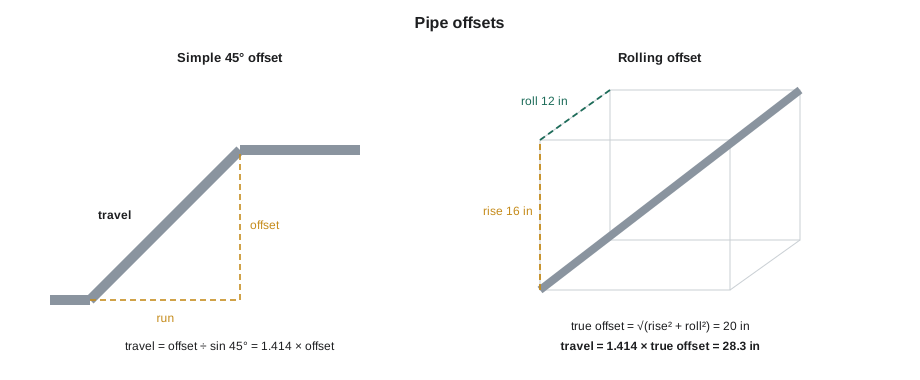
Pipefitters use right triangles every day. A pipe that jogs sideways to clear an obstruction makes an offset; the diagonal length between the centers of the two fittings is the travel, and the distance gained along the line is the run. For a 45° offset, the travel is the offset divided by sin 45°, or 1.414 times the offset. When the jog goes both sideways and up, a rolling offset, the true offset is first found by Pythagoras from the rise and the roll.
Worked problem
A rolling offset in the tunnel
A new condensate line in the tunnel must rise 16 in and move 12 in sideways to clear a support, using 45° elbows. Find the true offset and the travel between elbow centers.
Show solution
- True offset, by Pythagoras:
- \[\text{offset} = \sqrt{16^2 + 12^2} = 20 \text{ in}\]
- Travel for 45° fittings:
- \[\text{travel} = \frac{20}{\sin 45^\circ} = 20 \times 1.414 = 28.3 \text{ in}\]
Answer: The travel is 28.3 in center to center; the fitter subtracts the take-off of the two elbows to get the cut length of pipe.
Triangles without a right angle
Force diagrams, sling arrangements and some pipe layouts give triangles with no right angle. Two rules solve them. Label the sides a, b and c, and the angles opposite them A, B and C.
- The sine rule, a/sin A = b/sin B = c/sin C, is used when a side and the angle opposite it are known, together with one other side or angle.
- The cosine rule, c² = a² + b² − 2ab cos C, is used when two sides and the angle between them are known, or when all three sides are known and an angle is wanted.
The cosine rule is Pythagoras with a correction: when C is 90°, cos C is zero and the familiar theorem remains. The angles of any triangle add to 180°, which gives the third angle once two are known.
Worked problem
A brace between two supports
Two pipe supports leave a structural column at an angle of 70° to each other. One support is 10 ft long and the other 14 ft. How long is a brace joining their ends?
Show solution
- Cosine rule for the third side:
- \[c^2 = 10^2 + 14^2 - 2(10)(14)\cos 70^\circ = 296 - 95.8 = 200.2\]
- So:
- \[c = 14.15 \text{ ft}\]
Answer: The brace is about 14.15 ft, or 14 ft 1.8 in, long.
Working with plant formulas
A plant formula is only as good as the units put into it. Before substituting, write every quantity with its unit and make the units consistent: pressure in the same unit throughout, absolute pressure and absolute temperature wherever a gas law or steam property is involved, diameters converted to radii where the formula needs a radius. Carry the units through the arithmetic; if they do not cancel to the unit expected for the answer, the formula has been misapplied. That simple check, called dimensional analysis, catches most errors before they reach the answer sheet.
Keep more figures in the working than in the answer. Rounding each intermediate result to two figures can move the final answer by several in 100, enough to land on a distractor. Store intermediate values in the calculator's memory rather than copying rounded figures. Then round the final answer to the precision the data justify, usually three significant figures.
Finally, estimate. Before pressing the equals key, decide roughly what the answer should be: a hot water loop of a few megawatts with a 25 K rise needs a few tens of kilograms per second, not a few hundred. An answer ten times too large or too small is almost always a slipped decimal point or a unit left in the wrong form.
Back at the desk
By the end of the evening Okonkwo had filled six pages of the squared pad. Grazyna checked them against the answer key in his binder and circled two: a heat balance where he had divided by the temperature difference before subtracting, and a rolling offset where his calculator had been in radians. "Both are the kind of mistake the examiners build the wrong answers around," she said. She suggested he keep a single formula sheet at the front of his binder, adding each formula as he met it with its units written beside every symbol, and that he rework a page of mixed problems from memory every week until the rearranging was automatic. He taped the sheet inside the control room's study binder before he went home, so that the night shift could use it too.
Common mistakes
MistakeRearranging by moving a term across the equals sign without changing its sign.
InsteadA term that moves from one side to the other by addition or subtraction changes sign; a factor that moves by multiplication becomes a divisor.
MistakeTyping a long fraction into a calculator without brackets.
InsteadPut brackets around the whole numerator and the whole denominator; the calculator follows the order of operations, not the layout on the page.
MistakeUsing a diameter where the formula needs a radius, or the reverse.
InsteadWrite the formula with its symbols defined before substituting; πD²/4 and πr² are the same area.
MistakeLeaving the calculator in radians for a problem given in degrees.
InsteadCheck the angle mode before every trigonometry question; sin 45 in radians is 0.851, not 0.707.
MistakeKeeping both roots of a quadratic.
InsteadDiscard the root that has no physical meaning, such as a negative length or a negative time.
Summary and key terms
- Transpose a formula by undoing its operations in reverse order, doing the same thing to both sides.
- Two unknowns need two equations; mass and energy balances at a mixing point are the usual pair.
- Quadratic equations are solved with the quadratic formula; discard roots with no physical meaning.
- Logarithms undo powers; exponential decay toward a final value has a time constant, and natural logarithms give the time.
- Sine, cosine and tangent solve right triangles; the sine and cosine rules solve any triangle.
- Consistent units, more figures in the working than the answer, and a rough estimate catch most errors.
- Transposition
- Rearranging a formula so that a different quantity becomes its subject.
- Simultaneous equations
- Two or more equations that must be satisfied by the same values of the unknowns.
- Quadratic equation
- An equation in which the unknown appears squared, with two roots given by the quadratic formula.
- Natural logarithm
- The logarithm to base e, about 2.718, written ln; it undoes the exponential function.
- Time constant
- In exponential change, the time for the remaining difference to fall to about 37 in 100 of its starting value.
- Hypotenuse
- The side opposite the right angle in a right-angled triangle, and the longest side.
- Travel
- In a pipe offset, the center-to-center length of the diagonal pipe between the two fittings.
Practice problems
Work each problem on paper first, then reveal the answer to check.
Rearrange P = F ÷ A for A, and find the area needed for a force of 12,000 lbf at 300 psi.
Show answer
A = F ÷ P = 12,000 ÷ 300 = 40 in².
Solve x² − 4x − 21 = 0.
Show answer
(x − 7)(x + 3) = 0, so x = 7 or x = −3.
A 45° offset must move a line 10 in sideways. What is the travel?
Show answer
10 × 1.414 = 14.14 in.
A triangle has sides of 15 ft and 21 ft with 60° between them. Find the third side.
Show answer
c² = 225 + 441 − 630 × 0.5 = 351; c = 18.7 ft.
Find the volume of a vertical cylindrical tank 8 ft in diameter and 12 ft high, in gallons.
Show answer
π × 64 × 12 ÷ 4 = 603 ft³ × 7.48 = 4,510 gallons.
Lesson quiz · 5 questions
Score 60% or more to complete this lesson.
Create a free account to save your progress, take quizzes and earn a certificate.