
PWR-310 · Lesson 10 of 12 · 29 min
Combustion chemistry
▶ Video coming soon A video version of this lesson is on the way.
On Friday, August 28, 2026, Halvard Rosemund of Calderwood Combustion Services came to recheck boiler 2's burner, which had run for two weeks on its new forced draft fan motor. A different motor can turn the fan at a slightly different speed, and a few revolutions per minute is enough to shift the air-fuel ratio across the firing range. Okonkwo Demarest, on his last week of day relief, held the analyzer probe at the stack test port while Halvard stepped the burner through its range. At mid fire the analyzer settled at 3.4 in 100 oxygen, dry basis, 25 ppm carbon monoxide and a stack temperature of 374 °F. "Close enough to where we left it," Halvard said. "Now, can you tell me how much excess air that is, without the chart on the analyzer?"
This lesson builds the chemistry behind that question. It covers the elements and compounds in fuels, combustion equations and how to balance them, the air needed for complete combustion by mass and by volume, excess air and how it is found from a flue gas analysis, the products of combustion and the flue gas dew point, and the higher and lower heating values. Lesson 9 of PWR-210 introduced combustion; this lesson adds the calculations third class candidates are expected to work.
Fuels and their elements
Every common fuel burns because of three elements: carbon, hydrogen and, in small amounts, sulfur. Fuels also contain oxygen, nitrogen, moisture and, in solid and some liquid fuels, ash. The chemistry works in moles: a mole of any substance is its molar mass in grams (or a kilomole in kilograms, or a pound-mole in pounds). Rounded molar masses are enough for combustion work:
| Substance | Formula | Molar mass |
|---|---|---|
| Carbon | C | 12 |
| Hydrogen | H₂ | 2 |
| Oxygen | O₂ | 32 |
| Nitrogen | N₂ | 28 |
| Sulfur | S | 32 |
| Methane | CH₄ | 16 |
| Ethane | C₂H₆ | 30 |
| Propane | C₃H₈ | 44 |
| Carbon dioxide | CO₂ | 44 |
| Carbon monoxide | CO | 28 |
| Water | H₂O | 18 |
| Sulfur dioxide | SO₂ | 64 |
Natural gas is mostly methane with a little ethane, propane, nitrogen and carbon dioxide; the exact mix varies by supply and the utility reports it. Fuel oils are mixtures of hydrocarbons described by their ultimate analysis, the mass fractions of carbon, hydrogen, sulfur and the rest. The composition below is typical of pipeline gas and is used for the examples in this lesson.
| Component | Fraction by volume (typical) |
|---|---|
| Methane, CH₄ | 0.950 |
| Ethane, C₂H₆ | 0.025 |
| Propane, C₃H₈ | 0.005 |
| Nitrogen, N₂ | 0.015 |
| Carbon dioxide, CO₂ | 0.005 |
Combustion equations
Complete combustion turns all the carbon into carbon dioxide, all the hydrogen into water and all the sulfur into sulfur dioxide:
A hydrocarbon's equation is balanced in three steps: balance the carbon with CO₂, balance the hydrogen with H₂O, then count the oxygen atoms on the right and supply them as O₂ on the left. For methane:
and for the general hydrocarbon CₓHᵧ, the oxygen needed is x + y/4 moles per mole of fuel: 2 for methane, 3.5 for ethane, 5 for propane.
The equation can be read in moles, which for gases means volumes, or in masses. By mass, 16 kg of methane needs 64 kg of oxygen and makes 44 kg of CO₂ and 36 kg of water; each kilogram of methane therefore needs 4 kg of oxygen and produces 2.75 kg of CO₂ and 2.25 kg of water.
Incomplete combustion, from too little air, poor mixing or a flame chilled on a cold surface, leaves carbon monoxide and unburned fuel in the flue gas. Burning carbon only to CO releases less than a third of the heat it would give as CO₂, and CO is toxic. A flue gas CO reading is the operator's check that combustion is complete; a few tens of ppm is normal for a well-tuned gas burner, and a rising CO reading at constant oxygen points to a burner problem.
Air needed for combustion
Burners take their oxygen from air. For combustion calculations dry air is treated as 20.95 in 100 oxygen and 79.05 in 100 nitrogen by volume, and 23.2 and 76.8 in 100 by mass; the argon and other trace gases are counted with the nitrogen. So each cubic foot of oxygen needed brings 1 ÷ 0.2095 = 4.77 ft³ of air, and each pound of oxygen 1 ÷ 0.232 = 4.31 lb of air. The nitrogen passes through the furnace without burning, but it absorbs heat and carries it up the stack.
The air for exactly complete combustion with nothing left over is the theoretical or stoichiometric air.
Worked problem
Theoretical air for natural gas
Find the theoretical air for 1 ft³ of the typical natural gas, by volume, and for 1 lb of pure methane, by mass.
Show solution
- Oxygen needed per ft³ of gas, from x + y/4 for each hydrocarbon:
- \[0.950(2) + 0.025(3.5) + 0.005(5) = 2.0125 \text{ ft}^3\]
- Theoretical air by volume:
- \[\frac{2.0125}{0.2095} = 9.61 \text{ ft}^3 \text{ air per ft}^3 \text{ gas}\]
- For methane by mass, 4 lb of oxygen per lb:
- \[\frac{4}{0.232} = 17.2 \text{ lb air per lb CH}_4\]
Answer: Close to the familiar rule of thumb of about 10 volumes of air per volume of natural gas, or 17.2 kg (or lb) of air per kg (or lb) of methane. The nitrogen and carbon dioxide already in the gas need no oxygen.
For a liquid fuel with mass fractions C, H, S and O, the oxygen needed per kilogram (or pound) follows from the three basic equations: 32/12 = 2.67 kg of oxygen per kilogram of carbon, 8 per kilogram of hydrogen and 1 per kilogram of sulfur, less any oxygen already in the fuel.
Worked problem
Theoretical air for the backup fuel oil
Cantwell's backup fuel is a light distillate oil with a typical ultimate analysis of 86.5 in 100 carbon, 13.0 hydrogen and 0.3 sulfur by mass, with negligible oxygen. Find the theoretical air and the CO₂ and water produced per pound.
Show solution
- Oxygen:
- \[2.667(0.865) + 8(0.130) + 0.003 = 2.307 + 1.040 + 0.003 = 3.35 \text{ lb}\]
- Air:
- \[\frac{3.35}{0.232} = 14.4 \text{ lb air per lb oil}\]
- Products, from 44/12 lb of CO₂ per lb of carbon and 9 lb of water per lb of hydrogen:
- \[\text{CO}_2 = 3.667(0.865) = 3.17 \text{ lb}, \qquad \text{H}_2\text{O} = 9(0.130) = 1.17 \text{ lb}\]
Answer: About 14.4 units of air for each unit of oil. The oil makes more CO₂ per unit of heat than natural gas, because it has less hydrogen; that difference shows up in the greenhouse gas reporting covered in PWR-240.
Excess air
No burner mixes fuel and air perfectly, so some excess air is always supplied to make sure every molecule of fuel meets oxygen. Too little excess air leaves CO and unburned fuel, which waste heat and can accumulate to an explosive mixture in the furnace. Too much wastes heat by carrying extra air through the boiler and up the stack at stack temperature. A well-tuned gas burner runs at roughly 10 to 25 in 100 excess air, typically lowest at high fire. The oxygen trim fitted to boiler 1 holds it near its tuned value as conditions change.
Excess air is found from the oxygen left in the flue gas. With an actual air supply of (1 + EA) times the theoretical air, the leftover oxygen is 0.2095 × A₀ × EA per unit of fuel, where A₀ is the theoretical air, and the dry flue gas contains that oxygen, all the nitrogen, and the CO₂ from the fuel. Setting the analyzer's oxygen reading equal to the leftover oxygen's share of the dry flue gas gives an exact answer. A quick approximation, accurate enough for checking an analyzer, is:
Worked problem
Excess air on boiler 2
The analyzer reads 3.4 in 100 oxygen in the dry flue gas. For the typical gas, with A₀ = 9.61 ft³ of air and 1.02 ft³ of CO₂ (including the 0.005 already in the gas) per ft³ of fuel, find the excess air exactly and by the approximation, and the CO₂ in the dry flue gas.
Show solution
- Dry flue gas per unit volume of fuel, for an excess air fraction EA:
- \[\text{CO}_2 = 1.02, \quad \text{N}_2 = 0.015 + 0.7905 \times 9.61(1 + EA), \quad \text{O}_2 = 0.2095 \times 9.61 \times EA\]
- Setting the oxygen fraction of the dry total equal to 0.034 and solving gives:
- \[EA = 0.174\]
- The approximation gives:
- \[EA \approx \frac{3.4}{20.9 - 3.4} = 0.194\]
- Dry flue gas is then 10.30 volumes per volume of fuel, of which CO₂ is:
- \[\frac{1.02}{10.30} = 0.099\]
Answer: About 17 in 100 excess air, inside the normal range, with 9.9 in 100 CO₂ in the dry flue gas. The quick formula, which ignores the change in gas volume, overstated the excess air by about two points; it is useful as a check, not for a combustion test report.
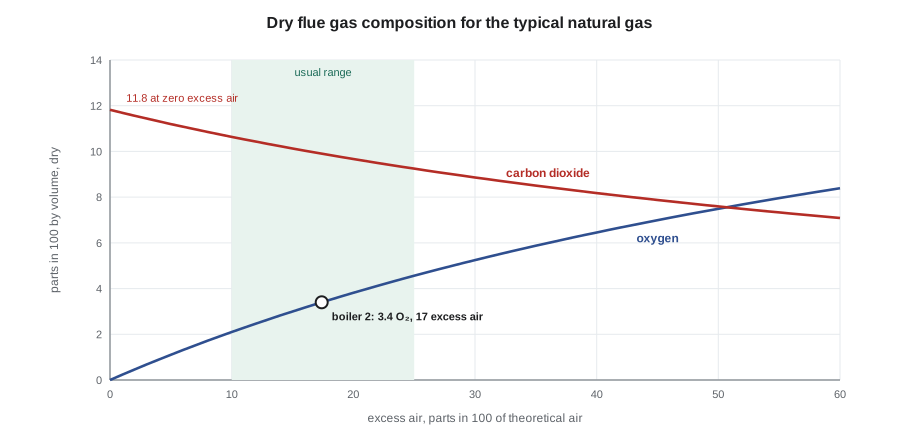
The CO₂ in the dry flue gas is highest at zero excess air, about 11.8 in 100 for this gas, and falls as excess air rises. Before oxygen analyzers were common, operators tuned burners by CO₂; the drawback is that CO₂ falls on both sides of the stoichiometric point, so a low CO₂ reading does not say whether the burner is short of air or has too much. Oxygen does not have that ambiguity, which is why it is the standard measurement today.
Products of combustion and the dew point
The wet flue gas contains everything in the dry gas plus the water vapor from burning the hydrogen, and any moisture in the air and fuel. For the typical gas, each volume of fuel makes 1.995 volumes of water vapor. With 17 in 100 excess air the total wet flue gas is about 12.3 volumes per volume of fuel.
By Dalton's law from lesson 7, the water vapor's partial pressure is its share of the total pressure. Any surface colder than the saturation temperature at that partial pressure condenses water from the gas: that temperature is the water dew point of the flue gas.
Worked problem
Dew point of the boiler 2 flue gas
Find the partial pressure of water vapor in the flue gas, with 1.995 volumes of water in 12.30 volumes of wet gas at 14.7 psia, and the dew point.
Show solution
- Partial pressure:
- \[p_w = \frac{1.995}{12.30} \times 14.7 = 2.38 \text{ psia}\]
- The saturation temperature at 2.38 psia, from the steam tables, is the dew point:
- \[T_{dp} = 133 \text{ °F}\]
Answer: About 133 °F. A conventional boiler and economizer must keep every gas-side surface well above that, because condensate in the flue is corrosive. A **condensing boiler** or condensing economizer does the opposite deliberately: it cools the gas below the dew point with cold return water, recovers the latent heat of the water vapor, and is built of materials that tolerate the condensate.
Fuels with sulfur have a second, higher dew point. Some of the SO₂ oxidizes to SO₃, which combines with water vapor to form sulfuric acid vapor, and the acid dew point can be well over 250 °F for high-sulfur oils. Cold-end corrosion of economizers and air heaters on oil-fired boilers is caused by that acid, which is why their minimum metal temperatures are set higher when burning oil than when burning gas.
Higher and lower heating values
The higher heating value, HHV, of a fuel is the heat released when it burns completely and the products are cooled back to the starting temperature, with the water condensed. The lower heating value, LHV, assumes the water stays as vapor, so it is smaller by the latent heat of that water. Canadian and US utilities bill natural gas on HHV; European practice and most gas turbine and engine ratings use LHV. An efficiency quoted on LHV looks higher than the same plant's efficiency on HHV, so the basis must always be stated.
Worked problem
From HHV to LHV
The gas has an HHV of 1,030 Btu/ft³. Each cubic foot produces 1.995 ft³ of water vapor, which is 1.995 ÷ 378.6 = 0.00527 lbmol, or 0.0949 lb. Take the latent heat as 1,050 Btu/lb. Find the LHV.
Show solution
- \[\text{LHV} = 1{,}030 - 0.0949 \times 1{,}050 = 1{,}030 - 100 = 930 \text{ Btu/ft}^3\]
Answer: The LHV is about 90 in 100 of the HHV. For oil the ratio is about 94 in 100, because oil has less hydrogen; for coal it is higher still.
The same arithmetic gives the CO₂ produced: 1.02 ft³ of CO₂ per ft³ of gas is 0.00269 lbmol, or 0.119 lb, about 115 lb of CO₂ per million Btu of HHV for this composition, close to the published emission factor used in PWR-240.
Halvard's question
Okonkwo worked the dry gas balance on the back of Halvard's service sheet: 17 in 100 excess air, CO₂ 9.9 dry, a dew point of 133 °F. Halvard's analyzer, which calculates excess air from its own fuel table, showed 18. "Your gas is a bit different from the default in my box," Halvard said, and changed the fuel setting to the utility's latest analysis. Okonkwo added the boiler 2 readings to the combustion log, noted that the new motor had left the air-fuel ratio essentially unchanged, and wrote one more line on his formula sheet: "Excess air from O₂: exact balance for reports, O₂ ÷ (20.9 − O₂) for checks."
Common mistakes
MistakeUsing oxygen instead of air in the air-fuel ratio.
InsteadDivide the oxygen needed by 0.2095 by volume, or 0.232 by mass, to get air.
MistakeBalancing a combustion equation by changing formulas.
InsteadChange only the numbers in front of each molecule; balance carbon, then hydrogen, then oxygen.
MistakeReading a flue gas analysis on a wet basis as if it were dry.
InsteadMost analyzers report oxygen on a dry basis; mixing bases moves the excess air figure.
MistakeTreating low CO₂ as proof of too much air.
InsteadCO₂ falls on both sides of stoichiometric; check oxygen and CO to tell which side the burner is on.
MistakeComparing an LHV efficiency with an HHV efficiency.
InsteadState the basis; LHV efficiencies for gas are about 10 points higher for the same plant.
Summary and key terms
- Carbon, hydrogen and sulfur burn to CO₂, H₂O and SO₂; a hydrocarbon CₓHᵧ needs x + y/4 moles of oxygen.
- Air is 20.95 in 100 oxygen by volume and 23.2 by mass; natural gas needs about 9.6 volumes of air, and methane 17.2 kg of air per kg.
- Excess air is found from the flue gas oxygen by a dry gas balance; O₂ ÷ (20.9 − O₂) is a quick check.
- CO₂ is highest at zero excess air and falls either way; oxygen and CO together show the burner's condition.
- The water dew point follows from the vapor's partial pressure; sulfur raises an acid dew point well above it.
- HHV includes the latent heat of the product water; LHV does not. Always state the basis.
- Stoichiometric air
- The exact quantity of air that supplies just enough oxygen for complete combustion.
- Excess air
- Air supplied beyond the stoichiometric quantity, usually expressed as a fraction of it.
- Ultimate analysis
- The mass fractions of carbon, hydrogen, sulfur, oxygen, nitrogen, moisture and ash in a fuel.
- Dry flue gas
- The products of combustion with their water vapor removed, the basis of most analyzer readings.
- Dew point
- The temperature at which water vapor in a gas begins to condense on a surface.
- Acid dew point
- The higher temperature at which sulfuric acid condenses from the flue gas of a sulfur-bearing fuel.
- Higher heating value
- The heat of combustion with the product water condensed.
- Lower heating value
- The heat of combustion with the product water left as vapor.
Practice problems
Work each problem on paper first, then reveal the answer to check.
Balance the combustion equation for propane.
Show answer
C₃H₈ + 5O₂ → 3CO₂ + 4H₂O.
How much air by volume is needed to burn 1 ft³ of propane completely?
Show answer
5 ÷ 0.2095 = 23.9 ft³.
What weight of CO₂ is made by burning 1 lb of carbon?
Show answer
44 ÷ 12 = 3.67 lb.
Flue gas oxygen reads 5.0 in 100 dry. Estimate the excess air with the quick formula.
Show answer
5.0 ÷ 15.9 = 0.31, about 31 in 100.
Lesson quiz · 5 questions
Score 60% or more to complete this lesson.
Create a free account to save your progress, take quizzes and earn a certificate.