
PWR-230 · Lesson 3 of 12 · 24 min
Internal combustion engines and generators
▶ Video coming soon A video version of this lesson is on the way.
On Monday, September 14, 2026, Pilar Quenneville ran the monthly test of Cantwell's standby generator, and Tamar Ellingsen went along with the test sheet on a clipboard. The generator room on the north wall held a 400 kW diesel generator set on a steel base tank, a radiator wall with louvers, two banks of starting batteries on chargers, and the automatic transfer switch in a gray cabinet by the door. "When the city's power goes, this engine has seconds to start and pick up the feed pumps, the burner controls and the emergency lights," Pilar said. "Today we find out whether it would."
This lesson covers how internal combustion engines work, the systems that support a standby diesel, how a generator makes power and how much current it supplies, and how transfer switches move the load. It ends with the testing that NFPA 110 requires for emergency power.
The four-stroke cycle
Most engines in plants are four-stroke engines. Each cylinder takes two revolutions of the crankshaft, four strokes of the piston, to complete one cycle:
- Intake: the piston moves down with the intake valve open, drawing in air (in a diesel) or a fuel-air mixture (in a spark-ignition engine).
- Compression: both valves closed, the piston moves up and compresses the charge.
- Power: the fuel burns, the pressure rises sharply and pushes the piston down. This is the only stroke that does work.
- Exhaust: the exhaust valve opens and the rising piston pushes the burned gas out.
A two-stroke engine completes the cycle in one revolution, using ports in the cylinder wall and a blower to scavenge the exhaust. Large slow-speed marine diesels and some older generator engines are two-stroke; most modern standby sets are four-stroke.
In a diesel or compression-ignition engine, only air is compressed, to a ratio of about 14:1 to 22:1, which heats it well above the fuel's ignition temperature. Fuel injected near the top of the compression stroke ignites on its own. In a spark-ignition engine running on natural gas, propane or gasoline, the mixture is compressed less, to about 8:1 to 12:1, and a spark plug ignites it. Natural gas engines are common in combined heat and power units; diesels dominate standby service because they start quickly, carry load fast and can store their fuel on site.
Engine systems
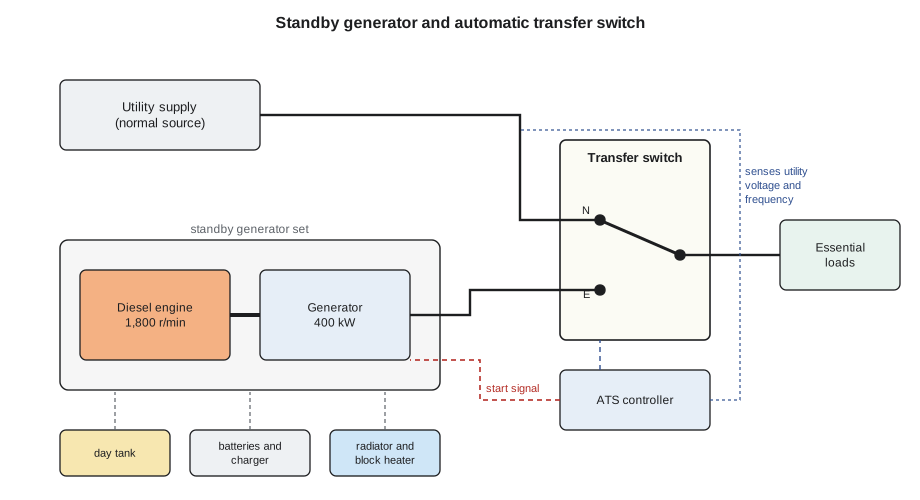
A standby diesel is a collection of systems, and the generator set will not work unless every one of them is ready.
- Fuel: a main or base tank, often a day tank with a transfer pump and float switch, a lift or supply pump, primary and secondary filters with a water separator, a high-pressure injection pump and injectors. Diesel stored for months picks up water and can grow microbes at the water layer, so tanks are checked for water and the fuel tested.
- Air intake: an air filter with a restriction indicator, and on most engines a turbocharger, a turbine in the exhaust driving a compressor in the intake, followed by an aftercooler that cools the compressed air so more of it fits in the cylinder.
- Cooling: a jacket water pump circulates coolant (water and glycol) through the block and heads to a radiator or a heat exchanger. A thermostat holds the engine temperature. A block heater keeps the standby engine warm, typically at 90 to 120 °F, so it starts easily and takes load quickly.
- Lubrication: a gear-driven oil pump, filters and a cooler. Low oil pressure shuts the engine down.
- Starting: electric starter motors on 24 V batteries kept charged by chargers, or air starters on larger engines. Batteries are the most common reason a standby engine fails to start.
- Exhaust: a muffler, a flexible connection, a rain cap, and a condensate drain. The exhaust must discharge well away from air intakes and doors, because it contains carbon monoxide.
- Governing: an electronic governor that holds the engine at exactly 1,800 r/min so the generator frequency stays at 60 Hz.
- Protection: shutdowns for overspeed, low oil pressure, high coolant temperature and failure to start (overcrank), with alarms for low fuel, low coolant level, charger failure and the like.
How the generator makes power
The engine drives a synchronous generator, or alternator. A rotating magnetic field, made by a DC field winding on the rotor, sweeps past the stationary armature windings and induces a three-phase voltage in them. The frequency depends only on the speed and the number of poles:
where f is the frequency in hertz, p the number of poles and N the speed in r/min. A 4-pole generator at 1,800 r/min gives:
That is why the governor must hold the speed so closely. An automatic voltage regulator controls the field current to hold the output voltage as the load changes.
Generators are rated in both kilowatts (real power, which the engine must supply) and kilovolt-amperes (apparent power, which sets the current and so the heating of the windings). The two are linked by the load's power factor:
Standby generators are usually rated at a power factor of 0.8.
Worked problem
Full-load current of the standby generator
Cantwell's generator is rated 400 kW at a power factor of 0.8, three-phase, 480 V. What are its kVA rating and full-load current?
Show solution
- Apparent power:
- \[400 \div 0.8 = 500 \text{ kVA}\]
- Three-phase current:
- \[I = \frac{500{,}000}{\sqrt{3} \times 480} \approx 601 \text{ A}\]
Answer: 500 kVA and about 601 A per phase. The breaker, cables and transfer switch are sized for that current.
A generator is limited by the engine for kilowatts and by the windings for current. A load with a poor power factor can overheat the windings even though the engine is far from its kilowatt limit. Large motors starting on a generator draw several times their running current, and the voltage dips while they accelerate; the generator was sized so that the feed pump motor can start on it without dropping the other loads.
Transfer switches
A transfer switch connects the essential loads either to the utility (the normal source) or to the generator (the emergency or alternate source), never to both at once unless it is specially designed for it. Its controller watches the utility voltage and frequency on every phase.
A typical automatic sequence on a utility failure is:
- The utility voltage drops below the pick-up setting. After a short start delay, usually 1 to 3 seconds to ride through a momentary dip, the controller signals the engine to start.
- The engine cranks, starts and reaches rated speed and voltage, typically within about 10 seconds for an emergency system.
- The switch transfers the load to the generator. Loads may be added in steps so that large motors start one at a time.
- When the utility returns and stays stable for the retransfer delay, often 5 to 30 minutes so a flickering supply does not cause repeated transfers, the switch moves the load back.
- The engine runs unloaded for a cool-down period, typically about 5 minutes, then stops and returns to standby.
Transfer switches are built in several types:
- Open transition (break-before-make): the load is disconnected from one source before it is connected to the other, with a brief interruption.
- Delayed transition: open transition with a deliberate pause in the neutral position, so motors and transformers can lose their residual voltage before reconnection. This avoids damaging inrush when motors are switched between sources that are out of phase.
- Closed transition (make-before-break): on a planned transfer between two live sources, the switch parallels them for a fraction of a second so the load sees no interruption. It needs synchronizing controls and the utility's approval.
Many transfer switches have a bypass-isolation feature so the switch itself can be maintained while the load stays powered. A transfer switch is electrical equipment at full fault current, and only qualified electrical workers open its cabinet. The operator's part is to run the test from the outside controls and record what happens.
Fuel supply and run time
A standby generator is only as good as the fuel it has on site. Cantwell's base tank holds 530 gal.
Worked problem
How long will the fuel last?
The base tank holds 530 gal. The generator burns about 27.7 gal/h at full load and 15.3 gal/h at half load. How long will a full tank last at each load?
Show solution
- \[530 \div 27.7 \approx 19 \text{ h at full load}\]
- \[530 \div 15.3 \approx 35 \text{ h at half load}\]
Answer: About 19 hours at full load and about a day and a half at half load. The plant's emergency plan includes a fuel supplier's priority delivery agreement for a longer outage, and the tank is kept close to full. Fuel consumption figures come from the engine's data sheet; these are typical for an engine of this size.
Fuel quality matters as much as quantity. Diesel ages, absorbs water from tank breathing and can support microbial growth at the water layer, which plugs filters at exactly the wrong moment. Tanks are checked for water, the fuel is sampled and tested on a schedule, and the fuel may be polished or treated.
Wet stacking and light-load running
A diesel that runs for long periods at light load does not get hot enough to burn its fuel completely. Unburned fuel and soot collect in the exhaust system and the cylinders, a condition called wet stacking, visible as black oily drips at the exhaust joints and white or black smoke when load is applied. It glazes cylinder liners and fouls injectors and turbochargers.
That is why test runs need real load, typically at least 30 in 100 of the nameplate rating or enough to reach the manufacturer's minimum exhaust temperature, and why a generator that cannot be loaded enough by the building is periodically run on a load bank, a portable bank of resistors that absorbs the generator's output as heat.
Testing emergency power
In Ohio, as in most states, emergency power for life safety systems is covered by the building and fire codes, which refer to NFPA 110, Standard for Emergency and Standby Power Systems. NFPA 110 classifies a system by how quickly power must be restored (a Type 10 system within 10 seconds) and how long it must run, and by Level: Level 1 where failure could cost lives, Level 2 where it is less critical. It calls for weekly inspection of the set and its systems, and monthly exercise for at least 30 minutes under load, at not less than 30 in 100 of nameplate kW or at a load that reaches the manufacturer's minimum exhaust temperature for a diesel. A diesel that cannot meet that load on its monthly test must also be run annually on supplemental load: at least 50 in 100 of nameplate for 30 minutes and then 75 in 100 for an hour, 1.5 hours in all. Level 1 systems are also tested at least every 36 months for their class duration, up to 4 hours. Transfer switches are operated monthly, and the fuel is tested at least annually.
Whatever the code, the purpose is the same: to prove, before an emergency, that the engine starts, picks up the load in time, carries it steadily and gives it back cleanly.
The monthly test
Pilar started with the weekly inspection items on the sheet: fuel level in the base tank, no water in the tank sample, coolant level, block heater working with the jacket water warm to the touch, oil level, battery charger readings and alarm panel clear, air filter restriction indicator in the green, louvers free and nothing stored in the room. A coolant hose near the radiator inlet had a fine surface crack. It was not leaking, but Pilar wrote a work order for Fenella Thorncroft's crew to replace it before the heating season's first cold spell.
She then notified the control room and the building's fire alarm monitoring company, as the procedure requires, and turned the transfer switch's test switch to simulate a utility failure. Tamar started a stopwatch. The engine cranked, caught and ran up to speed, and the transfer switch moved the essential load across with a solid clunk. Tamar stopped the watch at 8 seconds.
The essential panel's meter showed about 140 kW, a little more than a third of the generator's rating, which met the test load. Cantwell runs its monthly test for an hour, longer than the minimum. Pilar and Tamar logged the readings every fifteen minutes: oil pressure, coolant temperature, exhaust temperature, voltage on each phase, frequency (60.0 Hz) and kilowatts. When the hour was up, Pilar returned the test switch to normal. After the retransfer delay the load went back to the utility, the engine ran its five-minute cool-down and stopped. The block heater came back on, the charger rose to its float voltage and the sheet went to Grazyna with the hose work order attached.
"A test that starts the engine with no load proves only that it starts," Pilar said. "Ours proves it can carry the plant."
Safety around engines and generators
- Exhaust gas contains carbon monoxide. Never run an engine with its exhaust system open or leaking indoors, and keep the generator room ventilated.
- A standby engine can start at any moment without warning, on a utility dip or a remote signal. Before working on it, put the controller in the off position, lock out the starting circuit and the battery charger as the lockout procedure requires, and isolate the batteries.
- Batteries give off hydrogen when charging and contain acid. Keep sparks and flames away and wear eye and face protection when checking them.
- Hot exhaust parts, rotating fans and belts, and the coolant under pressure in a hot radiator all injure people. Let the engine cool before opening the radiator cap.
- The generator output is live whenever the engine runs. Electrical work belongs to qualified electrical workers.
Common mistakes
MistakeTesting the generator with no load because the building load is light.
InsteadRun on enough load, or a load bank, to reach the required load and exhaust temperature.
MistakeOpening the radiator cap on a hot engine.
InsteadLet it cool; hot coolant under pressure can scald.
MistakeWorking on a standby engine with its controller in automatic.
InsteadIt can start at any moment; switch off and lock out first.
MistakeIgnoring a battery charger alarm.
InsteadBatteries are the most common cause of failure to start.
MistakeJudging a generator only by its kW rating.
InsteadCurrent and power factor also limit it; check kVA.
Summary and key terms
- A four-stroke engine completes intake, compression, power and exhaust in two revolutions; a diesel ignites fuel by the heat of compression.
- A standby diesel depends on its fuel, air, cooling, lubrication, starting, exhaust, governing and protection systems.
- Generator frequency is f = pN ÷ 120, so a 4-pole set runs at 1,800 r/min for 60 Hz; kVA = kW ÷ power factor.
- A transfer switch starts the engine on utility failure, transfers the load, retransfers after a delay and lets the engine cool down.
- Light-load running causes wet stacking; tests need real load or a load bank.
- NFPA 110 requires weekly inspections, monthly exercise of at least 30 minutes at 30 in 100 or more of nameplate, and an annual load-bank test where the monthly load falls short.
- Four-stroke cycle
- An engine cycle of intake, compression, power and exhaust strokes over two crankshaft revolutions.
- Compression ignition
- Ignition of fuel by the heat of highly compressed air, as in a diesel engine.
- Turbocharger
- An exhaust-driven turbine and compressor that pushes more air into an engine.
- Block heater
- A heater that keeps a standby engine's coolant warm for quick starting.
- Automatic transfer switch
- A switch that moves loads between the utility and a generator automatically.
- Wet stacking
- Unburned fuel and soot collecting in a diesel exhaust from long running at light load.
- Load bank
- A bank of resistors used to load a generator for testing.
- Power factor
- The ratio of real power to apparent power in an AC circuit.
Practice problems
Work each problem on paper first, then reveal the answer to check.
What speed must a 2-pole generator run at for 60 Hz?
Show answer
3,600 r/min.
A 250 kW generator is rated at 0.8 power factor. What is its kVA rating?
Show answer
312.5 kVA.
A 300 kVA, 480 V three-phase generator: what is its full-load current?
Show answer
About 361 A.
A 400 gal tank feeds an engine burning 12 gal/h. How long will it last?
Show answer
About 33 hours.
Why is there a retransfer delay?
Show answer
So a utility supply that is flickering on and off does not cause repeated transfers.
Lesson quiz · 5 questions
Score 60% or more to complete this lesson.
Create a free account to save your progress, take quizzes and earn a certificate.