
PWR-230 · Lesson 1 of 12 · 25 min
Prime movers in a plant
▶ Video coming soon A video version of this lesson is on the way.
On Wednesday, September 9, 2026, her second day at Cantwell Energy Center, Tamar Ellingsen spent the morning with Grazyna Wolanski, the chief engineer, on what Grazyna called the rotating-equipment walk. They started in the boiler room and finished in the basement pump gallery, and at every machine Grazyna asked the same two questions: "What turns this shaft, and what does the shaft turn?" By lunch Tamar had a page of notes listing more than forty motors, one steam turbine, one diesel engine and the pumps, fans and compressors they drove. "Every one of these machines can hurt you, and every one of them can leave the city without heat if it fails," Grazyna said. "Learn how each one starts, how it stops, and what protects it."
This course is about those machines. PWR-210 covered the mechanics and thermodynamics behind them and PWR-220 covered the boilers that make the steam. This lesson sets out the main kinds of prime movers found in a plant, the machines they drive, how power, torque and speed relate, and the checks that apply to any rotating machine before it is started. The rest of the course takes each family of machines in turn.
Prime movers and driven machines
A prime mover is a machine that converts the energy in a fuel, in steam, in falling water or in the wind into mechanical work at a rotating shaft. A driven machine takes that shaft work and does something useful with it: a pump moves liquid, a fan moves air, a compressor raises gas pressure and a generator makes electricity.
The prime movers an operator meets most often are:
- Steam turbines, in which steam expands through nozzles and blades and turns a rotor. They range from small single-stage units of a few kilowatts driving a pump to utility turbines of more than 1,000 MW.
- Steam engines, the reciprocating machines of the nineteenth century, in which steam pushes a piston in a cylinder. Very few remain in service, but the exam syllabus still expects an operator to know how their valves and governors work, and some old plants keep one as a museum piece.
- Internal combustion engines, diesel or spark-ignition, which burn fuel inside the cylinder. In a heating plant they usually drive standby generators and sometimes fire pumps or combined heat and power units.
- Gas turbines, in which a compressor, a combustor and a turbine are joined on one shaft. They drive generators and compressors in larger plants, often with a heat recovery boiler on the exhaust.
- Hydraulic turbines and wind turbines, which take energy from falling water and moving air.
Strictly speaking, an electric motor is not a prime mover, because it converts electricity that some other prime mover made into shaft work. In practice it is the driver of almost every pump and fan in a modern plant, and the operator looks after it in the same way: lubrication, cooling, vibration, guards and safe isolation. This course treats motors as drivers alongside the true prime movers, and leaves their electrical theory to the electrical course.
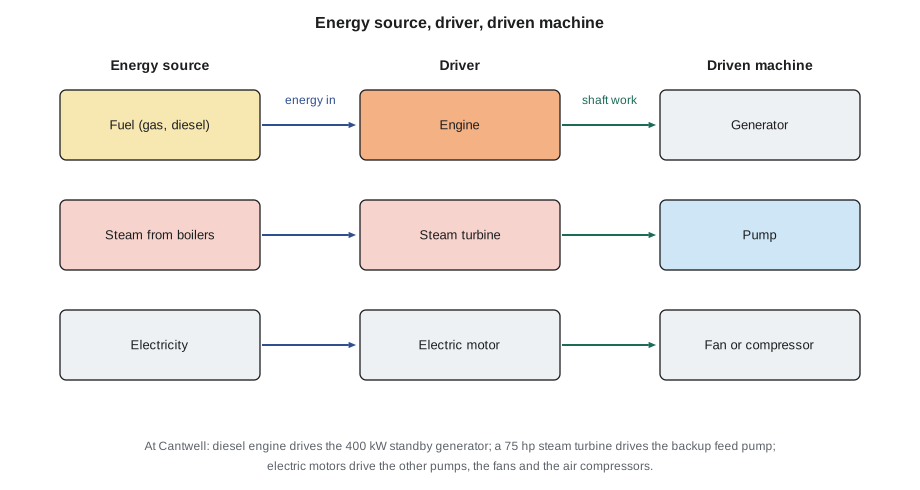
What drives what at Cantwell
Tamar's list sorted itself into a few groups, typical of a district heating plant:
- Motors drive the main boiler feed pumps, the condensate transfer pumps, the hot water circulating pumps, the forced draft fans, the instrument air compressors, the chemical feed pumps, the cooling tower fan and the chiller compressor. Most are three-phase induction motors at 460 V, a few of the larger ones on variable frequency drives.
- A 75 hp steam turbine drives the backup boiler feed pump. It takes steam from the header and exhausts into the deaerator.
- A diesel engine drives the 400 kW standby generator in its own room on the north wall, with a day tank and a separate fuel supply.
Grazyna explained why a district plant bothers with a steam turbine at all. If the electricity fails, the motor-driven feed pumps stop, but the boilers are still full of hot water and the burners can be restarted once the standby generator picks up the essential loads. Without feedwater, though, the drum level falls in a few minutes. A turbine-driven feed pump needs only steam, which the boilers are already making, so it can keep the boilers fed through a power failure while the generator starts and the electrical system is sorted out. It is the plant's insurance against low water.
Its exhaust is not wasted either. The turbine exhausts at low pressure into the deaerator, where the steam heats the feedwater. Most of the energy that did not become shaft work ends up back in the boiler water, which is why a small, inefficient turbine can still make sense in a steam plant.
Power, torque and speed
Every rotating machine is described by three related quantities: the torque it delivers or needs, the speed at which it turns, and the power it transmits, which is their product. PWR-210 lesson 3 introduced power as the rate of doing work; for a rotating shaft:
where P is the power in watts, T the torque in newton-meters, ω the angular speed in radians per second, and N the speed in revolutions per minute. In US customary units the same relationship is usually written with the constant 5,252:
with the torque in pound-feet. The constant comes from 33,000 ft·lb/min per horsepower divided by 2π.
Worked problem
Torque at the turbine shaft
The backup feed pump turbine is rated 75 hp at 3,600 r/min. What torque does it deliver at rated output?
Show solution
- Rearrange the horsepower equation for torque:
- \[T = \frac{5{,}252 \times \text{hp}}{N}\]
- Substitute:
- \[T = \frac{5{,}252 \times 75}{3{,}600} \approx 109 \text{ lb·ft}\]
Answer: About 109 lb·ft. At half the speed, the same torque would give only half the power, which is why a turbine slowed by a governor fault cannot carry its pump.
The way a driven machine's torque changes with speed decides how hard it is to start and how its power changes when it is slowed down:
- Variable torque loads, such as centrifugal pumps and fans, need little torque at low speed. Their torque rises with the square of the speed and their power with the cube (lesson 4). Slowing them saves a great deal of power, which is why variable frequency drives pay off on them.
- Constant torque loads, such as positive displacement pumps, reciprocating compressors and conveyors, need about the same torque at every speed, including at the moment of starting. Their power rises in proportion to speed.
- Constant power loads, such as some winders and machine tools, need high torque at low speed. They are rare in a boiler plant.
A motor or engine must produce more torque than the load needs at every speed between standstill and running speed, or the machine will stall partway up. A positive displacement compressor starting against a full receiver is a hard start; that is why compressors have unloaders that let them start with no pressure to push against (lesson 5).
Efficiency of prime movers
No prime mover turns all of its input into shaft work. The table gives typical full-load efficiencies; the actual value for a machine is on its data sheet or test report, and part-load efficiency is usually lower.
| Driver | Typical full-load efficiency (shaft work ÷ energy input) | Where the rest goes |
|---|---|---|
| Large induction motor | 93 to 97 in 100 | Winding and core heat, friction, fan |
| Small induction motor 10 hp | 88 to 92 in 100 | Winding and core heat, friction, fan |
| Small single-stage steam turbine | 20 to 50 in 100 of the ideal (isentropic) work | Stays in the exhaust steam, mostly recoverable |
| Large multistage steam turbine | 80 to 90 in 100 of the ideal work | Exhaust steam and losses |
| Diesel generator set | 33 to 42 in 100 of fuel energy as electricity | Exhaust, jacket water, radiation |
| Simple-cycle gas turbine | 25 to 40 in 100 of fuel energy | Hot exhaust, often recovered in a boiler |
Steam turbine efficiency is usually stated against the ideal, isentropic expansion rather than against the fuel, because the turbine does not burn anything. Lesson 2 works through how that efficiency sets the turbine's steam rate.
Worked problem
Fuel efficiency of the standby generator
At full load of 400 kW, the standby generator burns about 27.7 gal/h of diesel fuel. Take the fuel's energy content as 138,500 Btu/gal (a typical higher heating value). What is the overall efficiency from fuel to electricity?
Show solution
- Fuel energy per hour:
- \[27.7 \times 138{,}500 \approx 3{,}836{,}000 \text{ Btu/h}\]
- Convert to kilowatts (3,412 Btu/h = 1 kW):
- \[3{,}836{,}000 \div 3{,}412 \approx 1{,}124 \text{ kW}\]
- Efficiency:
- \[400 \div 1{,}124 \approx 0.356\]
Answer: About 0.36, or 36 in 100. Nearly two-thirds of the fuel energy leaves as heat in the exhaust, the jacket water and the radiator air. A combined heat and power unit captures much of that heat for useful heating.
Grazyna mentioned that a feasibility study for a gas-engine combined heat and power unit is on the list for the 2027 capital plan. If it goes ahead, the engine's jacket water and exhaust heat would feed the hot water system. For now it is only a study.
Prime movers and the license
In Ohio, licensing under Chapter 4104 of the Revised Code is based on the boilers, and the steam turbine on the backup feed pump is part of the steam plant that the licensed engineers operate. Other states and some cities license steam engines, turbines and large compressors separately, so an engineer who moves to another jurisdiction must check what its rules count.
The exam treats prime movers as part of the plant the engineer is responsible for. The engineer who signs the log is accountable for the turbine and the generator just as much as for the boilers.
Common features of rotating machines
Whatever drives them, rotating machines share a set of systems that the operator checks on every round:
- Lubrication: oil or grease to the bearings, and on larger machines an oil pump, cooler and filter (lesson 6).
- Cooling: air from a fan, jacket water, or cooling water to oil coolers and bearings.
- Shaft sealing: packing or mechanical seals where the shaft leaves a casing (lesson 4).
- Couplings and guards: the coupling between driver and driven machine, and the guard that stops anyone touching it (lesson 7).
- Speed control: a governor on a turbine or engine, or a drive on a motor.
- Protection: overspeed trips, low oil pressure trips, high temperature trips, vibration alarms and motor overloads.
An operator learns each machine's normal readings, because a change from normal is the first sign of trouble. A bearing that has run at 140 °F for a year and now reads 162 °F is telling the operator something, even though both readings are well below the alarm point.
Before starting any rotating machine
Grazyna gave Tamar the plant's general pre-start checklist, which applies before the specific procedure for each machine:
- Confirm the machine is released for service: no open work permit, all locks and tags removed by the people who applied them, and the maintenance crew clear.
- Check that guards are in place and nothing is left on or near the machine: tools, rags, loose covers.
- Check oil levels and lubrication, and start any auxiliary oil pump first.
- Check that cooling water or ventilation is available.
- Line up the valves: suction open, discharge as the procedure says, vents and drains closed, warm-up lines as required.
- For a turbine or engine, check that the trip is reset and the governor is in the start position.
- Stand clear of the coupling and out of the plane of rotation when starting, and watch and listen as it comes up to speed.
- After starting, check direction of rotation if the machine has been worked on, then check pressures, temperatures, vibration and leaks.
"Most rotating-equipment accidents happen at start-up and shutdown," Grazyna said. "Things change fast then. Do the checks every time, even on the pump you started yesterday."
Running, standby and redundancy
Essential services in a plant are usually provided by two or more machines so that one can be taken out for maintenance or fail without loss of service. The usual terms are:
- Duty or lead: the machine running now.
- Standby or lag: the machine ready to start automatically or by hand if the duty machine fails or the load rises.
- N+1: enough machines to carry the full load with one out of service.
At Cantwell the motor-driven feed pumps are duty and standby, the instrument air compressors are lead and lag, and the turbine-driven feed pump is a third line of defense. A standby machine that has not run for months may not start when it is needed, so plants rotate duty machines on a schedule and run standby machines for test. The backup turbine is run monthly, which lesson 2 follows, and the generator is tested on load monthly, which lesson 3 follows.
Rotating duty machines also spreads wear evenly, so that both pumps reach overhaul at about the same running hours rather than one wearing out while the other sits idle. Some plants prefer to keep one machine as the main duty unit and the other as a true standby, run only for tests; either approach works if the rotation or the test is actually done and recorded.
Reading a nameplate
Every motor, turbine, engine and pump has a nameplate, and the operator should be able to read it without a manual. A motor nameplate gives the rated power, voltage, full-load current, speed, frequency, service factor, insulation class, enclosure and frame. A turbine nameplate gives the rated power and speed, the inlet and exhaust steam conditions, and the trip speed. A pump nameplate gives the rated flow, head and speed, and often the impeller diameter.
Tamar copied the backup turbine's nameplate into her notebook: rated 75 hp at 3,600 r/min, inlet steam 150 psig saturated, exhaust 3 psig to the deaerator, overspeed trip set at about 110 in 100 of rated speed. Lesson 2 works with those numbers.
A nameplate is also the reference when a machine is replaced or repaired. A rewound motor should match the original voltage, speed and frame; a replacement pump impeller should match the trimmed diameter on the data sheet. When the nameplate is missing or painted over, the plant's equipment records are the backup, and a missing plate is worth reporting so the record can be checked and a new plate made.
Common mistakes
MistakeTreating a standby machine as ready because it ran last year.
InsteadRun standby machines on a schedule and record the result; one that has not run may not start.
MistakeAssuming a small steam turbine wastes most of its steam's energy.
InsteadIts exhaust heat usually goes to the deaerator or a heater and is recovered.
MistakeStarting a machine without checking that all locks and tags have been removed by their owners.
InsteadConfirm the release for service first, every time.
MistakeStanding beside the coupling while a machine starts.
InsteadStand clear and out of the plane of rotation.
MistakeIgnoring a reading that has changed but is still below the alarm.
InsteadCompare with normal readings; a trend is often the first warning.
Summary and key terms
- A prime mover turns the energy in fuel, steam, water or wind into shaft work; a driven machine uses that work.
- Steam turbines, internal combustion engines and gas turbines are the main prime movers in plants; electric motors drive most pumps and fans.
- Power equals torque times angular speed: P = 2πNT ÷ 60 in watts, or hp = T × N ÷ 5,252 in US units.
- Centrifugal pumps and fans are variable torque loads; positive displacement machines are constant torque loads.
- A turbine-driven feed pump keeps boilers fed when the electricity fails, and its exhaust heats the deaerator.
- Every rotating machine needs lubrication, cooling, sealing, guarding, speed control and protection, and every start begins with the same basic checks.
- Prime mover
- A machine that converts the energy in fuel, steam, water or wind into mechanical work at a shaft.
- Driven machine
- A machine that uses shaft work, such as a pump, fan, compressor or generator.
- Torque
- The turning effect of a force on a shaft, in newton-meters or pound-feet.
- Variable torque load
- A load, such as a centrifugal pump or fan, whose torque rises with the square of speed.
- Constant torque load
- A load, such as a positive displacement pump, that needs about the same torque at all speeds.
- Duty and standby
- An arrangement in which one machine runs and another is ready to take over.
- Combined heat and power
- Generating electricity and using the prime mover's waste heat for heating at the same site.
Practice problems
Work each problem on paper first, then reveal the answer to check.
A pump shaft carries 150 lb·ft at 1,780 r/min. What horsepower does it transmit?
Show answer
About 50.8 hp.
A motor must deliver 20 hp at 1,750 r/min. What is its torque?
Show answer
About 60.0 lb·ft.
A generator set makes 250 kW from 18.5 gal/h of fuel at 138,500 Btu/gal. What is its efficiency?
Show answer
Fuel input about 751 kW, efficiency about 0.33.
Name two variable torque loads and one constant torque load.
Show answer
Centrifugal pumps and fans; a positive displacement pump or reciprocating compressor.
Why does a turbine-driven feed pump make sense in a heating plant?
Show answer
It runs on steam when the power fails, and its exhaust heat is recovered in the deaerator.
Lesson quiz · 5 questions
Score 60% or more to complete this lesson.
Create a free account to save your progress, take quizzes and earn a certificate.