
PWR-230 · Lesson 12 of 12 · 23 min
Maintaining plant auxiliaries
▶ Video coming soon A video version of this lesson is on the way.
On Saturday, November 7, 2026, boiler feed pump 2 was opened for inspection. It had cavitated on October 27, when a low deaerator level and a pressure dip came together, and although it had run normally since, Grazyna Wolanski wanted to see inside it before the coldest months. Fenella Thorncroft planned the job, Lorne Fitzwilliam was the shift engineer who released the pump, and Tamar Ellingsen helped with the lockout and stayed to watch the millwrights lift the top half of the casing. "Every auxiliary in this plant has a maintenance plan," Fenella said. "The plan is the difference between fixing a pump on a Saturday when we choose to and fixing it on a January night when it chooses for us."
This last lesson pulls the course together: maintenance strategies and how a plant chooses among them, preventive maintenance schedules for the auxiliaries covered in lessons 1 to 11, how lockout protects people working on them, how work is planned, recorded and returned to service, and how reliability is measured.
Maintenance strategies
Plants use a mix of four approaches, chosen machine by machine:
- Reactive or run-to-failure maintenance: the machine runs until it breaks, then it is repaired. It suits cheap, non-critical items with a spare on the shelf, such as a small exhaust fan or a light fixture, but it is a poor choice for anything whose failure stops the plant or hurts someone.
- Preventive or time-based maintenance: tasks done on a fixed schedule, by calendar or running hours, whether or not the machine seems to need them: greasing bearings, changing filters, testing safety valves, running standby machines. It prevents failures whose timing is predictable.
- Predictive or condition-based maintenance: the machine's condition is measured, and work is done when the measurements show it is needed. Vibration analysis (lesson 7), oil analysis (lesson 6), infrared thermography of electrical gear and bearings, ultrasonic testing of traps and leaks (lessons 5 and 11), and performance checks against curves (lesson 4) are the main tools. It avoids both unnecessary work and surprise failures.
- Reliability-centered maintenance (RCM): a structured study of each system that asks how it can fail, what the consequences would be, and which task, if any, would prevent or detect each failure. It is used to design maintenance programs for critical systems.
Some tasks belong to the law, not to choice. Safety valve testing, emergency generator testing, pressure vessel inspections, refrigerant monitor tests and cooling tower programs are required by state rules, NFPA and ASHRAE standards and local codes, and must be done and recorded on their schedules whatever the strategy says.
A preventive maintenance schedule
Cantwell's computerized maintenance management system (CMMS) holds a record for every auxiliary, with its tasks and their intervals. The table shows typical tasks for the machines in this course; the actual list for each machine comes from its manual, the codes that apply to it and the plant's own history.
| Equipment | Typical preventive and predictive tasks |
|---|---|
| Pumps | Check seal or packing leakage on rounds; grease or check oil monthly; vibration monthly; performance check against curve yearly; alignment after any work |
| Steam turbine | Monthly run with hand trip test; oil sample quarterly; overspeed trip test yearly; governor service as the maker specifies |
| Standby generator | Weekly inspection; monthly load test with transfer switch; fuel test; battery and coolant checks; annual service |
| Air compressors and dryers | Daily readings; drains checked on rounds; filters and separators by hours or differential pressure; oil sample; leak survey twice a year |
| Receivers and pressure vessels | Drain and look over on rounds; safety valve hand test on schedule; internal inspection as the regulator requires |
| Fans and motors | Belt condition and tension; grease by schedule; vibration; infrared scan of starters and drives yearly |
| Heat exchangers | Trend approach temperatures and pressure drops; clean when trends show it; inspect gaskets and tubes |
| Cooling tower | Weekly inspection and water tests; Legionella testing as the plan requires; cleaning and disinfection; fan gearbox oil |
| Chiller and machinery room | Daily log; monthly monitor function test; monitor calibration twice a year; leak check; annual service |
| Steam traps | Survey at least yearly; strainers cleaned; failed traps replaced promptly |
A schedule works only if it is done. Grazyna reviews the CMMS backlog each week, and any task that is overdue on a safety device or a code-required test goes straight to her desk. Fenella is building the 2027 schedule now; it will add pump 2 to the monthly vibration route (lesson 7), move the trap survey to twice a year (lesson 11), and add the backup turbine's oil resample (lesson 6). Those changes are planned, not yet in force.
Work orders and planning
Every maintenance job starts as a work order: what is to be done, on which equipment, why, by whom, with what parts, tools and permits, and how long it should take. A planner like Fenella turns requests from the operators' rounds into planned jobs: she checks the history, orders the parts, books the crew, and arranges the outage with the shift engineer so the plant can carry the load while the machine is out.
For feed pump 2, her job plan listed the isolation points, the parts on hand (a mechanical seal kit, wear rings, bearings and gaskets, in case they were needed), the lifting plan for the casing top, the alignment check on reassembly, and the post-maintenance test: a run on minimum flow recirculation, then a curve check like the one in lesson 4 and vibration readings, before the pump was returned to standby.
Good records close the loop. Each completed work order records what was found, what was done, the parts used and the time taken. Over the years, that history shows which machines fail most, which tasks are worth doing and which are not, and when a machine is better replaced than repaired.
Lockout and isolation
Before anyone works on a machine, every source of energy that could move it, pressurize it, heat it or energize it must be isolated, locked and proven dead. PWR-110 lesson 5 covered the rules: OSHA's control of hazardous energy standard, 29 CFR 1910.147, which requires a written program, machine-specific procedures, training and annual inspections, and which Cantwell's procedure follows.
Auxiliaries have more energy sources than people expect. Feed pump 2 had at least six:
- Electrical: the motor, isolated at its breaker in the motor control center, locked open, and tested dead.
- Hydraulic pressure from the boilers: the discharge isolating valve closed and locked, because the discharge check valve alone cannot be trusted to hold back 150 psi from the header that feed pump 1 was still feeding.
- Suction pressure and hot water from the deaerator: the suction valve closed and locked. The deaerator stays in service, so its 221 °F water is right behind that valve.
- The minimum flow recirculation line back to the deaerator, closed and locked.
- Seal flush and cooling water lines, closed.
- Thermal energy: the casing full of water at 221 °F. It was drained and vented and allowed to cool before it was opened.
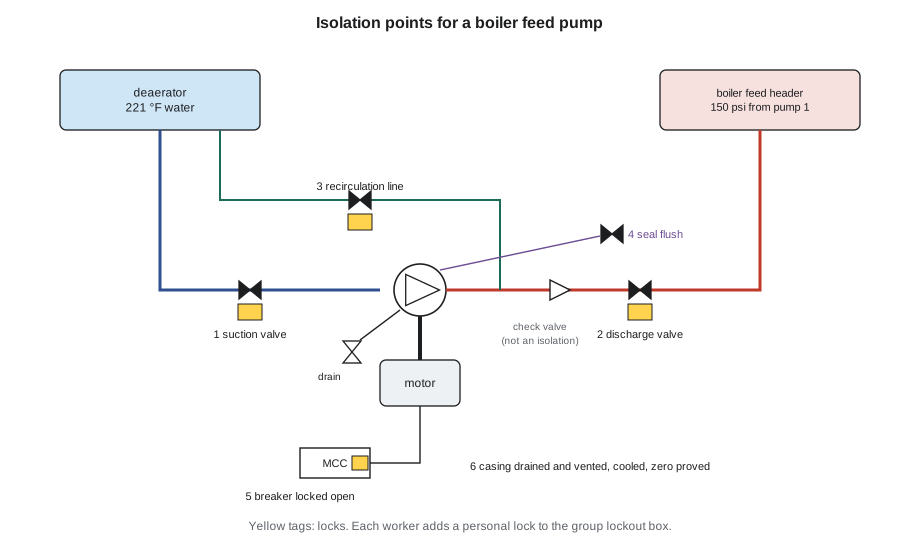
Lorne applied the plant lock to each isolation point and put the keys in the group lockout box; each millwright then put a personal lock on the box. He tried the motor's local start button to prove it would not start, opened the casing drains and vents to prove zero pressure and no flow past the closed valves, and checked the casing temperature with the infrared thermometer. Only then did he sign the work permit over to the crew.
When isolation depends on valves holding back high-pressure or hot fluids, a double block and bleed arrangement, two closed valves with a vented drain between them, gives much better protection than a single valve. Where that is not possible, the procedure may call for a blank or spectacle blind fitted in a flange. A drain or vent that keeps running after isolation means a valve is passing, and work does not start until that is fixed.
What they found
With the casing top lifted, the millwrights measured and photographed each part. The first-stage impeller showed light cavitation pitting near the leading edges of its vanes, the classic sign of the October 27 event: a band of small, frosted pits about an eighth of an inch wide, but no deep cavities or cracks. The wear ring clearances were within the manufacturer's limits, consistent with the pump making its full head in September. The bearings and the mechanical seal faces were in good condition.
Grazyna decided, with the pump manufacturer's representative on the phone, that the impeller could go back in service and be replaced at the pump's next planned overhaul, with a borescope look at the vane edges in the meantime. The more important fix was the one already in hand: the proposal from PWR-210 to raise the deaerator low-level alarm, going to the November operations meeting under management of change, so that operators are warned earlier and the pumps never again see a low level and a pressure dip together.
The pump was reassembled with new gaskets, the alignment checked with the cold offset in its record (lesson 7), and the guard refitted.
Returning equipment to service
Returning a machine to service is as dangerous as taking it out. The plant's procedure requires:
- The crew confirms the work is complete, tools and materials are removed, and guards and covers are in place.
- Each worker removes his or her own personal lock. A lock is never removed by anyone else except under the strict procedure for an absent worker, which involves verifying that the worker has left the site and is not at the machine, and the supervisor's authorization.
- The shift engineer walks down the machine, checks that drains and vents are in their running positions, and removes the plant locks in the reverse order of isolation: for a pump, filling and venting the casing from the suction side before opening the discharge.
- The machine is started under watch and tested as the work order requires.
- The work order is closed with the findings and the test results.
Feed pump 2 was filled slowly from the deaerator, vented and warmed until its casing matched the suction temperature, started on minimum flow recirculation, and checked: seal dry, bearings steady, vibration in zone A. Its discharge head matched its curve within a foot and a half. Lorne returned it to standby duty at the end of the shift.
Measuring reliability
Two simple measures describe how a machine is doing over time:
- Mean time between failures (MTBF): the total running time divided by the number of failures.
- Mean time to repair (MTTR): the average time it takes to restore the machine after a failure.
From these, the machine's availability, the fraction of time it is able to run, can be estimated:
Worked problem
Availability of a feed pump
The plant's records show that a pump ran 26,000 hours over a period in which it failed 3 times, and each repair took an average of 12 hours. What are its MTBF and availability?
Show solution
- \[\text{MTBF} = 26{,}000 \div 3 \approx 8{,}670 \text{ h}\]
- \[A = \frac{8{,}670}{8{,}670 + 12} \approx 0.9986\]
Answer: An MTBF of about 8,670 hours, about a year, and an availability of about 998.6 in 1,000. With a standby pump that is itself available and starts reliably, the chance that both are out at once is very small. That is the reason for the duty and standby arrangement in lesson 1, and the reason standby machines must be tested: an untested standby may not be available at all.
Records also show the bad actors, the few machines that cause most of the failures. Concentrating improvement work on them, by finding the root cause of their failures as PWR-220 lesson 12 did for boiler 3's tube, gives the biggest gain for the effort.
Spare parts and contractors
A plant keeps critical spares for machines whose failure would stop it and whose parts are not available quickly: seal kits and bearings for the feed pumps, a spare motor for the forced draft fans, trap and valve stock, filter elements, a turbine governor spare kit. The list is reviewed as equipment changes. Too few spares means long outages; too many ties up money and the parts deteriorate on the shelf.
Specialists do much of the maintenance on auxiliaries: the turbine service contractor, the generator dealer, the chiller and refrigerant technicians, the water treatment supplier, the electrician. The plant's engineers stay responsible for the plant while they work. That means issuing permits, doing the isolation and lockout, knowing what is being done and why, checking the work and the records, and testing the equipment before it goes back in service. A contractor's report is part of the plant's record, and the shift engineer reads it.
Management of change
Any change to equipment, settings, procedures or chemicals, beyond replacing like with like, goes through management of change: a written description of the change, a review of its hazards and effects by the people who understand them, approval, updates to drawings, procedures and training, and a check after it is made. The deaerator alarm change is an example. So is a new grease, a different trap type, a new refrigerant or a revised cooling tower program. Many accidents begin with a small change that nobody thought through.
Tamar's notebook
Over two months, Tamar's notebook had filled with the machines of this course: the turbine and its trip, the generator and its transfer switch, the feed pumps and their curves, the compressors and their leaks, the oil reports, the alignment of pump 2, the plate exchanger's scale, the cooling tower and its Legionella plan, the chiller room's monitor, the traps in the tunnels and now the inside of feed pump 2. On the last page Grazyna wrote three lines for her: know what normal looks like; test the things that protect you; and write down what you did.
Common mistakes
MistakeTrusting a check valve to hold back pressure during maintenance.
InsteadClose and lock an isolating valve, and bleed between valves where possible.
MistakeRemoving someone else's lock because the job looks finished.
InsteadEach worker removes his or her own lock; the absent-worker procedure is the only exception.
MistakeOpening a pump casing as soon as the motor is locked out.
InsteadIsolate all energy sources, drain, vent, cool and prove zero energy first.
MistakeSkipping a code-required test because the equipment seems fine.
InsteadLegally required tests are done on schedule and recorded.
MistakeChanging a setting or material without review because it seems minor.
InsteadUse management of change; small changes cause accidents.
Summary and key terms
- Plants combine reactive, preventive, predictive and reliability-centered maintenance, chosen machine by machine; code-required tasks are not optional.
- A CMMS holds each auxiliary's tasks and history; work orders plan the job and record the findings.
- Lockout isolates every energy source: electrical, pressure, hot fluids, connected lines, stored and thermal energy, then proves it dead.
- Returning to service requires the work complete, guards back, personal locks removed by their owners, a walkdown and a test under watch.
- MTBF, MTTR and availability, A = MTBF ÷ (MTBF + MTTR), measure reliability; standby machines must be tested to be counted on.
- Critical spares, supervised contractors and management of change complete a sound maintenance program.
- Preventive maintenance
- Maintenance done on a fixed schedule of time or running hours.
- Predictive maintenance
- Maintenance done when measurements of the machine's condition show it is needed.
- Reliability-centered maintenance
- A structured method for choosing maintenance tasks from how equipment fails and the consequences.
- Work order
- A document that authorizes, plans and records a maintenance job.
- Double block and bleed
- Isolation by two closed valves with a vented drain between them.
- Mean time between failures
- Total running time divided by the number of failures.
- Availability
- The fraction of time a machine is able to run.
- Management of change
- A formal review and approval process for changes to equipment, settings, procedures or materials.
Practice problems
Work each problem on paper first, then reveal the answer to check.
A compressor ran 12,000 h with 4 failures. What is its MTBF?
Show answer
3,000 h.
If its MTTR is 6 h, what is its availability?
Show answer
About 0.998.
Name four energy sources to isolate on a boiler feed pump.
Show answer
The motor, the discharge from the boiler header, the suction from the deaerator, the recirculation line, seal water lines, and the hot water in the casing.
Why must a pump be filled and vented before its discharge valve is opened on return to service?
Show answer
To prevent water hammer and protect the seal from running dry.
Give one task that is predictive and one that is preventive.
Show answer
Vibration analysis or oil analysis (predictive); greasing on a schedule or changing filters (preventive).
Lesson quiz · 5 questions
Score 60% or more to complete this lesson.
Create a free account to save your progress, take quizzes and earn a certificate.