
PWR-230 · Lesson 2 of 12 · 27 min
Steam turbine principles
▶ Video coming soon A video version of this lesson is on the way.
On Thursday, September 10, 2026, Lorne Fitzwilliam took Tamar Ellingsen to the backup feed pump for its monthly test run. The turbine sat at the end of the pump gallery, a squat gray casing with a governor on one end, a trip and throttle valve on its steam inlet and a fat exhaust pipe rising to the deaerator. "This machine runs one hour a month," Lorne said, "and the day it really matters, it will have to start first time with the power out and the drum levels falling. So we test it properly, and we test the trip every time."
This lesson explains how a steam turbine turns the energy in steam into shaft work, how small mechanical-drive turbines like Cantwell's are built and protected, and how one is warmed up, started and tripped. It finishes with the turbine's steam rate, worked from the same steam table values used in PWR-210 and PWR-220.
From heat to velocity to work
A steam turbine does its work in two steps. First, steam expands through a nozzle, falling in pressure and enthalpy, and the enthalpy it loses becomes kinetic energy: the steam leaves the nozzle as a fast jet. Second, the jet strikes curved blades (also called buckets) on a rotating wheel. The blades turn the jet around, and the change in the steam's momentum pushes on the blades and turns the rotor.
If the steam enters the nozzle slowly, the steady-flow energy equation from PWR-210 gives the jet velocity directly from the enthalpy drop:
with V in feet per second and the enthalpy drop Δh in Btu/lb. The constant 223.8 comes from the square root of 2 × 32.174 × 778.17.
Worked problem
Steam velocity leaving a nozzle
Steam loses 86 Btu/lb of enthalpy as it expands through a nozzle. Neglecting its inlet velocity, how fast is the jet?
Show solution
- \[V = 223.8 \sqrt{86} \approx 223.8 \times 9.27 \approx 2{,}075 \text{ ft/s}\]
Answer: About 2,075 ft/s, close to twice the speed of sound in air. Blades must move at a large fraction of that speed to capture the energy well, which is why turbines run fast and why their rotors are carefully balanced.
For an impulse blade to take the most energy from a jet, the blade must move at roughly half the jet speed. A small turbine running at 3,600 r/min has a wheel far too small for that, so the blades move much more slowly than the ideal. Small turbines accept that loss for the sake of simplicity and low cost, which is one reason their efficiency is low.
Impulse and reaction
Turbines are described by where the pressure drop happens:
- In an impulse stage, all of the pressure drop takes place in the stationary nozzles. The steam pressure is the same on both sides of the moving blades, which only change the jet's direction. The blades are symmetrical buckets.
- In a reaction stage, part of the pressure drop takes place in the moving blades themselves, which are shaped like nozzles. The steam speeds up as it passes through them, and the reaction of that acceleration adds to the force on the rotor, the way a rotating lawn sprinkler is pushed round by its own jets. Fixed blades between each row of moving blades redirect the steam.
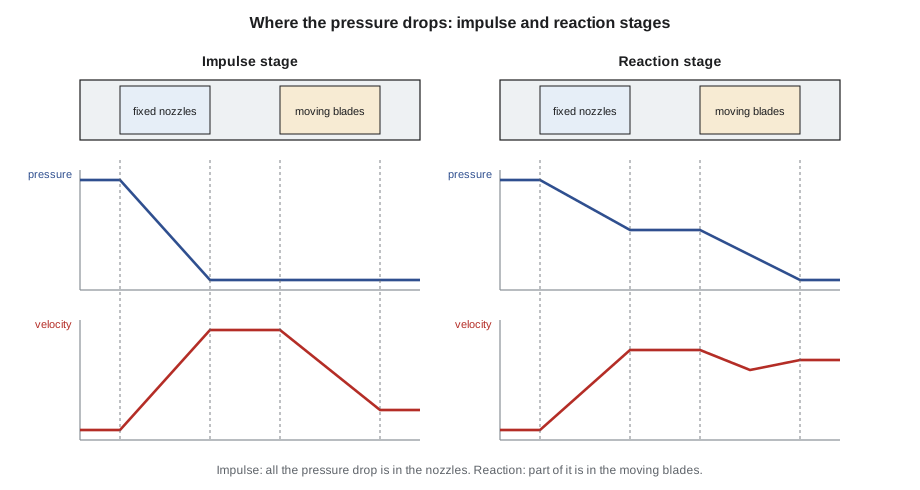
The degree of reaction is the fraction of the stage's enthalpy drop that occurs in the moving blades. A 50 in 100 reaction stage splits the drop equally between fixed and moving blades. Most large turbines combine impulse stages at the high-pressure end with reaction stages further along.
Because the whole enthalpy drop is too large to use in one row of blades efficiently, turbines divide it up by compounding:
- Velocity compounding (the Curtis stage): one set of nozzles makes one very fast jet, and two or three rows of moving blades, with fixed turning blades between them, take the velocity out in steps. It handles a large drop in a short machine and is common on small mechanical-drive turbines and as the first stage of larger ones.
- Pressure compounding (Rateau staging): a series of impulse stages, each with its own nozzles, takes the pressure down in steps. Each jet is slower, so blade speeds can be lower and efficiency higher.
- Pressure-velocity compounding: a Curtis stage followed by Rateau or reaction stages.

Kinds of turbine by where the steam goes
- A condensing turbine exhausts into a condenser under vacuum (lesson 8), so the steam expands much further and does much more work per kilogram. Utility and large industrial turbines are condensing.
- A back-pressure or non-condensing turbine exhausts at a pressure above atmospheric into a process steam header, a heater or the deaerator. It does less work per kilogram, but all of its exhaust steam is used. Cantwell's turbine is a small back-pressure turbine.
- An extraction turbine lets some steam out partway through, at a controlled pressure, for process or feedwater heating, and sends the rest on.
Back-pressure turbines are a natural fit in a heating plant. Whatever the turbine does not convert to work leaves in the exhaust, and if that exhaust heats the deaerator or a district heating exchanger, very little energy is lost overall.
Parts of a small mechanical-drive turbine
- The steam strainer at the inlet keeps scale and weld slag out of the nozzles.
- The trip and throttle valve is the turbine's main stop valve. It is opened by hand to admit steam and slams shut, by spring force, when the trip mechanism releases it. On some turbines the trip valve is separate from a hand throttle valve.
- The governor valve controls the steam flow to hold speed. It is moved by the governor.
- The nozzle ring or nozzle block carries the nozzles. Hand valves on some turbines close off groups of nozzles so the turbine can run efficiently at part load.
- The rotor: the shaft and the wheel or wheels carrying the blades.
- The glands seal the shaft where it leaves the casing. Small turbines use carbon rings held against the shaft by springs; larger ones use labyrinth seals, a series of sharp-edged fins that throttle the steam in steps. A small leak of steam from the gland leak-off is normal.
- The bearings: on small turbines, sleeve bearings fed by oil rings that ride on the shaft and lift oil from a sump, plus a thrust bearing to hold the rotor's axial position.
- The overspeed trip: a spring-loaded bolt or weight in the shaft end that flies outward at the trip speed, strikes a trip lever and releases the trip valve.
- The sentinel warning valve: a small spring-loaded valve on the exhaust casing that blows with a loud whistle if the exhaust pressure rises too high, for example because the exhaust valve has been left closed. It is a warning, not a relief valve; a full-capacity relief valve belongs on the exhaust line whenever the exhaust can be isolated.
- Casing drains at the low points of the casing and steam chest, which must be open during warm-up so that condensate does not collect where it can be picked up by the rotor.
Governors
A governor holds the turbine's speed close to its set point as the load changes. On a mechanical-drive turbine it adjusts the governor valve: if the pump load rises and the speed starts to fall, the governor opens the valve to admit more steam; if the load falls, it closes the valve. Governors range from simple to sophisticated:
- A mechanical flyweight governor: spinning weights move outward as speed rises and push the valve linkage directly. Simple and robust, but with a fairly large change in speed between no load and full load.
- A mechanical-hydraulic governor: flyweights move a small pilot valve that directs oil to a servo piston, which moves the governor valve with much more force and less speed change.
- An electronic governor: a magnetic speed pickup on the shaft feeds a controller that drives an actuator on the valve. It allows remote set point changes and close control.
The governor's droop or speed regulation is the drop in speed from no load to full load, expressed as a fraction of rated speed. A governor with 5 in 100 droop lets a 3,600 r/min turbine slow by about 180 r/min from no load to full load. Some droop makes the governor stable; zero droop (isochronous control) holds exactly constant speed and is used where only one machine controls a frequency or a speed.
The governor controls speed; it does not protect the turbine. If the governor valve sticks open and the load is lost, for example when a coupling breaks, the turbine can run away in seconds. That is what the overspeed trip is for.
The overspeed trip is never defeated
A turbine wheel stores enormous energy at speed, and the stress in it rises with the square of the speed. At about 110 in 100 of rated speed, a typical setting, the stress is already about 1.21 times the normal value. If the speed keeps rising, blades and then the wheel itself can fail, and the pieces leave the casing. Overspeed failures of turbines have killed operators.
That is why the plant's rules are absolute:
- The overspeed trip and the trip valve are never blocked, wired, wedged or gagged open, for any reason, while there is steam to the turbine.
- The trip is tested by hand at every monthly run, so the operator knows the trip valve closes freely and tightly.
- The actual overspeed trip speed is tested on the schedule the manufacturer and the plant set, under a written procedure, by people trained to do it, with a hand-held tachometer and someone at the hand trip. If the turbine reaches the trip speed and does not trip, it is tripped by hand at once and taken out of service.
- A turbine whose trip has failed or will not reset is out of service until it is repaired. It is not run "just this once" on the throttle valve.
Lorne put it plainly: "If anyone ever asks you to tie the trip so a turbine will stay running, the answer is no, and you tell the chief engineer. Nothing in this plant is worth that."
Other turbine trips may include low lube oil pressure, high exhaust pressure and high vibration. On Cantwell's small turbine the overspeed trip and the hand trip are the only ones; the sentinel valve gives warning of high exhaust pressure.
Warm-up and slow roll
A cold turbine must be brought up to temperature slowly and evenly. Steam admitted too fast condenses on the cold metal; the casing heats faster than the rotor and the clearances between them close; water collects in the casing and can be thrown against the blades. The general sequence, which the plant's own procedure details for each machine, is:
- Check oil levels and that the oil rings are turning freely once the shaft turns. On larger turbines, start the auxiliary oil pump.
- Open the exhaust valve fully first, so the turbine can never be pressurized against a closed exhaust. Check that the sentinel valve is free.
- Open the casing and steam chest drains, and blow down the steam supply line through its drain until dry steam arrives at the trip valve.
- Reset the trip and crack the trip and throttle valve to admit a little steam. Let the casing warm.
- Slow roll: let the rotor turn at a few hundred revolutions per minute. Listen for rubbing with a listening rod or stethoscope, watch the oil rings and the bearing temperatures, and check for vibration. A rub or any unusual noise means trip it and investigate.
- When the casing is warm and the drains blow dry steam, close the drains to their running position and open the throttle valve steadily, bringing the turbine up through its speed range to where the governor takes control.
- Check the governor holds speed, then load the pump according to its procedure.
A hot turbine that has just been shut down can usually be restarted more quickly, but the drains must still be opened. Water is the enemy of a turbine: a slug of condensate or carry-over from a boiler that is priming can strip blades in an instant. Any sign of water in the steam, such as a sudden drop in steam temperature, a change in sound or a rise in vibration, calls for an immediate trip.
The monthly run
At the turbine, Lorne showed Tamar the plant's run sheet and they went through it together. With the exhaust valve open and the drains open, he warmed the supply line and cracked the trip and throttle valve. The rotor began to turn slowly. He laid the tip of a listening rod on each bearing housing in turn and handed it to Tamar so she could hear a smooth hiss, no rubbing. After about ten minutes both bearing housings were warm, the oil rings were turning and the drains were blowing steam rather than water, except one.
The exhaust casing drain trap was cold and silent: failed closed, so condensate was not draining. Lorne opened the trap's bypass drain by hand, watched water run and then steam, and noted a work order for Fenella Thorncroft's crew to replace the trap. "If that had been missed, we'd have been rolling the wheel through water at the bottom of the casing," he said. Lesson 11 returns to steam traps.
He brought the turbine up to speed on the throttle valve until the governor took over at about 3,600 r/min, read the speed with a hand tachometer, and ran the pump on its minimum-flow recirculation line for thirty minutes, recording the bearing temperatures, oil levels, gland leak-off and vibration. Then came the trip test. Lorne had Tamar stand clear of the trip valve, struck the hand trip lever and the valve slammed shut. The turbine coasted down. He reset the trip, confirmed it latched, and noted on the sheet that the trip had operated. The run sheet went to Grazyna's tray; the full overspeed test is on the annual schedule with the turbine service contractor.
Steam rate
A turbine's steam rate is the mass of steam it uses per unit of work, in lb/hp·h. It depends on the enthalpy the steam can give up between inlet and exhaust, and on how much of that ideal drop the turbine actually captures, its isentropic efficiency.
The ideal drop is found by following a constant-entropy line from the inlet state down to the exhaust pressure, then reading the enthalpy there. The actual drop is the ideal drop times the efficiency.
Worked problem
Steam rate of the backup feed pump turbine
Steam enters the turbine dry saturated at the header pressure of 150 psig (164.7 psia), where h = 1,195 Btu/lb and s = 1.5629 Btu/lb·°R. It exhausts to the deaerator at 17.5 psia (about 3 psig), where h_f = 189 Btu/lb, h_fg = 964.6 Btu/lb, s_f = 0.3256 and s_fg = 1.4170 Btu/lb·°R. The turbine's isentropic efficiency is 0.45. Find the steam rate and the steam used at the rated 75 hp.
Show solution
- Quality at the exhaust after an ideal expansion:
- \[x = \frac{1.5629 - 0.3256}{1.4170} \approx 0.873\]
- Ideal exhaust enthalpy:
- \[h_{2s} = 189 + 0.873 \times 964.6 \approx 1{,}031 \text{ Btu/lb}\]
- Ideal and actual drops:
- \[1{,}195 - 1{,}031 = 164 \text{ Btu/lb} \to 0.45 \times 164 \approx 73.6 \text{ Btu/lb}\]
- Steam rate (1 hp·h = 2,544 Btu):
- \[2{,}544 \div 73.6 \approx 34.6 \text{ lb/hp·h}\]
- Steam flow at rated output:
- \[34.6 \times 75 \approx 2{,}590 \text{ lb/h}\]
Answer: About 34.6 lb/hp·h, or about 2,590 lb/h at full output: roughly a tenth of one boiler's rated steam. The exhaust leaves at about 1,121 Btu/lb, slightly wet, and nearly all of that heat goes into the deaerator. Of about 2.61 million Btu/h taken from the steam above feedwater enthalpy, about 0.19 million becomes shaft work and about 2.42 million heats feedwater.
The efficiency of 0.45 is typical of a small single-stage turbine at rated load; the figure for any real machine comes from its data sheet or a test. At part load, throttling at the governor valve lowers the effective efficiency, so the steam rate rises. If the turbine must run for long periods at light load, closing some of the nozzle hand valves, where fitted, keeps the remaining nozzles at full pressure and improves the steam rate.
Large condensing turbines, expanding to a vacuum of 2 inHg absolute or lower and with efficiencies of 0.85 or more, have steam rates of about 6.5 to 8 lb/hp·h, several times better. They are built for making electricity, not for driving a backup pump.
Common mistakes
MistakeBlocking or tying the overspeed trip so a turbine keeps running.
InsteadNever. A turbine with a faulty trip is out of service until it is repaired.
MistakeAdmitting steam before opening the exhaust valve.
InsteadOpen the exhaust fully first; the sentinel valve is only a warning.
MistakeStarting a cold turbine with the casing drains closed.
InsteadOpen drains and warm the casing slowly; water in a turbine strips blades.
MistakeTreating the governor as overspeed protection.
InsteadThe governor controls speed; only the trip protects against runaway.
MistakeJudging a back-pressure turbine as wasteful because its efficiency is low.
InsteadIts exhaust heat is used, so little energy is lost overall.
Summary and key terms
- A steam turbine converts enthalpy drop into jet velocity in nozzles, then into shaft work as blades turn the jet.
- In impulse stages the pressure drops only in the nozzles; in reaction stages part of the drop occurs in the moving blades.
- Velocity compounding (Curtis) and pressure compounding (Rateau) divide a large enthalpy drop into usable steps.
- The governor holds speed; the overspeed trip closes the trip valve if speed rises too far and is never defeated.
- Warm-up means opening the exhaust, opening drains, admitting steam slowly, slow rolling and listening before bringing the turbine to speed.
- Steam rate is 3,600 ÷ actual enthalpy drop in kg/kWh, or 2,544 ÷ actual drop in lb/hp·h; Cantwell's turbine uses about a tenth of a boiler's steam at full output.
- Impulse stage
- A turbine stage in which all the pressure drop occurs in the stationary nozzles.
- Reaction stage
- A turbine stage in which part of the pressure drop occurs in the moving blades.
- Curtis stage
- A velocity-compounded stage with one set of nozzles and two or more rows of moving blades.
- Back-pressure turbine
- A turbine that exhausts above atmospheric pressure into a header, heater or deaerator.
- Governor
- The control that holds a turbine's speed by adjusting its steam valve.
- Overspeed trip
- A device that closes the trip valve if the turbine exceeds a set speed.
- Sentinel warning valve
- A small valve on a turbine exhaust casing that whistles to warn of high exhaust pressure.
- Steam rate
- The steam a turbine uses per unit of work, in kg/kWh or lb/hp·h.
Practice problems
Work each problem on paper first, then reveal the answer to check.
Steam loses 52 Btu/lb through a nozzle. What is the jet velocity?
Show answer
About 1,614 ft/s.
A turbine's actual enthalpy drop is 64 Btu/lb. What is its steam rate?
Show answer
About 39.8 lb/hp·h.
A turbine rated at 3,600 r/min trips at 110 in 100 of rated speed. What is the trip speed?
Show answer
3,960 r/min.
By what factor does wheel stress rise at 110 in 100 of rated speed?
Show answer
About 1.21, because stress rises with the square of speed.
Why is the exhaust valve opened before steam is admitted?
Show answer
So the casing can never be pressurized against a closed exhaust.
Lesson quiz · 5 questions
Score 60% or more to complete this lesson.
Create a free account to save your progress, take quizzes and earn a certificate.