
PWR-220 · Lesson 8 of 12 · 26 min
External and internal water treatment
▶ Video coming soon A video version of this lesson is on the way.
On Thursday, November 5, 2026, Fenella Thorncroft's maintenance crew had softener B opened up in the water treatment room. Its resin was twelve years old, and its capacity between regenerations had been falling for a year, so Keziah Ostby had recommended replacing it before winter. The crew vacuumed out the old resin, inspected the underdrain and distributor, and poured in new resin from sealed bags. Tamar Ellingsen helped carry the bags and then stayed to watch the first regeneration. "Softener A carries the plant on its own today," Fenella said. "Tomorrow B comes back, and we test its outlet for hardness until we trust it."
Water treatment has two parts. External treatment removes impurities before the water reaches the boiler: softening, dealkalization, demineralization, reverse osmosis, filtration and deaeration. Internal treatment adds chemicals to the feedwater or boiler water to deal with whatever gets through: to keep hardness from forming scale, to remove the last oxygen, to keep the water alkaline, and to protect the condensate system. Most plants use both. This lesson covers the common methods and how Cantwell's program fits them together.
Filtration and clarification
Surface water and some well water carry suspended solids, color and organic matter. Large industrial plants may clarify such water by adding a coagulant that makes fine particles clump together, letting them settle, and then filtering the water through sand or multimedia filters. Water from a city main, like Cantwell's, has already been treated this way, so the plant needs only cartridge filters to protect downstream equipment. Activated carbon filters are used where chlorine or chloramine must be removed before equipment that it would damage, such as reverse osmosis membranes.
Sodium softening
A sodium zeolite or sodium cation softener passes water through a bed of ion exchange resin, small plastic beads that hold sodium ions loosely. Calcium and magnesium ions in the water swap places with the sodium, so the water leaves with its hardness replaced by sodium. When the resin has given up most of its sodium, it is exhausted and must be regenerated with strong salt brine. Regeneration has four steps:
- Backwash: water flows upward through the bed to loosen it and flush out trapped dirt and broken beads.
- Brine draw: salt brine is drawn slowly through the bed, driving off the calcium and magnesium and reloading it with sodium.
- Slow rinse: water pushes the brine through the bed at the same slow rate, finishing the exchange.
- Fast rinse: water rinses the remaining brine to drain until the outlet is free of salt and hardness.
Worked problem
Softener capacity and salt use
The new resin in softener B is 30 ft³ at a capacity of about 20,000 grains of hardness per cubic foot when regenerated with about 6 lb of salt per cubic foot. What is the softener's capacity, the salt used per regeneration, and the hardness removed per pound of salt?
Show solution
- Capacity:
- \[30 \times 20{,}000 = 600{,}000 \text{ grains}\]
- Salt per regeneration:
- \[30 \times 6 = 180 \text{ lb}\]
- Efficiency:
- \[600{,}000 \div 180 \approx 3{,}333 \text{ grains per lb of salt}\]
Answer: About 600,000 grains per regeneration, using 180 lb of salt. Using more salt per cubic foot raises the capacity, but each extra pound does less work, so plants choose a salt dose that balances capacity against salt cost. At Cantwell's make-up rate the softener runs a little over four days between regenerations.
Resin wears out slowly. Chlorine and chloramine in city water oxidize it, iron and organic matter foul it, and beads break up with each backwash. Signs of tired resin include falling capacity, hardness leakage early in a run, and a rising pressure drop across the bed. On November 6, after its first regeneration and rinse, softener B's outlet tested at zero hardness, and it was returned to duty alternating with softener A. Tamar logged the outlet tests every two hours for the first day, then every shift as normal.
Dealkalization
Softening leaves alkalinity in the water, and lesson 7 showed that bicarbonate alkalinity in the make-up turns into carbon dioxide in the steam. Where make-up is large and alkalinity high, plants add a dealkalizer:
- A chloride anion dealkalizer is a second ion exchange bed, after the softener, filled with anion resin regenerated with salt (often with a little caustic soda). It swaps bicarbonate, sulfate and nitrate for chloride, typically removing most of the alkalinity.
- A split-stream system passes part of the water through a hydrogen cation exchanger, which turns bicarbonate into carbonic acid, and blends it with softened water; the carbon dioxide is then blown out in a degasifier.
- A weak acid cation exchanger removes hardness associated with alkalinity and converts the bicarbonate to carbon dioxide, which is removed in a degasifier.
Dealkalizing Cantwell's make-up would remove most of the roughly 84 mg/L of carbon dioxide that the alkalinity can release into the steam, lower the amine needed for the condensate and allow somewhat higher cycles of concentration, at the cost of more equipment, salt and rinse water.
Demineralization and reverse osmosis
Demineralization removes nearly all dissolved salts. Water passes through a strong acid cation exchanger in the hydrogen form, which exchanges all cations for hydrogen, and then a strong base anion exchanger in the hydroxide form, which exchanges all anions for hydroxide. The hydrogen and hydroxide combine to form water. A final mixed bed of cation and anion resin polishes the water to very high purity. The beds are regenerated with acid and caustic, which need careful handling. Demineralized water is standard for high-pressure utility boilers.
Reverse osmosis (RO) pushes water at high pressure through semi-permeable membranes that let water pass but hold back most dissolved salts, typically 95 to 99 parts in 100. The purified water is the permeate; the water carrying the rejected salts, the concentrate or reject, goes to drain. The fraction of the feed that becomes permeate is the recovery, often around 75 in 100 for a system like Cantwell would need. RO membranes need softened or antiscalant-treated, dechlorinated feed, because hardness scales them and chlorine destroys them.
Worked problem
What reverse osmosis would do for blowdown
Boiler 2's feedwater conductivity is 150 µS/cm and its boiler water limit is 3,000 µS/cm, so it runs at 20 cycles, with about 695 lb/h of blowdown from 13,900 lb/h of feed. If RO make-up lowered the feed conductivity to 15 µS/cm, what cycles and blowdown would the same limit allow? And how much water would the RO send to drain to make 770 US gallons an hour of permeate at 75 in 100 recovery?
Show solution
- Cycles:
- \[3{,}000 \div 15 = 200\]
- Blowdown:
- \[13{,}900 \div 200 \approx 70 \text{ lb/h}\]
- RO feed:
- \[770 \div 0.75 \approx 1{,}027 \text{ gal/h}\]
- Concentrate to drain:
- \[1{,}027 - 770 = 257 \text{ gal/h}\]
Answer: In theory the blowdown on boiler 2 would fall from about 695 lb/h to about 70 lb/h, saving most of the heat and treated water it carries. In practice other limits, such as the minimum blowdown needed to remove sludge and the program's alkalinity range, set the real cycles below 200. And the RO itself would send more than 250 gallons an hour of cold, untreated water to drain. Whether RO pays depends on the cost of water, heat, chemicals and the equipment, which is the kind of study a chief engineer weighs for a capital plan.
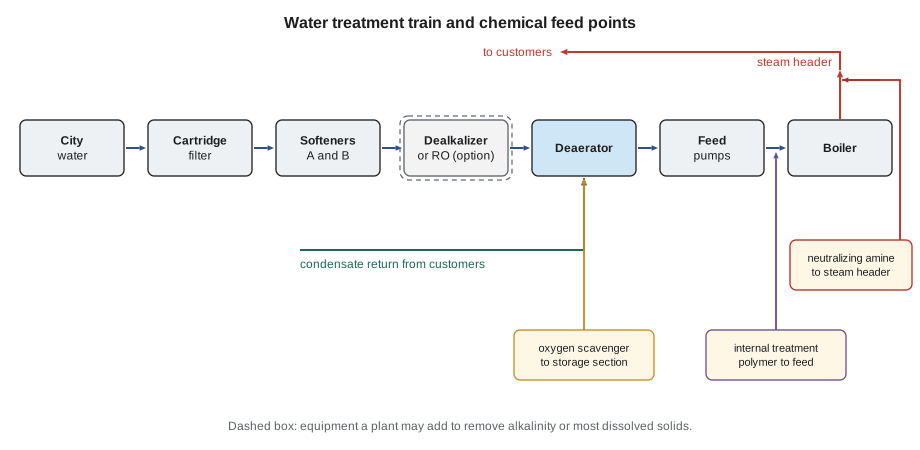
Internal treatment for scale
However good the external treatment, a little hardness and iron reach the boiler. Internal treatment keeps them from forming hard scale. The main programs are:
- Phosphate programs add sodium phosphate, which reacts with calcium to form a soft, fluffy sludge (calcium hydroxyapatite) instead of hard scale, provided the boiler water is alkaline enough. The sludge is removed by bottom blowdown. A sludge conditioner or dispersant keeps it fluid. At higher pressures, coordinated or congruent phosphate programs control the ratio of sodium to phosphate to avoid caustic and acid attack.
- Chelant programs add a chelating agent, such as EDTA or NTA, which binds calcium, magnesium and iron into soluble compounds that leave with the blowdown. Chelants can give very clean boilers but must be fed carefully: an overdose with no hardness to bind attacks steel.
- Polymer programs use synthetic polymers that keep hardness and iron dispersed, or hold them in solution, so they do not deposit. All-polymer programs are common in low-pressure industrial boilers fed with softened water, and many phosphate and chelant programs include a polymer too.
Cantwell uses a polymer dispersant program with softened make-up. Keziah's tests check the polymer level, often with a tracer that can be measured directly, and the absence of hardness in the boiler water.
Oxygen scavengers
An oxygen scavenger removes the oxygen that the deaerator leaves (lesson 4) and keeps a reserve in the boiler water to deal with any brief upset.
- Sodium sulfite is the most common in low-pressure boilers. It reacts with oxygen to form sodium sulfate. A catalyzed sulfite, with a trace of cobalt, reacts fast enough even in cold water. It adds dissolved solids, and at higher pressures it can break down to give corrosive gases, so it is used up to moderate pressures.
- Hydrazine reacts with oxygen to form only water and nitrogen, adding no solids, and it helps form a protective magnetite layer on steel. It is a suspected carcinogen, so most plants have replaced it.
- Hydrazine alternatives include carbohydrazide, diethylhydroxylamine (DEHA), erythorbate and hydroquinone. They add few or no solids, several are volatile so they also protect the condensate system, and they are safer to handle.
Cantwell feeds catalyzed sulfite into the deaerator storage section, so it has time to react before the water reaches the boilers, and controls it to keep a sulfite residual in the boiler water within the program's range, typically a few tens of mg/L for a low-pressure boiler.
Worked problem
Where the sulfite goes
Boiler 2 blows down about 695 lb/h, and the program holds a sulfite residual of about 30 ppm. Lesson 4 found the deaerator's 7 ppb of oxygen needs only about 0.0015 lb/h of sulfite for all of Cantwell's feed. How much sulfite leaves boiler 2 in its blowdown?
Show solution
- \[695 \times 30 \times 10^{-6} \approx 0.021 \text{ lb/h} \approx 0.5 \text{ lb/day}\]
Answer: About 0.021 lb/h, fourteen times as much as the oxygen consumes. Most of the scavenger fed to a well-deaerated plant goes to maintaining the residual. That residual is the safety margin: if the deaerator falters, the reserve reacts with the extra oxygen before pitting begins, and the falling residual alerts the operators.
Condensate treatment: amines
Carbon dioxide in the steam makes condensate acid. Two kinds of amine protect condensate lines:
- Neutralizing amines, such as morpholine, cyclohexylamine and diethylaminoethanol (DEAE), are volatile alkaline chemicals that travel with the steam and neutralize carbonic acid where the condensate forms. Each amine has a different distribution ratio, the ratio of its concentration in the steam to that in the condensate, so blends are used to protect both nearby and distant parts of a system.
- Filming amines, such as octadecylamine, form a thin water-repellent film on the inside of condensate lines, keeping both carbonic acid and oxygen away from the steel.
In a district energy system, much of the condensate is in customers' buildings, and some is not returned at all. Cantwell feeds a neutralizing amine blend into the steam header so that it reaches every building, and Keziah tests condensate pH and iron at sample points on the return to judge how well it works. Where steam is used for humidification or food, only approved amines, or none, may be used, which the program must take into account.
Feeding chemicals safely
Treatment chemicals are fed by small metering pumps from day tanks, at rates the program sets and the operators adjust from test results. Feed lines and injection quills must be checked for leaks and blockages, and the pump stroke and tank level recorded each shift. Most treatment chemicals are corrosive or irritating: caustic soda, acids for regeneration, concentrated sulfite and amines can all burn skin and eyes. Operators read the safety data sheet for each product, wear the specified eye, face and hand protection when handling them, never mix chemicals in a tank or drain, and know where the eyewash and safety shower are before they start.
Choosing a program
No one treatment program suits every plant. The choice depends on several things that the water treatment supplier and the chief engineer weigh together:
- Boiler pressure and design: higher pressures need purer water, tighter control of caustic and lower silica, and rule out some chemicals altogether.
- Make-up quality and amount: a plant with high make-up and hard, alkaline water needs more external treatment than one that returns most of its condensate.
- What the steam is used for: steam for food, humidification or sterilization limits the chemicals that may be fed, especially amines.
- Condensate return: a district system with long return lines and customers' equipment needs strong condensate protection.
- Operator time and skill: some programs need more frequent and more careful testing than others.
- Cost: chemicals, salt, water, sewer charges, heat lost in blowdown, and the equipment for external treatment.
Cantwell's polymer, catalyzed sulfite and neutralizing amine program suits a low-pressure plant with softened make-up and a long condensate system. If the plant added a dealkalizer or reverse osmosis, the internal program would be revised to match, with lower chemical feeds and higher cycles. Any such change is handled under management of change, with new test ranges, training and updated logs.
Common mistakes
MistakeThinking a softener removes alkalinity or dissolved solids.
InsteadIt only swaps hardness for sodium; dealkalizers, demineralizers or RO remove the rest.
MistakeFeeding chelant with no regard to hardness level.
InsteadOverfed chelant attacks boiler steel.
MistakeTreating oxygen scavenger as a substitute for deaeration.
InsteadThe scavenger polishes and keeps a reserve; the deaerator does the work.
MistakeIgnoring a falling sulfite residual.
InsteadIt often means oxygen is getting in or the feed has stopped.
MistakeSending chlorinated water to RO membranes.
InsteadChlorine destroys most membranes; dechlorinate first.
Summary and key terms
- External treatment removes impurities before the boiler; internal treatment conditions what gets through.
- Sodium softeners exchange hardness for sodium and are regenerated by backwash, brine, slow rinse and fast rinse.
- Dealkalizers remove alkalinity; demineralizers and reverse osmosis remove most dissolved solids, allowing higher cycles.
- Phosphate, chelant and polymer programs prevent scale; Cantwell uses a polymer program with softened make-up.
- Sulfite, hydrazine and its alternatives scavenge oxygen; most of the feed maintains a protective residual.
- Neutralizing and filming amines protect condensate lines from carbonic acid and oxygen.
- External treatment
- Removal of impurities from water before it enters the boiler.
- Internal treatment
- Chemicals added to feedwater or boiler water to prevent scale, corrosion and carryover.
- Regeneration
- Restoring an exhausted ion exchange resin by passing a regenerant, such as brine, through it.
- Dealkalizer
- An ion exchange unit that removes bicarbonate and other alkalinity from make-up water.
- Reverse osmosis
- A process that forces water through membranes that reject most dissolved salts.
- Chelant
- A chemical that binds hardness and iron into soluble compounds.
- Oxygen scavenger
- A chemical that reacts with and removes dissolved oxygen.
- Neutralizing amine
- A volatile alkaline chemical that travels with steam and neutralizes carbonic acid in condensate.
Practice problems
Work each problem on paper first, then reveal the answer to check.
A softener holds 20 ft³ of resin at 20,000 grains per cubic foot. What is its capacity?
Show answer
400,000 grains.
Raw water hardness is 9 gpg and make-up is 500 gal/h. How long does a 400,000 grain softener last?
Show answer
About 89 hours (400,000 ÷ 4,500 grains/h).
Feed conductivity is 30 µS/cm and the limit is 3,000. What cycles are possible?
Show answer
100.
An RO unit makes 400 gal/h of permeate at 75 in 100 recovery. How much goes to drain?
Show answer
About 133 gal/h.
Why is catalyzed sulfite fed into the deaerator storage section?
Show answer
To give it time to react with oxygen before the water reaches the boiler.
Lesson quiz · 5 questions
Score 60% or more to complete this lesson.
Create a free account to save your progress, take quizzes and earn a certificate.