
PWR-220 · Lesson 12 of 12 · 22 min
Boiler failures and what causes them
▶ Video coming soon A video version of this lesson is on the way.
On Saturday, November 14, 2026, the laboratory report on boiler 3's failed tube arrived, and Grazyna Wolanski asked Tamar Ellingsen to read it with her before it went into the boiler's file. The lab had split the tube section lengthwise. Its inside surface was dotted with rounded pits, some capped with small reddish-brown mounds, and the pinhole that had leaked was at the bottom of the deepest one. Elsewhere the inside of the tube had a thin, even, black oxide layer. "Oxygen pitting," Grazyna said. "Not overheating, not scale. Now the question is where the oxygen came from, because our deaerator has tested fine every month."
This lesson describes the main ways boilers fail, what each failure looks like, and what causes it. Knowing the appearance of a failure helps operators and inspectors find its cause, and knowing the cause is the only way to stop the next one. The lesson ends with what Cantwell found and changed.
Why boilers fail
Boilers fail when the metal can no longer carry the stress put on it. That happens in one of three ways: the metal gets too hot and loses strength; the metal gets too thin from corrosion or erosion; or the metal cracks from fatigue, stress corrosion or embrittlement. Almost every failure in a well-built boiler traces back to water, fire or operation:
- Water side: low water, scale and deposits, dissolved oxygen, wrong chemistry.
- Fire side: flame impingement, fuel ash and acid, erosion.
- Operation: fast start-ups and shutdowns, thermal cycling, poor layup, overfiring.
Some failures are sudden and violent; others take years. The violent ones are why boiler codes exist.
A short history
In the nineteenth and early twentieth centuries, boiler explosions killed thousands of people in factories, ships, railways and homes. One of the worst in North America happened at the Grover Shoe Factory in Brockton, Massachusetts, in March 1905, when a boiler exploded early on a working morning, the building collapsed and caught fire, and dozens of workers died. Massachusetts responded with boiler rules in 1907, other states followed with conflicting rules of their own, and the confusion led ASME to publish its first boiler code, for power boilers, in 1914 and 1915. The provinces and the National Board followed. The rules on materials, design, inspection, safety valves and low water protection that this course describes were written, in large part, from the wreckage of failures.
Overheating from low water
Low water is the most dangerous failure an operator can cause or prevent. When the water level falls below the top of the tubes or the furnace crown, the uncovered metal is no longer cooled. Within minutes it reaches temperatures at which steel loses most of its strength, and the pressure stretches it.
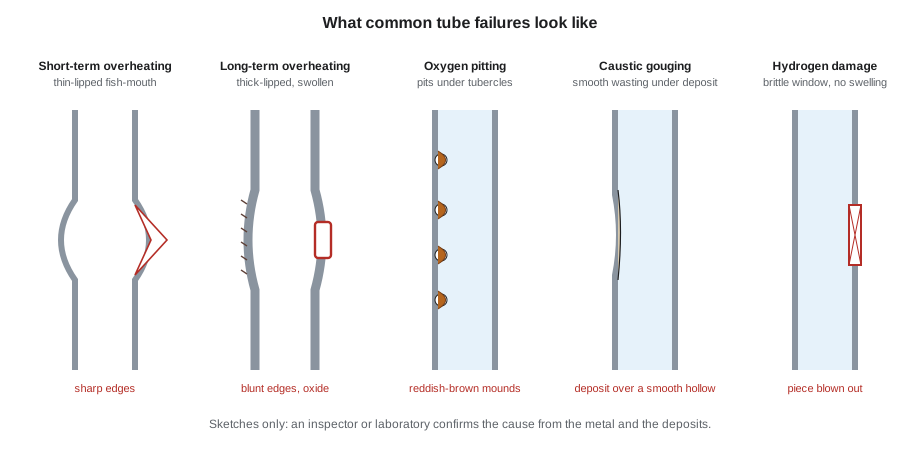
- In a watertube boiler, the first tubes to be uncovered or starved of circulation overheat. They bulge, blister and then rupture with a thin-lipped, fish-mouth split, the edges stretched sharp. Tubes may sag, pull out of the drum, or distort the drum seams.
- In a firetube boiler, the crown of the furnace or the top rows of tubes overheat. The furnace may collapse inward, and tubes may leak at the tube sheets.
If a boiler is found with its water level out of sight in the gauge glass, the safe response is to shut off the fuel at once and leave the feedwater alone until the boiler has cooled and been examined. Adding cold water to red-hot metal can crack it or cause a sudden burst of steam. The low water cutoffs should have shut the burner off long before the level reached that point; if they did not, the boiler must not be restarted until the cutoffs and the cause have been checked by the inspector.
Overheating from scale and deposits
Scale and deposits insulate the tube from the water. The tube metal must then run hotter to pass the same heat. A thin layer of scale may raise the metal temperature by tens of degrees; a thick one by hundreds. The damage depends on how hot and for how long:
- Short-term overheating, from a sudden loss of cooling, gives the thin-lipped rupture described above.
- Long-term overheating, from scale or slightly too much heat over months or years, puts the tube into the creep range (lesson 2). The tube swells slowly, its outside develops thick oxide and fine cracks, and it finally fails with a thick-lipped rupture, the edges blunt because the metal crept rather than stretched suddenly.
Both are prevented by keeping hardness, iron and silica out of the boiler, controlling blowdown, and never firing above the boiler's rating. When a tube fails by overheating, the inspector will look at the deposits on its inside surface and ask for the water treatment records.
Oxygen pitting
Oxygen pitting is the localized attack of steel by dissolved oxygen. It forms rounded pits, often capped with reddish-brown or black tubercles of iron oxide, under which the pit keeps growing. It is found where oxygen reaches hot or wet steel: in feed lines, economizers, at the water line in drums, and above all in idle boilers that have been laid up badly, where air dissolves into the water and attacks the metal for months. Because pitting concentrates the attack in small spots, a tube can be perforated while most of its wall is still sound.
Worked problem
How fast was the pitting?
Boiler 3's floor tubes have a wall thickness of 0.105 in. During the November repair, the contractor's borescope and ultrasonic readings found the deepest remaining pit in a neighboring tube at 0.063 in. The boiler had stood idle and full of water from early May to mid-September, about 4.5 months. If the pit formed during that idle period, what was its average growth rate, how much wall is left, and what would another idle season do?
Show solution
- Growth rate:
- \[0.063 \div 4.5 \approx 0.014 \text{ in per month}\]
- Wall left:
- \[0.105 - 0.063 = 0.042 \text{ in}\]
- Another 4.5-month idle season at the same rate:
- \[0.014 \times 4.5 \approx 0.063 \text{ in, more than the 0.042 in left}\]
Answer: The pit grew at roughly 0.014 in a month while the boiler was idle, and about 40 in 100 of the wall is left at that spot. Another summer laid up the same way would very likely perforate it. In service, with deaerated and scavenged water, the same steel loses only a tiny fraction of that. The damage was done by the layup, not by operation.
Caustic attack and caustic embrittlement
Boiler water is kept alkaline, but sodium hydroxide that is allowed to concentrate attacks steel. Concentration happens where water boils away and leaves its solids behind: under porous deposits, in crevices, at leaking seams and rolled joints, and where steam blankets a tube.
- Caustic gouging is a smooth, irregular wasting of the metal under a deposit, often on the hot side of a tube, where concentrated caustic dissolves the protective oxide and then the steel.
- Caustic embrittlement, or caustic stress corrosion cracking, is cracking along the grain boundaries of highly stressed steel exposed to concentrated caustic, typically at riveted seams and rolled tube ends where a slight leak lets water evaporate and concentrate. The cracks are fine and branching, and a seam can fail suddenly. It was a major cause of explosions in riveted boilers.
Both are prevented by controlling the amount of free hydroxide in the boiler water, keeping the boiler free of deposits, and fixing leaks at seams and tube ends promptly. Some programs add inhibitors, such as nitrate, and coordinated phosphate programs at higher pressures limit free caustic.
Hydrogen damage and acid attack
Hydrogen damage happens when corrosion under a dense deposit produces atomic hydrogen, usually because the boiler water has become acidic, as it can after a condenser leak in a power station or an acid cleaning gone wrong. The hydrogen diffuses into the steel and reacts with its carbon to form methane at the grain boundaries, cracking the metal from inside and destroying its strength. The tube fails with a thick-walled, brittle fracture in which a whole piece, a window, may blow out without the tube having swelled. It is found most often in high-pressure boilers, and its prevention is close control of water chemistry and quick action on any contamination.
General acid attack, from acid entering the boiler or poor acid cleaning, thins and roughens the metal over a wide area.
Fire-side failures
- Flame impingement: a misaligned, damaged or poorly adjusted burner lets the flame strike tubes or refractory directly. The tubes overheat locally, bulge and fail, and refractory spalls. Burner alignment and flame pattern are checked at every burner service and by operators through the sight ports.
- Erosion: soot blower steam or air, or abrasive fly ash in solid-fuel boilers, wears tubes thin in a pattern that follows the jet or the gas flow.
- Low-temperature corrosion: acid or water condensing on economizers, air heaters or cold casing (lesson 3).
- High-temperature ash corrosion: in oil- and coal-fired boilers, molten ash compounds attack superheater and reheater tubes.
- Furnace explosions: unburned fuel igniting in the furnace, prevented by purging, proven air flow, flame supervision and correct light-off procedures (lesson 6).
Thermal fatigue and corrosion fatigue
Thermal fatigue cracks metal that is repeatedly heated and cooled faster than its thickness can follow. It appears at places where hot and cold meet or where thick and thin parts join: tube-to-drum joints, economizer inlet headers that receive cold feed, attemperator nozzles, drain and blowdown connections, and drums that are started and stopped often. The cracks are usually straight and grouped in parallel or crazed patterns.
Corrosion fatigue combines cyclic stress with corrosion. The cracks are usually filled with oxide and wider than plain fatigue cracks. It is common near tube attachments and supports in boilers that cycle often and have marginal water chemistry.
Both are prevented by steady operation: following the manufacturer's warm-up and cool-down rates, avoiding slugs of cold water into hot parts, keeping feedwater temperature up, and keeping the number of starts and stops as low as the load allows.
Investigating a failure
When a boiler fails, the evidence disappears quickly. Good practice is to:
- Make the boiler safe and protect people first.
- Preserve the evidence: photograph the failure before it is disturbed, keep the failed part, and keep deposits from being washed off until the inspector or investigator has seen them.
- Collect the records: the log, trends, water treatment results, recent maintenance and any unusual operation.
- Have the failed part examined by a laboratory if the cause is not obvious. Metallography can show whether the metal overheated and for how long, and deposit analysis shows what the water left behind.
- Find the root cause, not just the failed part: why the oxygen, scale, low water or flame reached the metal, and why the existing safeguards did not stop it.
- Fix the cause and record it in the boiler's failure history, so the lesson outlasts the people who learned it.
| Failure | Typical appearance | Usual cause |
|---|---|---|
| Short-term overheating | Thin-lipped, fish-mouth rupture | Low water or loss of circulation |
| Long-term overheating | Swollen tube, thick-lipped rupture, heavy outside oxide | Scale, deposits or overfiring |
| Oxygen pitting | Rounded pits under tubercles | Oxygen in feedwater or poor layup |
| Caustic gouging | Smooth wasting under deposits | Concentrated caustic under deposits |
| Caustic embrittlement | Fine branching cracks at seams or tube ends | Caustic concentrating at leaks under high stress |
| Hydrogen damage | Brittle window fracture without swelling | Acidic contamination under deposits |
| Thermal fatigue | Parallel or crazed cracks at joints | Repeated rapid heating and cooling |
What Cantwell found and changed
Grazyna and Tamar worked through the evidence. The pits were on the floor tubes, which are the last to drain and the most likely to hold stagnant water. The deaerator and scavenger records were good every month of operation. Boiler 3 had been the summer standby, laid up full of water from early May until its September inspection. The layup log showed that the water had been treated when the boiler was shut down, but the sulfite residual had not been tested again after June, and the drum had been opened twice during the summer for small jobs, letting air in each time.
The conclusion went into the failure history: oxygen pitting during wet layup, caused by loss of scavenger residual and air admitted during the idle period. Grazyna drafted the changes for the next operations meeting:
- Revise the wet layup procedure: fill the boiler completely to the top of the drum, treat the water to a higher scavenger residual and pH, test it weekly and top up the treatment, and keep a slight nitrogen pressure on the steam space so no air can enter. Any opening of a laid-up boiler is to be followed by retreatment.
- Consider dry layup for idle periods longer than a few months: drain, dry and seal the boiler with trays of desiccant, inspected monthly.
- Plan the replacement of the floor tubes with the deepest pits at a planned outage in 2027, with ultrasonic thickness readings on the rest, as Ottoline Brackwater had recommended.
- Add the layup checks to the shift task list so they are logged like any other test.
"Every failure in that file teaches the same lesson in a different way," Grazyna said. "Water, fire or operation. If you look after those three, most boilers will outlast the people who run them."
Common mistakes
MistakeAdding feedwater to a boiler whose level is out of sight.
InsteadShut off the fuel and let the boiler cool; cold water on hot metal can crack it.
MistakeWashing out deposits before the inspector has seen a failure.
InsteadPreserve the evidence; the deposits often explain the failure.
MistakeAssuming a pinhole means the whole tube is thin.
InsteadPitting concentrates attack; the wall may be sound elsewhere, or other pits may be close behind.
MistakeLaying up a boiler wet and forgetting it.
InsteadTest and retreat the layup water and keep air out.
MistakeBlaming the part rather than the cause.
InsteadFind out why the oxygen, scale, low water or flame reached the metal.
Summary and key terms
- Boilers fail when metal gets too hot, too thin or cracked; the causes are almost always water, fire or operation.
- Low water causes short-term overheating with thin-lipped ruptures; the response is to shut off the fuel, not to add water.
- Scale causes long-term overheating and creep, with thick-lipped ruptures.
- Oxygen pitting forms rounded pits under tubercles, especially in poorly laid-up boilers; caustic attack and hydrogen damage come from concentrated or acidic water under deposits.
- Flame impingement, erosion, cold-end corrosion and thermal fatigue are fire-side and operating causes.
- Failure investigation preserves evidence, finds the root cause, fixes it and records it in the failure history.
- Fish-mouth rupture
- A thin-lipped tube rupture typical of short-term overheating.
- Thick-lipped rupture
- A blunt-edged tube rupture typical of long-term overheating and creep.
- Tubercle
- A mound of iron oxide over an oxygen pit.
- Caustic embrittlement
- Intergranular cracking of stressed steel by concentrated sodium hydroxide.
- Caustic gouging
- Smooth, irregular wasting of steel by concentrated caustic under deposits.
- Hydrogen damage
- Loss of strength and cracking of steel caused by hydrogen produced by corrosion under deposits.
- Flame impingement
- Direct contact of flame with tubes or refractory, causing local overheating.
- Layup
- The protection of an idle boiler against corrosion, wet or dry.
Practice problems
Work each problem on paper first, then reveal the answer to check.
A tube with a 0.120 in wall has a pit 0.048 in deep. What fraction of the wall remains at the pit?
Show answer
0.6, or 60 in 100.
A pit grew 0.036 in in 3 months. At the same rate, how long until a remaining 0.060 in of wall is gone?
Show answer
5 months.
Which failure gives a thin-lipped, fish-mouth rupture?
Show answer
Short-term overheating, usually from low water.
Where does caustic embrittlement usually occur?
Show answer
At highly stressed seams and rolled tube ends where slight leaks concentrate caustic.
What are the three main sources of boiler failures?
Show answer
Water, fire and operation.
Lesson quiz · 5 questions
Score 60% or more to complete this lesson.
Create a free account to save your progress, take quizzes and earn a certificate.