
PWR-220 · Lesson 6 of 12 · 24 min
Combustion control and draft systems
▶ Video coming soon A video version of this lesson is on the way.
On Thursday, October 29, 2026, Halvard Rosemund of Calderwood Combustion Services spent the day at Cantwell commissioning a new oxygen trim system on boiler 1. Six days earlier, Pilar Quenneville's combustion test on that boiler had found 3.0 in 100 oxygen in the flue gas, 20 ppm of carbon monoxide and a stack temperature of 370 °F, all acceptable but with more excess air than the boiler needed. The trim system would measure oxygen continuously and fine-tune the air to hold a lower, steady value across the firing range. "The burner's linkage or curves get it close," Halvard told Tamar Ellingsen, "but air density changes with the weather and the fuel changes a little day to day. Trim takes care of the drift."
This lesson covers how a boiler's fuel and air are controlled to match the load, how the flue gas is moved through the boiler and up the stack, and the safety principles behind both. PWR-120 lesson 6 covered burners and the basics of combustion; PWR-210 lesson 9 calculated combustion air and stack losses.
What combustion control must do
A combustion control system receives a firing rate demand from the steam pressure master (lesson 5) and sets the fuel and air to match it. It must:
- Match the heat input to the load, so steam pressure stays steady.
- Keep the fuel-air ratio correct at every firing rate, with enough excess air to burn all the fuel completely but no more than needed, because every extra kilogram or pound of air carries heat up the stack.
- Never let the mixture go fuel-rich, even for a moment during a load change. A fuel-rich furnace makes carbon monoxide and unburned fuel, which can ignite explosively when air catches up.
- Keep the furnace pressure or draft within limits.
How these jobs are done depends on the size and type of the boiler.
Positioning systems
In a positioning system, the firing rate demand sets the position of the fuel valve and the air damper, but neither fuel flow nor air flow is measured.
- Single-point positioning, or a jackshaft system, drives the fuel valve and air damper from one motor through a shaft and adjustable linkages or cams. It is simple and reliable but cannot correct for wear, slack in the linkages or changes in air density.
- Parallel positioning gives the fuel valve and the air damper (and often a fan speed drive) their own servo motors. A microprocessor controller moves each to a position set by a characterized curve programmed during burner set-up, point by point across the firing range. It removes linkage slack and lets the curve be shaped precisely.
Cantwell's steam boilers use parallel positioning. Halvard set their curves during the October 8 burner service. A positioning system is only as good as its set-up: the right ratio of fuel to air at each point depends on the fuel's heating value, the air temperature and the fan's condition, none of which the system measures.
Fully metered control with cross-limiting
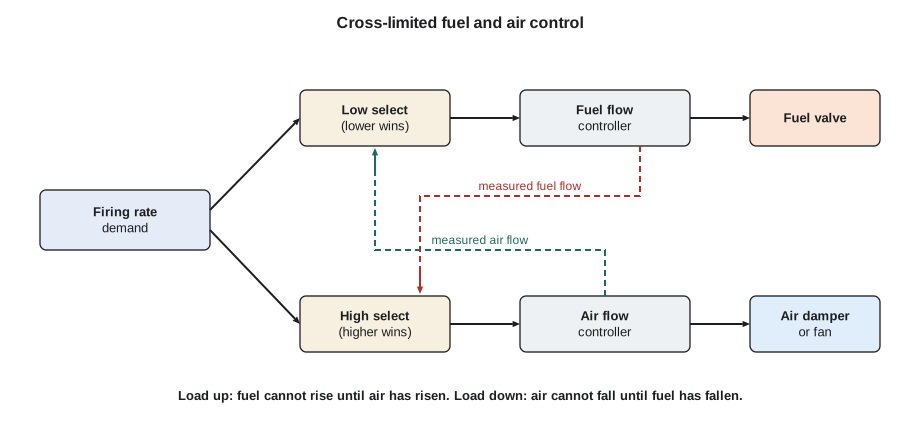
Larger boilers measure both fuel flow and air flow and control each with its own flow controller. This is fully metered or metering control. Its key safety feature is cross-limiting, which keeps the mixture on the air-rich side during load changes:
- On a load increase, air must rise first. The fuel flow set point is the lower of the firing rate demand and the measured air flow (converted to its fuel equivalent). Fuel cannot rise until air has risen.
- On a load decrease, fuel must fall first. The air flow set point is the higher of the firing rate demand and the measured fuel flow (converted to its air equivalent). Air cannot fall until fuel has fallen.
This is often summarized as "air leads fuel up, fuel leads air down". The low and high selectors that do it are simple, but they mean a sticky fuel valve or a slow fan cannot make the furnace fuel-rich.
Oxygen trim
An oxygen trim system measures the oxygen in the flue gas, usually with a zirconium oxide probe mounted in the boiler outlet or breeching, and trims the air (or the fuel-air ratio) to hold an oxygen set point. The set point is usually a curve, higher at low fire, where mixing is poorer, and lower at high fire. The trim is limited to a small band either side of the burner's base curve, so that a failed analyzer cannot drive the burner far from its safe setting, and on a fault the trim returns to zero and the burner runs on its base curve.
Some systems add carbon monoxide trim, which lowers the air until a trace of CO appears and then backs off slightly. It finds the lowest safe excess air directly.
Worked problem
Savings from lower excess air
Boiler 1 burns about 871 lb/h of natural gas (about 19,400 ft³/h). Natural gas needs about 17.2 lb of air per pound for complete combustion. Excess air is roughly O₂ ÷ (21 − O₂). If trim lowers the flue gas oxygen from 3.0 to 2.0 in 100, with the stack at 370 °F and combustion air at 70 °F, estimate the heat saved, taking c_p = 0.26 Btu/lb·°F for the flue gas.
Show solution
- Excess air before and after:
- \[3 \div 18 \approx 0.167 \qquad 2 \div 19 \approx 0.105\]
- Air flow before and after:
- \[871 \times 17.2 \times 1.167 \approx 17{,}478 \text{ lb/h} \qquad 871 \times 17.2 \times 1.105 \approx 16{,}559 \text{ lb/h}\]
- Less flue gas:
- \[17{,}478 - 16{,}559 = 919 \text{ lb/h}\]
- Heat no longer carried up the stack:
- \[919 \times 0.26 \times (370 - 70) \approx 71{,}700 \text{ Btu/h}\]
- Fraction of the fuel input of about 19,980,000 Btu/h:
- \[71{,}700 \div 19{,}980{,}000 \approx 0.0036\]
Answer: About 0.4 in 100 of the fuel. Over a year of about 6,000 hours at this rate that is roughly 420,000 ft³ of gas, or around 3,800 dollars at a sample price of 9 dollars per 1,000 ft³. The bigger benefit is often that the oxygen stays where it is set as the weather changes, instead of drifting high in summer or dangerously low in very cold weather.
Air density is the reason. Cold air is denser than warm air, so a fan at a fixed damper position pushes more kilograms or pounds of air on a cold day. A burner set up in summer runs with extra excess air in winter; one set up in winter can run short of air in a summer heat wave. By the end of the day Halvard had boiler 1 holding about 2.0 in 100 oxygen at high fire and 3.5 in 100 at low fire, with CO below 30 ppm throughout. He showed Tamar how the trim output appeared on the control screen and how to recognize an analyzer fault alarm.
Draft
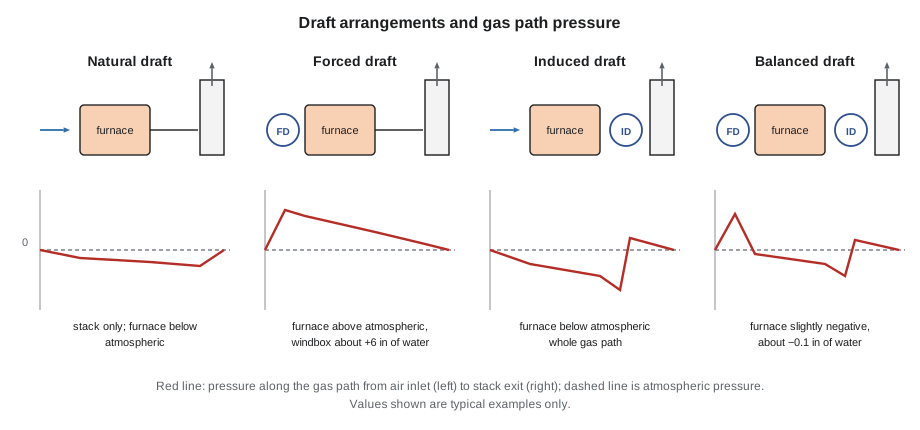
Draft is the pressure difference that moves air into the furnace and flue gas out through the stack. It is measured in inches of water column, with a manometer or draft gauge. A small difference does a lot of work: a few hundred pascals or a fraction of an inch of water is typical.
- Natural draft comes from the stack itself. Hot flue gas in the stack is lighter than the cold outside air, so the column of outside air pushes the gas up.
- Forced draft (FD) uses a fan to push air into the furnace. The furnace and gas passages run above atmospheric pressure, so the casing must be gastight. Most packaged boilers, including Cantwell's, are forced draft.
- Induced draft (ID) uses a fan after the boiler to pull gas through it, so the furnace runs below atmospheric pressure.
- Balanced draft uses both: the FD fan supplies the air, and the ID fan holds the furnace slightly below atmospheric pressure, typically a little negative, so any leak draws air in rather than pushing hot gas out. Large boilers, especially those burning coal or with long gas paths, usually use balanced draft.
Worked problem
Natural draft of a stack
Cantwell's stack rises about 100 ft above the boiler outlets. On a day when the outside air is at 32 °F, density about 0.0807 lb/ft³, the flue gas averages about 392 °F. Taking the flue gas density as that of air at the same temperature, estimate the theoretical draft.
Show solution
- Flue gas density, scaling by absolute temperature:
- \[0.0807 \times \frac{492}{852} \approx 0.0466 \text{ lb/ft}^3\]
- Pressure difference:
- \[100 \times (0.0807 - 0.0466) = 3.41 \text{ lb/ft}^2\]
- Converting, with 1 in of water equal to about 5.2 lb/ft²:
- \[3.41 \div 5.2 \approx 0.66 \text{ in of water}\]
Answer: About 0.66 in of water in theory, less in practice because of friction and heat loss in the stack. On a hot summer day the draft is noticeably lower. For a forced draft boiler the stack draft is a help, not the main driving force, but it changes the furnace pressure with the weather, which is why some boilers have a **barometric damper** or a draft control damper in the breeching.
Fans and how they are controlled
Boiler fans are usually centrifugal. FD fans handle clean, cool air and are often backward-curved or airfoil types for efficiency. ID fans handle hot, dusty gas, run hotter and slower, and are built more heavily. Fan output is controlled by:
- Outlet dampers, which are simple but waste fan power by throttling.
- Inlet vanes, which pre-swirl the air entering the fan and are more efficient at part load.
- Variable frequency drives (VFDs), which change the fan speed and save the most power. Fan power falls roughly with the cube of speed, so a fan at 80 in 100 speed uses only about half the power.
Many parallel positioning systems drive both the air damper and the fan VFD from the burner curve. If a VFD trips or a damper actuator fails, the burner management system must shut the burner down, because the air can no longer be proven.
Furnace pressure control and implosion
On a balanced draft boiler, a furnace pressure controller adjusts the ID fan to hold the furnace at its set point, often a little below atmospheric. Furnace pressure must be watched on any boiler:
- High furnace pressure on a forced draft boiler can mean a blocked gas path, a closed stack damper, or a fuel-rich puff of combustion. Hot gas can leak from casing joints and doors.
- Low furnace pressure on a balanced draft boiler is a hazard of its own. If the fuel trips while the ID fan keeps running at full speed, the sudden collapse of hot gas volume can pull the furnace pressure far below atmospheric and implode the furnace walls. Large balanced draft boilers have furnace pressure trips and fan controls arranged to prevent it.
- Furnace explosions happen when unburned fuel collects in the furnace and then ignites. That is why every start begins with a timed purge at a proven air flow, why fuel valves must be proven closed, and why an operator never retries ignition after a flame failure without completing a purge.
Emissions and flue gas recirculation
Combustion control also affects emissions. Low excess air lowers stack loss and nitrogen oxides, but too little air makes carbon monoxide. Many boilers have low-NOx burners, which stage the fuel or the air so the flame is cooler, and flue gas recirculation (FGR), which returns some cooled flue gas to the burner air to lower the flame temperature. FGR changes the oxygen reading at the burner, so it is characterized into the burner curves along with the fuel and air. Permit limits for NOx and CO are set by the environmental regulator, and the plant's combustion tests record them along with efficiency.
Checking combustion on rounds
Automatic controls do not remove the need to look. On each round, operators check the things the control system cannot see for itself:
- The flame, through the sight port: a stable, well-shaped flame that does not touch the furnace walls or floor, without smoky tips, sparks or pulsing. A change in flame shape at the same firing rate is often the first sign of a damaged burner part or a shifted diffuser.
- The oxygen and the trim output. If the trim is sitting at the edge of its band, the base curve no longer fits and the burner needs a technician's attention, even though the oxygen reading looks right.
- The stack. A clear stack is normal for gas. Visible smoke means incomplete combustion, and a dense white plume on a cold day is usually water vapor, but one that does not clear can mean a tube leak (lesson 11).
- Fan and damper positions against the firing rate, and any unusual noise or vibration from the fans.
- Furnace pressure or windbox pressure, compared with the readings for the same firing rate on earlier rounds.
Halvard left a laminated sheet beside boiler 1's control panel with the expected oxygen, damper position and windbox pressure at five firing rates. Tamar used it on her next round and found every point within a few tenths of the sheet. Readings that drift away from such a sheet over weeks, even within the alarm limits, are a reason to call the burner technician before the next scheduled service rather than after.
Common mistakes
MistakeThinking a positioning system measures fuel and air.
InsteadIt only sets positions; set-up and trim correct for what it cannot measure.
MistakeLetting fuel lead air on a load increase.
InsteadAir leads fuel up and fuel leads air down, so the mixture stays air-rich.
MistakeTrusting the oxygen analyzer without limits on the trim.
InsteadTrim works within a narrow band and returns to the base curve on a fault.
MistakeAssuming stack draft is the same all year.
InsteadDraft falls as outside air warms; cold air is denser.
MistakeRetrying ignition straight after a flame failure.
InsteadComplete the purge first; unburned fuel can explode.
Summary and key terms
- Combustion control matches heat input to the firing rate demand while keeping the fuel-air ratio correct and never fuel-rich.
- Single-point and parallel positioning set fuel valve and damper positions without measuring flows.
- Fully metered control measures fuel and air; cross-limiting makes air lead fuel up and fuel lead air down.
- Oxygen trim corrects air for changing air density and fuel; savings are typically a fraction of a part in 100, plus steadier operation.
- Draft may be natural, forced, induced or balanced; natural draft depends on stack height and the density difference between outside air and flue gas.
- Purge, proven air flow and furnace pressure protection guard against explosions and implosions.
- Firing rate demand
- The signal from the steam pressure master that tells the combustion control how hard to fire.
- Parallel positioning
- Control in which separate servo motors position the fuel valve and air damper along programmed curves.
- Cross-limiting
- Selectors that keep air ahead of fuel on increases and fuel ahead of air on decreases.
- Oxygen trim
- Automatic adjustment of combustion air to hold a flue gas oxygen set point.
- Forced draft
- Draft produced by a fan pushing air into the furnace.
- Induced draft
- Draft produced by a fan pulling gas out of the boiler.
- Balanced draft
- The use of forced and induced draft fans together, holding the furnace slightly below atmospheric pressure.
- Purge
- A timed flow of air through the furnace before ignition to remove any combustible gas.
Practice problems
Work each problem on paper first, then reveal the answer to check.
What excess air corresponds to 4 in 100 oxygen in the flue gas?
Show answer
About 0.24, or 24 in 100 (4 ÷ 17).
A 60 ft stack has air at 0.075 lb/ft³ outside and gas at 0.044 lb/ft³ inside. What is the theoretical draft?
Show answer
1.86 lb/ft², about 0.36 in of water.
On a load decrease in a cross-limited system, which falls first?
Show answer
Fuel.
A fan runs at 70 in 100 speed. Roughly what fraction of full power does it use?
Show answer
About 0.34 (0.7 cubed).
Why is a purge required before every ignition?
Show answer
To remove any fuel or combustible gas that may have collected in the furnace.
Lesson quiz · 5 questions
Score 60% or more to complete this lesson.
Create a free account to save your progress, take quizzes and earn a certificate.