
PWR-220 · Lesson 7 of 12 · 28 min
Water chemistry and impurities
▶ Video coming soon A video version of this lesson is on the way.
On Monday, November 9, 2026, Keziah Ostby of Beaumont Water Services arrived for her monthly visit with something extra in her folder: the annual analysis of the city water that Cantwell uses for make-up. She spread it out on the water lab bench for Grazyna Wolanski and Tamar Ellingsen. "Every number on this sheet ends up either in the softener, in the boiler or in the steam," she said. "The treatment program is built around them. If the city changes its source or its treatment, this is where we see it first."
This lesson covers what is in water and why it matters to a boiler: the units used to measure impurities, hardness, alkalinity and how to read P and M alkalinity, silica, dissolved gases, pH and conductivity, and the typical limits that boiler water programs work to. Lesson 8 covers how the impurities are removed or controlled.
Why impurities matter
Pure water does not exist outside a laboratory. Rain picks up gases from the air, and water on the ground and underground dissolves minerals from the soil and rock it passes through. In a boiler those impurities cause three kinds of trouble:
- Scale and deposits: minerals that become less soluble as water is heated, or that concentrate as the water boils, coat the hottest surfaces. Scale insulates the tube, so the metal runs hotter.
- Corrosion: dissolved oxygen, carbon dioxide and acidity attack steel in the boiler, the feed system and the condensate return.
- Carryover: high dissolved solids, alkalinity, oil or organic matter cause foaming and priming in the drum, and silica can vaporize with the steam at high pressure. Carried-over solids deposit in superheaters, turbines, valves and customer equipment.
Units of measurement
Impurities are measured as a concentration:
- Milligrams per liter (mg/L), which for dilute water is effectively the same as parts per million (ppm) by weight.
- Micrograms per liter (µg/L) or parts per billion (ppb), for very small amounts such as dissolved oxygen in deaerated feedwater.
- Grains per gallon (gpg), still used for hardness, especially in the United States. One grain per US gallon is about 17.1 mg/L.
Hardness and alkalinity are usually stated as calcium carbonate (as CaCO₃). This converts calcium, magnesium, bicarbonate and other ions to a common basis so they can be added and compared. When a report says hardness is 120 mg/L as CaCO₃, it means the calcium and magnesium together are equivalent to 120 mg/L of calcium carbonate, whatever their actual weights.
Worked problem
Converting hardness units
The city water's total hardness is 7 grains per gallon. What is that in mg/L as CaCO₃?
Show solution
- \[7 \times 17.1 \approx 120 \text{ mg/L}\]
Answer: About 7 grains per gallon, or 120 mg/L, which is moderately hard water. Typical classifications call water under about 60 mg/L soft, 60 to 120 moderately hard, 120 to 180 hard, and above that very hard.
Hardness
Hardness is the total of the calcium and magnesium in the water. It is the main cause of boiler scale. Calcium carbonate, calcium sulfate and magnesium silicate are all less soluble in hot water than in cold, so they come out of solution on the hottest surfaces first.
- Carbonate hardness, once called temporary hardness, is the part balanced by bicarbonate. Heating breaks down the bicarbonate and drops out calcium carbonate, which is why kettles fur up.
- Non-carbonate hardness, once called permanent hardness, is balanced by sulfate, chloride and nitrate. Heating alone does not remove it, but it scales a boiler just the same as the water concentrates.
When total hardness is greater than total alkalinity, the carbonate hardness equals the alkalinity and the rest is non-carbonate. When alkalinity is greater than hardness, all the hardness is carbonate hardness.
Keziah's report showed a total hardness of 7 grains per gallon and an M alkalinity of about 95 mg/L, both as CaCO₃. So about 95 of the 120 is carbonate hardness, and about 25 is non-carbonate. The softeners (lesson 8) remove both kinds.
Alkalinity
Alkalinity is the water's ability to neutralize acid. In natural water it is almost all bicarbonate; in boiler water, carbonate and hydroxide take over as the bicarbonate breaks down. It is measured by titrating a sample with acid to two end points:
- P alkalinity (phenolphthalein alkalinity), measured to the phenolphthalein end point at a pH of about 8.3. It includes all the hydroxide and half the carbonate.
- M alkalinity (methyl orange or total alkalinity), measured to a pH of about 4.3 to 4.5. It includes all the hydroxide, carbonate and bicarbonate.
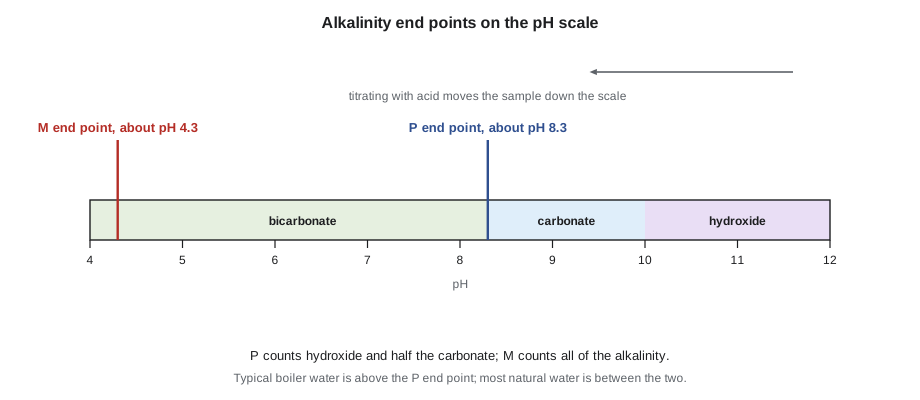
From P and M together, the amounts of hydroxide (OH), carbonate (CO₃) and bicarbonate (HCO₃), all as CaCO₃, can be worked out using five rules:
| Result of the titration | Hydroxide | Carbonate | Bicarbonate |
|---|---|---|---|
| P is zero | 0 | 0 | M |
| P is less than half of M | 0 | 2P | M − 2P |
| P equals half of M | 0 | 2P | 0 |
| P is more than half of M | 2P − M | 2(M − P) | 0 |
| P equals M | M | 0 | 0 |
Worked problem
Reading P and M alkalinity
Two samples are titrated. The raw city water gives P = 0 and M = 95 ppm. Boiler 2's water gives P = 300 ppm and M = 450 ppm. What forms of alkalinity are present in each?
Show solution
- Raw water: P is zero, so all 95 is bicarbonate.
- Boiler water: half of M is 225, and P (300) is more than that, so there is no bicarbonate.
- \[\text{OH} = 2P - M = 600 - 450 = 150\]
- \[\text{CO}_3 = 2(M - P) = 2 \times 150 = 300\]
- Check: 150 + 300 = 450, which equals M.
Answer: The raw water carries 95 of bicarbonate alkalinity, all of which breaks down in the boiler. The boiler water holds 150 of hydroxide and 300 of carbonate alkalinity, which is the alkaline, non-scaling condition most low-pressure programs aim for. The ratio of hydroxide to the other solids matters too, because concentrated hydroxide can attack steel (lesson 12).
What happens to bicarbonate in the boiler
Bicarbonate is the source of most of the carbon dioxide in a steam system. In the heat of the boiler it breaks down, first to carbonate and then partly to hydroxide, and each step releases carbon dioxide gas, which leaves with the steam. As a rule of thumb, each mg/L of bicarbonate alkalinity (as CaCO₃) in the feedwater can release up to about 0.88 mg/L of carbon dioxide into the steam. When the steam condenses in customers' buildings and the return lines, the carbon dioxide dissolves in the condensate as carbonic acid, which corrodes steel condensate lines, especially at threads and the bottoms of pipes.
Worked problem
Carbon dioxide from make-up alkalinity
Cantwell uses about 770 US gallons an hour of softened make-up with an M alkalinity of about 95 ppm, all bicarbonate. Softening does not remove alkalinity. How much carbon dioxide could the make-up release into the steam each hour and each day?
Show solution
- Carbon dioxide concentration:
- \[95 \times 0.88 \approx 84 \text{ ppm}\]
- Mass of make-up per hour, at 8.34 lb per gallon:
- \[770 \times 8.34 \approx 6{,}422 \text{ lb/h}\]
- Carbon dioxide per hour:
- \[6{,}422 \times 84 \times 10^{-6} \approx 0.54 \text{ lb/h}\]
- Per day:
- \[0.54 \times 24 \approx 13 \text{ lb}\]
Answer: Up to about 13 lb of carbon dioxide a day goes out with the steam, most of it into the customers' condensate. That is why Cantwell feeds a neutralizing amine to raise condensate pH, and why lesson 8 looks at dealkalization as an option.
Silica, iron and other dissolved solids
- Silica (SiO₂) forms a hard, glassy scale that is very difficult to remove and insulates far worse than calcium carbonate scale. At higher pressures it also dissolves in the steam and deposits on turbine blades. Silica limits in boiler water therefore fall steeply as pressure rises. Keziah's report showed about 6 ppm in the city water, low enough that it is controlled by blowdown at Cantwell's pressure.
- Iron and copper come mainly from corrosion in the feed and condensate system, not the raw water. They deposit in the boiler as porous scale, under which corrosion can concentrate.
- Chloride and sulfate do not scale at normal concentrations, but they add to the dissolved solids and conductivity, and chloride can concentrate under deposits.
- Sodium and potassium salts are very soluble. Softening swaps calcium and magnesium for sodium, so softened water has the same total dissolved solids as the raw water.
- Suspended solids, such as silt and organic matter, cause sludge and foaming; most city water has very little.
- Oil and grease from leaking heat exchangers or pumps form an insulating film and cause foaming. Any trace of oil in a boiler must be traced to its source and removed.
Dissolved gases
Oxygen causes localized pitting of steel, especially in feed lines, economizers and the steam drum near the water line. Its attack speeds up with temperature, which is why deaeration (lesson 4) and scavenging (lesson 8) are essential. Carbon dioxide enters with the make-up as free gas and is formed from bicarbonate; it causes general thinning and grooving of condensate lines. Ammonia, from some amines or contamination, can attack copper alloys in the presence of oxygen.
pH and conductivity
pH measures how acid or alkaline water is, on a scale from 0 to 14. Seven is neutral; lower is acid and higher is alkaline. Each step of one unit is a tenfold change in acidity. Steel corrodes fastest in acid water and is most protected in moderately alkaline water, so boiler water is kept alkaline, typically between about pH 10.5 and 11.5 for low-pressure industrial boilers, and feedwater and condensate a little above neutral, typically around 8.5 to 9.5.
Conductivity measures how easily water carries an electric current, in microsiemens per centimeter (µS/cm). Dissolved salts carry the current, so conductivity rises with the total dissolved solids. It is the quickest way to judge how concentrated boiler water is and to control blowdown. As a rough rule, total dissolved solids in mg/L are about 0.6 to 0.7 times the conductivity in µS/cm, but the factor depends on which salts are present, and highly alkaline boiler water is usually neutralized before measurement so the hydroxide does not exaggerate the reading.
Worked problem
Estimating dissolved solids from conductivity
Boiler 2's neutralized conductivity is 3,000 µS/cm. Using a factor of 0.65, estimate the total dissolved solids.
Show solution
- \[3{,}000 \times 0.65 = 1{,}950 \text{ mg/L}\]
Answer: Roughly 1,950 mg/L of dissolved solids. Plants control blowdown by conductivity rather than by laboratory TDS tests because it is fast and continuous; the factor matters only when comparing with a TDS limit.
Typical limits
Limits on feedwater and boiler water are set by the boiler manufacturer and the water treatment program. Widely used guidelines published by ASME and by the boiler manufacturers' association (ABMA) give ranges by boiler type and pressure. For an industrial watertube boiler at Cantwell's pressure, in very broad terms and as typical values only:
- Feedwater: total hardness kept to a small fraction of a mg/L, typically no more than about 0.3; iron and copper each kept to about 0.1 mg/L or less; dissolved oxygen in the low parts per billion after deaeration and scavenging; pH typically 8.3 to 10.
- Boiler water: silica up to roughly 150 mg/L at this pressure range; neutralized conductivity in the low thousands of µS/cm, with the exact limit set by the program and the drum's steam separating equipment; enough alkalinity to keep pH in the treatment range, but not so much that foaming or caustic attack becomes a risk.
- Condensate: pH typically 8.3 to 9.0 or so, with low iron as the sign that corrosion is under control.
Limits tighten sharply as pressure rises. A utility boiler at high pressure works with dissolved solids measured in parts per billion and demineralized make-up, because the steam must be extremely pure for the turbine.
Keziah's report showed no surprises. The city's hardness, alkalinity and silica were within a few mg/L of the previous year's. She noted one change: the city had raised its chloramine dose slightly, which she said would not affect the boilers but was worth watching at the softeners, since chloramine can slowly degrade resin. Grazyna filed the report in the water treatment binder with the previous years' sheets.
Testing at the bench
Most of the tests in this lesson are done by operators at the plant's own bench, using kits from the treatment supplier. A few habits keep the results honest:
- Use the right sample: from the sample cooler, flushed and cool, in a clean bottle rinsed with the sample itself.
- Measure the volume accurately with the kit's graduated tube or syringe; a titration result is only as good as the volume it started from.
- Add the titrant drop by drop near the end point, swirling after each drop, and read the color change against a white background.
- Neutralize boiler water before conductivity, using the program's method, so that results can be compared with the limit and with earlier days.
- Check the reagents' dates and replace any that are out of date or contaminated; a bottle left open can give results that drift over weeks.
- Record the result at once, with the time and the sample point, and repeat any result that looks out of line before acting on it.
Keziah compared Tamar's P and M results on boiler 2 with her own that morning. Tamar's M result was 10 mg/L higher; she had overshot the end point by two drops. Keziah showed her how to add the last few drops more slowly, and the repeat agreed to within 5 mg/L. "The numbers in the log are what we steer the program by," Keziah said. "A careful test every shift is worth more than a perfect test once a month."
Common mistakes
MistakeThinking softened water is pure water.
InsteadSoftening swaps hardness for sodium; dissolved solids and alkalinity remain.
MistakeAdding P and M as if they were separate amounts.
InsteadM includes P; use the five rules to split hydroxide, carbonate and bicarbonate.
MistakeIgnoring bicarbonate in the make-up.
InsteadIt releases carbon dioxide that corrodes condensate lines.
MistakeMeasuring boiler water conductivity without neutralizing.
InsteadHydroxide inflates the reading; follow the program's method.
MistakeAssuming the same limits apply at every pressure.
InsteadSilica and solids limits tighten sharply as pressure rises.
Summary and key terms
- Impurities cause scale, corrosion and carryover; they are measured in mg/L (ppm), ppb or grains per gallon, often as CaCO₃.
- Hardness is calcium and magnesium; carbonate hardness is balanced by bicarbonate, non-carbonate by sulfate and chloride.
- P alkalinity is measured to about pH 8.3 and M to about 4.3; five rules split them into hydroxide, carbonate and bicarbonate.
- Bicarbonate breaks down in the boiler and releases up to about 0.88 mg/L of carbon dioxide per mg/L of alkalinity, which corrodes condensate lines.
- Silica forms hard, glassy scale and vaporizes at high pressure; oxygen pits steel.
- pH and conductivity are the everyday control tests; typical limits depend on boiler type and pressure.
- Hardness
- The total calcium and magnesium in water, usually stated as CaCO₃.
- P alkalinity
- Alkalinity measured by titration to the phenolphthalein end point, about pH 8.3.
- M alkalinity
- Total alkalinity, measured by titration to about pH 4.3.
- As CaCO₃
- A common basis that expresses ions as an equivalent amount of calcium carbonate.
- Grains per gallon
- A unit of hardness; one grain per US gallon is about 17.1 mg/L.
- Conductivity
- The ability of water to carry electric current, rising with dissolved solids, in µS/cm.
- Carbonic acid
- The weak acid formed when carbon dioxide dissolves in condensate.
- Silica
- Silicon dioxide, which forms hard scale and can vaporize with steam at high pressure.
Practice problems
Work each problem on paper first, then reveal the answer to check.
Convert 10 grains per gallon of hardness to mg/L.
Show answer
About 171 mg/L.
A sample has P = 100 and M = 300. What forms of alkalinity are present?
Show answer
Carbonate 200 and bicarbonate 100; no hydroxide.
A sample has P = 250 and M = 400. What forms are present?
Show answer
Hydroxide 100 and carbonate 300.
Feedwater has 50 mg/L of bicarbonate alkalinity. About how much carbon dioxide could it release?
Show answer
About 44 mg/L.
Estimate TDS for a neutralized conductivity of 2,400 µS/cm using 0.65.
Show answer
About 1,560 mg/L.
Lesson quiz · 5 questions
Score 60% or more to complete this lesson.
Create a free account to save your progress, take quizzes and earn a certificate.