
PWR-220 · Lesson 11 of 12 · 21 min
Boiler inspections, repairs and records
▶ Video coming soon A video version of this lesson is on the way.
At 01:30 on Monday, November 2, 2026, Desmond Kirwan was halfway through his night round when he noticed the make-up flow meter in the water treatment room reading higher than usual for the load. Back in the control room he pulled up the trends. The plant's make-up had been creeping up since about 22:00, and boiler 3's feedwater flow was now running noticeably above its steam flow plus blowdown. At the boiler he heard a faint hiss behind the furnace side casing that had not been there the night before. He called Grazyna Wolanski at home, took boiler 3 off line on the procedure for a suspected tube leak, and let it cool on its normal schedule. By the time Tamar Ellingsen came on shift that morning, the boiler was cooling, isolated and tagged.
This lesson covers the inspections that keep a boiler legally in service, how an operator prepares for one, how repairs and alterations are controlled, and the records that tie it all together. Lesson 10 described the codes; this lesson is about using them.
Finding a leak from the numbers
A small tube leak inside a boiler is rarely seen directly. It is usually found from the water balance, because the water that leaks has to be replaced through the feedwater.
Worked problem
Water balance on a leaking boiler
At 01:30 boiler 3's instruments showed feedwater 21,720 lb/h and steam 20,280 lb/h. The boiler runs at 20 cycles. How much water was unaccounted for?
Show solution
- Expected blowdown:
- \[B = 20{,}280 \div (20 - 1) \approx 1{,}067 \text{ lb/h}\]
- Expected feedwater:
- \[20{,}280 + 1{,}067 = 21{,}347 \text{ lb/h}\]
- Unaccounted for:
- \[21{,}720 - 21{,}347 = 373 \text{ lb/h}\]
Answer: About 373 lb/h, roughly 45 gallons an hour, which matched the rise in make-up. Flow meters are not perfect, so a small imbalance alone proves nothing, but an imbalance that appears suddenly, grows, and matches a rise in make-up, together with a new noise, is a strong sign of a leak.
Other signs of a tube leak include a white plume of steam at the stack that does not clear, wet or steaming spots on the casing, a rise in furnace pressure, a flame that is disturbed or hard to hold, and wet soot in the gas passages. A large leak is an emergency: the boiler is tripped and the feedwater kept on only if the level can be held. Whether to keep feeding a boiler with a major tube failure is a decision covered by the plant's emergency procedure, because cold water on overheated tubes can make the damage worse.
Kinds of inspection
Boiler inspections are of three kinds:
- Operator inspections: the rounds, tests and observations that the plant's own staff make every shift, recorded in the log. These catch most problems early.
- External inspections, made while the boiler is running, by an inspector: the condition of the casing, fittings, piping and supports; the operation of the gauge glasses, low water cutoffs, safety valves and controls; leaks; and the plant's records.
- Internal inspections, made with the boiler shut down, drained, cleaned and opened: the drums, tubes, headers, furnace, baffles and refractory are examined for scale, deposits, corrosion, pitting, cracks, bulges, erosion and leaks, and wall thicknesses may be measured by ultrasonic testing.
In Ohio, power boilers must be inspected internally and externally each year, by a state inspector or a commissioned insurance company inspector, and must have a current certificate of operation posted at the boiler. Cantwell's insurer's inspector is Ottoline Brackwater, who planned a December internal inspection of hot water boiler 1.
Preparing a boiler for internal inspection
An internal inspection is only as good as the preparation. Operators typically:
- Shut down and cool the boiler on the manufacturer's schedule, without forced cooling that would stress the drums and tubes. Drain it only when cool enough, typically below about 200 °F, and with the vent open so it does not draw a vacuum.
- Isolate it from every source of pressure, fuel and energy: steam stop valves and non-return valves closed and locked, feedwater, blowdown and chemical feed lines closed with double block and bleed or blanked, fuel valves locked and the burner electrically isolated, all under the plant's lockout procedure (PWR-110). On a boiler connected to a common header, a single closed valve is not enough.
- Open and ventilate the manways and handholes, test the atmosphere, and set up the confined space entry permit before anyone enters a drum or furnace.
- Clean the water side and fire side so the inspector can see the metal, unless the inspector wants to see the deposits first, as is common when looking for the cause of a failure.
- Have the records ready: the boiler log since the last inspection, water treatment records, low water cutoff and safety valve test records, and any repair records.
The operator accompanies the inspector, opens what the inspector asks to see, and records the findings. The inspector may ask for thickness readings, a hydrostatic test, removal of a tube sample or repairs before the boiler returns to service.
Repairs and alterations
Under the NBIC, work on a pressure part is either a repair or an alteration:
- A repair restores a boiler to a safe and satisfactory condition without changing its design. Replacing a leaking tube with one of the same specification, or rewelding a cracked seal weld, is a repair.
- An alteration changes the design: the pressure, temperature, capacity, heating surface or the way it is supported. Adding an economizer, raising the MAWP or changing the burner fuel in a way that affects the pressure parts is an alteration, and needs design review and registration like new construction.
Welded repairs follow a set sequence:
- A repair plan, describing the work, materials, welding procedures and examination, is agreed with the inspector before work starts.
- The work is done by an organization authorized to do it, using qualified procedures and qualified welders (lesson 2).
- The repair is examined, visually and by any further method the inspector requires.
- A pressure test is made where the inspector requires one, typically a hydrostatic test, at a pressure the inspector sets within the inspection code's limits.
- The repair is documented on the required report, and the boiler's records are updated.
In Ohio, welded repairs to the pressure boundary must be made by a holder of the National Board R certificate, following NBIC Part 3. The repair is recorded on the National Board's repair report form, and the R certificate holder attaches or stamps a repair nameplate. Some routine repairs, such as replacing tubes, may be handled under simpler arrangements that the inspector and jurisdiction allow, but they still need the inspector's acceptance.
Boiler 3's repair
On the morning of November 3, with boiler 3 cool and drained, the boiler service contractor opened the furnace and found the leak: a pinhole in a floor tube near the rear wall of the furnace, with a small wet patch of refractory beneath it. Grazyna called Ottoline Brackwater, who came that afternoon, looked at the tube and agreed a repair plan: the contractor, an R certificate holder, would cut out the leaking tube and roll in a new tube of the same specification at both drums, keep the section of tube that had failed for laboratory examination, examine the work, and hydrostatically test the boiler. The contractor documented the repair under its R certificate program, though rolled tube ends themselves need no welding.
The new tube went in on November 4. On November 5 the boiler was filled with warm, treated water and hydrostatically tested in Ottoline's presence at the pressure she set, with every rolled joint dry. She accepted the repair, signed the report, and asked for the lab report on the failed tube when it came back, because a pinhole in a tube that should have lasted decades needed an explanation. Boiler 3 was refilled, warmed and brought back on line at low fire on November 6.
Tamar kept a list of what went into the file: the log entries from the night of November 2, the trends of feed, steam and make-up flow, Ottoline's repair acceptance, the contractor's report, the hydrostatic test record, photographs of the tube, and a copy of the work order. "If it fails again," Grazyna said, "this is what the next person will need to see."
Pressure tests after repairs
A hydrostatic test after a repair proves that the repaired part is tight and strong. It is not a substitute for examination of welds. The inspector decides whether a test is needed and at what pressure. When a boiler is hydrostatically tested in service, the safety valves are removed and blanked or gagged according to the manufacturer's instructions and removed or released afterwards, the boiler is completely filled with all air vented, the water temperature is kept moderate (lesson 10), and the pressure is raised slowly and held while the inspector looks for leaks. A boiler must never be tested with air or steam in place of water.
Gags left in a safety valve after a test have caused explosions. The plant's procedure lists each gag or blank installed, and the last step before the boiler is fired is to confirm that every one has been removed and recorded.
Records
Records are how a plant proves its boilers are safe, how inspectors judge them, and how the next engineer learns what happened. The main ones are:
- The boiler log: shift entries of pressures, temperatures, levels, flows, tests, blowdowns, alarms, starts and stops, unusual events and handovers.
- The manufacturer's data report and the boiler's registration documents (lesson 2 and lesson 10).
- The certificate of operation, posted at the boiler, and the inspector's reports.
- Repair and alteration records, including repair plans, reports, test records and nameplates.
- Safety valve records: make, model, set pressure, capacity, test dates and results, and any repairs by a qualified valve repairer.
- Low water cutoff test records, with dates, results and names.
- Water treatment logs and the treatment supplier's reports (lesson 9).
- Maintenance records, management of change records, and a failure history for each boiler.
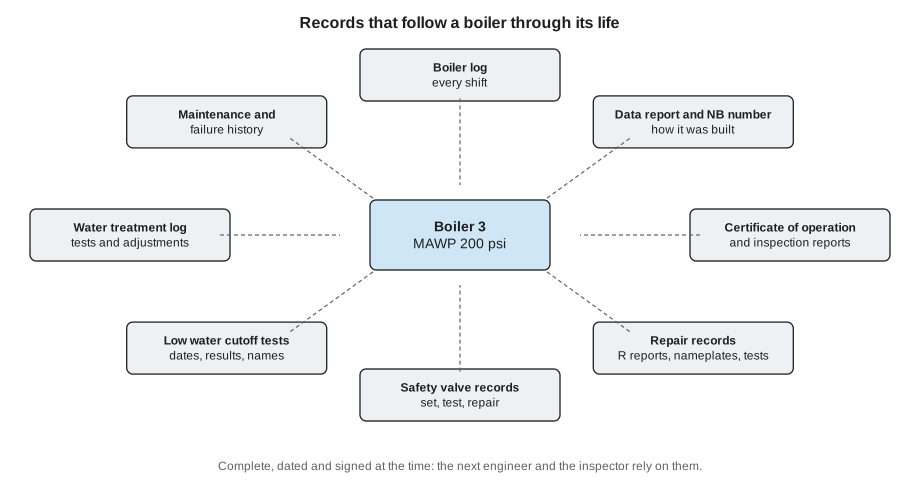
Good records are complete, legible, dated and signed. They are written at the time, not reconstructed later, and they record what was found as well as what was done. A log entry that reads "all normal" tells the next engineer nothing; one that gives the actual readings and notes anything unusual tells them a great deal. Electronic logs and trend data are records too, and the plant's procedures say how long each kind of record is kept.
Desmond's entries from the night of November 2 were a good example. They gave the time he first noticed the make-up, the flows he read, the noise and its location, the time he called Grazyna, the time the boiler was tripped and isolated, and the condition he left it in at handover. Grazyna used them, word for word, in the report she wrote for the plant's operations meeting.
Planned inspections at Cantwell
Two more inspections were on the plant calendar when this course was written. Boiler 2's fire-side inspection was booked for later in November, to look at the convection bank and the burner throat after its stack temperature trend, and Ottoline's December internal inspection of hot water boiler 1 would follow. For each, the shift engineers would prepare the boiler, the records and the lockout plan in advance, using the same checklist that had served boiler 3.
After the inspection
An inspection is not finished when the inspector leaves. The inspector's report may list recommendations or requirements, each with a time to complete it. The chief engineer assigns each item, tracks it to completion, and keeps the evidence that it was done, because the next inspection begins by checking the last one's items.
Returning a boiler to service after an internal inspection is a procedure of its own. All tools, rags and lights are removed from the drums and furnace, and a final look inside is made by someone who did not do the work. New gaskets are fitted to every manway and handhole, the covers are tightened as the manufacturer specifies, and they are retightened once the boiler warms. Every lock and tag is removed under the lockout procedure, in the right order, by the people who placed them. The boiler is filled with treated water, vented, and warmed on the normal start-up schedule, with extra attention to every opened joint for leaks.
On boiler 3's return on November 6, Tamar walked the boiler with Lorne Fitzwilliam at each stage of the warm-up, checking the two drum manways and the rolled ends of the new tube. A small weep at one manway gasket stopped when it was retightened at low pressure, as the procedure allows, and the log recorded it.
Common mistakes
MistakeIgnoring a small imbalance between feed, steam and blowdown.
InsteadA sudden, growing imbalance with rising make-up is a classic sign of a tube leak.
MistakeStarting a welded repair and calling the inspector afterwards.
InsteadThe repair plan is agreed with the inspector before work starts.
MistakeRelying on one closed valve to isolate a boiler on a common header.
InsteadUse double block and bleed or blanks under the lockout procedure.
MistakeFiring a boiler after a hydrostatic test without checking the safety valves.
InsteadConfirm every gag or blank has been removed and recorded.
MistakeWriting "all normal" in the log.
InsteadRecord the actual readings and anything unusual.
Summary and key terms
- Tube leaks are often found from the water balance: feedwater exceeding steam plus blowdown, with rising make-up.
- Inspections are operator, external and internal; certificates are issued by authorized or commissioned inspectors at set intervals.
- Preparing for internal inspection means slow cooling, full isolation under lockout, ventilation and confined space controls, cleaning and having records ready.
- A repair restores the design; an alteration changes it and needs design review.
- Welded repairs in Ohio are made by R certificate holders under NBIC Part 3, with an inspector's acceptance.
- Records, from the log to the failure history, prove the boiler's condition and guide the next decision.
- External inspection
- An inspection of a boiler while it is operating.
- Internal inspection
- An inspection of a boiler that is shut down, drained, cleaned and opened.
- Repair
- Work that restores a boiler to safe condition without changing its design.
- Alteration
- A change to a boiler's design, pressure, temperature, capacity or support.
- Repair plan
- A written description of a repair, agreed with the inspector before work begins.
- Gag
- A clamp that holds a safety valve closed during a hydrostatic test, removed afterwards.
- Water balance
- A comparison of feedwater with steam plus blowdown, used to find leaks.
- Failure history
- The record of every failure of a boiler, with its cause and repair.
Practice problems
Work each problem on paper first, then reveal the answer to check.
A boiler makes 16,800 lb/h of steam at 20 cycles, and the feed meter reads 17,900 lb/h. How much water is unaccounted for?
Show answer
About 216 lb/h (17,900 − 16,800 − 884).
Is replacing a tube with one of the same specification a repair or an alteration?
Show answer
A repair.
Name three records an inspector will ask to see.
Show answer
The boiler log, low water cutoff test records and safety valve records (also water treatment and repair records).
Why must the boiler be cooled slowly before draining?
Show answer
To avoid thermal stress in drums and tubes, and so it can be drained safely without a vacuum.
What must be checked before firing a boiler after a hydrostatic test?
Show answer
That every safety valve gag or blank has been removed.
Lesson quiz · 5 questions
Score 60% or more to complete this lesson.
Create a free account to save your progress, take quizzes and earn a certificate.