
PWR-220 · Lesson 4 of 12 · 26 min
Feedwater heaters and deaerators
▶ Video coming soon A video version of this lesson is on the way.
On Wednesday, October 7, 2026, Lorne Fitzwilliam led Tamar Ellingsen up the steel stairs to the deaerator platform, high above the boiler feed pumps. The monthly deaerator check was on the shift's job list: read the pressure gauge and the water thermometer, look at the vent plume, and draw a sample from the storage section for a dissolved oxygen test. "This tank protects every tube in the plant," Lorne said. "If it stops doing its job, the boilers start pitting, and you will not know until a tube fails months later. So we check it properly every month, not just glance at the gauge."
This lesson covers how feedwater is heated before it reaches the boiler. In large plants that means closed feedwater heaters, shell-and-tube heat exchangers heated by steam extracted from turbines. In almost every steam plant it means a deaerator, an open heater that both heats the water and strips out dissolved oxygen and carbon dioxide. PWR-210 lesson 12 calculated the steam a deaerator uses; this lesson is about how it works and how to check it.
Why heat the feedwater
Heating feedwater before it enters the boiler does three things:
- It saves fuel when the heat comes from a source that would otherwise be wasted, such as flash steam, exhaust steam from a turbine-driven pump, or steam extracted from a turbine after it has done some work.
- It reduces thermal stress in the drum and economizer, because hot feedwater is closer to the drum water temperature (lesson 2).
- It removes dissolved gases, because gases are much less soluble in hot water than in cold.
The last point is the most important for a heating or district energy plant like Cantwell. Dissolved oxygen is the main cause of pitting in boilers, feed lines and economizers, and dissolved carbon dioxide forms carbonic acid in condensate lines.
Open and closed heaters
Feedwater heaters are of two kinds:
- In an open or direct-contact heater, steam and water mix. The water can be heated right up to the saturation temperature of the steam, and dissolved gases escape. A deaerator is an open heater. Because it is at a low pressure, a pump must be placed after it to raise the water to boiler pressure.
- In a closed heater, the water flows through tubes and the steam condenses on the outside, in the shell. The water never touches the steam, so the heater can be placed after the boiler feed pump at full boiler pressure, and several can be arranged in series. The condensed steam, the drains, is sent on to the next lower-pressure heater or to the deaerator.
A typical utility plant has several low-pressure closed heaters before the deaerator, the deaerator itself, and several high-pressure closed heaters after the boiler feed pump. Each is heated by steam extracted from a turbine stage at the matching pressure. Industrial and heating plants usually have only the deaerator.
Closed feedwater heaters
A closed heater is usually a horizontal or vertical shell with a U-tube bundle. Larger high-pressure heaters have three zones:
- A desuperheating zone, where the superheated extraction steam first meets the tubes nearest the water outlet and gives up its superheat.
- A condensing zone, the largest, where the steam condenses at its saturation temperature.
- A drain cooling zone, where the condensate is cooled below its saturation temperature by the incoming feedwater before it leaves the shell.
Two temperature differences describe how well a closed heater is performing:
- The terminal temperature difference (TTD): the saturation temperature of the shell steam minus the feedwater outlet temperature.
- The drain cooler approach (DCA): the drain outlet temperature minus the feedwater inlet temperature.
A rising TTD means the heater is transferring less heat, perhaps from fouled tubes, air building up in the shell, or a high drain level flooding part of the tubes. A falling DCA together with a rising TTD often points to a high shell level. Heater shells have level controls and high-level alarms, and a very high level trips the extraction steam and may isolate the heater. Water backing up the extraction line into a turbine can wreck it, which is why extraction lines carry non-return valves.
Worked problem
Steam used by a closed heater
A closed heater raises 110,000 lb/h of feedwater from 248 °F to 302 °F. It is heated by steam condensing at 72.5 psia, where t_sat = 305.3 °F and h_fg = 906 Btu/lb. Take the water specific heat as 1 Btu/lb·°F. What is the heater duty, the steam needed and the TTD?
Show solution
- Duty:
- \[110{,}000 \times 1 \times (302 - 248) = 5{,}940{,}000 \text{ Btu/h}\]
- Steam needed, if all of it condenses and leaves as saturated drains:
- \[5{,}940{,}000 \div 906 \approx 6{,}556 \text{ lb/h}\]
- TTD:
- \[305.3 - 302 = 3.3 \text{ °F}\]
Answer: About 6,560 lb/h of steam, and a TTD of about 3 °F, which is typical of a clean heater. If the TTD crept up to 10 or 15 °F at the same load, the heater would need investigating.
A tube leak in a high-pressure heater sends feedwater at boiler pressure into the shell. Signs include a rising shell level with the drain valve opening wider, a falling feedwater flow to the boiler for the same feed pump output, and a heater that suddenly needs less extraction steam. A leaking heater is isolated on the water side through its bypass, and the extraction steam is shut off, following the plant's procedure in the right order.
How a deaerator works
The amount of gas that can stay dissolved in water depends on two things: the temperature of the water and the amount of that gas in the space above it. This is Henry's law. A deaerator uses both:
- It heats the water to its saturation temperature, where almost no gas can stay dissolved.
- It keeps the gas above the water very low, by filling the space with steam and venting the released gases continuously.
- It breaks the water into thin films or fine droplets, so the gas has only a short distance to travel to escape.
- It scrubs the water with steam, which carries the released gases to the vent.
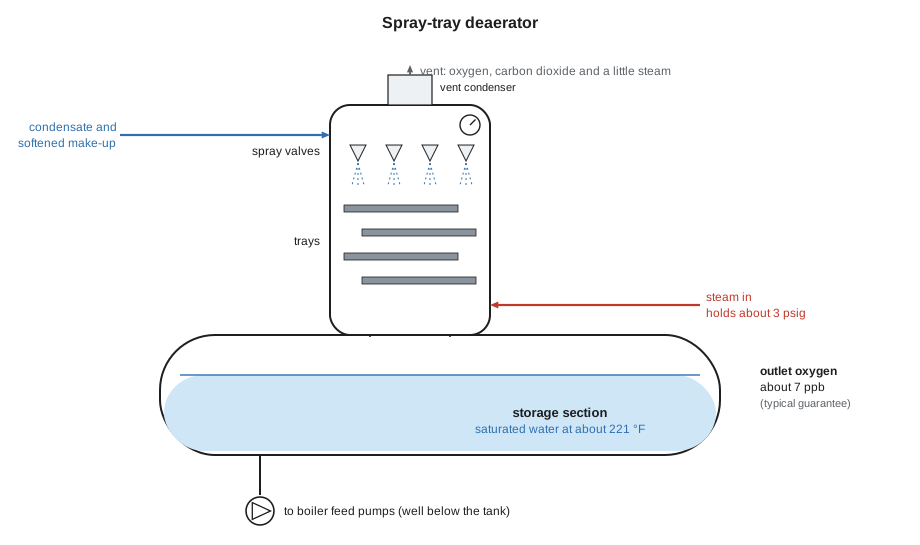
Deaerators come in several types:
- Spray deaerators spray the water into a steam-filled chamber through spring-loaded nozzles. Steam enters below and scrubs the water again before it falls into storage.
- Tray deaerators let the water cascade down through stacks of perforated trays against rising steam.
- Spray-tray deaerators, like Cantwell's, combine the two: the spray does most of the heating and degassing, and the trays finish the job.
- Vacuum deaerators work below atmospheric pressure, using a vacuum pump or ejector, where steam is not available or the water must stay cool, such as for hot water systems.
Most pressurized deaerators in boiler plants run at a slight pressure, typically 3 to 5 psig, so the water temperature is a little above 100 °C or 212 °F and air cannot leak in. The vent, often with a small vent condenser that uses the incoming water to condense most of the vented steam, must always be open enough to carry away the released gases. A plume of steam a short distance long is normal. No plume at all usually means the vent has been throttled too far, and the gases are building up inside.
What a deaerator should achieve
Deaerator performance is stated as the dissolved oxygen in the water leaving the storage section. A good pressurized deaerator is typically guaranteed to reduce oxygen to about 0.005 cc/L, which is about 7 parts per billion (ppb) by weight, and to remove essentially all free carbon dioxide. Water from the city main may hold 8,000 to 10,000 ppb of oxygen when cold, so the deaerator removes more than 999 parts in 1,000. A small chemical oxygen scavenger dose (lesson 8) removes the last traces and leaves a residual in the boiler as a safety margin.
Bound carbon dioxide, in the form of bicarbonate and carbonate, is not removed in the deaerator. It breaks down in the boiler and leaves with the steam, which is why lesson 7 and lesson 8 deal with alkalinity and amines.
Checking a deaerator
The quickest check is to compare the water temperature in the storage section with the saturation temperature for the deaerator pressure. Water that is fully heated is at saturation; water noticeably cooler than saturation has not been fully heated, and oxygen may be getting through.
Worked problem
Is the deaerator water at saturation?
Cantwell's deaerator gauge reads 2.84 psig. Taking atmospheric pressure as 14.7 psia, what should the water temperature be? If the thermometer read 215 °F, what would that show?
Show solution
- Absolute pressure:
- \[2.84 + 14.7 = 17.54 \text{ psia}\]
- From the steam tables, water boils at 17.54 psia at 221 °F. At 215 °F the saturation pressure would be only about 15.6 psia, about 0.9 psig.
- Shortfall:
- \[221 - 215 = 6 \text{ °F below saturation}\]
Answer: The water should be at about 221 °F. A reading of 215 °F would mean the water is 6 °F short of saturation and the deaerator is not fully heating it. Possible causes include a steam pressure control valve that is not keeping up, a sudden large flow of cold make-up, fouled or collapsed trays, a stuck spray valve, or a faulty thermometer. The operator would confirm the reading, check the vent and steam supply, and test the outlet oxygen.
That morning both readings agreed: the gauge read 2.9 psig and the thermometer 221 °F. The vent plume was a steady wisp about a foot and a half long. Lorne then drew a sample from the storage section through the sample cooler, letting it run until the water was cool and the line was flushed, and filled a sealed test ampoule under the flowing water so no air could reach it. The color developed to the faintest shade on the comparator, below 10 ppb. He logged the result alongside the pressure and temperature.
Dissolved oxygen tests must be done carefully, because the sample is only a few parts per billion and air touching it for a second spoils the result. The sample line must be flushed thoroughly, the water must be cool so the gas stays dissolved, and the ampoule must be filled and broken under water. Plants with larger boilers often add a continuous dissolved oxygen analyzer.
Oxygen scavenger demand
Even a good deaerator leaves a little oxygen, and the scavenger dose is set to remove it. Sodium sulfite reacts with oxygen to form sodium sulfate. In theory about 7.9 lb of sodium sulfite removes 1 lb of oxygen; in practice catalyzed sulfite is fed at a little more than that, plus enough to keep a residual in the boiler.
Worked problem
Sulfite needed for a deaerator's outlet oxygen
Boiler feedwater flows at 26,500 lb/h. How much sodium sulfite is needed each hour to remove the oxygen if the deaerator outlet is 7 ppb (0.007 ppm), and how much a day if a fault let it rise to 0.5 ppm?
Show solution
- At 7 ppb, oxygen per hour:
- \[26{,}500 \times 0.007 \times 10^{-6} \approx 0.000186 \text{ lb/h}\]
- Sulfite:
- \[0.000186 \times 7.9 \approx 0.0015 \text{ lb/h}\]
- At 0.5 ppm, oxygen per hour:
- \[26{,}500 \times 0.5 \times 10^{-6} \approx 0.0133 \text{ lb/h}\]
- Sulfite per day:
- \[0.0133 \times 7.9 \times 24 \approx 2.5 \text{ lb/day}\]
Answer: With the deaerator working, the scavenger needed to remove the oxygen is tiny, a small fraction of an ounce an hour. If the deaerator failed, the demand would jump about seventy-fold. The sulfite residual in the boiler would fall quickly, which is often the first sign in the water test log that the deaerator has a problem. The scavenger is a polishing step, not a substitute for deaeration.
Deaerator safety and operation
A deaerator is a pressure vessel, built to ASME Section VIII and protected by its own relief valve, sized to pass the full steam supply if the pressure control valve fails open. It also has these features:
- Pressure control: a steam pressure-reducing valve holds the deaerator pressure; in plants with turbine exhaust, a back-pressure arrangement may supply it.
- Level control: a level controller opens the make-up and condensate inlet valves, with high- and low-level alarms. A high-level overflow protects against flooding, which could back water into the steam supply line.
- Vacuum protection: a vacuum breaker, because a deaerator cooled with its steam supply shut can collapse under atmospheric pressure.
- Height above the feed pumps: the storage tank is set high so the water at the pump suction has enough pressure above its saturation pressure to prevent flashing and cavitation. This margin is the net positive suction head available. Because the water is saturated, the only margin comes from the height of the water column, less friction in the suction pipe.
Deaerator storage tanks have failed by cracking at welds, in some cases suddenly. Cracks are found by examining the welds during inspections, usually with wet fluorescent magnetic particle testing. Operators help by keeping the pressure and temperature steady and avoiding sudden cold water slugs, which cause thermal stress at the nozzles.
When a deaerator must be taken out of service, the plant usually feeds the boilers with less-heated water and increases the scavenger dose temporarily, with the water treatment supplier's advice. That is an abnormal condition to be logged and kept as short as possible.
Common mistakes
MistakeClosing the deaerator vent to stop the plume.
InsteadThe vent must stay open enough to carry away the released gases; no plume often means the vent is choked.
MistakeJudging the deaerator by its pressure gauge alone.
InsteadCompare the water temperature with the saturation temperature for that pressure.
MistakeTaking an oxygen sample without flushing or cooling the line.
InsteadFlush, cool and fill the ampoule under flowing water, or the result is meaningless.
MistakeRaising the scavenger dose to cover a poorly working deaerator.
InsteadFix the deaerator; the scavenger is a polishing step.
MistakeIgnoring a rising TTD on a closed heater.
InsteadIt means fouling, trapped air or a high drain level; investigate it.
Summary and key terms
- Feedwater heating saves fuel, reduces thermal stress, and removes dissolved gases.
- Open heaters mix steam and water; closed heaters keep them apart and can run at boiler pressure.
- Closed heater performance is judged by the terminal temperature difference and the drain cooler approach.
- A deaerator heats water to saturation, breaks it into films or droplets, scrubs it with steam and vents the gases, reducing oxygen to about 7 ppb (typical guarantee).
- The quickest deaerator check compares water temperature with the saturation temperature for its pressure.
- Oxygen scavenger demand is small when the deaerator works and rises sharply if it fails; a falling boiler residual is a warning.
- Open feedwater heater
- A heater in which steam and water mix directly, such as a deaerator.
- Closed feedwater heater
- A shell-and-tube heater in which steam condenses on tubes carrying the feedwater.
- Terminal temperature difference
- The shell steam saturation temperature minus the feedwater outlet temperature of a closed heater.
- Drain cooler approach
- The drain outlet temperature minus the feedwater inlet temperature of a closed heater.
- Deaerator
- An open heater that removes dissolved oxygen and carbon dioxide from feedwater by heating and scrubbing it with steam.
- Henry's law
- The amount of a gas that dissolves in water is proportional to the amount of that gas in the space above the water.
- Vent condenser
- A small heat exchanger on a deaerator vent that condenses most of the vented steam using incoming water.
- Net positive suction head
- The margin of pressure above the vapor pressure of the liquid at a pump suction.
Practice problems
Work each problem on paper first, then reveal the answer to check.
A deaerator gauge reads 5 psig. With atmospheric pressure at 14.7 psia, what is the absolute pressure?
Show answer
19.7 psia (water should be at about 227 °F).
Steam at 72.5 psia (305.3 °F) heats water to 297 °F in a closed heater. What is the TTD?
Show answer
8.3 °F.
How much sodium sulfite removes 2 lb of oxygen, in theory?
Show answer
About 15.8 lb.
Why are deaerators placed high above the feed pumps?
Show answer
To give the saturated water enough pressure at the pump suction to avoid flashing and cavitation.
Name two signs of a tube leak in a closed feedwater heater.
Show answer
Rising shell level with the drain valve opening wider; lower feed flow to the boiler for the same pump output.
Lesson quiz · 5 questions
Score 60% or more to complete this lesson.
Create a free account to save your progress, take quizzes and earn a certificate.