
PWR-110 · Lesson 6 of 12 · 22 min
Confined spaces, vessels and boiler entry
▶ Video coming soon A video version of this lesson is on the way.
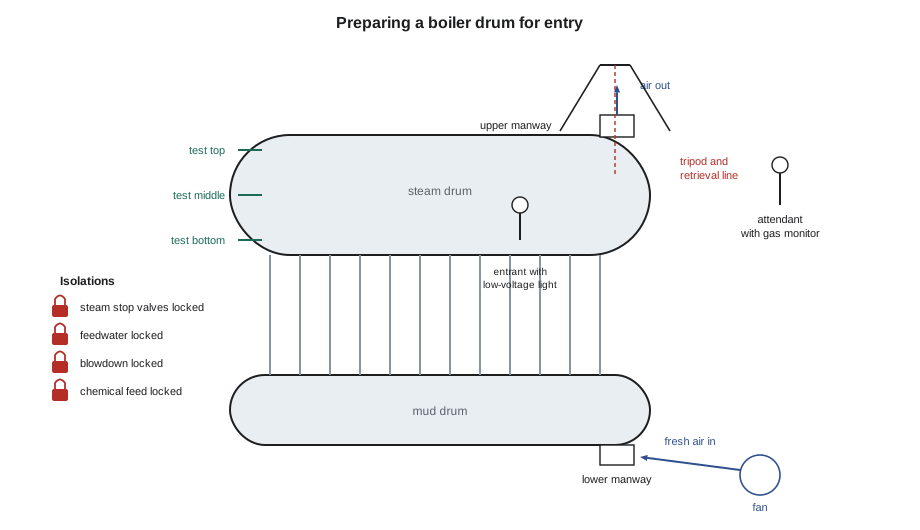
The night before the TSSA inspection in September, boiler 3 had to be opened for the first time since its last annual outage. Tamar was not allowed inside, but she was the attendant's helper, and that turned out to teach her more than going in would have. Pilar Quenneville, the shift engineer in charge of the entry, worked through the entry permit line by line with the two maintenance workers: isolation complete and verified, the boiler drained and cooled, manholes and handholes open, a fan blowing fresh air in through the lower manway and out of the upper one, the atmosphere tested at the top, middle and bottom of the drum, low-voltage lights, and a rescue plan with the harness and tripod set up at the drum manway. When the gas monitor read 20.9 in 100 oxygen and zero for everything else, Pilar signed the permit and the first worker climbed in.
This lesson explains what makes a space confined, why confined spaces kill, and how a boiler, a deaerator or a tank is safely prepared, tested, entered and closed. In the United States general industry plants follow OSHA's permit-required confined spaces standard, 29 CFR 1910.146.
What a confined space is
OSHA defines a confined space as a space large enough for a worker to enter and work in, with limited or restricted means of entry or exit, and not designed for continuous occupancy. A permit-required confined space also has one or more serious hazards: a hazardous or potentially hazardous atmosphere, material that could engulf an entrant, an internal shape that could trap or asphyxiate, or any other recognized serious safety or health hazard. Boiler drums and furnaces, deaerators, condensate and feedwater tanks, chemical tanks, flues and breeching, pits and some valve vaults in the steam distribution system are typically permit spaces.
Confined spaces kill in a few familiar ways. The air may lack oxygen, because rusting steel inside a closed vessel has used it up or because an inert gas such as nitrogen was used to protect the vessel. The air may be toxic, from carbon monoxide in a flue, hydrogen sulfide in a sump, or chemical vapors in a tank. It may be flammable. And the space itself may trap people: hot water or steam let in through a leaking valve, a burner fired by mistake, a fan started with someone in the flue. A grim pattern repeats in confined space deaths: the first victim collapses, and one or more would-be rescuers go in after them without breathing protection and collapse too. Many of those who die are rescuers.
The rules under OSHA
OSHA's standard requires an employer whose workers enter permit spaces to have a written permit space program. Before each entry the employer issues an entry permit, signed by an entry supervisor, that records the space, the purpose, the date and duration, the authorized entrants, the attendant, the hazards and the controls, the acceptable entry conditions and test results, the rescue services and the communication method. Roles are defined: authorized entrants, an attendant who stays outside and monitors, and an entry supervisor who authorizes the entry and can end it. Rescue must be available, either an in-house team or an outside service that can respond in time, and non-entry rescue with a retrieval system is preferred where practicable.
OSHA treats an atmosphere as hazardous if oxygen is below 19.5 in 100 or above 23.5 in 100, if flammable gas is at or above 10 in 100 of its lower flammable limit (LFL), or if a toxic substance is above its permissible exposure limit. Testing goes in a set order: oxygen first, then combustible gases, then toxic gases. If the only hazard is an atmosphere that ventilation alone keeps safe, OSHA allows alternate procedures under strict conditions, but a boiler with its pipes and burners is normally entered under a full permit.
| Check | Acceptable for entry (OSHA summary) |
|---|---|
| Oxygen | 19.5 to 23.5 in 100 by volume |
| Flammable gas | Below 10 in 100 of the lower flammable limit |
| Toxic gases (CO, H₂S and others) | Below the permissible exposure limits |
| Temperature | Cool enough to work safely (set by the permit) |
Preparing a boiler for entry
Preparing a boiler is mostly lockout (lesson 5) on a large scale, followed by cooling, ventilating and testing. The sequence at Cantwell for boiler 3 was:
- Shut down and cool. The burner was stopped and the boiler cooled slowly over many hours, as the maker's instructions say, to avoid thermal stress. Pressure was allowed to fall naturally, with the drum vent opened once the pressure was low.
- Isolate everything. Steam stop valves with the free-blow drain open between them, feedwater stop and check valves, continuous and bottom blowdown, chemical feed, sample lines, the gas supply to the burner (locked at the manual shutoff valve, with the burner's own safety shutoff valves also closed) and the burner and fan motors at their breakers.
- Drain. The boiler was drained to the blowdown tank once the water was cool enough, with the vent open so it would not draw a vacuum.
- Open and ventilate. Manholes and handholes were opened only after the boiler was confirmed empty and at zero pressure, standing to the side of each cover as it was loosened. A fan blew fresh air in at the lowest opening.
- Test and permit. The atmosphere was tested at several levels, the permit was completed and signed, the rescue equipment was set up, and the attendant took position.
Inside, workers use low-voltage lighting or lighting protected by a ground fault circuit interrupter, because a boiler drum is a wet, conductive space where a fault at 120 V could kill. Tools are lowered rather than dropped. The attendant keeps a log of who is inside, stays in contact, and never enters to rescue; their job is to raise the alarm and use the retrieval system from outside.
Worked problem
Ventilation air changes
Boiler 3's drum and tube spaces hold about 335 cubic feet of air. The ventilation fan delivers about 530 cubic feet per minute. How many air changes per hour does that give, and how long does one air change take?
Show solution
- Air per hour:
- \[530 \times 60 = 31{,}800 \text{ ft}^3/\text{h}\]
- Air changes per hour:
- \[31{,}800 \div 335 \approx 95\]
- Time for one change:
- \[335 \div 530 \approx 0.63 \text{ min} \approx 38 \text{ s}\]
Answer: About 95 air changes an hour, or one every 38 seconds, if the air sweeps the whole space. In practice air short-circuits between openings, which is why fresh air is blown in at the lowest opening and leaves at the highest, and why testing is done at every level and repeated during the work, not only before entry.
Testing the atmosphere
Gas monitors must be bump tested before each day's use, by exposing them briefly to a test gas to prove each sensor responds, and calibrated as the maker's schedule requires. Testing starts from outside, lowering the sampling hose into the space to test at the top, middle and bottom, because gases separate: carbon monoxide mixes with air, hydrogen sulfide and many solvent vapors are heavier and collect low, and methane rises. Results go on the permit. During the work the monitor stays with the entrants or the attendant and alarms if conditions change, and the space is retested after any break.
Testing is not a formality. Steel boilers that have been closed and wet for a long time can contain low-oxygen air, even after draining. A space can become hazardous during work too: welding and cutting consume oxygen and make fumes, solvents release vapor, and a leaking valve can let in steam, gas or nitrogen. If an alarm sounds, everyone leaves immediately, and nobody re-enters until the cause is found and the permit is reissued.
Closing up and returning to service
When work is done, the entry supervisor makes sure every person and every tool is out, the inside is clean and clear of rags, lights and loose parts, and the inspector, if one is involved, has finished. A head count matches the attendant's log. Covers go back on with new gaskets, tightened to the maker's instructions. The permit is closed and filed. Isolations are removed in a planned order, the boiler is filled slowly with treated water, vented, checked for leaks and brought up to temperature gradually. Lorne made Tamar count the tools out of boiler 3 against the list the workers had written when they went in, and initial the permit beside his signature.
Confined spaces outside the boiler house
Not every confined space at Cantwell is inside the plant. The steam distribution system runs through tunnels and vaults under the downtown streets, where valves, expansion joints and traps sit in concrete chambers reached through manholes. These spaces can fill with steam from a leaking joint, with water from a broken main, or with gases seeping from the soil or a nearby sewer, and they can be very hot. Every vault entry is treated as a confined space entry with a permit, testing, ventilation and an attendant at the surface, and the work is coordinated with the city when a manhole is in a roadway, because traffic is a hazard of its own.
Hot work in a confined space, such as welding a pipe support inside a vault or cutting out a corroded section of breeching, needs extra precautions: a hot work permit on top of the entry permit, continuous gas monitoring, ventilation that carries the fumes away from the workers, a fire extinguisher at hand, and a stricter flammable gas limit. Grazyna's procedures do not allow any gas cylinder to be taken into a confined space; welding gases are fed in through hoses from cylinders outside, and the hoses are removed whenever work stops.
Rescue planning
A rescue plan is written before the entry, not improvised during an emergency. For boiler drums, Cantwell's plan relies on non-entry rescue: every entrant wears a full body harness attached to a line running to a tripod and winch at the manway, so the attendant can pull them out without going in. Where the shape of the space makes that impossible, such as inside a furnace with baffles or a vault with an offset passage, the plan names a trained rescue team with breathing apparatus who must be on site or able to arrive within a set time before the entry can start. The plan also lists how to call the fire department, the nearest hospital and the plant's first aiders.
Rescue equipment is checked before every entry: the harness inspected, the winch tested with a load, the line checked for wear, and the communication method tested. During the boiler 3 entry Tamar's job was to check off each item on the permit as Pilar inspected it, and to keep the entry log of who went in and came out, and when.
Worked problem
Planning the work time
During the boiler 3 entry, the atmosphere was retested every 30 minutes and after each break. The workers entered at 7:40 p.m., took a break from 9:10 to 9:30, and came out for good at 11:20. How many tests were needed, counting the initial test before entry?
Show solution
- Before entry:
- \[1 \text{ test}\]
- First period, 90 minutes of work:
- \[90 \div 30 = 3 \text{ tests}\]
- After the break:
- \[1 \text{ test}\]
- Second period, 110 minutes of work:
- \[\lfloor 110 \div 30 \rfloor = 3 \text{ tests}\]
- Total:
- \[1 + 3 + 1 + 3 = 8\]
Answer: Eight tests, each recorded on the permit with the time, the readings and the tester's initials. Continuous monitoring by a gas detector worn by the entrants ran throughout, so the scheduled tests were a check on the monitor as well as on the space.
Common mistakes
MistakeEntering to rescue a collapsed worker without breathing protection.
InsteadRaise the alarm and use the retrieval system from outside; trained rescuers with breathing apparatus go in.
MistakeTesting the atmosphere only at the manway.
InsteadTest at the top, middle and bottom; gases separate.
MistakeTrusting a boiler is safe because it has been drained.
InsteadClosed, wet steel can use up oxygen; always test, and isolate every connection.
MistakeUsing 120 V tools and lights inside a drum without protection.
InsteadUse low-voltage lighting or ground fault protection in wet, conductive spaces.
MistakeOpening a manway cover facing the opening.
InsteadStand to the side, and loosen it only when the boiler is confirmed empty and at zero pressure.
Summary and key terms
- A confined space has limited entry and exit and is not for continuous occupancy; OSHA 1910.146 covers permit spaces with serious hazards.
- Low oxygen, toxic or flammable air, engulfment and unexpected energy are the main dangers; many victims are would-be rescuers.
- Entry needs a program, an assessment and plan, a permit, testing, an attendant and a rescue plan.
- Hazardous atmospheres include oxygen below 19.5 or above 23.5 in 100, and flammable gas at 10 in 100 of the LFL or more.
- A boiler is cooled, isolated, drained, opened, ventilated and tested before entry.
- Test at several levels, bump test monitors and retest during the work.
- Close up with a tool and head count, new gaskets, a closed permit and a slow return to service.
- Permit-required confined space
- A confined space with a serious hazard, entered only under a written permit.
- Entry supervisor
- The person who authorizes, oversees and can end a permit entry.
- Attendant
- The person outside a permit space who monitors, keeps contact and summons rescue.
- LFL
- Lower flammable limit, the lowest concentration of a gas in air that can burn.
- Bump test
- A brief exposure of a gas monitor to test gas to prove its sensors respond.
- Retrieval system
- A harness, line and winch or tripod for pulling an entrant out without entering.
Practice problems
Work each problem on paper first, then reveal the answer to check.
Name three kinds of confined space in a boiler plant.
Show answer
A boiler drum, a deaerator, a condensate or chemical tank (also flues, pits and valve chambers).
Why do so many confined space deaths involve rescuers?
Show answer
They enter without breathing protection to help and are overcome by the same atmosphere.
Why is the atmosphere tested at several levels?
Show answer
Gases separate; some collect low and some rise.
What is the attendant's role if an entrant collapses?
Show answer
Raise the alarm and use the retrieval system from outside; never enter.
Why is low-voltage or ground fault protected lighting used inside a drum?
Show answer
The space is wet and conductive, so a fault at normal voltage could be fatal.
Lesson quiz · 5 questions
Score 60% or more to complete this lesson.
Create a free account to save your progress, take quizzes and earn a certificate.