
PWR-110 · Lesson 2 of 12 · 20 min
Boiler laws, state and city licensing and the ASME codes
▶ Video coming soon A video version of this lesson is on the way.
On Wednesday, September 16, 2026, a state-commissioned boiler inspector spent the morning at Cantwell for the annual internal inspection of boiler 3, which had been opened, cleaned and drained for him the week before. Tamar watched from the drum manway as he checked the tubes and drum internals with a light and a mirror, then followed him round the outside as he read the nameplate and stamping, looked at the safety valve tags and asked Lorne for the low water cutoff test records. Before he left he completed his report so that the state could renew the boiler's certificate of operation, and Grazyna filed his copy beside the others. "Every one of those papers comes from a law," Lorne said afterwards. "If you know which law, you know what the inspector will ask for."
This lesson explains who makes and enforces the rules for boilers, pressure vessels and the people who run them in the United States, with Ohio as the main example: the ASME codes, the National Board, state boiler laws and state and city licensing. Lesson 3 then looks closely at licenses, boiler sizes and supervision.
Why boilers are regulated
Boiler laws exist because boilers once killed people regularly. In the nineteenth century, steam boiler explosions on riverboats, locomotives and in factories caused hundreds of deaths a year in North America. A boiler's water and steam store an enormous amount of energy; when a shell or a drum fails, the drop in pressure lets the water flash to steam all at once, and the expansion throws the boiler and the building apart. Two responses grew out of those disasters. Engineers wrote construction codes setting rules for materials, design, fabrication, inspection and safety valves. Governments passed boiler laws requiring that boilers be built to those codes, registered, inspected regularly and run by qualified people. Explosions of properly built, inspected and operated boilers are now rare; most of the serious incidents that remain involve low water, failed safety devices or furnace explosions, which is why so much of this course is about operation.
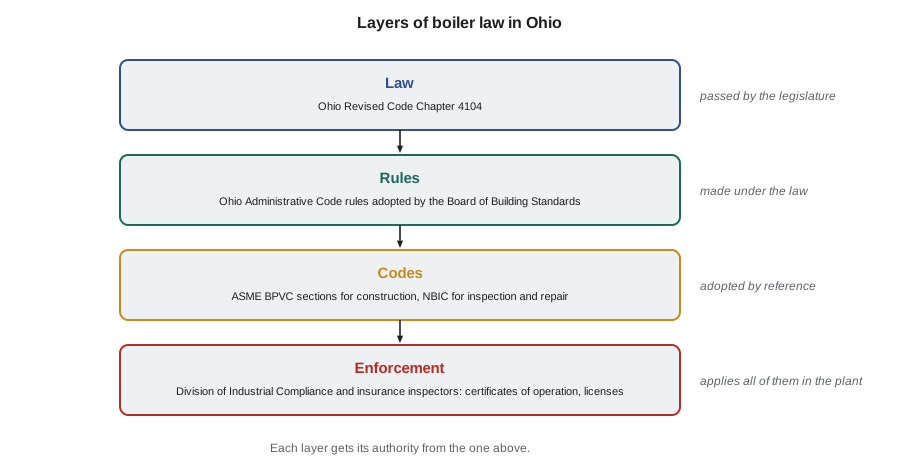
The rules come in layers. A statute (an act passed by the legislature) sets out the broad powers and duties. Regulations made under the act fill in the details. Codes and standards, written by technical bodies, are adopted by reference in the regulations, which gives them the force of law. And an enforcement body registers equipment, inspects it, examines and certifies people, and can order unsafe equipment out of service.
The ASME codes and the National Board
In the United States the construction rules for boilers and pressure vessels come almost entirely from the ASME Boiler and Pressure Vessel Code (BPVC), written by committees of the American Society of Mechanical Engineers and revised every two years. States adopt the BPVC in their laws. Several sections matter in a heating or power plant: Section I for power boilers, Section IV for heating boilers, Section VIII for pressure vessels, and Section IX for welding qualifications. Sections VI and VII give recommended rules for the care and operation of heating and power boilers. ASME CSD-1 sets requirements for the controls and safety devices on automatically fired boilers, and many states, including Ohio, adopt it as well.
The National Board of Boiler and Pressure Vessel Inspectors is an organization of the chief boiler inspectors of the states, cities and Canadian provinces. It commissions inspectors after examination, keeps a registry of boilers built to ASME rules (the National Board number stamped on many nameplates), and publishes the National Board Inspection Code (NBIC), which covers the installation, inspection, repair and alteration of boilers and vessels once they are in service. Repairs to the pressure parts of a boiler must be made by an organization holding a National Board "R" certificate and accepted by an inspector. That is why Cantwell's maintenance staff do not weld on boiler pressure parts themselves.
Other laws apply to the people working in the plant. The federal Occupational Safety and Health Act and the OSHA general industry standards (29 CFR 1910) cover lockout, guarding, confined spaces, noise, chemicals and the employer's duties to train and protect workers, and OSHA enforces them in Ohio. Fire codes, building codes and the fuel gas codes also apply to boiler rooms, fuel storage and exits. Lessons 4 to 8 come back to these.
State boiler laws: Ohio as an example
Ohio's boiler law is in Chapter 4104 of the Ohio Revised Code. The Board of Building Standards adopts the detailed boiler rules, found in Chapter 4101:4 of the Ohio Administrative Code, which bring in the ASME code sections, ASME CSD-1 and the NBIC. The Division of Industrial Compliance in the Ohio Department of Commerce runs the program: it keeps boiler records, issues certificates of operation, employs state boiler inspectors and accepts inspections by commissioned inspectors employed by insurance companies. Boilers must be inspected at intervals the rules set (power boilers typically every year), and a boiler without a current certificate of operation may not be run. The same law and the superintendent's rules set up Ohio's operator licenses, covered in lesson 3.
Inspectors check far more than the steel. They want to see the plant's log (lesson 10), the records of safety valve and low water cutoff tests required by CSD-1 and the owner's procedures, the water treatment program, and the licenses of the operators on duty. An engineer who can lay those records on the desk in a few minutes usually has an easy inspection.
| Layer | Ohio | What it does |
|---|---|---|
| Statute | Ohio Revised Code Chapter 4104 | Sets the boiler program, inspections and operator licenses |
| Rules | Ohio Administrative Code Chapter 4101:4, plus licensing rules | Adopt codes, set inspection and certificate requirements |
| Codes adopted | ASME BPVC sections, ASME CSD-1, the NBIC | Design, construction, controls, repair rules |
| Enforcement | Division of Industrial Compliance, state and insurance inspectors | Inspects, issues certificates of operation, licenses operators |
Licensing in other states and cities
Outside Ohio the picture is uneven. Some states license operators by boiler type and pressure, as Ohio does. Massachusetts licenses first, second, third and fourth class engineers and firemen, with the class required depending on the size and type of plant. Some large cities license engineers within their limits even where the state does not. Some states license no one and rely on employers, insurers and union apprenticeships for training. The ASME codes and the National Board are the common ground everywhere, so a boiler's construction and inspection rules are much the same across the country even where the operator rules are not.
For an engineer moving between states, the practical steps are the same: find out which agency licenses boiler operators there, whether the city adds its own license, what grade the plant requires, and whether experience and licenses from another state count. Many states recognize National Board commissions for inspectors, but operator licenses rarely transfer automatically.
Worked problem
Reading a nameplate
Boiler 2's nameplate shows a maximum allowable working pressure of 200 psi, the ASME stamp and a National Board number. The safety valves are set at 200 psi and the plant normally runs at 150 psi. By how much is the normal operating pressure below the safety valve setting, as a fraction of the setting?
Show solution
- Margin:
- \[200 - 150 = 50 \text{ psi}\]
- Fraction of the setting:
- \[50 \div 200 = 0.25\]
Answer: The plant runs 50 psi, or 25 in 100 of the setting, below the safety valves. That margin stops the valves from simmering and leaking during normal swings in pressure. The safety valve setting may never be higher than the nameplate's maximum allowable working pressure, and changing it is a job for an authorized repair organization, accepted by an inspector.
What the law expects of the engineer
Laws describe duties in general terms, but in the plant they come down to habits. The owner must keep the boilers' certificates of operation current, have them inspected, employ licensed operators where the law requires them, and keep the controls and safety devices tested and working. The chief engineer is responsible for the plant's safe condition, the training and supervision of operators, maintenance, and accurate records. Shift engineers run the plant safely during their shifts and keep the log. Everyone must hold the license the job requires, carry or display it as required, and not do work they are not qualified for.
Lorne summed it up for Tamar in three rules. Never alter a safety device or a setting without authority. Never operate equipment you are not qualified for. And write down what happened, especially when it went wrong, because the log protects the engineer who told the truth and exposes the one who did not.
What happened at the inspection
The inspector's visit in September followed a pattern Lorne had seen many times. Before he looked inside boiler 3, he checked the boiler's certificate of operation and the licenses of the operators on shift, compared the nameplate and the ASME stamping with the state's records, and read the last year's records of the boiler's low water cutoff tests and safety valve tests. Inside the drum he looked for scale and pitting on the tubes and drum, checked the internal feed pipe and the separators, and looked at the condition of the welds around the manway. Outside, he checked the gauge glass and its valves, the pressure gauge, the safety valve nameplates showing their set pressures and capacities, and the blowdown piping. He asked Lorne to explain how the boiler was isolated from the steam header, and Lorne walked him to the two stop valves and the open free-blow drain between them.
The inspector found one item to correct. A pressure gauge on the boiler's feedwater line had a cracked face, and he asked for it to be replaced before the boiler went back into service. He also suggested that the plant record the water chemistry results beside each blowdown entry in the log, so the blowdown rate could be checked against the test results. Neither was a violation of anything dramatic, but both went on Grazyna's action list that afternoon, and she sent a note confirming the gauge replacement before boiler 3 was fired again.
Watching the inspection taught Tamar something Lorne had been saying for weeks: the inspector is not there to run the plant, and does not see it most of the year. He looks at a boiler for a few hours and at the plant's records for a few minutes, and from those he judges whether the people who run it every day are doing their jobs. A plant with clean records, tested safety devices and engineers who can answer questions about their isolations earns trust. A plant with gaps in its log or a safety valve that has not been tested in years gets a much harder look.
When the law changes
Codes and regulations change. The ASME code is revised every two years, the NBIC regularly, and Ohio's Board of Building Standards updates its rules to adopt newer editions. Insurers issue their own recommendations after incidents across many plants. Engineers are expected to keep up: the chief reads the state's notices and the insurer's reports, the plant's procedures are updated when the rules change, and shift engineers read the changes and sign to show they have. An engineer who has worked in a plant for years may find that something they learned early is no longer how it is done.
Common mistakes
MistakeBelieving the inspector is responsible for the boiler's safety between inspections.
InsteadThe owner, the chief and the shift engineers are responsible every day; inspections check that they are doing it.
MistakeRaising a safety valve setting to stop a valve simmering.
InsteadFind out why pressure is near the setting; setting changes need authority and may never exceed the maximum allowable working pressure.
MistakeThinking a license from one state lets you run a plant in another.
InsteadCheck the state and city rules where the plant is; licenses rarely transfer automatically.
MistakeLetting plant maintenance staff weld on a boiler's pressure parts.
InsteadRepairs to pressure parts must be made by an "R" certificate holder and accepted by an inspector.
Summary and key terms
- Boiler laws grew out of deadly explosions and now combine construction codes, registration, inspection and qualified operators.
- The legal layers are the statute, its regulations, adopted codes and standards, and an enforcement body.
- Ohio's boiler law is ORC Chapter 4104, with rules in OAC Chapter 4101:4 and a program run by the Division of Industrial Compliance.
- The ASME Boiler and Pressure Vessel Code sets construction rules; the National Board commissions inspectors and publishes the NBIC.
- Licensing varies: some states license by boiler type, Massachusetts uses graded licenses, some cities add their own.
- Workplace safety laws also apply in the plant, alongside boiler laws.
- Inspectors look at records and procedures as well as the equipment.
- ASME BPVC
- The ASME Boiler and Pressure Vessel Code, the construction code for boilers and vessels.
- ASME CSD-1
- The ASME standard for controls and safety devices on automatically fired boilers.
- National Board
- The organization of chief boiler inspectors that commissions inspectors and publishes the NBIC.
- NBIC
- The National Board Inspection Code, for inspection, repair and alteration of boilers in service.
- "R" certificate
- National Board authorization to repair the pressure parts of boilers and vessels.
- Certificate of operation
- The state document showing a boiler has passed inspection and may be run.
- Board of Building Standards
- The Ohio board that adopts the boiler rules.
Practice problems
Work each problem on paper first, then reveal the answer to check.
What are the four layers of boiler law?
Show answer
The statute, its regulations, adopted codes and standards, and an enforcement body.
Which ASME section covers power boilers?
Show answer
Section I.
Who must make repairs to a boiler's pressure parts?
Show answer
An organization holding a National Board "R" certificate, accepted by an inspector.
Boiler safety valves are set at the maximum allowable working pressure. May the setting be raised?
Show answer
No; it may never exceed the maximum allowable working pressure.
Name one state that uses graded engineer licenses.
Show answer
Massachusetts.
Lesson quiz · 5 questions
Score 60% or more to complete this lesson.
Create a free account to save your progress, take quizzes and earn a certificate.