
PWR-110 · Lesson 7 of 12 · 23 min
Fire protection and plant emergencies
▶ Video coming soon A video version of this lesson is on the way.
At 2:40 in the morning on Tuesday, October 20, 2026, boiler 1's flame safeguard locked out and the alarm horn sounded in the control room. Tamar was on nights that week with Desmond Kirwan. Her hand was halfway to the reset button on the burner panel when Desmond said quietly, "Not yet." He checked the steam header pressure, which boiler 2 was holding, then read the fault on the safeguard's display: flame failure during the run, not during light-off. He looked through the sight glass at the dark furnace, checked that the burner's safety shutoff valves had closed and the gas pressure was normal, and only then let the purge run before a single restart attempt. The burner lit and held. In the morning the instrument technician found a cracked flame scanner lens. "One reset after a proper check," Desmond wrote in the log. "Never two in a row on a guess."
This lesson covers how fires start and how they are fought, how furnace explosions are prevented, and how a plant responds to the emergencies it is most likely to face: flame failures, low water, tube failures, power failures, gas leaks and the need to evacuate. Each plant's emergency procedures are written for its own equipment, and engineers learn them before they need them.
How fires start and spread
A fire needs fuel, heat and oxygen, and a chemical chain reaction that keeps it burning; take away any one and the fire goes out. That idea, the fire tetrahedron, explains every method of firefighting: cooling removes heat, smothering removes oxygen, shutting a fuel valve removes fuel, and some extinguishing agents interrupt the chain reaction. Boiler plants have plenty of fuel: natural gas, fuel oil for backup firing, lubricating oil, oily rags, insulation soaked with oil, wooden pallets and paper in storerooms. They also have plenty of heat sources: burners, hot surfaces, electrical faults, cutting and welding.
Most plant fires are small at first: a smoldering rag near a hot pipe, an oil leak dripping onto insulation, a motor winding overheating. Good housekeeping prevents many of them. Oily rags go in closed metal containers, oil leaks are fixed and soaked insulation is replaced, combustible storage is kept away from boilers and hot piping, and hot work is done only under a hot work permit, with a fire watch and an extinguisher at hand.
| Class | Fuel | Suitable agents (typical) |
|---|---|---|
| A | Ordinary combustibles: wood, paper, cloth, rubber, many plastics | Water, foam, multipurpose dry chemical |
| B | Flammable liquids and gases: fuel oil, lubricating oil, solvents, natural gas | Dry chemical, carbon dioxide, foam (shut off a gas supply first) |
| C | Energized electrical equipment | Carbon dioxide, dry chemical (non-conducting agents) |
| D | Combustible metals: magnesium, titanium, sodium | Special dry powders for the metal |
| K | Cooking oils and fats | Wet chemical |
Portable extinguishers are rated for the classes they can fight, and the label shows them. Fire codes require portable extinguishers to be installed and maintained, following NFPA 10, with monthly visual checks and annual maintenance by a qualified person; OSHA's 29 CFR 1910.157 adds training rules where employees are expected to use them. A plant like Cantwell has multipurpose dry chemical extinguishers throughout, carbon dioxide extinguishers near the motor control center, and a fire alarm system tied to a monitoring service.
Using an extinguisher is simple if it has been practiced: pull the pin, aim at the base of the fire, squeeze the handle, sweep from side to side. An engineer fights a fire only if it is small, the alarm has been raised, there is a clear way out behind them, and they have the right extinguisher. A fire that is growing, or that cannot be put out in the first few seconds of discharge, means leaving, closing doors behind and letting the fire department take over. For a gas-fed fire, the first step is to shut off the gas from a safe place; extinguishing a gas flame while gas keeps flowing creates an explosive cloud.
Preventing furnace explosions
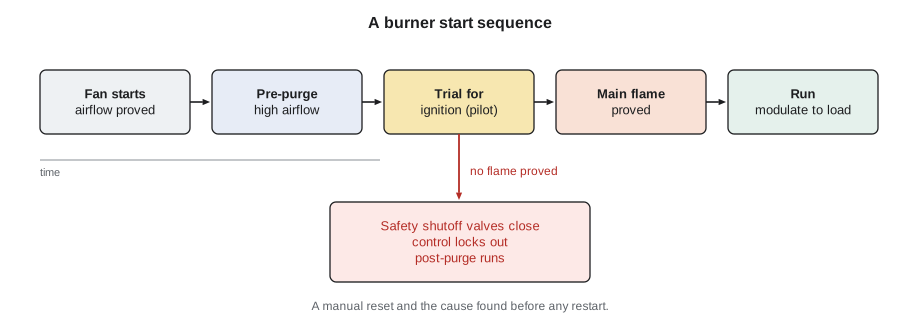
Lesson 4 described furnace explosions. They are prevented by burner management: a flame safeguard control that supervises the flame with a scanner or flame rod, proves that air is flowing and fuel valves are closed before starting, purges the furnace and flue with fresh air before every light-off, allows only a short trial for ignition and shuts the fuel valves within seconds if no flame is proved, and shuts them again whenever the flame is lost during a run. The fuel train has two automatic safety shutoff valves in series, often with a proof of closure switch or a valve leak test, so that a single valve leaking cannot fill a cold furnace with gas.
The purge is the step operators are most often tempted to shorten. Its purpose is to sweep out any fuel that might have collected, so it has to move several times the volume of the furnace and flue passages through the boiler at a high airflow. ASME CSD-1, NFPA 85 for larger boilers and the burner's own listing set the requirements; four or more changes of the furnace volume is a common figure (typical). The engineer's rules are simple: never bypass a purge or a flame safeguard, never hold a fuel valve open by hand, and after a failed light-off or flame failure, find the cause before trying again.
Worked problem
How long must the purge run?
Boiler 1's furnace and flue passages hold about 1,480 cubic feet. During purge the forced draft fan moves about 7,400 cubic feet per minute. If the plant's procedure requires four volume changes, what is the minimum purge time?
Show solution
- Air needed:
- \[4 \times 1{,}480 = 5{,}920 \text{ ft}^3\]
- Time:
- \[5{,}920 \div 7{,}400 = 0.8 \text{ min} = 48 \text{ s}\]
Answer: At least 48 seconds at full purge airflow. The safeguard on boiler 1 is set longer than that, and it times the purge only once the airflow switch proves high airflow; that is why a fan that is slipping on its belt can cause purge failures.
Boiler emergencies
Some emergencies are particular to boilers, and each has a response every engineer should know without looking it up.
- Low water. If the water level drops out of sight in the gauge glass, the fuel is shut off at once if the low water cutoff has not already done it. Feedwater is not added to a boiler that may have overheated, because cold water on red-hot steel can cause a violent failure; the boiler is left to cool slowly with the fuel off and the steam outlet open to keep pressure under control, and then inspected. The plant procedure, and the chief engineer, decide when it is safe to refill.
- High water. Water carried over with the steam can damage turbines and cause water hammer in the distribution lines. The engineer reduces the feed, checks the controls and blows down as the procedure says, and warns customers or downstream equipment if water may have gone out with the steam.
- Tube failure. A ruptured tube floods the furnace with steam and water and may blow out the flame. The fuel is shut off, the boiler is taken off line and isolated from the header, and pressure is allowed to fall in a controlled way. Whether to keep feeding water depends on whether level can be held, which the procedure and the shift engineer decide.
- Flame failure and lockout. As Desmond showed, the safeguard has already shut the fuel. The engineer reads the fault, looks for the cause and allows a reset only when the cause is understood and the procedure allows it.
- Power failure. Pumps, fans and controls stop. Boilers shut down safely on loss of power. Standby power or steam-driven equipment, such as Cantwell's turbine feed pump, keeps water going to boilers that are still hot and full of steam. The engineer checks levels on every boiler, starts standby equipment as the procedure says, and restarts in a planned order when power returns.
- Gas leak. Leave, warn, do not operate switches, shut off the gas at a safe location, ventilate, call the utility and the fire department as the procedure says, and keep everyone out until the area is tested.
Boiler rooms also have an emergency shutdown switch outside the main exit door, which stops the burners when pressed. ASME CSD-1 requires a manual emergency shutdown switch outside the boiler room door for many automatically fired boilers, so that the fire department or an engineer can shut the boilers down from a safe place.
Emergency plans and drills
Every plant has a written emergency response plan that lists the emergencies it might face, who does what, how alarms are raised, evacuation routes and assembly points, how to reach the fire department, the gas utility, the electrical utility and key customers, and who talks to the media. At Cantwell the plan also covers loss of steam to the most sensitive customers, a seniors' residence and a hotel kitchen, who are called first if steam is interrupted. Copies are posted in the control room and at each exit.
Plans work only if people have practiced them. Cantwell holds an evacuation drill twice a year and a tabletop exercise each fall. On Wednesday, October 14, Grazyna ran the fall exercise in the control room: a gas leak at the burner front of boiler 2 during the day shift. Each person said aloud what they would do and in what order. Tamar's job in the scenario was to warn the maintenance crew in the shop and lead them to the assembly point across the street, counting heads. Afterwards Grazyna changed one line of the plan, because nobody had been named to meet the fire department at the gate.
| Emergency | First actions (summary) |
|---|---|
| Fire, small | Raise the alarm; use the right extinguisher only with a clear exit behind you |
| Fire, growing | Raise the alarm, shut fuel from a safe place if possible, evacuate, close doors |
| Gas smell | Leave, warn, no switches, shut gas at a safe location, call the utility |
| Low water out of sight | Shut off fuel; do not add feedwater; let the boiler cool; call the chief |
| Flame failure | Read the fault; check the burner and fuel train; one reset only when the cause is clear |
| Power failure | Check every boiler's level; start standby feed; restart in order when power returns |
Fuel oil and backup firing
Many district energy plants and hospitals can burn fuel oil as well as natural gas, so they can keep running if the gas supply is cut or curtailed. Cantwell keeps light fuel oil in an outdoor tank with a containment dike and pumps it to the burners when needed. Fuel oil is a Class B fire hazard and an environmental hazard if it leaks. Engineers check the tank's level and the dike for water and oil on rounds, keep oil-soaked materials away from hot surfaces, and test the changeover from gas to oil on a schedule so that it works when it is needed. A spill from the tank or its piping is reported and cleaned up following the spill plan, and spills that reach the ground or drains are reported to the environmental authorities as the law requires.
After an emergency
Every emergency, even a minor one, is followed by a review. The log records the facts while they are fresh. Any injury, fire, release or equipment failure that the law requires to be reported is reported within the time set: to the boiler regulator for boiler accidents, to the workplace safety regulator for serious injuries, and to environmental authorities for spills. The plant then asks what happened, why, and what will stop it happening again, and changes procedures, equipment or training as needed. After the flame failure on boiler 1, the review found that the flame scanner lenses on all three boilers had never been on the maintenance schedule; they were added, with cleaning every three months and replacement every two years.
Worked problem
Emergency response time
Cantwell's plan says the shift engineer must call the seniors' residence within 15 minutes of any loss of steam to it. If a trip happens at 2:52 a.m. and the engineer spends 6 minutes securing the boiler and 4 minutes confirming the steam header pressure is falling, how much time is left to make the call?
Show solution
- Time used:
- \[6 + 4 = 10 \text{ min}\]
- Time left:
- \[15 - 10 = 5 \text{ min}\]
Answer: Five minutes. In practice the call is made as soon as the engineer knows steam is falling, not at the last minute. The plan lists the residence's maintenance contact and night number beside the phone so no time is lost looking for it.
Common mistakes
MistakeResetting a locked-out burner again and again.
InsteadFind the cause first; allow one reset only when it is understood.
MistakeAdding feedwater to a boiler whose level has gone out of sight.
InsteadShut off the fuel and let it cool; cold water on overheated steel can cause a violent failure.
MistakePutting out a gas fire while the gas keeps flowing.
InsteadShut off the gas from a safe place first.
MistakeShortening the purge to get a boiler on line faster.
InsteadNever bypass or shorten the purge; it removes fuel that could explode.
MistakeFighting a growing fire.
InsteadRaise the alarm, leave, close doors and let the fire department take over.
Summary and key terms
- A fire needs fuel, heat, oxygen and a chain reaction; firefighting removes one of them.
- Extinguishers are rated by class (A, B, C, D, K); multipurpose dry chemical and carbon dioxide are common in plants.
- Fight only small fires with the right extinguisher and a clear exit; use pull, aim, squeeze, sweep.
- Burner management purges, supervises the flame and shuts the fuel valves on any failure.
- Never bypass a purge or safeguard, never hold a fuel valve open, and find the cause before resetting.
- Low water: shut off fuel and do not add feedwater to an overheated boiler.
- Emergency plans and drills make sure everyone knows their role before it is needed.
- Fire tetrahedron
- Fuel, heat, oxygen and the chain reaction that a fire needs.
- Flame safeguard
- The control that proves flame and shuts the fuel valves when flame is lost.
- Purge
- Sweeping the furnace and flue with fresh air before light-off to remove any fuel.
- Trial for ignition
- The short period allowed for a flame to be proved before the fuel valves close.
- Lockout (burner)
- The safeguard's shut-down state after a failure, needing a manual reset.
- Emergency shutdown switch
- A switch outside the boiler room exit that stops the burners.
- Emergency response plan
- The written plan of who does what in each plant emergency.
Practice problems
Work each problem on paper first, then reveal the answer to check.
What four things does a fire need?
Show answer
Fuel, heat, oxygen and a chain reaction.
What class of fire is energized electrical equipment?
Show answer
Class C.
A furnace holds 1,480 cubic feet and the fan moves 7,400 cfm. How long is a four-change purge?
Show answer
48 seconds.
Why must feedwater not be added to a boiler whose level has gone out of sight?
Show answer
The steel may be overheated, and cold water on it can cause a violent failure.
Where is a boiler room's emergency shutdown switch usually located?
Show answer
Outside the main exit door.
Lesson quiz · 5 questions
Score 60% or more to complete this lesson.
Create a free account to save your progress, take quizzes and earn a certificate.