
PWR-110 · Lesson 4 of 12 · 23 min
Plant hazards and safe work
▶ Video coming soon A video version of this lesson is on the way.
On Tuesday, September 29, 2026, Tamar was halfway down the walkway beside boiler 1 when Lorne put a hand on her arm and pointed. About 6 ft ahead, a thin, almost invisible shimmer was coming off a small fitting on a steam trap line. There was no cloud, no hiss she could hear over the burners, only a faint wobble in the light. Lorne held a broom handle out at arm's length into the shimmer; the bristles jerked and steamed. "Superheated or high-pressure steam leaks can be invisible," he said. "That jet would have cut through your trouser leg and into the bone. We go round." They closed the trap's isolating valves from the other side, tagged the line and wrote a work order for Fenella. In the log Lorne wrote the time, the location and the words "invisible leak, area barricaded".
This lesson surveys the hazards of a boiler plant and the habits that keep engineers safe: recognizing the hazard, controlling it at the source, and protecting people when it cannot be removed. It sets up the lessons that follow on lockout, confined spaces, fire and chemicals. The OSHA general industry standards (29 CFR 1910) apply to the plant, alongside the boiler laws in lesson 2.
Steam, hot water and hot surfaces
Steam burns are worse than burns from boiling water at the same temperature, because steam that condenses on skin gives up its latent heat, about 970 Btu per pound at atmospheric pressure, on top of the heat in the water itself. A small leak of high-pressure steam leaves the fitting as a jet that may be invisible for the first stretch, until it cools and condenses into the familiar white cloud further out. Where a leak is suspected, engineers test the air ahead of them with a broom or a piece of cloth on a stick, never with a hand, and they approach from the side, never along the line of the jet.
Hot water under pressure is just as dangerous. Water in a boiler at 150 psi is at about 366 °F; when it escapes to atmosphere, part of it flashes instantly to steam and the rest sprays out boiling. Blowdown lines, drains, gauge glass connections and sample coolers all carry this water. Valves on these lines are opened slowly, from the side, with the engineer standing where a burst would not hit them.
Hot surfaces are everywhere: uninsulated valves and flanges, steam traps, sample lines, the skin of a boiler near the burner, and the stack. Most surfaces that people can touch are insulated or guarded, but insulation is often removed for maintenance and not replaced. A useful habit is to treat every pipe as hot until proved otherwise, to wear gloves when touching valves, and to report missing insulation, which is also a waste of energy.
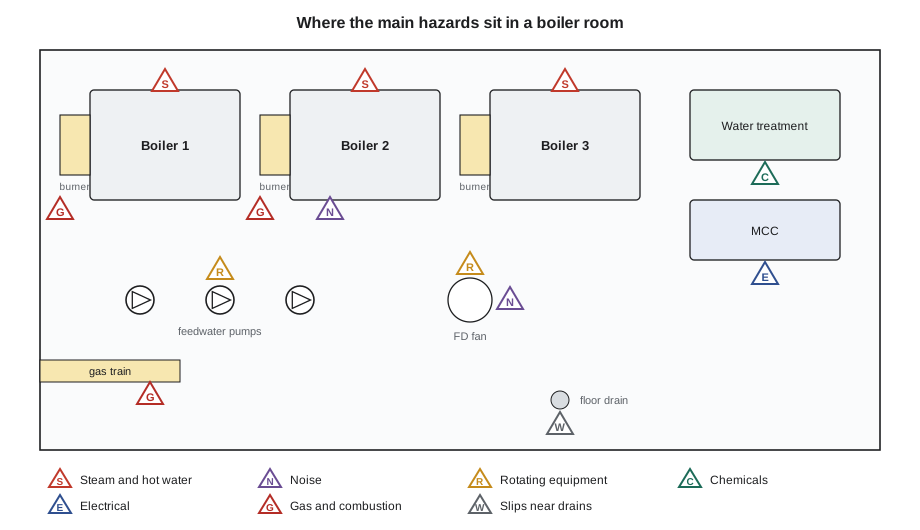
Noise
Forced draft fans, burners, steam vents, pumps and compressors make boiler rooms loud, often above 85 dBA near the equipment. Long exposure causes permanent hearing loss, which is painless and gradual and therefore easy to ignore. OSHA's general industry noise standard (29 CFR 1910.95) sets a permissible exposure limit of 90 dBA averaged over eight hours with a 5 dB exchange rate, and requires a hearing conservation program, with monitoring, hearing tests, training and protectors, once exposures reach an action level of 85 dBA. Employers must use engineering or administrative controls where they are feasible.
Worked problem
How long at a given noise level?
OSHA's limit is 90 dBA for 8 hours, with a 5 dB exchange rate. How long may an unprotected worker spend each day in an area at 100 dBA?
Show solution
- Each 5 dB above 90 halves the time:
- \[100 - 90 = 10 \text{ dB} = 2 \text{ halvings}\]
- Allowed time:
- \[8 \div 2^{2} = 2 \text{ h}\]
Answer: Two hours. Rounds that pass through loud areas add up over a shift, so Cantwell requires hearing protection in the boiler room whenever the burners are firing, whatever the time spent.
Pressure, stored energy and moving machinery
Besides steam and water, a plant holds energy in compressed air receivers, hydraulic systems, springs in valve actuators, chemical feed lines and electrical systems. Any of it can be released by opening the wrong flange, loosening a fitting under pressure or starting a machine someone is working on. That is why lesson 5's lockout rules apply to every kind of energy, not only electricity. A basic rule in the plant is that a flange or fitting is never loosened until the line has been isolated, drained or vented, and proved to be at zero pressure.
Rotating equipment, such as pumps, fans, couplings and belt drives, can catch clothing, hair and fingers. Guards must be in place whenever equipment can run, and they are removed only with the equipment locked out. Loose clothing, rings and long hair are risks around rotating shafts. Many pumps and fans start automatically on demand, so a machine that is stopped is not necessarily safe; only a machine that is locked out is.
Combustion hazards
The most destructive event in a fired boiler is a furnace explosion, when fuel that has collected in the furnace or flue passages ignites all at once. It usually follows a failed ignition attempt, a flame that went out without the fuel being shut off, or fuel leaking through a valve into a cold furnace. Modern burners have flame safeguards and purge sequences to prevent it (lesson 7), and engineers must never bypass them, retry ignition repeatedly without purging, or look into a sight port in line with a burner during light-off.
Carbon monoxide comes from incomplete combustion: a dirty burner, a blocked flue, too little air or a cracked heat exchanger. It is colorless and odorless and can kill in a closed room. Cantwell has fixed CO and combustible gas detectors in the boiler room, and engineers carry personal four-gas monitors when they work near burners or enter enclosed spaces. Natural gas leaks are a fire and explosion hazard; the procedure Tamar learned in her first week, to leave, warn others, avoid switches and call from outside, applies to any strong gas smell.
Electrical, chemical and everyday hazards
Boiler plants have motors, motor control centers, transformers and switchgear. Engineers operate breakers and starters as part of their job, and must follow the electrical safety program: approach boundaries, arc flash labels, the right personal protective equipment and lockout before any work. The US electrical safety standard is NFPA 70E, with OSHA's electrical rules in 29 CFR 1910 Subpart S, and electrical work itself is done by qualified electricians. Chemicals for water treatment are covered in lesson 8.
Many plant injuries are not dramatic. Wet floors near drains and sample sinks, oily ladders, tools left on walkways, poor lighting and climbing on piping cause slips, trips and falls. Heat stress is real in summer, when the area above the boilers can be much hotter than outside. Lifting valves, motors and bags of salt for the softeners can strain backs. Good housekeeping, proper lighting, fixed ladders and platforms, mechanical lifting aids and drinking water close at hand prevent most of these injuries.
Controlling hazards
Safety professionals rank controls in a hierarchy of controls, from the most effective to the least: elimination (remove the hazard), substitution (replace it with something less dangerous), engineering controls (guards, enclosures, interlocks, ventilation), administrative controls (procedures, permits, training, signs, rotation) and personal protective equipment (PPE). PPE is the last line of defense, not the first, because it only protects the person wearing it, and only if it is the right equipment, worn correctly.
| Hazard | Example control | Level |
|---|---|---|
| Steam leak at a trap | Isolate, depressurize and repair the fitting | Elimination |
| Corrosive cleaning chemical | Use a milder product approved by the water treatment supplier | Substitution |
| Rotating coupling | Fixed guard; lockout to remove it | Engineering |
| Noisy fan room | Silencer on the fan inlet; acoustic enclosure | Engineering |
| Boiler entry | Confined space entry permit and procedure | Administrative |
| Blowdown valve | Face shield, gloves, long sleeves; stand to the side | PPE and practice |
In every Canadian province and US state, workers have rights and duties under occupational safety law. Workers must follow the safe work procedures, use the equipment provided and report hazards. Employers must provide training, equipment and supervision. And workers have the right to refuse work they believe is dangerous; the refusal triggers an investigation, and the worker may not be punished for it. At Cantwell, Grazyna's standing order is that anyone may stop a job they think is unsafe, and the job does not restart until a shift engineer has checked it.
Cantwell's basic PPE in the boiler room is safety footwear, safety glasses, hearing protection and long sleeves of non-melting fabric. Engineers add face shields and leather gloves for blowdowns and gauge glass work, chemical goggles, gloves and aprons for chemical handling, and arc-rated clothing for electrical switching above set energy levels. A job hazard analysis (JHA), a short written review of the steps of a task, the hazards of each step and the controls, is done before any non-routine job.
Safety culture in the plant
Rules and equipment prevent many injuries, but the habits and attitudes of the people in the plant decide whether the rules are followed when nobody is watching. A plant with a strong safety culture is one where people report near misses without fear, stop jobs that look wrong, wear their protective equipment as a matter of course, and expect supervisors to take safety concerns seriously. A plant with a weak one is where shortcuts become normal, near misses are hidden, and people assume that because nothing has gone wrong yet, nothing will.
Near misses, events that could have caused harm but did not, are the most valuable information a plant has, because they show where the next injury might come from. Cantwell asks engineers to write up every near miss on a one-page form: what happened, what could have happened, and what would stop it happening again. The invisible steam leak Lorne found in September became a near-miss report, and the action that came out of it was a monthly ultrasonic and thermal camera survey of the plant's steam traps, which found three more leaking traps in October before anyone walked into one.
Heat stress
In summer, the air above Cantwell's boilers and around the deaerator platform can be far hotter than outdoors, and the humidity from steam vents and drains makes it harder for the body to cool by sweating. Heat stress starts with tiredness, headache and heavy sweating, can progress to heat exhaustion with dizziness and nausea, and can become heat stroke, a medical emergency in which the body stops cooling itself, the skin may be hot and dry, and confusion or collapse follows. Prevention is practical: drink water frequently, take breaks in a cool area, rotate work in hot areas, wear light clothing under the required protective equipment, and watch co-workers for signs. Anyone showing signs of heat stroke is cooled immediately and an ambulance is called.
Working alone
Plants sometimes have only one engineer on duty, especially at night or on weekends. Working alone raises the stakes of any injury, because there may be no one to help or to call for help. Cantwell's rules for lone work are that the engineer checks in with the city's security office every two hours by phone, carries a radio and a personal alarm, and does not do higher-risk tasks such as confined space entry, work at heights or any lockout needing more than one person until a second qualified person is on site. The control room phone and the security office's number are posted at every phone in the plant.
Worked problem
Combining exposures
On a round, an engineer spends 30 minutes in the boiler room at 100 dBA. OSHA's rule allows 2 hours at that level. What fraction of the daily allowance has been used, and how much is left if the rest of the shift is quiet?
Show solution
- Fraction used:
- \[0.5 \div 2 = 0.25\]
- Fraction remaining:
- \[1 - 0.25 = 0.75\]
Answer: One round has used a quarter of the day's allowance. Three such rounds would use three quarters, and four would use it all. That is why the plant simply requires hearing protection in the boiler room whenever the burners are firing, rather than asking people to track their exposure minute by minute.
Common mistakes
MistakeTesting for a steam leak with a hand.
InsteadUse a broom or a cloth on a stick from the side, and approach from out of the jet's line.
MistakeLoosening a fitting to see whether a line is under pressure.
InsteadIsolate, drain or vent, and prove zero pressure before opening anything.
MistakeTreating a stopped pump as safe to work on.
InsteadPumps and fans can start automatically; only locked-out equipment is safe.
MistakeRelying on PPE alone.
InsteadWork down the hierarchy of controls; PPE is the last line of defense.
MistakeSkipping hearing protection for a quick pass through the boiler room.
InsteadShort exposures add up; wear protection whenever the area is loud.
Summary and key terms
- High-pressure steam leaks can be invisible and cut deeply; test for them with a broom, from the side.
- Steam burns are severe because condensing steam releases its latent heat on the skin.
- Hot water under pressure flashes to steam when released; open blowdowns and drains slowly from the side.
- OSHA's noise limit is 90 dBA over 8 hours, with a hearing conservation program from 85 dBA.
- Stored energy includes steam, water, air, springs, chemicals and electricity; all of it is isolated before work.
- Furnace explosions and carbon monoxide are the main combustion hazards; safeguards are never bypassed.
- The hierarchy of controls runs from elimination to PPE; workers may refuse unsafe work.
- Latent heat
- The heat released when steam condenses to water at the same temperature.
- Flashing
- The instant boiling of hot water when its pressure drops.
- Exchange rate
- The number of decibels by which noise must rise to halve the allowed exposure time.
- Furnace explosion
- The sudden ignition of fuel that has collected in a boiler furnace or flue.
- Hierarchy of controls
- The ranking of hazard controls from elimination to personal protective equipment.
- Job hazard analysis
- A written review of a task's steps, hazards and controls before the work starts.
- Right to refuse
- A worker's legal right to refuse work they believe is dangerous.
Practice problems
Work each problem on paper first, then reveal the answer to check.
Why might a high-pressure steam leak be invisible?
Show answer
Near the fitting the steam has not yet cooled and condensed into a visible cloud.
At 100 dBA, how long may an unprotected worker stay under OSHA's rule?
Show answer
Two hours.
What usually causes a furnace explosion?
Show answer
Fuel collecting in the furnace and igniting at once, often after a failed ignition or lost flame.
Which control is the last line of defense?
Show answer
Personal protective equipment.
What may a worker do if they believe a job is dangerous?
Show answer
Refuse the work and report it; the refusal is investigated.
Lesson quiz · 5 questions
Score 60% or more to complete this lesson.
Create a free account to save your progress, take quizzes and earn a certificate.