
PHOT-211 · Lesson 7 of 12 · 25 min
Beauty and fashion lighting
Beauty and fashion photography place extreme demands on light. Beauty images, for cosmetics, skincare, hair and jewelry, show faces at very close range and must render skin, makeup and features flawlessly at large sizes on billboards, packaging and screens. Fashion images must show clothing, fabric and movement while creating a mood that sells a brand or tells an editorial story. Both genres have developed distinctive lighting vocabularies, from the luminous clamshell of cosmetics advertising to the hard, graphic light of high fashion. This lesson covers the goals of beauty lighting, classic beauty setups, catchlights and eyes, lighting for makeup and skin, lighting for different skin tones, fashion lighting styles, lighting fabric and movement, working with hair and makeup artists, and consistency in campaigns.
Goals of beauty lighting
Beauty lighting aims to make skin look smooth and luminous while retaining texture, reveal the shape of the face, show makeup colors accurately, create attractive catchlights, and minimize retouching time. It is usually soft and frontal, with low ratios and carefully controlled specular highlights, because skin at close range shows every shadow, pore and blemish under hard light. At the same time, completely flat light makes faces look round and featureless, so beauty setups introduce subtle shaping through the placement of sources, the use of reflectors and flags, and contouring with makeup. The lighting must also suit the product: a matte foundation, a glossy lip or a shimmering eyeshadow each reflect light differently.
Classic beauty setups
Several setups are used repeatedly in beauty photography:
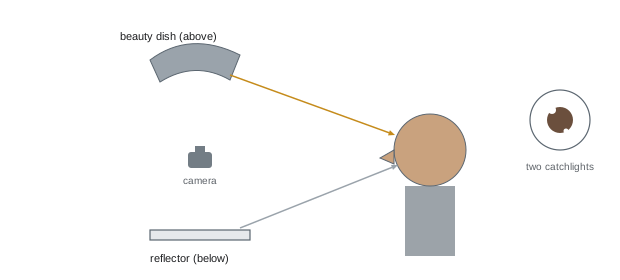
- Clamshell: a beauty dish or softbox above the camera, angled down, and a reflector or second softbox below, angled up, forming a shell around the lens. It produces soft, even light that fills under the eyes and chin, with a pair of catchlights. Adjusting the lower light's strength controls how much the shadows beneath the cheekbones remain.
- Beauty dish with diffusion sock: a beauty dish gives a crisp but soft-edged light with defined highlights on cheekbones and a distinctive circular catchlight; adding a sock softens it. Often used high and centered for butterfly lighting.
- Large source on axis: a large octabox or parabolic directly behind the camera, very close to the subject, for luminous, almost shadowless light with large catchlights.
- Ring light: a circular light around the lens, producing shadowless frontal light, a soft shadow halo behind the subject on nearby backgrounds and ring-shaped catchlights. Associated with fashion and beauty from the 1990s onward.
- Strip boxes on either side with a frontal key: two vertical strips at about 90 degrees on either side of the face define the jaw and cheekbones, while a frontal key fills the face.
Each setup can be combined with white V-flats close to the subject for additional wrap, and with flags or black cards to sculpt shape.
Catchlights and eyes
In beauty and fashion close-ups, the eyes are often the focus, and catchlights, the reflections of light sources in the eyes, are prominent. Their shape, size and position reveal the lighting and affect expression: a single catchlight at about ten or two o'clock looks natural; a large octagonal or circular catchlight signals studio beauty; a ring-shaped catchlight indicates a ring light; strip boxes create vertical rectangles; and a reflector below creates a second, smaller catchlight in the lower iris. Multiple catchlights from many sources can look distracting or artificial. Catchlights should be in both eyes, of similar size and position. Retouchers sometimes refine or replace catchlights, but planning them in lighting is better.
Lighting for makeup and skin
Makeup and skin respond differently to light. Matte makeup absorbs light and looks smooth under soft light; glossy lipsticks and highlighters reflect sources as specular highlights, which must be shaped by the size and placement of the lights; metallic and glitter products sparkle under smaller, harder sources. Beauty photographers often adjust light to show each product's finish: a larger source for a smooth foundation, a smaller or closer source to make a highlighter glow. Color accuracy matters greatly: use high-quality flash or high-CRI continuous light, set white balance with a gray card, and photograph a color chart for product color matching. Makeup artists may adjust their work after seeing test images, since makeup that looks right in person can appear different under studio light, particularly products containing reflective particles or ingredients such as titanium dioxide and zinc oxide in sunscreens, which can create a white flashback under flash.
Worked problem
Reducing shine on a beauty close-up
In a clamshell beauty setup, the model's forehead and nose show bright, hard specular highlights, while the client wants a soft, satin finish. What adjustments can reduce the shine?
Show solution
- Ask the makeup artist to apply powder to the shiny areas.
- Add a diffusion sock to the beauty dish or switch to a larger octabox, increasing the source size so highlights become broader and softer.
- Move the key slightly higher or to the side so the specular reflections fall away from the camera angle.
- Reduce the key power slightly and increase the lower fill so the overall exposure is maintained with less intense highlights.
Answer: Powder the skin, enlarge and soften the key, shift its angle so reflections miss the lens, and rebalance key and fill.
Lighting different skin tones
Beauty and fashion photography serves people of every skin tone, and lighting must be adjusted accordingly. Darker skin reflects less light and often shows a beautiful natural sheen, so it benefits from slightly more exposure on the face, larger or closer sources that create broad, smooth specular highlights, and attention to the warmth and variety of undertones, which can range from red and golden to cool and blue. Lighter skin reflects more light and shows redness and veins easily, so softer, slightly warmer light and careful exposure to protect highlights are important. When people with different skin tones appear together, light each person individually, as discussed in CINE-202, rather than exposing for one and losing the other. Historically, film stocks and lighting conventions were calibrated for lighter skin, and contemporary photographers are expected to light all skin tones with equal care and skill.
Fashion lighting styles
Fashion lighting varies widely with the brand, the clothing and the story. Common styles include:
- Hard, graphic light: a bare reflector or small dish, often high and slightly off-axis, creating crisp shadows and strong contrast, associated with high fashion and editorial work from Richard Avedon's later work onward.
- Soft, clean commercial light: large softboxes and fill, with even illumination of the garment, used for catalog and e-commerce fashion.
- Sunlight simulation: a hard light outside a window or high to one side, imitating sun, often with a warm gel, for summer campaigns shot indoors.
- Ring light and on-axis flash: flat, high-energy light with a halo shadow, popular in editorial and street-inspired fashion.
- Cinematic light: motivated sources, practicals and colored accents, telling a story as in a film still.
Full-length fashion images require light that covers the whole body evenly, from head to shoes, so larger sources placed farther away, or vertical strip boxes, are common. The light should show the cut, texture and color of the clothing as well as the model.
Lighting fabric and movement
Fabrics respond to light in characteristic ways. Satin and silk reflect sources as long, flowing highlights; lighting from the side or behind reveals sheen and drape. Velvet and wool absorb light and need more exposure and raking light to show texture. Sequins and metallic fabrics sparkle under small, hard sources and can look flat under very soft light. Black clothing absorbs light and can lose all detail; a rim or kicker light reveals its shape, and slightly more exposure in the shadows, checked with the histogram, retains texture. White clothing can clip easily, so protect highlights. Movement, such as a model walking, spinning or a fan blowing fabric, requires fast flash durations (Lesson 6) and a large lit area so that the subject remains correctly exposed throughout.
| Fabric | How it reacts | Lighting approach |
|---|---|---|
| Satin and silk | Long, flowing reflections | Side or back light, large sources for smooth highlights |
| Velvet | Absorbs light, deep tones | Raking light, more exposure |
| Sequins and metallics | Sparkle from small sources | Hard or small sources, some fill |
| Black garments | Lose detail easily | Rim or kicker, protect shadow detail |
| White garments | Clip easily | Meter carefully, protect highlights |
| Denim and knitwear | Strong texture | Side light to reveal weave |
Working with hair and makeup artists and stylists
Beauty and fashion shoots are collaborative. Makeup artists, hair stylists and wardrobe stylists shape the subject's appearance, and lighting decisions affect how their work appears. Share lighting tests early so that they can adjust; ask about products that may reflect flash unusually; allow time for touch-ups between setups, since hot lights, movement and time affect makeup and hair; and communicate clearly about what each setup requires. Monitors showing tethered images help the whole team see the results. A respectful, efficient set where everyone understands the plan produces better images.
Consistency in campaigns
Advertising campaigns often require many images, with different models, products or garments, that look consistent, sometimes shot on different days or in different cities. Consistency requires documenting lighting setups precisely with diagrams, distances, power settings and modifiers; using the same equipment and modifiers; photographing gray cards and color charts for each setup; shooting tethered with a reference image on screen for comparison; and maintaining consistent white balance, exposure and processing. Large campaigns often employ a digital technician to manage tethering, color and file handling during the shoot.
Beauty lighting for hair
Hair campaigns require light that shows shine, movement, color and texture. Large strip boxes or softboxes behind and to the sides create long, glossy highlights along the hair, the visual sign of healthy hair in advertising; a frontal key lights the face; and fans create movement, with short flash durations to freeze strands. Hair color affects exposure: dark hair needs more light to show detail and shine, while blond and gray hair can clip easily. Smooth, straight hair reflects broad highlights, while curly and textured hair shows its shape through many small highlights, best revealed by side and back light at different angles. Lighting should celebrate every hair type rather than impose a single standard.
Close-up detail and macro beauty
Extreme close-ups of eyes, lips and skin texture for cosmetics campaigns use macro lenses at high magnification, with very shallow depth of field and every detail visible. Light must be very even and soft, often from large sources close to the subject or from ring-shaped sources around the lens, and the subject must remain still; focus stacking may be needed. Skin preparation by the makeup artist is essential at this scale, since retouching can only do so much without losing realism.
Fashion on location versus in studio
Fashion lighting techniques translate between studio and location. On location, photographers often use the sun as a hard key or backlight and add strobes with large modifiers to fill or overpower it, controlling ambient with shutter speed, ND filters or high-speed sync (Lesson 5). In the studio, they may recreate location light, such as a sunlit window, to give control and consistency. Understanding both lets photographers choose the most efficient approach for each brief.
Lighting for lookbooks and e-commerce fashion
Lookbooks and e-commerce fashion require consistent, efficient lighting across many outfits and models: typically large soft sources from the front and sides, white or light gray backgrounds lit separately, and fixed camera positions, so that each garment appears accurately and consistently. Changes between outfits should not require changing lights. This style prioritizes accuracy and speed over mood.
Common mistakes
MistakeHard, small sources on close-up beauty skin.
InsteadUse large, soft sources with controlled highlights.
MistakeCompletely flat beauty light.
InsteadAdd subtle shaping with placement, reflectors and flags.
MistakeMismatched or multiple distracting catchlights.
InsteadPlan catchlight shape, size and position.
MistakeExposing all skin tones identically.
InsteadLight and expose each person individually.
MistakeLosing black garments in shadow.
InsteadUse rim light and protect shadow detail.
Summary and key terms
- Beauty lighting is soft and frontal with subtle shaping and accurate color.
- Clamshell, beauty dish, on-axis, ring light and strip setups are standard.
- Catchlights reveal and shape the lighting in close-ups.
- Makeup finishes and sunscreens react differently to light.
- All skin tones require individual care in lighting and exposure.
- Fashion lighting ranges from hard graphic to soft commercial and cinematic.
- Fabrics, movement, collaboration and documentation shape fashion results.
- Beauty lighting
- Soft, flattering light for close-up faces.
- Clamshell
- Key above and fill below the camera.
- Beauty dish
- Dish reflector with a center deflector.
- Diffusion sock
- Fabric cover softening a beauty dish.
- Ring light
- Circular light around the lens.
- Catchlight
- Reflection of a light source in the eye.
- Specular highlight
- Bright reflection of a source on a surface.
- Flashback
- White cast from reflective ingredients under flash.
- Undertone
- Underlying color of skin.
- Digital technician
- Crew member managing tethering and files.
Practice problems
Work each problem on paper first, then reveal the answer to check.
Why is beauty lighting usually soft?
Show answer
Close-up skin shows every shadow and blemish under hard light.
Describe clamshell lighting.
Show answer
Key above the camera and fill below it.
What catchlight does a ring light create?
Show answer
A ring shape.
How can shine be reduced in a beauty close-up?
Show answer
Powder, larger softer source, change angle, rebalance.
What causes white flashback?
Show answer
Reflective ingredients such as titanium dioxide and zinc oxide.
How should darker skin usually be lit?
Show answer
Slightly more exposure, larger or closer sources for broad sheen.
Name two fashion lighting styles.
Show answer
Hard graphic, soft commercial, sun simulation, ring light, cinematic.
How should satin be lit?
Show answer
Side or back light with large sources.
How do you keep detail in black clothing?
Show answer
Rim or kicker light and protected shadows.
Name two ways to keep a campaign consistent.
Show answer
Diagrams and settings, same modifiers, charts, tethered references.
Lesson quiz · 5 questions
Score 60% or more to complete this lesson.
Create a free account to save your progress, take quizzes and earn a certificate.