
NUC-430 · Lesson 9 of 12 · 21 min
Licensing new reactors and SMRs
Teodora Vasquez's team at Meridian Nuclear Engineering has spent three years supporting TVA's small modular reactor project at Clinch River, and on the day Hana joins them the mood is cheerful: the construction permit has just been issued. "Ten years ago people said nobody would license a new reactor here except a large light water plant," Teodora tells her. "Now we have a permit for a BWRX-300 on the same site where the country tried to build a breeder reactor in the 1980s. The hard part was not the technology. It was showing the NRC a safety case for a design that had never been built anywhere."
What is new about new reactors
The existing fleets in both countries are dominated by large water-cooled reactors: CANDU pressurized heavy water reactors in Canada and pressurized and boiling light water reactors in the United States. The regulatory frameworks grew up around these designs, and many requirements assume their features, such as a large containment building, active emergency core cooling systems and a large emergency planning zone. New designs differ in several ways. Small modular reactors, usually defined as those producing up to about 300 megawatts of electricity, are factory-built in modules and may rely on passive safety features that need no power or operator action. Advanced reactors use coolants other than water, such as molten salt, liquid sodium, helium gas or lead, and fuels such as TRISO particles, metallic fuel or fuel dissolved in salt. Microreactors produce a few megawatts and may be transportable.
These differences create both opportunities and challenges for regulators. A design with a small inventory, low power density and passive cooling may have far smaller accident consequences, which could justify a smaller emergency planning zone, fewer staff and simpler security. But a design that has never operated has little operating experience to draw on, its fuel and materials may lack the data that water reactors have accumulated over decades, and its computer codes may not be validated for its conditions. The regulator must decide how much evidence is enough without either blocking innovation or accepting unproven claims.
The US frameworks
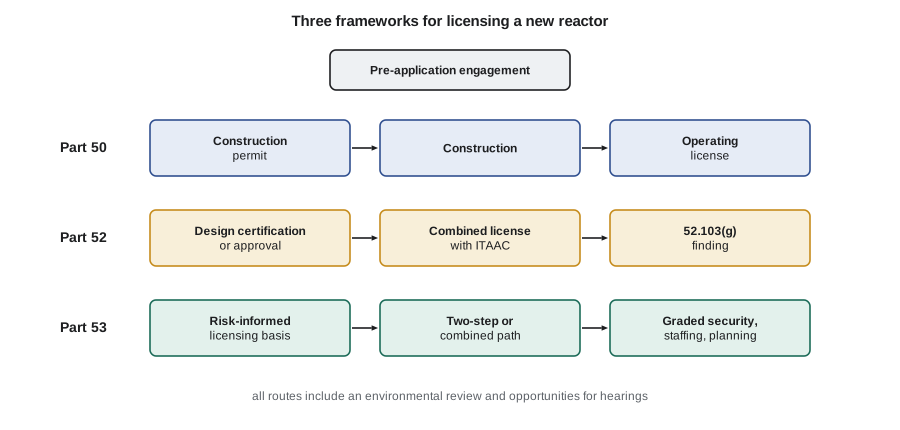
US applicants for new reactors can choose among three frameworks. Part 50, the traditional two-step route, has been used for most recent advanced reactor projects, including Kairos Power's Hermes test reactors, Abilene Christian University's molten salt research reactor and TVA's Clinch River BWRX-300. Part 52, with design certifications and combined licenses, was used for Vogtle 3 and 4 and for NuScale's designs, the first SMR design certified by the NRC in 2023. Part 53, the new framework required by the Nuclear Energy Innovation and Modernization Act and finalized in 2026, is technology-inclusive and risk-informed: it sets safety criteria in terms of outcomes, uses a probabilistic risk assessment to choose licensing basis events and classify equipment, and allows security, staffing and emergency planning to be scaled to the design's hazard.
Congress and the executive branch have pushed for faster licensing. The ADVANCE Act of 2024 directed the NRC to reduce fees for advanced reactor applicants, to develop processes for licensing microreactors and reactors at brownfield sites, and to prepare for licensing reactors for non-power uses. The May 2025 executive order on reforming the NRC set an 18-month deadline for final decisions on new reactor applications and directed a wholesale revision of the agency's regulations. The NRC adopted a rule in 2023 that lets SMRs and other new technologies size their emergency planning zones based on their potential consequences, rather than the 10-mile zone used for large reactors.
Key regulatory issues for new designs
| Issue | Why it is hard | Typical regulatory approach |
|---|---|---|
| Fuel qualification | new fuels lack decades of irradiation data | irradiation tests, topical reports, margins |
| Code validation | codes not validated for new coolants or geometries | experiments, benchmarking, confirmatory analysis |
| Source term | what could be released depends on new fuel and coolant behavior | mechanistic source term with conservatism |
| Emergency planning zone | consequence-based sizing needs strong evidence | dose criteria at the zone boundary |
| Staffing and remote operation | fewer operators or multiple modules per control room | human factors engineering and validation |
| Security | large guard forces may be disproportionate | security by design, graded requirements |
| Manufacturing | factory-built modules shipped to site | quality oversight of the factory, transport |
| Multi-module sites | events affecting several modules at once | integrated risk analysis |
Fuel qualification is a good example of how the issues play out. A light water reactor fuel design has been tested in many reactors over decades, and its behavior under accident conditions is well understood. TRISO fuel, in which tiny kernels of uranium are coated with layers of carbon and silicon carbide, has a long history of testing but less commercial use, and the regulator must be satisfied that the particles retain fission products at the temperatures the design predicts. The US Department of Energy's advanced gas reactor fuel program produced a large body of data, and the NRC approved a topical report on TRISO fuel performance in 2020, which applicants can now reference. This kind of shared evidence base makes each subsequent review easier.
Comparing pathways
For a utility that plans several units of the same design, the licensing pathway matters for the first unit and even more for the ones that follow. If the first review resolves the design issues, later units at the same or other sites need only site-specific review. Teodora's team built a simple model to compare approaches.
# Compare licensing durations (months) for a first unit and follow-on units (illustrative).
paths = {
    # (design review before construction, construction-stage review, operating-stage review)
    "two-step": {"first": (0, 24, 24), "follow": (0, 15, 15)},
    "design-first": {"first": (36, 18, 6), "follow": (0, 12, 4)},
    "risk-informed": {"first": (18, 20, 10), "follow": (0, 12, 6)},
}
UNITS = 4
for name, p in paths.items():
    first = sum(p["first"]); follow = sum(p["follow"])
    total = first + (UNITS - 1) * follow
    print(f"{name:14s} first unit {first:3d}  each follow-on {follow:3d}  fleet of {UNITS}: {total:3d} months of licensing")
best = min(paths, key=lambda n: sum(paths[n]["first"]) + (UNITS - 1) * sum(paths[n]["follow"]))
print("lowest total licensing effort:", best)two-step first unit 48 each follow-on 30 fleet of 4: 138 months of licensing design-first first unit 60 each follow-on 16 fleet of 4: 108 months of licensing risk-informed first unit 48 each follow-on 18 fleet of 4: 102 months of licensing lowest total licensing effort: risk-informed
The output shows why standardization matters. The design-first pathway takes longest for the first unit, because the full design must be approved before construction, but follow-on units are licensed quickly because they reference the approved design. The two-step pathway starts construction sooner but carries more review into the operating stage for every unit. The numbers are illustrative; what matters is the pattern. In practice the advantage of standardization is lost if each unit is customized, which is why regulators and utilities alike stress keeping designs identical across a fleet.
International cooperation
Because most SMR designs are being offered in several countries, regulators have found value in sharing reviews. The NRC and the CNSC signed a memorandum of cooperation in 2019 to collaborate on advanced reactor and SMR technologies, and they have issued joint reports on aspects of designs reviewed in both countries, including the BWRX-300 under construction at Darlington in Ontario. Each regulator still makes its own licensing decision under its own law, but sharing technical work avoids duplication and helps align requirements. The IAEA runs a regulators' forum on SMRs and an initiative on harmonization and standardization.
Worked problem
Emergency planning zone area
A large reactor has a plume exposure emergency planning zone of radius 16 kilometers, about 10 miles. An SMR proposes a zone of radius 1 kilometer, about 0.6 mile. By what factor is the area smaller?
Show solution
- Area scales with radius squared.
- Factor = (16 / 1)² = 256.
Answer: The area is 256 times smaller, which greatly reduces the population and planning effort involved.
Policy behind the projects
The United States' renewed interest in new reactors has been shaped by federal policy and funding. The Department of Energy's Advanced Reactor Demonstration Program, begun in 2020, funds the construction of TerraPower's Natrium sodium-cooled reactor in Wyoming and X-energy's Xe-100 high-temperature gas reactor, and the department supports test and demonstration reactors at national laboratories, some of which are authorized by the department itself rather than licensed by the NRC. Executive orders in May 2025 set goals for a large expansion of nuclear capacity and directed agencies to speed up deployment. Utilities are also bringing back retired plants: the Palisades plant in Michigan was returned to an operating licensing status in 2025, the first such restart, and others have been proposed.
Microreactors and transportable reactors
Microreactors, producing a few megawatts to perhaps twenty, raise new regulatory questions. Designers envisage factory fueling and sealing, transport to a remote community, mine or military base, operation for years without refueling and return to the factory at the end of life. That model challenges assumptions built into existing rules: that a reactor is built and licensed at a single site, that it has a large on-site staff and security force, and that fuel is handled on site. Regulators are working through how to license the factory, the transport of a fueled reactor, operation with few or no staff on site and remote monitoring. Both countries' regulators have said that the safety objectives do not change, but the means of meeting them may.
The ADVANCE Act directed the NRC to develop guidance for licensing microreactors, including options for factory fabrication, transport and operation with reduced staffing, and the agency has issued policy papers proposing approaches. Military bases and remote sites are among the first likely users, and the Department of Defense and Department of Energy have run programs to demonstrate microreactors.
The first-of-a-kind problem
Every new design faces the first-of-a-kind problem. The first unit carries the cost of resolving every design issue, building a supply chain, training a workforce and convincing the regulator, the public and investors. If the first unit is late or over budget, the design may never be built again; if it succeeds, the second unit is cheaper and faster. Regulators can help or hinder at this stage. A clear, predictable process, with issues identified early and decisions made on schedule, reduces risk. Requirements that shift during the review, or questions raised late, add cost and delay. But a regulator that relaxes its standards to help a project would undermine the very confidence that makes the next project possible.
Teodora has seen both sides. "The worst thing for a first-of-a-kind project is not a tough regulator," she says. "It is an unpredictable one. Tell me early what you need and I will find a way to give it to you. Tell me late and I have a half-built plant waiting for an answer. The best reviews I have worked on had the toughest questions asked in the first six months."
Lessons the reviews have taught
Reviews of new designs over the past decade have taught some recurring lessons. Applications that were complete, well organized and supported by mature analysis moved quickly; those that left major questions to be answered during the review did not. Novel approaches were accepted when applicants engaged early and provided strong evidence, and resisted when they appeared late with little support. Reviews that drew on shared work, such as approved topical reports or another regulator's review of the same design, saved time. And the most difficult issues were rarely about the reactor physics; they were about fuel, materials, codes and the integration of the design with a real site and organization.
These lessons apply to regulators as well as to applicants. Regulators have learned to plan reviews in detail, to set and publish schedules, to concentrate effort on the issues that matter most to safety, and to explain their questions clearly. The changes now under way in both countries, from Part 53 to the CNSC's guidance for SMRs, are attempts to build those lessons into the rules.
Hana's checklist for a new design
At the end of her week with the new build team, Hana writes a one-page checklist of the questions she expects any regulator to ask about a new design, whatever its coolant or size. Is the fuel qualified for the conditions it will see, including accidents? Are the computer codes validated against experiments relevant to this design? What is the source term, and how was it derived? Which events form the licensing basis, and how were they chosen? Which equipment is safety related, and on what evidence? How many operators are needed, and has the control room been validated with them? How will the site be secured, and why is that proportionate? How will the plant be decommissioned, and who will pay? Teodora reads it and hands it back with one addition at the bottom: what has the applicant done to engage the people who live nearby? "Every one of these can stop a project," she says. "The last one stops more than people think."
Common mistakes
MistakeSMRs are safe by definition because they are small.
InsteadTheir safety must be demonstrated with evidence like any other design.
MistakePart 53 is the only way to license an advanced reactor.
InsteadParts 50 and 52 remain available and have been used for advanced designs.
MistakeA vendor design review or standard design approval licenses the design for any site.
InsteadEach project still needs site-specific licenses.
Summary and key terms
- New designs differ from the existing fleet in size, coolant, fuel and safety features.
- Regulators must judge how much evidence is enough for designs without operating experience.
- US applicants can use Part 50, Part 52 or the new risk-informed Part 53.
- Fuel qualification, code validation, source term and emergency planning are recurring issues.
- Standardization lets follow-on units be licensed much faster than the first.
- SMR
- Small modular reactor, generally up to about 300 megawatts of electricity.
- Part 53
- The risk-informed, technology-inclusive licensing framework finalized in 2026.
- Technology-inclusive
- A framework that does not assume a particular reactor type.
- TRISO
- Coated particle fuel with layers of carbon and silicon carbide.
- Source term
- The amount and type of radioactive material that could be released.
- Standard design approval
- NRC approval of a design that can be referenced in applications.
Practice problems
Work each problem on paper first, then reveal the answer to check.
Which law required the NRC to create Part 53?
Show answer
The Nuclear Energy Innovation and Modernization Act of 2019.
Why is fuel qualification hard for advanced reactors?
Show answer
New fuels lack long irradiation and accident data.
An EPZ shrinks from 10 km to 2 km radius. By what factor does its area fall?
Show answer
25.
Which SMR design was the first certified by the NRC?
Show answer
NuScale, in 2023.
Why does standardization matter?
Show answer
Follow-on units can reference the approved design and be licensed faster.
Lesson quiz · 5 questions
Score 60% or more to complete this lesson.
Create a free account to save your progress, take quizzes and earn a certificate.