
NUC-430 · Lesson 3 of 12 · 21 min
Licensing stages
Dr. Teodora Vasquez runs project licensing at Meridian Nuclear Engineering, and she describes a nuclear plant's life as a series of gates. "A reactor is never licensed once," she tells Hana. "It is licensed to prepare a site, then to build, then to run, then to take apart, and every gate needs its own case. The clever part of a licensing strategy is knowing which questions must be answered at which gate, so that you are not trying to prove everything at once and not leaving anything to the end." This lesson follows those gates through the life cycle of a facility.
The life cycle of a nuclear facility
Every nuclear facility passes through the same broad phases: choosing and evaluating a site, designing, constructing, commissioning, operating, and finally decommissioning and releasing the site. Regulators in both countries license these phases, but they divide them into licenses in different ways. The underlying logic is the same. Questions about the site, such as seismic hazard, flooding, population and the environment, are answered early, before large sums are spent. Questions about the design are answered before construction starts. Questions about how the plant will be run, such as procedures, staffing and emergency plans, are answered before fuel is loaded. And questions about how the plant will be taken apart are considered from the start, so that decommissioning is planned and funded long before it happens.
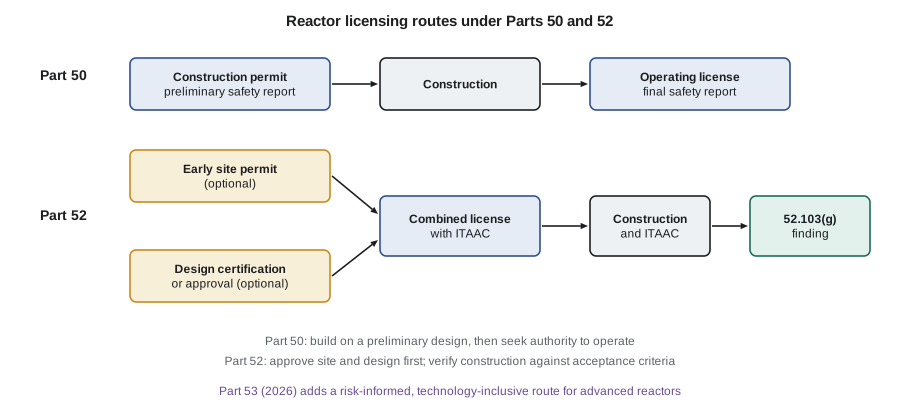
The NRC offers two main routes for licensing a power reactor. Under Part 50, the traditional two-step process, an applicant first obtains a construction permit, then builds the plant and applies separately for an operating license. Almost all of the existing fleet was licensed this way. Under Part 52, adopted in 1989, the applicant can obtain a combined license that authorizes both construction and operation, subject to verification that the plant was built as designed. Part 52 also provides early site permits, which approve a site for a future plant, and standard design certifications, which approve a design by rule so that it can be referenced in many applications. Part 53, finalized in 2026, adds a third route for advanced reactors.
Siting and early site permits
An early site permit resolves site safety, environmental protection and emergency preparedness issues for a site before the applicant chooses a design. The permit can last 10 to 20 years and can be renewed, so a utility can bank a site for future use. The application describes the site's geology, seismology, hydrology and meteorology, population, nearby industrial and military hazards, and the environmental effects of building and running a plant there, using a bounding set of plant parameters to cover the range of designs that might be built. The NRC issued an early site permit for the Clinch River site in Tennessee to TVA in 2019, based on a plant parameter envelope for small modular reactors. That permit later supported TVA's construction permit application for a BWRX-300, which the NRC approved in 2026.
Siting decisions involve both safety and public acceptance. A good site has stable geology, a reliable source of cooling water, low population density in the immediate area and roads that allow evacuation if needed. It also has a community willing to host the plant. Many new projects are proposed at existing nuclear sites for exactly these reasons: the site has already been studied, the community is familiar with nuclear operations, and the infrastructure is in place.
Construction and design approval
Under Part 50, a construction permit is issued on the basis of a preliminary safety analysis report that describes the design and shows that the plant can be built and operated without undue risk; details can be filled in during construction. Under Part 52, the design is approved before construction starts, either through a design certification rule or a standard design approval, or within the combined license application itself. The combined license then includes inspections, tests, analyzes and acceptance criteria, called ITAAC, which list what must be shown to confirm that the plant was built as approved. Before the licensee can load fuel, the NRC must find under 10 CFR 52.103(g) that all of the acceptance criteria have been met.
| Approval | Main purpose | Key information in the application |
|---|---|---|
| Early site permit (Part 52) | approve a site | site safety analysis, environmental report, emergency planning |
| Design certification (Part 52) | approve a standard design by rule | final safety analysis of the design |
| Construction permit (Part 50) | build the facility | preliminary safety analysis report, environmental report |
| Operating license (Part 50) | load fuel and run | final safety analysis report, technical specifications |
| Combined license (Part 52) | build and run | final safety analysis, ITAAC, emergency plans |
Commissioning and operation
An operating license under Part 50, or a combined license after the 52.103(g) finding, allows the licensee to load fuel and run the reactor. Before that point the licensee must have a final safety analysis report, technical specifications, licensed operators who have passed NRC examinations, approved emergency plans with FEMA's finding on off-site preparedness, a security plan and programs for radiation protection, fire protection and quality assurance. Start-up testing follows an approved program, and the plant moves to full power in steps. Power reactor licenses are issued for 40 years, a term set in the Atomic Energy Act for economic and antitrust reasons rather than technical ones, and can be renewed for 20 years at a time under Part 54.
Commissioning is where the paper plant meets the real one. Systems are tested individually, then together, then with fuel in the core. Each test checks that equipment performs as the safety analysis assumed. A failure during commissioning is not a disaster; it is the reason the tests are done. But the results must be documented, the cause understood and the fix verified before the regulator lets the plant proceed.
Planning the licensing schedule
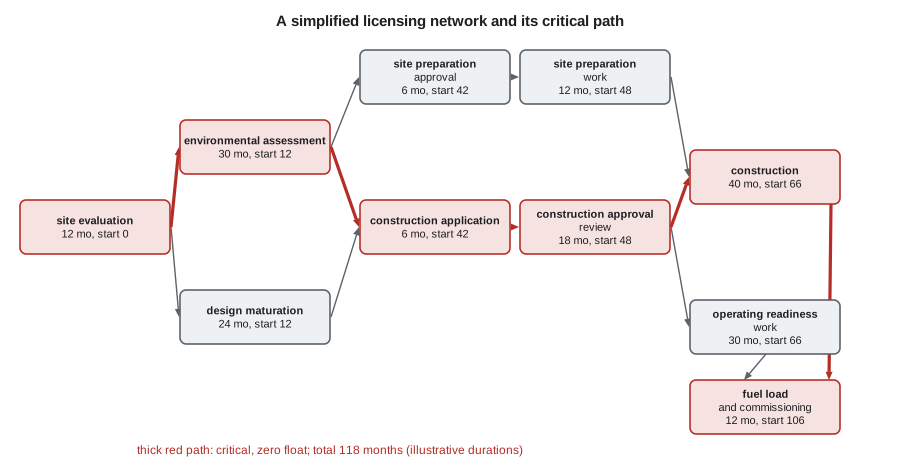
A licensing program for a new reactor is a project in its own right, with hundreds of activities and dependencies. The environmental assessment must be far enough along before site preparation; the design must be mature enough before the construction application; the operating programs must be ready before fuel load. Teodora uses the critical path method to find the chain of activities that sets the earliest finish date. Any delay to an activity on the critical path delays the whole project, while activities off the path have float that absorbs delay.
# Critical path through a simplified new-reactor licensing schedule (months, illustrative).
acts = {  # name: (duration, predecessors)
    "site evaluation": (12, []),
    "environmental assessment": (30, ["site evaluation"]),
    "site preparation license": (6, ["environmental assessment"]),
    "design maturation": (24, ["site evaluation"]),
    "construction application": (6, ["design maturation", "environmental assessment"]),
    "construction license review": (18, ["construction application"]),
    "site preparation work": (12, ["site preparation license"]),
    "construction": (40, ["construction license review", "site preparation work"]),
    "operating programs": (30, ["construction license review"]),
    "operating license and commissioning": (12, ["construction", "operating programs"]),
}
es, ef = {}, {}
for a in acts:  # dictionary is in topological order
    d, pre = acts[a]
    es[a] = max((ef[p] for p in pre), default=0); ef[a] = es[a] + d
end = max(ef.values())
ls, lf = {}, {}
for a in reversed(list(acts)):
    succ = [b for b in acts if a in acts[b][1]]
    lf[a] = min((ls[b] for b in succ), default=end); ls[a] = lf[a] - acts[a][0]
for a in acts:
    fl = ls[a] - es[a]
    print(f"{a:38s} ES {es[a]:3d} EF {ef[a]:3d} float {fl:3d}{'  critical' if fl == 0 else ''}")
print("project duration", end, "months")site evaluation ES 0 EF 12 float 0 critical environmental assessment ES 12 EF 42 float 0 critical site preparation license ES 42 EF 48 float 6 design maturation ES 12 EF 36 float 6 construction application ES 42 EF 48 float 0 critical construction license review ES 48 EF 66 float 0 critical site preparation work ES 48 EF 60 float 6 construction ES 66 EF 106 float 0 critical operating programs ES 66 EF 96 float 10 operating license and commissioning ES 106 EF 118 float 0 critical project duration 118 months
The output shows that the chain through the environmental assessment and the construction license review is critical. Speeding up the design work, which has float, would not bring the date forward; speeding up the environmental review would. This is why many recent projects start the environmental assessment early, sometimes before a design is chosen, using a bounding envelope of plant parameters.
Long-term operation and renewal
License renewal under 10 CFR Part 54 focuses on managing the effects of aging on passive, long-lived structures and components such as the reactor vessel, piping and concrete, together with time-limited aging analyzes. The NRC does not re-review the whole design, on the principle that the existing regulatory process continues to provide adequate protection. Most of the US fleet has renewed its licenses to 60 years, and several plants, including Turkey Point, Peach Bottom, Surry and others, have received subsequent license renewals to 80 years after the agency updated its environmental review.
Worked problem
Critical path float
An activity has an earliest start of month 14 and a latest start of month 20. How much float does it have, and is it on the critical path?
Show solution
- Float = latest start − earliest start = 20 − 14 = 6 months.
- Activities on the critical path have zero float.
Answer: Six months of float, so it is not on the critical path.
Choosing a licensing route
For a new project, the choice of route has large consequences for schedule and risk. Part 50 lets construction start on a less complete design, which can save time at the start but leaves more open questions for the operating license review, a pattern that caused long delays for some plants in the 1970s and 1980s. Part 52 front-loads the design review so that construction proceeds on an approved design, but it makes design changes during construction more difficult, as the Vogtle 3 and 4 project found when it needed many license amendments. Recent advanced reactor projects have often chosen Part 50: Kairos Power received a construction permit for its Hermes test reactor in Tennessee in 2023, the first for a non-light-water reactor in decades, and TVA chose a construction permit for its Clinch River BWRX-300.
Teodora sums up the trade-off for Hana with a simple rule. "Front-loading reduces risk later but costs time now. Leaving questions open saves time now but risks delay later, often at the worst moment, when the plant is half built and every month costs interest. The right answer depends on how mature the design is. A first-of-a-kind design rarely has every answer ready before construction, so you plan for change and keep the regulator informed."
Pre-application engagement
Long before a formal application, applicants meet NRC staff in public pre-application meetings to discuss the scope of the submission, the topics that will need the most attention and the schedule. Applicants may submit topical reports on specific issues, such as a fuel qualification method or a source term approach, which the staff review and approve separately so that the application can reference them. Regulatory engagement plans set out these interactions. Early engagement does not reduce the evidence the applicant must provide, but it reduces surprises and lets the staff plan resources. Under recent reforms, the agency has set generic milestone schedules with target review times for different kinds of applications.
Operator licensing
The facility is not the only thing that needs a license. Under 10 CFR Part 55, every reactor operator and senior reactor operator at a power plant must hold an NRC license. Candidates complete the facility's training program and pass a written examination and an operating test, including a simulator scenario, prepared or approved by the NRC. Licenses are valid for six years and require continuing requalification training and examinations in the meantime. The training programs themselves follow a systematic approach to training, accredited by an industry body.
This dual approach, licensing both the plant and the people who run it, reflects a basic lesson from the earliest accidents: a well-designed plant can still be put at risk by operators who do not understand it. Lesson 4 shows how the safety case treats human actions as part of the plant's defense in depth.
When a stage goes wrong
Licensing stages also give the regulator natural points at which to stop a project that is not ready. If the environmental assessment finds significant adverse effects that cannot be mitigated, the site preparation license will not be issued. If the design review finds open safety issues, the construction license can be delayed until they are resolved, or issued with conditions that must be met before particular work starts. If commissioning tests show that a system does not perform as the safety analysis assumed, the hold point is not released. Each of these outcomes is costly for the applicant, but far less costly than discovering the problem after the plant is running.
History offers examples of both success and failure. Projects that moved through the stages with mature designs, experienced teams and early engagement have generally been licensed on schedule. Projects that started construction with incomplete designs, changed designs repeatedly during construction or lost the trust of their communities have faced long delays, cost overruns and, in some cases, cancellation. Teodora's advice to Hana is to treat each licensing stage as a chance to find problems while they are still cheap to fix, not as an obstacle to get past as quickly as possible.
Common mistakes
MistakeA combined license allows fuel load as soon as it is issued.
InsteadFuel load waits for the 52.103(g) finding that all ITAAC are met.
MistakeSpeeding up any activity speeds up the project.
InsteadOnly activities on the critical path set the finish date.
MistakeSite questions can be left until construction.
InsteadThey are answered first, before large sums are committed.
Summary and key terms
- A facility is licensed in stages that follow its life cycle.
- Site questions are answered first, design questions before construction and operational questions before fuel load.
- Part 50 uses a construction permit and an operating license; Part 52 uses a combined license with ITAAC.
- Commissioning proceeds through regulatory hold points.
- The critical path method identifies which activities set the schedule.
- Early site permit
- Approval of a site for a future reactor.
- Design certification
- Approval of a standard design by rulemaking.
- Combined license
- A Part 52 license to construct and operate.
- ITAAC
- Inspections, tests, analyzes and acceptance criteria verifying as-built conformance.
- License renewal
- Extension of an operating license under Part 54.
- Critical path
- The chain of activities with zero float that sets the finish date.
Practice problems
Work each problem on paper first, then reveal the answer to check.
What are the two steps under Part 50?
Show answer
Construction permit, then operating license.
Why are site questions answered first?
Show answer
So that large sums are not spent on a site that proves unsuitable.
What is ITAAC?
Show answer
Inspections, tests, analyzes and acceptance criteria.
An activity has earliest start 8 and latest start 8. Is it critical?
Show answer
Yes, its float is zero.
Which part of 10 CFR governs license renewal?
Show answer
Part 54.
Lesson quiz · 5 questions
Score 60% or more to complete this lesson.
Create a free account to save your progress, take quizzes and earn a certificate.