
NUC-430 · Lesson 2 of 12 · 20 min
The Atomic Energy Act and the NRC
Elena Marchetti keeps a well-thumbed copy of the Atomic Energy Act on her desk. "It was written in 1954 for a world that had a handful of reactors on paper," she tells Hana, "and it has been amended dozens of times since. But everything the NRC does flows from it and from the 1974 law that created the commission, and every license condition you will ever read can be traced back to them." This lesson follows that chain: from the statutes to the commission they created, the regulations in Title 10 of the Code of Federal Regulations and the licenses that bind each facility.
The statutes
The Atomic Energy Act of 1954 is the foundation of civilian nuclear law in the United States. It ended the government's monopoly on nuclear technology, allowed private companies to own and operate reactors under license, and gave a federal commission authority to license and regulate them so as to protect public health and safety and the common defense and security. The Energy Reorganization Act of 1974 abolished the old Atomic Energy Commission and created the Nuclear Regulatory Commission to carry out the regulatory parts of the 1954 Act. Other statutes add to the framework: the Price-Anderson Act of 1957 on liability insurance, the National Environmental Policy Act of 1969 on environmental review, the Nuclear Waste Policy Act of 1982, and more recently the Nuclear Energy Innovation and Modernization Act of 2019 and the ADVANCE Act of 2024.
The Atomic Energy Act is long and detailed. Section 101 makes it unlawful to build or operate a utilization or production facility, which includes a power reactor, without a license. Sections 103 and 104 set out the two kinds of license for commercial and research reactors. Section 182 lets the commission require any information it needs to decide whether a facility will provide adequate protection to the health and safety of the public. Section 189 gives interested persons the right to request a hearing. Section 274 lets the commission hand much of its authority over certain materials to states that sign an agreement, as described below.
The commission and its staff
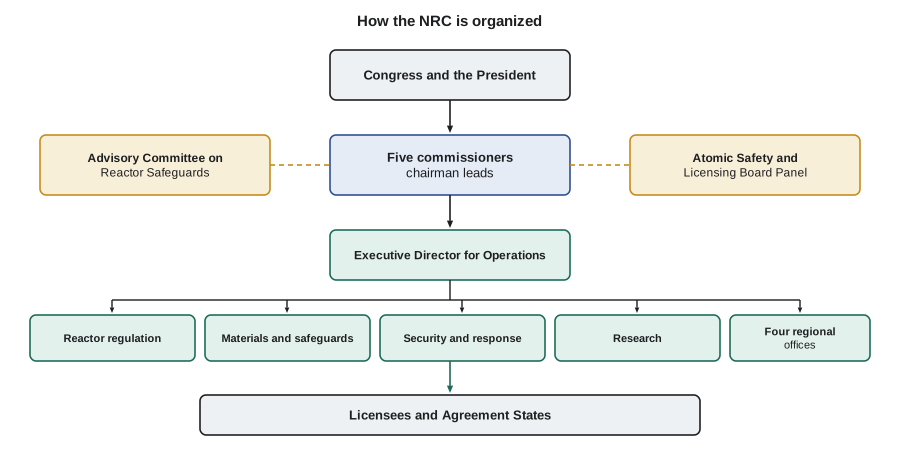
The Nuclear Regulatory Commission is led by five commissioners appointed by the President and confirmed by the Senate for staggered five-year terms. No more than three may belong to the same political party, and the President designates one as chairman, who acts as the principal executive officer. The commissioners set policy, adopt regulations, and decide contested matters on appeal. About three thousand staff carry out the agency's work through headquarters offices, including the Office of Nuclear Reactor Regulation, the Office of Nuclear Material Safety and Safeguards, the Office of Nuclear Security and Incident Response and the Office of Nuclear Regulatory Research, and through four regional offices that run inspections. The Advisory Committee on Reactor Safeguards, an independent group of technical experts created by the 1954 Act, reviews safety issues and advises the commission.
The NRC regulates commercial power and research reactors, fuel cycle facilities, the medical, industrial and academic use of radioactive materials, the transport of radioactive materials together with the Department of Transportation, and the storage and disposal of radioactive waste. It does not regulate most of the Department of Energy's own facilities, such as national laboratories and defense sites, which the department oversees itself, nor naval reactors. Under section 274, about forty states, called Agreement States, have taken over the licensing and inspection of most radioactive materials users within their borders, such as hospitals and industrial radiographers. Reactors, however, remain under federal licensing everywhere.
Title 10 of the Code of Federal Regulations
The NRC's regulations are published in Title 10 of the Code of Federal Regulations, usually cited as 10 CFR. Each part covers a topic. Part 2 sets out procedures for licensing and hearings. Part 20 sets standards for protection against radiation. Part 50 governs the traditional two-step licensing of reactors, with a construction permit followed by an operating license, and contains the general design criteria in its Appendix A. Part 51 implements the National Environmental Policy Act. Part 52, adopted in 1989, provides one-step combined licenses, early site permits and standard design certifications. Part 53, finalized in 2026, is a new risk-informed and technology-inclusive framework for advanced reactors. Part 73 covers physical protection, Part 100 reactor siting and Part 140 financial protection under Price-Anderson.
# Which parts of 10 CFR apply to each activity?
PARTS = {
    "power reactor operation": [2, 19, 20, 21, 50, 51, 55, 71, 73, 100, 140, 170, 171],
    "hospital nuclear medicine": [19, 20, 30, 35, 171],
    "uranium mill": [19, 20, 40, 51, 71, 171],
    "portable gauge on a road crew": [19, 20, 30, 71, 171],
}
for act, parts in PARTS.items():
    print(f"{act:32s} {len(parts):2d} parts: {parts}")
common = set.intersection(*(set(p) for p in PARTS.values()))
print("apply to every licensee:", sorted(common))
print("Part 20 = standards for protection against radiation; Part 19 = notices and reports to workers")power reactor operation 13 parts: [2, 19, 20, 21, 50, 51, 55, 71, 73, 100, 140, 170, 171] hospital nuclear medicine 5 parts: [19, 20, 30, 35, 171] uranium mill 6 parts: [19, 20, 40, 51, 71, 171] portable gauge on a road crew 5 parts: [19, 20, 30, 71, 171] apply to every licensee: [19, 20, 171] Part 20 = standards for protection against radiation; Part 19 = notices and reports to workers
Regulations set binding requirements, while guidance explains how they can be met. The NRC publishes regulatory guides, which describe methods the staff finds acceptable; NUREG reports, including the Standard Review Plan used by reviewers of reactor applications, NUREG-0800; and generic communications such as bulletins and information notices. Guidance is not binding: a licensee may propose another method, but must then show that it meets the regulation. Commitments made in an application, and the technical specifications attached to a license, do become part of the licensing basis and are enforceable.
Licenses and their conditions
An NRC operating license for a power reactor is a legal document with a set of conditions and, as an appendix, the technical specifications. The technical specifications set safety limits, limiting conditions for operation with the actions required if equipment becomes inoperable, surveillance requirements and administrative controls. The licensing basis also includes the updated final safety analysis report and the commitments the licensee has made. Licensees can change their facility without prior NRC approval if a screening under 10 CFR 50.59 shows that the change does not exceed certain criteria; otherwise they must request a license amendment. Power reactor licenses are issued for up to 40 years and can be renewed for 20 more, and several plants have now received subsequent renewals to 80 years.
| Licensing basis element | Example content |
|---|---|
| License conditions | requirements specific to the plant |
| Technical specifications | safety limits, limiting conditions for operation, surveillances |
| Updated final safety analysis report | design and accident analysis |
| Commitments | actions promised in correspondence |
| Orders | requirements imposed by the commission |
| Exemptions | approved departures from a rule |
| Program documents | quality assurance, emergency, security plans |
Hearings and adjudication
Under section 189 of the Atomic Energy Act, any person whose interest may be affected by a licensing action can request a hearing. Contested hearings are run by the Atomic Safety and Licensing Board Panel, whose boards of administrative judges, usually one lawyer and two technical experts, decide whether petitioners have standing and admissible contentions and then hear the case. Decisions can be appealed to the commissioners and then to a federal court of appeals. Construction permits and combined licenses also require a mandatory hearing even if no one contests them, a requirement Congress and the commission have debated changing. Lesson 6 describes how the public takes part.
Worked problem
Tracing a requirement
A plant must keep worker doses below annual limits. Trace the requirement to its legal sources.
Show solution
- Statute: the Atomic Energy Act gives the commission authority to set standards to protect health and safety.
- Regulation: 10 CFR Part 20 sets occupational dose limits and requires a radiation protection program.
- License: the technical specifications' administrative controls require a radiation protection program with procedures.
- Guidance: regulatory guides in Division 8 describe acceptable methods.
Answer: Each requirement sits in a chain from statute to regulation to license to guidance.
Other laws and other agencies
The NRC is the nuclear regulator, but it does not work alone. The Environmental Protection Agency sets generally applicable environmental standards for radiation, such as the limits on doses to the public from the uranium fuel cycle and the standards for waste repositories, and the NRC applies them in its licenses. The Federal Emergency Management Agency reviews off-site emergency plans around power plants, and the NRC considers its findings when it decides whether emergency preparedness is adequate. The Department of Transportation shares responsibility for shipments of radioactive material. The Price-Anderson Act requires each power reactor licensee to carry the maximum private insurance available and to take part in an industry-wide retrospective premium program, which together provide more than sixteen billion dollars of coverage for public liability from a nuclear incident.
States and local governments have a role too. They decide on the need for new generation and regulate electricity rates through public utility commissions, run off-site emergency plans with FEMA's support, and may regulate certain non-radiological matters such as water discharges under permits delegated by the EPA. The Supreme Court held in 1983, in a case about California's moratorium on new plants, that states may regulate the economic aspects of nuclear power but not its radiological safety, which is reserved to the federal government.
Petitions and rulemaking
Any member of the public can ask the NRC to take enforcement action against a licensee by filing a petition under 10 CFR 2.206, and the staff must evaluate and respond to it. Anyone can also petition for a new rule or a change to an existing one under 10 CFR 2.802. The commission makes rules through notice-and-comment procedures under the Administrative Procedure Act: a proposed rule is published in the Federal Register, the public comments, and a final rule is issued with a response to the comments. Major rules also need a regulatory analysis of costs and benefits, and the backfit rule in 10 CFR 50.109 limits new requirements on existing plants unless they give a substantial safety benefit that justifies their cost or are needed for adequate protection.
Hana asks Elena which idea matters most in daily work. "Adequate protection," Elena says without hesitating. "The Atomic Energy Act says the commission may not issue a license if it would be inimical to the health and safety of the public. The courts and the commission have interpreted that as a standard of reasonable assurance of adequate protection. It is not a demand for zero risk, and it is not something cost can override. Every safety case has to show it. You will hear that phrase again and again this term."
Recent changes
The NRC's framework has changed rapidly in recent years. The Nuclear Energy Innovation and Modernization Act of 2019 required a new licensing framework for advanced reactors, which became Part 53. The ADVANCE Act of 2024 told the agency to update its mission statement to include not unnecessarily limiting the benefits of nuclear technology, to cut certain fees for advanced reactor applicants and to speed reviews. In May 2025 an executive order directed a wide reform, including fixed deadlines for licensing decisions and a review of the agency's regulations. Lesson 9 describes how these changes affect new reactors.
Where Hana fits in
At the end of the week Elena asks Hana to draw, on one sheet, every link between a single requirement and the bodies that touch it. Hana picks emergency preparedness. The arrows run from the Atomic Energy Act, through 10 CFR 50.47 and Appendix E to Part 50, to the plant's emergency plan; out to FEMA, which evaluates the off-site plans and exercises; to the state and county agencies that would order protective actions; to the NRC's resident and regional inspectors who observe the plant's drills; and back to the commission, which must find reasonable assurance that adequate protective measures can and will be taken. "That diagram is the regulatory system in miniature," Elena says. "The statute gives the commission its power, but safety depends on many organizations doing their parts and on the regulator checking that they connect." Hana pins the sheet above her desk, where it stays for the rest of the term.
Drawing such a map is a useful exercise for any engineer entering the industry. It shows which documents must change when a design changes, which organizations must be told, and who will check the result. It also shows why regulatory affairs staff spend so much of their time on correspondence: much of the system works through letters, submissions and responses that create a written record of every commitment.
Common mistakes
MistakeAgreement States license nuclear power reactors.
InsteadOnly the NRC licenses reactors; Agreement States license certain materials.
MistakeRegulatory guides are binding.
InsteadThey describe one acceptable method; a licensee may justify another.
MistakeThe commission is part of the Department of Energy.
InsteadThe NRC is an independent agency, separate from the department.
Summary and key terms
- The Atomic Energy Act of 1954 and the Energy Reorganization Act of 1974 are the basis of NRC authority.
- Five commissioners set policy; staff review and inspect through headquarters and four regions.
- Regulations are in 10 CFR; guidance such as regulatory guides and NUREGs is not binding.
- The licensing basis includes the license, technical specifications, safety analysis report and commitments.
- Interested persons may request hearings before licensing boards.
- Atomic Energy Act
- The 1954 statute that is the basis of civilian nuclear regulation.
- Agreement State
- A state that has taken over licensing of certain radioactive materials.
- 10 CFR
- Title 10 of the Code of Federal Regulations, containing NRC rules.
- Technical specifications
- License appendix setting safety limits and operating conditions.
- 50.59
- The process for changes that do not need prior NRC approval.
- ASLB
- Atomic Safety and Licensing Board, which hears contested cases.
Practice problems
Work each problem on paper first, then reveal the answer to check.
When was the NRC created?
Show answer
By the Energy Reorganization Act of 1974; it began work in January 1975.
How many commissioners lead the NRC?
Show answer
Five, with staggered five-year terms.
Which part of 10 CFR provides combined licenses?
Show answer
Part 52.
What is an Agreement State?
Show answer
A state that licenses certain radioactive materials under section 274.
Where can a licensing board decision be appealed?
Show answer
To the commissioners and then to a federal court of appeals.
Lesson quiz · 5 questions
Score 60% or more to complete this lesson.
Create a free account to save your progress, take quizzes and earn a certificate.