
NUC-430 · Lesson 6 of 12 · 21 min
Indigenous and public engagement
Dr. Malik Osei has been asked by Meridian Nuclear Engineering to coordinate engagement for a client's new reactor project, and he invites Hana to a public meeting near Clinch River. About sixty people come. Some ask about jobs, some about the river, some about waste, and a representative of a tribal nation whose ancestral lands include the area asks why her nation was not consulted before the site was chosen. Malik answers carefully and writes the question down. On the drive back he tells Hana, "That was the most important question of the night, and the honest answer is that the project should have started engaging earlier. Engagement is not a meeting. It is a relationship, and relationships take years."
Why engagement matters
Nuclear projects affect people who did not choose them and who will live with them for generations. Public and Indigenous engagement gives those people information about what is proposed, a way to raise concerns and contribute knowledge, and an opportunity to influence decisions. It also improves the decisions themselves: local residents and Indigenous knowledge holders often know things about a site that studies miss, and questions from the public can reveal weaknesses in a safety case. Projects that engage early and honestly tend to face fewer delays and less opposition than those that treat engagement as a box to tick.
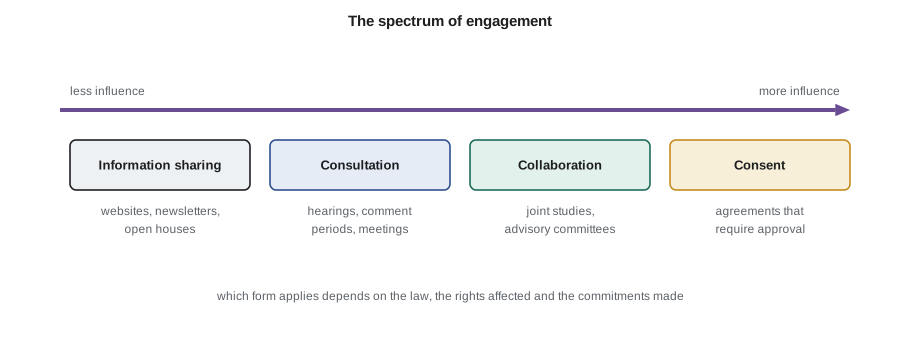
Engagement has different forms. Information sharing tells people what is happening. Consultation asks for their views and considers them before deciding. Collaboration works with them to design solutions. Consent means the decision cannot proceed without their agreement. Which form applies depends on the legal context, the rights affected and the commitments the proponent and the government have made.
Tribal nations and consultation
The United States recognizes 574 federally recognized tribal nations as sovereign governments with a government-to-government relationship with the federal government. Executive orders, beginning with EO 13175 in 2000, require federal agencies to consult tribal governments on actions with tribal implications. The National Historic Preservation Act requires agencies, under section 106, to consult tribes on effects to historic properties of religious and cultural significance, even when those properties lie off tribal lands. The NRC adopted a Tribal Policy Statement in 2017 that commits it to outreach, consultation and coordination with tribes, and it has a tribal liaison function to support these relationships.
Several tribal nations live close to nuclear facilities. The Prairie Island Indian Community in Minnesota, for example, has a reservation next to a nuclear plant and its used fuel storage installation, and has taken part in NRC proceedings for many years. Other tribes have been affected by uranium mining and milling in the West, a legacy that shapes their views of nuclear projects today. Meaningful consultation recognizes this history and the tribes' status as governments, not merely as members of the public.
The NRC's Tribal Protocol Manual describes how staff identify tribes that may be interested in a licensing action, initiate consultation early in the review, invite tribes to participate in environmental reviews as cooperating agencies where appropriate, and coordinate section 106 consultation with the environmental review. Licensees and applicants are expected to engage with tribes as well, but consultation in the legal sense is a government-to-government responsibility of the agency.
Public participation in licensing
The public can take part in NRC licensing in several ways. Anyone can comment on environmental impact statements and proposed rules. Persons whose interests may be affected can petition for a hearing under section 189 of the Atomic Energy Act by showing standing and filing at least one admissible contention, a specific issue of law or fact supported by facts or expert opinion. The NRC holds public meetings on many licensing and oversight matters, publishes documents in its online records system, and runs an annual assessment meeting near each plant. There is no general participant funding program comparable to Canada's; intervenors usually rely on their own resources or those of non-governmental organizations.
| Mechanism | Who can use it | What it achieves |
|---|---|---|
| Comments on draft EIS | anyone | issues addressed in final EIS |
| Hearing request with contentions | persons with standing | adjudicated hearing before a board |
| 2.206 petition | anyone | request for enforcement action |
| Rulemaking petition and comments | anyone | input on rules |
| Public meetings | anyone | information and dialogue with staff |
Tracking engagement
Engagement produces commitments. When a community raises a concern and the proponent promises to study it, to change a design or to report back, that promise must be kept, and the community must see that it has been. Malik's team keeps a register of every question and commitment, with the date it was raised, who owns it, the response and the date it was closed. The register is reviewed at each project meeting and summarized in the engagement report submitted to the regulator.
# Summarize an engagement register (illustrative entries).
from collections import Counter
# (topic, day raised, day responded or None if open)
reg = [("waste", 3, 20), ("lake", 5, 28), ("jobs", 9, 15), ("waste", 12, 50), ("lake", 14, 30),
       ("emergency plans", 20, 41), ("waste", 22, 40), ("sacred site survey", 25, None),
       ("lake", 30, 52), ("traffic", 31, 38), ("waste", 40, 66), ("lake", 44, 70)]
TARGET, TODAY = 30, 90
by_topic = Counter(t for t, _, _ in reg)
open_items = [(t, r) for t, r, d in reg if d is None]
on_time = sum(1 for _, r, d in reg if d is not None and d - r <= TARGET)
answered = sum(1 for _, _, d in reg if d is not None)
for t, n in by_topic.most_common():
    print(f"{t:20s} {n} item{'s' if n > 1 else ''}")
print(f"answered {answered}/{len(reg)}, within {TARGET} days: {on_time}/{answered} = {on_time/answered:.0%}")
for t, r in open_items:
print(f"OPEN: {t} raised day {r}, {TODAY - r} days old")waste 4 items lake 4 items jobs 1 item emergency plans 1 item sacred site survey 1 item traffic 1 item answered 11/12, within 30 days: 10/11 = 91% OPEN: sacred site survey raised day 25, 65 days old
The output shows that waste and lake questions dominate, that most responses meet the target, and that one item about a sacred site survey is still open past its target. Malik flags it for the next meeting with the community, because overdue commitments on cultural matters damage trust more than almost anything else.
What good engagement looks like
Experience in both countries suggests some principles. Start early, before key decisions such as site selection are made, so that input can still change them. Be honest about what is and is not open to influence. Provide information in plain language and in forms people can use. Fund participation so that communities can hire their own experts. Listen to Indigenous knowledge and respect the community's control over it. Respond to every concern, and say what was done about it. Continue engagement through the life of the facility, not only during licensing. And recognize that a community may say no, and that the answer must be taken seriously.
Worked problem
Response rate
An engagement register records 84 questions. Of these, 71 received a response within 30 days, 9 within 60 days and 4 are still open. What percentage met the 30-day target?
Show solution
- Percentage = 71 / 84 = 84.5 percent.
Answer: About 85 percent met the target; the 4 open items need attention.
Lessons from waste siting
Some of the clearest lessons about engagement in the United States come from radioactive waste. The Nuclear Waste Policy Act amendments of 1987 selected Yucca Mountain in Nevada as the only site to be studied for a repository for used fuel, over the strong opposition of the state. The project spent decades in study and licensing, and the Department of Energy submitted a license application in 2008, but federal funding for the project was largely ended from 2010. The experience convinced many people that a repository cannot be imposed on an unwilling host, and the Department of Energy has since pursued a consent-based approach to siting storage and disposal facilities, funding communities and organizations to learn about the options and discuss them.
The contrast with countries that have made progress on repositories, such as Finland and Sweden, is often drawn. In both, the host municipalities had the right to say no, the waste agencies spent years building trust, and the communities that volunteered had long experience with nearby nuclear plants. Many American analysts argue that a similar approach, with real local decision-making power, is the only path likely to work in the United States.
Malik draws the same conclusion from both countries. "The technical case for a project is necessary but not sufficient," he says. "People need to trust the organization making the case, and they need to know that they can say no. Paradoxically, the right to refuse is often what makes people willing to say yes."
Communicating about risk
Much engagement turns on risk. Research on risk perception, notably by the psychologist Paul Slovic and colleagues, has shown that people judge risks not only by expected harm but by qualities such as whether the risk is voluntary, familiar, controllable, fairly distributed and capable of catastrophe. Nuclear power scores high on the qualities that increase concern: it is involuntary for neighbors, unfamiliar, invisible, and associated with rare but severe accidents. Telling people that their concern is irrational because the expected number of deaths is small rarely persuades anyone and often deepens mistrust.
Good risk communication starts by listening to what people are worried about, explains what is known and not known in plain language, gives comparisons that help without belittling, and describes what is being done to manage the risk and how the public can check. It is honest about uncertainty and about past mistakes. It is consistent over time, so that information during an event matches what was said before it. And it comes from people the audience trusts, which is often not the company or the regulator but independent scientists, doctors or community leaders.
The NRC publishes its inspection reports, performance assessments, event notifications and a large online library of documents, partly to let people check its work. Licensees publish annual environmental and effluent reports. Both have found that being open about minor events builds credibility for the times when it matters most.
Engagement through the life of a facility
Engagement does not end when a license is issued. Operating stations maintain community advisory committees, publish newsletters and run visitor centers, share event information promptly, and support local emergency planning. When a station plans a major change, such as refurbishment, a power increase or a new waste facility, engagement begins again. When a station approaches the end of its life, the community has a strong interest in the decommissioning plan, the timing and the jobs that will be lost, as lesson 10 discusses. The relationship spans the whole life of the facility, which may be eighty years or more.
Hana goes back to the meeting hall a month later with Malik. This time the project team has brought a draft plan for a joint cultural resources survey with the tribal nation, and the representative who asked the hard question has agreed to help shape its scope. "It is a start," Malik says afterward. "Not because we have solved anything, but because we are now doing the work together."
Benefits, partnership and ownership
Engagement increasingly includes discussion of who benefits from a project. Large nuclear projects bring jobs, contracts, tax revenue and training opportunities, and communities reasonably ask how much of this will stay with them. Proponents may sign community benefit agreements that commit to local hiring, procurement from local and Indigenous businesses, training programs and funding for community priorities. Some go further and offer equity partnerships, in which Indigenous Nations or local communities own a share of the project and receive part of its revenue. These arrangements change the relationship from one of affected party and proponent to one of partners with a shared interest in the project's success, including its safety.
Benefit agreements raise questions of their own. Communities may worry that accepting benefits will be seen as consent to everything the project does, or that the agreement will divide the community between those who gain and those who bear the costs. Regulators are careful to keep benefit agreements separate from licensing decisions: a payment to a community does not make an unsafe project acceptable, and a license must be justified on safety grounds alone. Good practice is for the community to negotiate with independent advice, for the agreement to be public where the community agrees, and for it to include ways to resolve disputes.
Elena reminds Hana that the NRC's licensing decisions turn on safety, security and environmental findings, and that the agency does not weigh the commercial arrangements between an applicant and a community as a substitute for them. Economic benefits do appear in the environmental impact statement as socioeconomic effects, but they cannot outweigh a failure to provide adequate protection. The two kinds of question run side by side and inform each other, but they are not interchangeable.
A measure of how far practice has moved is that many proponents now describe their relationships with nearby communities and Nations as a condition of the project's success rather than an obstacle to it. Malik tells Hana that the best indicator he knows is simple: whether the community would describe the relationship in the same words as the company does.
Common mistakes
MistakeEngagement means holding a public meeting.
InsteadIt is a continuing relationship involving information, dialogue and response.
MistakeTribes are consulted as members of the public.
InsteadTribes are sovereign governments consulted government-to-government.
MistakeIndigenous knowledge is just another data source to be collected.
InsteadIt is shared on the community's terms and its control remains with the community.
Summary and key terms
- Engagement gives affected people information, a voice and influence over decisions.
- Tribal nations are consulted government-to-government under executive orders and section 106.
- The NRC's Tribal Policy Statement guides its consultation.
- The public can comment, request hearings and petition the agency.
- Commitments made during engagement must be tracked and kept.
- Government-to-government
- Consultation between federal agencies and tribal nations as sovereigns.
- Section 106
- The National Historic Preservation Act consultation requirement.
- Contention
- A specific issue raised in a hearing request.
- Standing
- The legal interest needed to request a hearing.
- Cooperating agency
- An agency or tribe that helps prepare an environmental review.
- Engagement register
- A record of questions, commitments and responses.
Practice problems
Work each problem on paper first, then reveal the answer to check.
How many federally recognized tribal nations are there?
Show answer
574.
What does a hearing request need?
Show answer
Standing and at least one admissible contention.
Name the four forms on the engagement spectrum.
Show answer
Information sharing, consultation, collaboration, consent.
A register has 60 items, 51 answered on time. What is the on-time rate?
Show answer
85 percent.
Why start engagement early?
Show answer
So that input can still influence key decisions.
Lesson quiz · 5 questions
Score 60% or more to complete this lesson.
Create a free account to save your progress, take quizzes and earn a certificate.