
NUC-430 · Lesson 12 of 12 · 19 min
Case studies
On Hana's last day in regulatory affairs, Elena Marchetti gathers the whole cast of her rotation in the conference room: Teodora Vasquez, Rohan Desai, Malik Osei, Marcel Thibodeau and Lise Fortin. "We each chose one case," Elena says. "Not because they are the most famous, but because each one taught the regulators something they still use. Hana, your job is to tell us at the end what they have in common." This lesson follows their cases, each read through the ideas of the earlier lessons.
Case 1: Millstone and the watch list
Marcel goes first, because he started his career nearby. In the early 1990s, engineers at the Millstone station in Connecticut raised concerns that the plant had been moving the whole core into the spent fuel pool during refueling, contrary to its licensing basis, and that management had not responded to their complaints. Their persistence, and a national magazine cover story in 1996, exposed broader problems: a culture in which workers who raised concerns were harassed, a large backlog of unresolved issues and design documents that no longer matched the plant. The NRC placed all three units on its watch list in the highest category in 1996, requiring commission approval before any could restart, and the units stayed shut down for years.
Millstone 3 restarted in 1998 and Millstone 2 in 1999, after the licensee replaced its management, reviewed its design basis and set up an independent oversight program for employee concerns that the NRC required. Millstone 1 never restarted. The NRC itself came under criticism for failing to act on the warning signs for years, and its response included a new emphasis on a safety-conscious work environment, a revised allegation program and, a few years later, the reactor oversight process, designed to make its assessment of plants more objective and transparent.
The lesson Marcel draws is that a regulator can see a problem for years without forcing it to be fixed, and that the most important indicators of decline are organizational: backlogs that grow, concerns that go unanswered, and managers who stop hearing bad news. The tools in lesson 7, from performance ratings to the attention paid to the corrective action program, were shaped by cases like this.
Case 2: Davis-Besse and the vessel head
Rohan's case concerns the reactor vessel head at the Davis-Besse plant in Ohio. Boric acid from a leaking control rod drive nozzle had been depositing on the head for years. In March 2002, during a refueling outage, workers found that it had eaten a cavity the size of a football through about 15 centimeters, or 6 inches, of carbon steel, leaving only the thin stainless steel cladding to hold the reactor pressure. Earlier in 2001 the NRC had asked plants of this design to inspect for nozzle cracking by the end of the year; Davis-Besse had asked to run until its February 2002 outage, and the NRC had agreed rather than order an earlier shutdown.
The plant stayed shut down for two years while the head was replaced and the licensee overhauled its management and safety culture. Investigations found that the licensee had put production ahead of safety, that it had cleaned boric acid deposits without finding their source, and that information it had given the NRC was incomplete. The NRC fined the licensee more than five million dollars, the largest civil penalty in its history at the time, and some individuals were prosecuted. The agency's own inspector general criticized the decision to let the plant run until February. The case led to new inspection requirements for vessel heads, a review of how the NRC weighs safety and economics in such decisions, and the inclusion of safety culture in the reactor oversight process.
Case 3: Fukushima Daiichi and regulatory capture
Lise's case is the 2011 accident at Fukushima Daiichi, which she followed closely because of its effects on the ocean. The earthquake shut the operating reactors down safely, but the tsunami that followed flooded the site, disabled the emergency diesel generators and electrical switchgear and caused a loss of all cooling at three reactors, whose cores melted. Hydrogen explosions damaged the reactor buildings, and radioactive releases led to the evacuation of more than a hundred thousand people. The independent investigation commission set up by the Japanese parliament concluded in 2012 that the accident was preventable and called it a profoundly man-made disaster: the regulator and the operator had known for years that larger tsunamis were possible but had not required or made the necessary improvements, and the regulator had lacked independence from the industry and the ministry that promoted nuclear power.
Japan responded by creating the Nuclear Regulation Authority in 2012, an independent body outside the ministry that promotes nuclear energy, which wrote new requirements and required every reactor to show that it met them before restarting. Regulators around the world reviewed their own plants, as lesson 1 described. Lise draws a lesson about the danger of regulatory capture, where a regulator comes to share the views and interests of the industry it regulates, and about the importance of revisiting the design basis when new evidence about natural hazards emerges.
Case 4: Licensing a new build
Teodora's case is the most recent completed new build in North America. The Vogtle 3 and 4 project in Georgia received the first combined licenses under Part 52 in 2012, for two AP1000 reactors. Construction was beset by problems: the first-of-a-kind modular construction proved harder than planned, the design needed many license amendments, the reactor vendor filed for bankruptcy in 2017 and the cost rose to more than thirty billion dollars. Unit 3 entered commercial operation in 2023 and Unit 4 in April 2024. The project showed both that the Part 52 process can deliver licensed reactors and that licensing is only one of the risks of a first-of-a-kind project.
The contrast with recent SMR projects is instructive. The BWRX-300 at Darlington received its license to construct in April 2025 and the Clinch River unit its construction permit in 2026, each after reviews of roughly two years, helped by shared technical work between the two regulators and by the use of existing sites with completed environmental studies. Whether construction goes more smoothly than at Vogtle will be the real test. Teodora's lesson is that licensing success depends on a mature design and good preparation, and that construction success depends on supply chains, workforce and project management that the regulator does not control.
Comparing the timelines
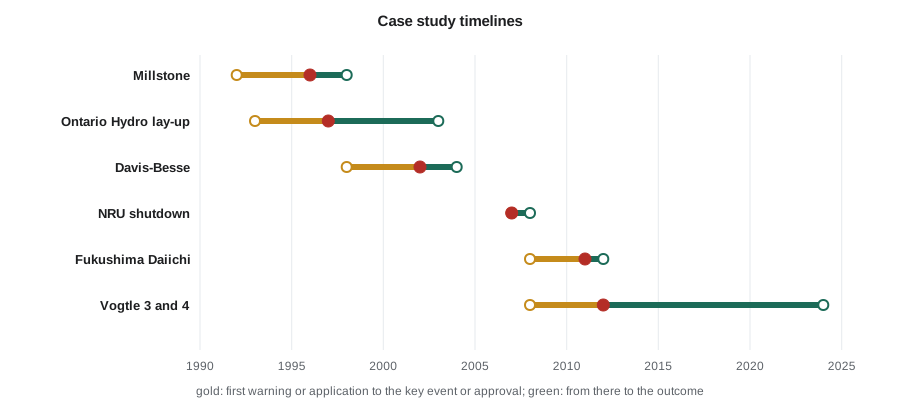
Elena asks Hana to put the cases on a common time axis, measuring how long each took from the first warning signs to the regulatory response, and from the response to the outcome.
# Durations between milestones in the case studies (years rounded; early warning dates approximate).
cases = {
    "Ontario Hydro lay-up": {"warnings": 1993, "response": 1997, "outcome": 2003},
    "Millstone": {"warnings": 1992, "response": 1996, "outcome": 1998},
    "Davis-Besse": {"warnings": 1998, "response": 2002, "outcome": 2004},
    "Fukushima Daiichi": {"warnings": 2008, "response": 2011, "outcome": 2012},
    "Vogtle 3 and 4": {"warnings": 2008, "response": 2012, "outcome": 2024},
}
labels = {"Vogtle 3 and 4": ("application", "license", "Unit 4 operation"),
          "Fukushima Daiichi": ("tsunami estimate", "accident", "new regulator")}
for name, m in cases.items():
    a, b, c = labels.get(name, ("warning signs", "regulatory response", "first recovery"))
    print(f"{name:22s} {a} -> {b}: {m['response'] - m['warnings']:2d} y   {b} -> {c}: {m['outcome'] - m['response']:2d} y")
decline = [m for n, m in cases.items() if n != "Vogtle 3 and 4"]
avg = sum(m["response"] - m["warnings"] for m in decline) / len(decline)
print(f"mean time from first warning to response in the decline cases: {avg:.1f} years")Ontario Hydro lay-up warning signs -> regulatory response: 4 y regulatory response -> first recovery: 6 y Millstone warning signs -> regulatory response: 4 y regulatory response -> first recovery: 2 y Davis-Besse warning signs -> regulatory response: 4 y regulatory response -> first recovery: 2 y Fukushima Daiichi tsunami estimate -> accident: 3 y accident -> new regulator: 1 y Vogtle 3 and 4 application -> license: 4 y license -> Unit 4 operation: 12 y mean time from first warning to response in the decline cases: 3.8 years
The output makes a pattern visible. In every case of decline, warning signs preceded the regulatory response by years, and recovery took years more. The time from warning to response is the window in which a regulator, or the licensee itself, could have acted at much lower cost. The new build cases show a different pattern: long licensing and construction periods for the first unit, which the industry hopes to shorten for the units that follow.
What the cases have in common
At the end of the session Hana gives her answer. In each case of decline, the hardware problem was real but the root cause was organizational: management that did not want to hear bad news, a regulator that was too slow, too close to the industry or overruled, and warning signs that were noticed but not acted on. In each case recovery required changes in people, culture and oversight, not just repairs. And in each case the lesson was built into the regulatory system that exists today, from performance ratings and the reactor oversight process to independence, safety culture oversight and periodic re-examination of the design basis. The new build cases add a different lesson: that clear, predictable licensing is necessary but not sufficient for a project to succeed.
Elena nods. "That is the job," she says. "Not just to know the rules, but to remember why they were written. Every page in that binder I gave you on your first day has a story like these behind it."
Two cases from across the border
Elena adds two cases from Canada that American regulators studied closely. In 1997 an independent assessment of Ontario Hydro's nuclear stations, led by experienced managers from the United States, rated their performance as minimally acceptable and found deep problems in management, safety culture and maintenance. The utility laid up seven of its oldest reactors to concentrate on the rest, and the recovery took years; some units never restarted, and the utility itself was broken up. In 2007 the NRU research reactor at Chalk River, a major source of medical isotopes, stayed shut down after the regulator found that required upgrades to its emergency power had not been made. The isotope shortage became an international crisis, Parliament passed a law authorizing the reactor to restart notwithstanding its license, and the government removed the head of the Canadian Nuclear Safety Commission, a case still cited in debates about regulatory independence.
Placed side by side, the four North American cases show the same pattern in two different regulatory systems. Each began with technical symptoms that were noticed but not acted on, each involved an organization that had stopped listening to its own people or to its regulator, and each changed how regulators in both countries think about oversight.
Safety culture as a regulatory topic
One outcome of these cases is that regulators now treat safety culture as something they can and should assess. Safety culture is commonly described as the assembly of characteristics and attitudes in an organization and its people that establishes that, as an overriding priority, safety issues receive the attention warranted by their significance. It shows in whether workers raise concerns and managers act on them, in whether procedures are followed and questioned when they seem wrong, in whether decisions favor safety when it conflicts with schedule or cost, and in whether the organization learns from its own experience and that of others.
The NRC issued a Safety Culture Policy Statement in 2011, setting out traits of a positive safety culture that it expects all licensees to maintain. The policy is not a regulation, but the reactor oversight process uses cross-cutting aspects, such as problem identification and resolution and human performance, to identify safety culture issues in inspection findings, and plants with significant performance problems may be required to have an independent safety culture assessment.
Rohan adds a caution about measurement. "You cannot audit culture the way you audit a test record. Surveys and interviews help, but the real evidence is in how people behave when something goes wrong and nobody is watching. That is why the best indicator is still the corrective action program: how many problems people report, how quickly they are fixed, and whether the same problem comes back."
Lise adds that the cases are not only about failure. In each, people inside the organizations saw the problems and spoke up, and in each the eventual response, though late, made the system stronger. "The test of a regulatory system is not whether it ever fails," she says, "but whether it learns when it does, and whether it listens to the people who see trouble coming."
Common mistakes
MistakeAccidents and declines are caused by single technical failures.
InsteadRoot causes are usually organizational and develop over years.
MistakeRegulators always act promptly on warning signs.
InsteadThe cases show delays of years between warnings and action.
MistakeA license guarantees a successful project.
InsteadConstruction risks lie largely outside the regulator's control.
Summary and key terms
- Millstone showed how a culture of suppressing concerns can undermine safety.
- Davis-Besse showed the cost of putting production ahead of safety.
- Fukushima showed the danger of regulatory capture and an outdated design basis.
- Vogtle and recent SMR projects show the strengths and limits of modern licensing.
- The common lesson is that organizational factors and independent oversight are central to safety.
- Independent integrated performance assessment
- The 1997 review of Ontario Hydro’s nuclear performance.
- Regulatory capture
- A regulator coming to serve the interests of the industry it regulates.
- Watch list
- An NRC list of plants needing heightened attention, used before the reactor oversight process.
- Boric acid corrosion
- Corrosion of carbon steel by concentrated boric acid from leaks.
- Nuclear Regulation Authority
- Japan’s independent regulator created in 2012.
- First-of-a-kind
- The first unit of a new design, carrying the cost of resolving its issues.
Practice problems
Work each problem on paper first, then reveal the answer to check.
Which category of the watch list were the Millstone units placed in?
Show answer
The highest, requiring commission approval to restart.
How thick was the remaining cladding at Davis-Besse compared with the vessel head steel?
Show answer
Only a thin stainless steel layer remained of a head about 15 centimeters thick.
What did the Japanese parliament's commission call the Fukushima accident?
Show answer
A profoundly man-made disaster.
When did Vogtle 4 enter commercial operation?
Show answer
April 2024.
What common root cause appears in the cases of decline?
Show answer
Organizational factors, such as ignoring warning signs.
Lesson quiz · 5 questions
Score 60% or more to complete this lesson.
Create a free account to save your progress, take quizzes and earn a certificate.