
NUC-430 · Lesson 5 of 12 · 21 min
Environmental assessment
Dr. Lise Fortin is an aquatic ecologist who has spent much of her career studying fish around power station cooling water intakes. At Meridian Nuclear Engineering she leads environmental assessment work, and her office is full of maps. "Engineers think the environment is what is left over after the plant is designed," she tells Hana, spreading out a chart of the shoreline near Clinch River. "For an assessment it is the other way round. You start with what is there, the fish, the wetlands, the people who fish and hunt here, and you ask what the project will change."
Purpose of environmental assessment
Environmental assessment is a process for predicting the effects of a proposed project on the environment before decisions are made, so that harmful effects can be avoided, reduced or offset and decision-makers and the public know what they are accepting. It looks at the whole project: site preparation, construction, operation, decommissioning and accidents and malfunctions. It considers the biophysical environment, such as air, water, soil, fish and wildlife, and the human environment, including health, the economy, land use, culture and heritage. Modern assessments also consider effects on the rights of Indigenous peoples, on climate and on sustainability.
For a nuclear project, some effects are similar to those of any large industrial project: land clearing, noise, traffic, construction workforce, water intake and thermal discharge. Others are specific to nuclear: routine releases of radionuclides to air and water, doses to the public and to non-human biota, radioactive waste, and the consequences of accidents. Assessments for nuclear projects therefore draw on radiation protection and safety analysis as well as on ecology and social science.
The National Environmental Policy Act
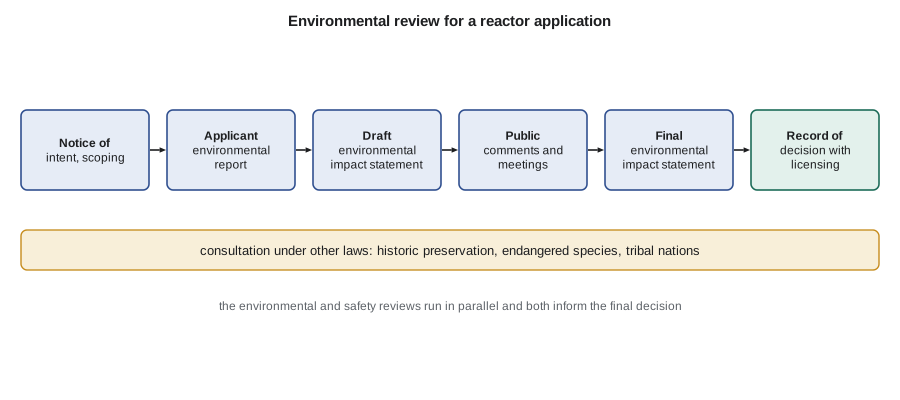
In the United States, the National Environmental Policy Act of 1969 requires federal agencies to consider the environmental effects of their major actions, including issuing licenses, and to consider reasonable alternatives. It does not require the agency to choose the least harmful option, only to take a hard look at the effects and disclose them. The NRC implements the Act through 10 CFR Part 51. Issuing a construction permit, early site permit or combined license requires an environmental impact statement; smaller actions may need only an environmental assessment leading to a finding of no significant impact, and many routine actions are categorically excluded. Congress amended NEPA in 2023 to set page and time limits, and a 2025 Supreme Court decision emphasized that agencies have broad discretion in deciding the scope of their reviews.
The NRC also has a role in environmental protection under the Atomic Energy Act, through its dose limits for members of the public in Part 20 and the design objectives for keeping effluents as low as reasonably achievable in Appendix I to Part 50. The Environmental Protection Agency sets the fuel cycle standard in 40 CFR Part 190. Other environmental laws apply as well, such as the Clean Water Act permit for thermal discharges, which is issued by the EPA or a state, and the Endangered Species Act consultation with the Fish and Wildlife Service and the National Marine Fisheries Service.
The steps of an assessment
Although the legal details differ, assessments in both countries follow similar steps. Scoping decides which components of the environment and which effects the assessment will cover, based on the project description and on public and Indigenous input. Baseline studies describe the existing environment, often over several years to capture natural variation. Effects analysis predicts how the project will change each valued component, using models of dispersion, dose, habitat loss, noise and so on. Mitigation measures are proposed for adverse effects. Residual effects, those remaining after mitigation, are assessed for significance. Cumulative effects, the combined effects of the project with other past, present and foreseeable projects, are considered. Finally, a follow-up program is designed to check whether the predictions were right and whether mitigation works.
| Step | Question asked | Typical outputs |
|---|---|---|
| Scoping | What should the assessment cover? | list of valued components, study areas |
| Baseline | What is there now? | field surveys, monitoring data |
| Effects analysis | How will the project change it? | model predictions, dose estimates |
| Mitigation | How can adverse effects be reduced? | design changes, offsets, management plans |
| Significance | Are the residual effects significant? | conclusions for each component |
| Cumulative effects | What do all projects together do? | regional analysis |
| Follow-up | Were the predictions right? | monitoring program, adaptive management |
Judging significance
The central judgment in most assessments is whether residual effects are significant. Assessments usually describe each effect by several criteria: its direction, adverse or beneficial; its magnitude, from negligible to high; its geographic extent, from the site to the region; its duration, from short-term to permanent; its frequency; its reversibility; and the ecological or social context, such as whether the affected species is at risk. These criteria are combined, sometimes in a matrix, to reach a conclusion. The combination always involves judgment, and good assessments explain their reasoning rather than hiding it in a formula.
# Toy significance matrix for residual effects (teaching scheme, scores 1-3 per criterion).
CRIT = ("magnitude", "extent", "duration", "reversibility", "context")
effects = {
    "construction noise on residents": (2, 1, 1, 1, 1),
    "loss of shoreline wetland":       (2, 1, 3, 2, 2),
    "thermal plume on fish":           (3, 2, 3, 2, 3),
    "routine radiological dose":       (1, 2, 3, 1, 1),
}
THRESHOLD = 12
for name, s in sorted(effects.items(), key=lambda kv: -sum(kv[1])):
    total = sum(s)
    flag = "significant" if total >= THRESHOLD or (s[0] == 3 and s[4] == 3) else "not significant"
    detail = ", ".join(f"{c} {v}" for c, v in zip(CRIT, s))
    print(f"{name:34s} score {total:2d}  {flag:16s} ({detail})")
print("scores frame the discussion; the conclusion must be explained in words")thermal plume on fish score 13 significant (magnitude 3, extent 2, duration 3, reversibility 2, context 3) loss of shoreline wetland score 10 not significant (magnitude 2, extent 1, duration 3, reversibility 2, context 2) routine radiological dose score 8 not significant (magnitude 1, extent 2, duration 3, reversibility 1, context 1) construction noise on residents score 6 not significant (magnitude 2, extent 1, duration 1, reversibility 1, context 1) scores frame the discussion; the conclusion must be explained in words
The output ranks the thermal plume's effect on fish as the only effect that crosses the significance threshold in this toy scheme, because it is high in magnitude, long-lasting and affects a sensitive species. Lise points out to Hana that the score is a starting point for discussion. In a real assessment the team would examine whether a different intake design, such as an offshore intake with low velocity, could reduce the effect, and would set up a monitoring program to check the prediction.
Radiological effects on people and biota
For routine operation, the radiological part of an assessment estimates doses to the most exposed members of the public, usually a hypothetical person or group living near the site and eating local food and fish. The calculation follows releases through air and water pathways to the dose received. For a well-run reactor these doses are a small fraction of the public dose limit of 1 millisievert per year, or 100 millirem, and much smaller than doses from natural background radiation. Assessments also estimate dose rates to non-human biota, such as fish, birds and small mammals, and compare them with screening benchmarks. The assessment of accidents uses the safety analysis to estimate doses for a range of accident scenarios and to show that emergency plans can protect the public.
Worked problem
Comparing a predicted dose
An assessment predicts a dose of 2.5 microsieverts per year to the most exposed person near a new reactor. What fraction is this of the public dose limit of 1 millisievert per year, and of a natural background of about 1.8 millisieverts per year?
Show solution
- Fraction of limit = 0.0025 / 1 = 0.25 percent.
- Fraction of background = 0.0025 / 1.8 = 0.14 percent.
Answer: About a quarter of one percent of the limit and a seventh of one percent of background.
Assessment and the licensing decision
The NRC's environmental review and its safety review run in parallel, and the licensing decision draws on both. The record of decision documents how environmental factors were weighed. For new reactors on existing sites, the environmental review can often rely on earlier studies, and the NRC has developed generic environmental impact statements, for license renewal and more recently for advanced reactors, that cover issues common to many plants so that site-specific reviews can focus on what is new. Under recent reforms the agency has worked to shorten its environmental reviews and to make more use of these generic analyzes.
Cooling water: the largest ecological question
For most nuclear stations on lakes, rivers and coasts, the largest ecological effect is not radiological but the use of cooling water. A large once-through cooled station draws tens of cubic meters of water per second for each unit. Fish and other organisms can be pinned against the intake screens, called impingement, or drawn through the screens and the condenser, called entrainment, where eggs and larvae are killed by heat, pressure changes and mechanical stress. The heated water returned to the lake forms a thermal plume that can change the habitat for fish that are sensitive to temperature, particularly cold-water species and their eggs.
In the United States, section 316(b) of the Clean Water Act requires the location, design, construction and capacity of cooling water intake structures to reflect the best technology available for minimizing adverse environmental impact, and EPA rules adopted in 2014 set requirements for existing facilities. Options include closed-cycle cooling with towers, which reduces water withdrawal by about 95 percent, fine-mesh screens, fish return systems and reduced intake velocity. Thermal discharges are controlled under section 316(a), with limits set in the plant's discharge permit.
Lise has a habit of bringing Hana back to specifics. "Ask which fish, which life stage and which month," she says. "A thermal plume that is harmless in July can be harmful in February if it draws fish to warm water and then the unit trips, dropping the temperature suddenly. That kind of cold shock has killed fish at plants before. You only find these effects if you know the biology."
Indigenous knowledge in assessment
Modern assessments draw on Indigenous knowledge as well as scientific studies. Indigenous Nations and communities often hold detailed knowledge of the land, water and species around a proposed site, built up over many generations, including where species spawn, how their numbers have changed and which places are culturally important. This knowledge can change what an assessment looks at and what it concludes. It is shared on the community's terms, often under agreements that protect confidential information such as the locations of sacred sites. Lesson 6 discusses engagement in more detail.
Accidents and malfunctions
An assessment must consider the effects of accidents and malfunctions, not only of routine operation. For a nuclear project this means using the results of the safety analysis to estimate the consequences of a range of accident scenarios, from minor spills to severe accidents with off-site releases, and describing how emergency plans would protect the public. The assessment does not repeat the safety analysis, but it translates it into effects on the environment and people. For a severe accident, the assessment may consider effects on land use, agriculture and fisheries, and the need for long-term protective actions, even though the probability is very low.
Public concern about nuclear accidents is often greater than concern about routine effects, and assessments that treat accidents too briefly tend to lose public trust. Good practice is to describe the accident scenarios clearly, explain how their frequencies were estimated, show the range of consequences, and be open about uncertainties.
Follow-up and adaptive management
Predictions in an assessment are uncertain, and a follow-up program checks them. The program specifies what will be monitored, where, how often and for how long, what results would show that a prediction was wrong, and what action would follow. Monitoring results are reported to the regulator and usually to the public. If effects turn out larger than predicted, mitigation is adjusted, a practice called adaptive management. Follow-up also builds knowledge for future assessments: the measured effects of one project help predict the effects of the next.
NRC licenses require radiological environmental monitoring programs, and licensees publish annual reports on the results. States near nuclear plants often run their own monitoring programs as well. The results to date have generally shown radiation levels near plants well below levels that would affect health, with occasional findings, such as tritium in groundwater from leaking pipes at some sites in the 2000s, that led to industry initiatives on groundwater protection.
At the end of the week Lise gives Hana a task: read the follow-up reports for a station's first ten years and compare the measured effects with the original predictions. Hana finds that most predictions were close, that the thermal plume was somewhat larger than predicted in some winters, and that the monitoring had led to a change in how the station managed discharges during cold periods. "That is what follow-up is for," Lise says.
Common mistakes
MistakeAn assessment requires the least harmful option to be chosen.
InsteadIt requires effects to be understood and disclosed; the decision weighs them.
MistakeOnly radiological effects matter for a nuclear project.
InsteadConventional effects such as habitat loss and thermal discharges are often larger.
MistakeSignificance is calculated by a formula.
InsteadCriteria are combined using explained judgment.
Summary and key terms
- Environmental assessment predicts effects before decisions are made.
- NEPA requires an environmental impact statement for new reactor licenses.
- Assessments follow scoping, baseline, effects, mitigation, significance, cumulative effects and follow-up.
- Significance combines magnitude, extent, duration, reversibility and context.
- Routine radiological doses are small fractions of limits and background.
- NEPA
- The National Environmental Policy Act of 1969.
- EIS
- Environmental impact statement, required for major federal actions.
- Scoping
- Deciding which issues the assessment will cover.
- Residual effect
- An effect remaining after mitigation.
- Cumulative effect
- The combined effect of a project and other projects.
- Record of decision
- The document explaining the agency’s decision.
Practice problems
Work each problem on paper first, then reveal the answer to check.
What is a residual effect?
Show answer
An effect that remains after mitigation.
Which NRC regulations implement NEPA?
Show answer
10 CFR Part 51.
Name four criteria used to judge significance.
Show answer
Magnitude, extent, duration and reversibility, among others.
A dose of 5 microsieverts per year is what fraction of 1 millisievert?
Show answer
0.5 percent.
Why is a follow-up program needed?
Show answer
To check predictions and whether mitigation works.
Lesson quiz · 5 questions
Score 60% or more to complete this lesson.
Create a free account to save your progress, take quizzes and earn a certificate.