
NUC-430 · Lesson 11 of 12 · 21 min
International standards: IAEA
Teodora Vasquez once spent two weeks in another country as a member of an IAEA peer review team, examining that country's regulator. She tells Hana it was the most instructive fortnight of her career. "You sit with people from eight countries and argue about what good regulation looks like," she says. "Everyone brings their own habits, and you find out which of yours are principles and which are just habits. The common language we used was the IAEA safety standards. If you understand how they are built, you can read any country's rules."
Why international standards
A serious nuclear accident anywhere affects public confidence everywhere, and radioactive releases cross borders. Countries therefore have a strong interest in each other's safety. At the same time, safety is a national responsibility: each country licenses and regulates its own facilities under its own law. International standards bridge the two. They set out a common understanding of what a high level of safety requires, which countries can adopt into their own frameworks, and they provide a reference against which peer reviews can judge national practice. They also help vendors who sell designs in several countries, by reducing differences between requirements.
The International Atomic Energy Agency, founded in 1957 as an autonomous organization within the United Nations family, is the main body that develops nuclear safety standards. Its statute authorizes it to establish standards of safety for protection of health and minimization of danger to life and property. The standards are not binding on member states unless a state adopts them, but they are binding on the IAEA's own operations and on activities it assists, and they are widely used as the basis for national regulations. Both Canada and the United States take part in developing them and draw on them in their own rules.
The hierarchy of safety standards
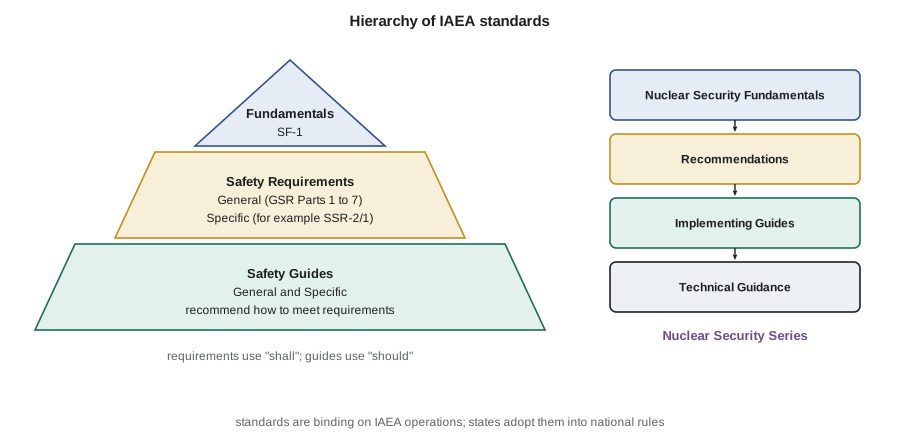
The IAEA safety standards have three levels. At the top are the Safety Fundamentals, a single publication, SF-1, issued in 2006 and co-sponsored by several international organizations, which sets out the fundamental safety objective, to protect people and the environment from harmful effects of ionizing radiation, and ten safety principles. Below it are the Safety Requirements, which state what must be done to meet the objective, using the word "shall." General Safety Requirements apply to all facilities and activities and cover topics such as the governmental and regulatory framework, leadership and management, radiation protection, safety assessment, decommissioning and emergency preparedness. Specific Safety Requirements apply to particular kinds of facility, such as the design of nuclear power plants, SSR-2/1, and their commissioning and operation, SSR-2/2. At the bottom are Safety Guides, which recommend how the requirements can be met, using the word "should."
| Principle | Short statement |
|---|---|
| 1 | Responsibility for safety rests with the person or organization responsible for the facility |
| 2 | An effective legal and governmental framework, including an independent regulator, must be established |
| 3 | Effective leadership and management for safety must be established and sustained |
| 4 | Facilities and activities must yield an overall benefit |
| 5 | Protection must be optimized to provide the highest level of safety that can reasonably be achieved |
| 6 | Measures for controlling radiation risks must ensure that no individual bears an unacceptable risk of harm |
| 7 | People and the environment, present and future, must be protected |
| 8 | All practical efforts must be made to prevent and mitigate accidents |
| 9 | Arrangements must be made for emergency preparedness and response |
| 10 | Protective actions to reduce existing or unregulated radiation risks must be justified and optimized |
The standards are developed through a long consultative process. A draft is prepared by the IAEA secretariat with experts, reviewed by one or more of the safety standards committees made up of representatives of member states, circulated to all member states for comment, revised, and approved by the Commission on Safety Standards before publication. Requirements are approved by the IAEA Board of Governors. Each standard is reviewed periodically. The process is slow, often taking several years for a single standard, but it produces documents that reflect broad international agreement.
Navigating the standards
With more than a hundred safety standards in force, knowing where to look is a skill in itself. A designer looking for requirements on the reactor coolant system starts with SSR-2/1, then turns to the specific safety guides on the design of the reactor coolant system and on safety classification. A regulator looking at its own framework starts with GSR Part 1. An operator preparing for decommissioning starts with GSR Part 6. Teodora gives Hana a simple navigator she uses.
# Navigate a small extract of the IAEA safety standards hierarchy by topic.
TREE = {"SF-1 Fundamental Safety Principles": {
    "GSR Part 1 Governmental, legal and regulatory framework": {"GSG-12 Organization of the regulatory body": {}},
    "GSR Part 2 Leadership and management for safety": {"GS-G-3.5 Management system for nuclear installations": {}},
    "GSR Part 3 Radiation protection and safety of radiation sources": {"GSG-7 Occupational radiation protection": {}},
    "GSR Part 4 Safety assessment for facilities and activities": {
        "SSG-2 Deterministic safety analysis": {}, "SSG-3 Level 1 probabilistic safety assessment": {}},
    "GSR Part 6 Decommissioning of facilities": {"SSG-47 Decommissioning of nuclear power plants": {}},
    "GSR Part 7 Preparedness and response for a nuclear or radiological emergency": {},
    "SSR-2/1 Safety of nuclear power plants: design": {
        "SSG-30 Safety classification of structures, systems and components": {},
        "SSG-56 Design of the reactor coolant system": {}},
    "SSR-2/2 Safety of nuclear power plants: commissioning and operation": {},
}}
def code(name):
    w = name.split(" ")
    return " ".join(w[:3]) if w[0] == "GSR" else w[0]
def find(tree, word, path=()):
    for name, kids in tree.items():
        p = path + (name,)
        if word.lower() in name.lower():
            yield p, kids
        else:
            yield from find(kids, word, p)
for topic in ("safety assessment", "decommissioning", "coolant"):
    for p, kids in find(TREE, topic):
        print(f"{topic}: " + " > ".join(code(n) for n in p))
        print("    " + p[-1])
        for k in kids:
print(" guide: " + k)safety assessment: SF-1 > GSR Part 4
GSR Part 4 Safety assessment for facilities and activities
guide: SSG-2 Deterministic safety analysis
guide: SSG-3 Level 1 probabilistic safety assessment
decommissioning: SF-1 > GSR Part 6
GSR Part 6 Decommissioning of facilities
guide: SSG-47 Decommissioning of nuclear power plants
coolant: SF-1 > SSR-2/1 > SSG-56
SSG-56 Design of the reactor coolant systemThe output shows that a question about safety assessment leads from SF-1 through GSR Part 4 to safety guides on deterministic and probabilistic analysis, while a question about decommissioning leads through GSR Part 6. The real collection is larger, and each standard cross-references others, but the hierarchy is the same.
The conventions
The safety standards are not binding, but several international conventions are. The Convention on Nuclear Safety, adopted in 1994 and in force since 1996, commits parties that operate land-based civil nuclear power plants to maintain a high level of safety by establishing a legislative and regulatory framework, an independent regulator and safety requirements in areas such as siting, design, operation and emergency preparedness. It has no enforcement mechanism; instead, parties submit national reports every three years and review each other's reports at review meetings, where they can ask hard questions in a peer setting. The Joint Convention on the Safety of Spent Fuel Management and on the Safety of Radioactive Waste Management, in force since 2001, works the same way for waste. The Conventions on Early Notification and on Assistance, adopted in 1986 after the Chernobyl accident, require states to notify others promptly of accidents with transboundary effects and set up a framework for assistance.
The United States is a party to all of these conventions, and the NRC prepares the national reports with the Department of Energy and other agencies. In its reports and at review meetings the United States has described its regulatory framework, its actions after Fukushima, its oversight process and its approach to new reactors, and has answered questions from other parties on topics such as license renewal to 80 years and the independence of its regulator.
Peer review services
The IAEA offers peer review services at the request of member states. The Integrated Regulatory Review Service, IRRS, sends a team of senior regulators from other countries to review a country's regulatory framework against the IAEA standards and report recommendations and suggestions; a follow-up mission a few years later checks progress. The Operational Safety Review Team, OSART, reviews the operational safety of a power plant. Other services cover long-term operation, called SALTO, emergency preparedness, called EPREV, waste and decommissioning, called ARTEMIS, and physical protection, called IPPAS. Reports are usually published, and many countries commit to hosting IRRS missions regularly.
The United States hosted a full-scope IRRS mission in 2010 and a follow-up in 2014. The teams found a mature, effective regulator with strong practices in areas such as the reactor oversight process and openness, and made recommendations and suggestions, which the NRC addressed in action plans. The NRC has since hosted further review missions and provides experts to missions in other countries.
Worked problem
Review meeting cycle
The Convention on Nuclear Safety holds a review meeting every three years. If one was held in 2023, in which year would the next two normally fall?
Show solution
- 2023 + 3 = 2026.
- 2026 + 3 = 2029.
Answer: 2026 and 2029, with national reports prepared in the year before each meeting.
How national rules use the standards
The NRC has developed most of its rules independently, and many predate the current IAEA standards. It takes part in drafting the standards and compares its own requirements with them during reviews, but it does not adopt them directly into its regulations, and US requirements differ in places in structure and terminology. The NRC has said that it considers the IAEA standards when developing new requirements and that its framework is broadly consistent with them, a conclusion the IRRS teams generally shared while making specific recommendations.
Differences between national rules and the international standards are not necessarily weaknesses. A national rule may be more detailed, may reflect experience with a particular technology or may impose a higher standard. What matters is that the differences are understood and justified, which is one of the things peer reviews examine.
Other international bodies
The IAEA is not the only international body in nuclear safety. The Nuclear Energy Agency of the Organization for Economic Co-operation and Development, founded in 1958, brings together regulators and research organizations from mostly industrialized countries to share information, run joint research projects and develop common positions. Its Multinational Design Evaluation Program, begun in 2006, lets regulators reviewing the same reactor design share their findings and work toward common positions. The Western European Nuclear Regulators Association develops common reference levels for safety among European regulators. The International Commission on Radiological Protection, an independent scientific body, publishes recommendations on radiation protection that form the basis of the IAEA's radiation protection standards and of national dose limits.
The industry has its own international bodies. The World Association of Nuclear Operators, founded in 1989 after the Chernobyl accident, links every operator of a commercial nuclear power plant in the world and runs peer reviews of plants, shares operating experience and provides technical support. Owners groups for particular reactor types, such as the CANDU Owners Group, share information and research among utilities that operate the same technology.
The International Nuclear and Radiological Event Scale
The International Nuclear and Radiological Event Scale, introduced in 1990 by the IAEA and the Nuclear Energy Agency, is a tool for communicating the safety significance of events to the public. It has seven levels. Levels 1 to 3 are incidents, from an anomaly to a serious incident, and levels 4 to 7 are accidents, from an accident with local consequences to a major accident with widespread health and environmental effects. Events with no safety significance are below the scale, at level 0. Each step up the scale represents roughly a tenfold increase in severity. Chernobyl in 1986 and Fukushima Daiichi in 2011 were rated at level 7; Three Mile Island in 1979 was rated at level 5. The scale is designed for communication, not for regulatory decisions, and national regulators rate events in their own countries.
Strengthening the regime after Fukushima
The Fukushima accident led to a review of the international framework. The IAEA adopted an Action Plan on Nuclear Safety in 2011, which strengthened peer reviews, emergency preparedness and the safety standards themselves; several standards, including SSR-2/1, were revised to address events beyond the design basis, the need for independent and diverse means of cooling and the protection of spent fuel pools. In 2015 the parties to the Convention on Nuclear Safety adopted the Vienna Declaration on Nuclear Safety, which set principles for new plants to be designed to prevent accidents and, if an accident occurs, to mitigate it and avoid releases requiring long-term off-site protective measures, and for existing plants to be assessed periodically and improved where reasonably practicable.
Teodora recalls the debates. "Some countries wanted to amend the convention to make it stronger. Others thought that would take years and might never be ratified. The declaration was the compromise: no new treaty, but a clear statement of what everyone would aim for. It has been surprisingly influential, because parties now report against it at every review meeting."
For an engineer, the practical value of the international framework is that it provides a common vocabulary and a common set of expectations. A design team working on a reactor for export can map its safety case to the IAEA requirements and know that regulators in many countries will recognize the structure. A licensee can compare its practices with the guides and with what peer review teams have found elsewhere. And a regulator can use the standards and peer reviews to test its own framework against the best of its peers.
Common mistakes
MistakeIAEA safety standards are binding international law.
InsteadThey are binding only on IAEA operations and assisted projects, or when a state adopts them.
MistakeThe Convention on Nuclear Safety has inspectors.
InsteadIt works through national reports and peer review.
MistakeSafety Guides state requirements.
InsteadGuides recommend how to meet requirements, using "should."
Summary and key terms
- International standards bridge national responsibility and common interest in safety.
- The IAEA standards have three levels: Fundamentals, Requirements and Guides.
- The Safety Fundamentals set one objective and ten principles.
- The Convention on Nuclear Safety and the Joint Convention are binding but rely on peer review.
- IAEA peer review services such as IRRS and OSART compare national practice with the standards.
- IAEA
- International Atomic Energy Agency, founded in 1957.
- SF-1
- The Safety Fundamentals publication.
- GSR
- General Safety Requirements, applying to all facilities.
- SSR-2/1
- Specific Safety Requirements on the design of nuclear power plants.
- IRRS
- Integrated Regulatory Review Service, a peer review of a regulator.
- Convention on Nuclear Safety
- A treaty committing parties to high safety levels, reviewed every three years.
Practice problems
Work each problem on paper first, then reveal the answer to check.
What are the three levels of IAEA safety standards?
Show answer
Fundamentals, Requirements and Guides.
How many safety principles are in SF-1?
Show answer
Ten.
Which standard covers design of nuclear power plants?
Show answer
SSR-2/1.
How does the Convention on Nuclear Safety work without inspectors?
Show answer
Through national reports and peer review meetings.
When did the United States host its full-scope IRRS mission?
Show answer
2010, with a follow-up in 2014.
Lesson quiz · 5 questions
Score 60% or more to complete this lesson.
Create a free account to save your progress, take quizzes and earn a certificate.