
NUC-430 · Lesson 9 of 12 · 21 min
Licensing new reactors and SMRs
Teodora Vasquez's team at Meridian Nuclear Engineering has spent three years supporting OPG's small modular reactor project at Darlington, and on the day Hana joins them the mood is cheerful: the first unit's reactor building has just reached a construction milestone. "Five years ago people said nobody would license a new reactor in Canada again," Teodora tells her. "Now we have the first licence to construct a grid-scale SMR in the G7, and three more units planned on the same site. The hard part was not the technology. It was showing the Commission a safety case for a design that had never been built anywhere."
What is new about new reactors
The existing fleets in both countries are dominated by large water-cooled reactors: CANDU pressurized heavy water reactors in Canada and pressurized and boiling light water reactors in the United States. The regulatory frameworks grew up around these designs, and many requirements assume their features, such as a large containment building, active emergency core cooling systems and a large emergency planning zone. New designs differ in several ways. Small modular reactors, usually defined as those producing up to about 300 megawatts of electricity, are factory-built in modules and may rely on passive safety features that need no power or operator action. Advanced reactors use coolants other than water, such as molten salt, liquid sodium, helium gas or lead, and fuels such as TRISO particles, metallic fuel or fuel dissolved in salt. Microreactors produce a few megawatts and may be transportable.
These differences create both opportunities and challenges for regulators. A design with a small inventory, low power density and passive cooling may have far smaller accident consequences, which could justify a smaller emergency planning zone, fewer staff and simpler security. But a design that has never operated has little operating experience to draw on, its fuel and materials may lack the data that water reactors have accumulated over decades, and its computer codes may not be validated for its conditions. The regulator must decide how much evidence is enough without either blocking innovation or accepting unproven claims.
The Canadian approach
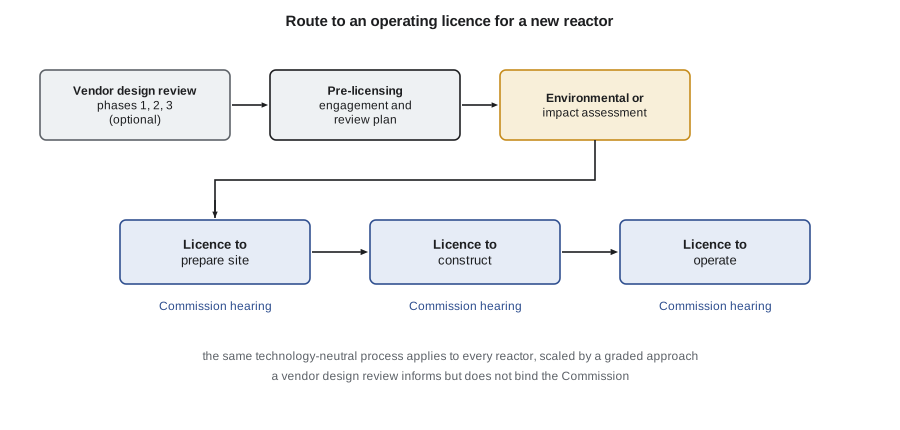
Canada's framework is technology-neutral by design: the Nuclear Safety and Control Act and its regulations set objectives and high-level requirements rather than prescribing particular technologies, so the same licensing process applies to any reactor. The CNSC applies a graded approach, scaling the depth of review to the risk and novelty of the design, and has published guidance for SMR proponents on how it will apply its requirements. Proponents may first use the optional pre-licensing vendor design review, in which staff assess a design in three phases: phase 1 against the CNSC's requirements in general, phase 2 for potential fundamental barriers to licensing, and phase 3 in response to specific follow-up questions. More than a dozen SMR designs have been through at least one phase.
The CNSC issued OPG a licence to construct the first BWRX-300 at Darlington in April 2025, after a hearing in which the Commission considered the design, the site, the environmental assessment carried out for the new nuclear project in 2009 to 2011, and the engagement with Indigenous Nations. It was the first licence to construct a grid-scale SMR in a G7 country. The licence covers one unit, and OPG plans four units on the site. Other provinces, including Saskatchewan, New Brunswick and Alberta, are exploring SMRs, and the CNSC has worked with regulators in other countries to share reviews of common designs.
Key regulatory issues for new designs
| Issue | Why it is hard | Typical regulatory approach |
|---|---|---|
| Fuel qualification | new fuels lack decades of irradiation data | irradiation tests, topical reports, margins |
| Code validation | codes not validated for new coolants or geometries | experiments, benchmarking, confirmatory analysis |
| Source term | what could be released depends on new fuel and coolant behaviour | mechanistic source term with conservatism |
| Emergency planning zone | consequence-based sizing needs strong evidence | dose criteria at the zone boundary |
| Staffing and remote operation | fewer operators or multiple modules per control room | human factors engineering and validation |
| Security | large guard forces may be disproportionate | security by design, graded requirements |
| Manufacturing | factory-built modules shipped to site | quality oversight of the factory, transport |
| Multi-module sites | events affecting several modules at once | integrated risk analysis |
Fuel qualification is a good example of how the issues play out. A light water reactor fuel design has been tested in many reactors over decades, and its behaviour under accident conditions is well understood. TRISO fuel, in which tiny kernels of uranium are coated with layers of carbon and silicon carbide, has a long history of testing but less commercial use, and the regulator must be satisfied that the particles retain fission products at the temperatures the design predicts. The US Department of Energy's advanced gas reactor fuel programme produced a large body of data, and the NRC approved a topical report on TRISO fuel performance in 2020, which applicants can now reference. This kind of shared evidence base makes each subsequent review easier.
Comparing pathways
For a utility that plans several units of the same design, the licensing pathway matters for the first unit and even more for the ones that follow. If the first review resolves the design issues, later units at the same or other sites need only site-specific review. Teodora's team built a simple model to compare approaches.
# Compare licensing durations (months) for a first unit and follow-on units (illustrative).
paths = {
    # (design review before construction, construction-stage review, operating-stage review)
    "two-step": {"first": (0, 24, 24), "follow": (0, 15, 15)},
    "design-first": {"first": (36, 18, 6), "follow": (0, 12, 4)},
    "risk-informed": {"first": (18, 20, 10), "follow": (0, 12, 6)},
}
UNITS = 4
for name, p in paths.items():
    first = sum(p["first"]); follow = sum(p["follow"])
    total = first + (UNITS - 1) * follow
    print(f"{name:14s} first unit {first:3d}  each follow-on {follow:3d}  fleet of {UNITS}: {total:3d} months of licensing")
best = min(paths, key=lambda n: sum(paths[n]["first"]) + (UNITS - 1) * sum(paths[n]["follow"]))
print("lowest total licensing effort:", best)two-step first unit 48 each follow-on 30 fleet of 4: 138 months of licensing design-first first unit 60 each follow-on 16 fleet of 4: 108 months of licensing risk-informed first unit 48 each follow-on 18 fleet of 4: 102 months of licensing lowest total licensing effort: risk-informed
The output shows why standardization matters. The design-first pathway takes longest for the first unit, because the full design must be approved before construction, but follow-on units are licensed quickly because they reference the approved design. The two-step pathway starts construction sooner but carries more review into the operating stage for every unit. The numbers are illustrative; what matters is the pattern. In practice the advantage of standardization is lost if each unit is customized, which is why regulators and utilities alike stress keeping designs identical across a fleet.
International cooperation
Because most SMR designs are being offered in several countries, regulators have found value in sharing reviews. The CNSC and the NRC signed a memorandum of cooperation in 2019 to collaborate on advanced reactor and SMR technologies, and they have issued joint reports on aspects of designs reviewed in both countries, including the BWRX-300. Each regulator still makes its own licensing decision under its own law, but sharing technical work avoids duplication and helps align requirements. The IAEA runs a regulators' forum on SMRs and an initiative on harmonization and standardization.
Worked problem
Emergency planning zone area
A large reactor has a plume exposure emergency planning zone of radius 16 kilometres. An SMR proposes a zone of radius 1 kilometre. By what factor is the area smaller?
Show solution
- Area scales with radius squared.
- Factor = (16 / 1)² = 256.
Answer: The area is 256 times smaller, which greatly reduces the population and planning effort involved.
Policy behind the projects
Canada's renewed interest in new reactors has been shaped by federal and provincial policy. A national SMR roadmap published in 2018 by a group of governments, utilities and industry was followed by an SMR action plan in 2020. Ontario, Saskatchewan, New Brunswick and Alberta signed agreements to work together on SMR deployment, and Ontario has also begun planning for new large reactors, with proposals at the Bruce site and at Wesleyville near Port Hope. The CNSC does not promote these projects, but it has had to prepare for an increase in applications, by hiring and training staff, publishing guidance and agreeing review plans with proponents.
Microreactors and transportable reactors
Microreactors, producing a few megawatts to perhaps twenty, raise new regulatory questions. Designers envisage factory fuelling and sealing, transport to a remote community, mine or military base, operation for years without refuelling and return to the factory at the end of life. That model challenges assumptions built into existing rules: that a reactor is built and licensed at a single site, that it has a large on-site staff and security force, and that fuel is handled on site. Regulators are working through how to license the factory, the transport of a fuelled reactor, operation with few or no staff on site and remote monitoring. Both countries' regulators have said that the safety objectives do not change, but the means of meeting them may.
Remote northern communities and mines in Canada that rely on diesel generators are often cited as potential users of microreactors, and the CNSC has reviewed several microreactor designs through its vendor design review process. Any such project would also need the support of the host community and, where applicable, the Indigenous Nations whose rights could be affected, as lesson 6 described.
The first-of-a-kind problem
Every new design faces the first-of-a-kind problem. The first unit carries the cost of resolving every design issue, building a supply chain, training a workforce and convincing the regulator, the public and investors. If the first unit is late or over budget, the design may never be built again; if it succeeds, the second unit is cheaper and faster. Regulators can help or hinder at this stage. A clear, predictable process, with issues identified early and decisions made on schedule, reduces risk. Requirements that shift during the review, or questions raised late, add cost and delay. But a regulator that relaxes its standards to help a project would undermine the very confidence that makes the next project possible.
Teodora has seen both sides. "The worst thing for a first-of-a-kind project is not a tough regulator," she says. "It is an unpredictable one. Tell me early what you need and I will find a way to give it to you. Tell me late and I have a half-built plant waiting for an answer. The best reviews I have worked on had the toughest questions asked in the first six months."
Lessons the reviews have taught
Reviews of new designs over the past decade have taught some recurring lessons. Applications that were complete, well organized and supported by mature analysis moved quickly; those that left major questions to be answered during the review did not. Novel approaches were accepted when applicants engaged early and provided strong evidence, and resisted when they appeared late with little support. Reviews that drew on shared work, such as approved topical reports or another regulator's review of the same design, saved time. And the most difficult issues were rarely about the reactor physics; they were about fuel, materials, codes and the integration of the design with a real site and organization.
These lessons apply to regulators as well as to applicants. Regulators have learned to plan reviews in detail, to set and publish schedules, to concentrate effort on the issues that matter most to safety, and to explain their questions clearly. The changes now under way in both countries, from Part 53 to the CNSC's guidance for SMRs, are attempts to build those lessons into the rules.
Hana's checklist for a new design
At the end of her week with the new build team, Hana writes a one-page checklist of the questions she expects any regulator to ask about a new design, whatever its coolant or size. Is the fuel qualified for the conditions it will see, including accidents? Are the computer codes validated against experiments relevant to this design? What is the source term, and how was it derived? Which events form the licensing basis, and how were they chosen? Which equipment is safety related, and on what evidence? How many operators are needed, and has the control room been validated with them? How will the site be secured, and why is that proportionate? How will the plant be decommissioned, and who will pay? Teodora reads it and hands it back with one addition at the bottom: what has the applicant done to engage the people who live nearby? "Every one of these can stop a project," she says. "The last one stops more than people think."
Common mistakes
MistakeSMRs are safe by definition because they are small.
InsteadTheir safety must be demonstrated with evidence like any other design.
MistakeCanada has a separate licensing law for SMRs.
InsteadThe same technology-neutral framework applies, with a graded approach.
MistakeA vendor design review or standard design approval licenses the design for any site.
InsteadEach project still needs site-specific licences.
Summary and key terms
- New designs differ from the existing fleet in size, coolant, fuel and safety features.
- Regulators must judge how much evidence is enough for designs without operating experience.
- Canada's technology-neutral framework applies a graded approach, with optional vendor design reviews.
- Fuel qualification, code validation, source term and emergency planning are recurring issues.
- Standardization lets follow-on units be licensed much faster than the first.
- SMR
- Small modular reactor, generally up to about 300 megawatts of electricity.
- Vendor design review
- Optional pre-licensing CNSC assessment of a design in three phases.
- Technology-neutral
- A framework that does not assume a particular reactor type.
- TRISO
- Coated particle fuel with layers of carbon and silicon carbide.
- Source term
- The amount and type of radioactive material that could be released.
- BWRX-300
- A 300-megawatt boiling water SMR under construction at Darlington.
Practice problems
Work each problem on paper first, then reveal the answer to check.
How many phases does a vendor design review have?
Show answer
Three.
Why is fuel qualification hard for advanced reactors?
Show answer
New fuels lack long irradiation and accident data.
An EPZ shrinks from 10 km to 2 km radius. By what factor does its area fall?
Show answer
25.
When was the Darlington BWRX-300 licence to construct issued?
Show answer
April 2025.
Why does standardization matter?
Show answer
Follow-on units can reference the approved design and be licensed faster.
Lesson quiz · 5 questions
Score 60% or more to complete this lesson.
Create a free account to save your progress, take quizzes and earn a certificate.