
NUC-430 · Lesson 6 of 12 · 21 min
Indigenous and public engagement
Dr. Malik Osei has been asked by Meridian Nuclear Engineering to coordinate engagement for a client's new reactor project, and he invites Hana to a meeting in a community hall near Darlington. About sixty people come. Some ask about jobs, some about the lake, some about waste, and one elder from a nearby First Nation asks why nobody asked her community before the site was chosen. Malik answers carefully and writes the question down. On the drive back he tells Hana, "That was the most important question of the night, and the honest answer is that the project should have started engaging earlier. Engagement is not a meeting. It is a relationship, and relationships take years."
Why engagement matters
Nuclear projects affect people who did not choose them and who will live with them for generations. Public and Indigenous engagement gives those people information about what is proposed, a way to raise concerns and contribute knowledge, and an opportunity to influence decisions. It also improves the decisions themselves: local residents and Indigenous knowledge holders often know things about a site that studies miss, and questions from the public can reveal weaknesses in a safety case. Projects that engage early and honestly tend to face fewer delays and less opposition than those that treat engagement as a box to tick.
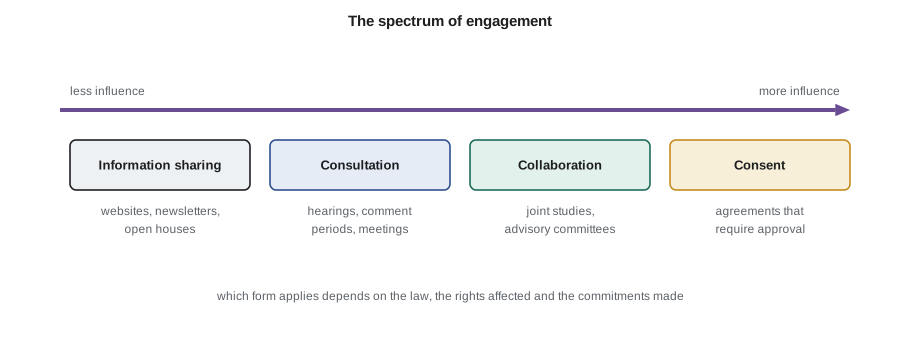
Engagement has different forms. Information sharing tells people what is happening. Consultation asks for their views and considers them before deciding. Collaboration works with them to design solutions. Consent means the decision cannot proceed without their agreement. Which form applies depends on the legal context, the rights affected and the commitments the proponent and the government have made.
Indigenous rights and the duty to consult
Section 35 of the Constitution Act, 1982, recognizes and affirms the existing Aboriginal and treaty rights of the Indigenous peoples of Canada. The Supreme Court of Canada has held, beginning with the Haida Nation decision in 2004, that the Crown has a duty to consult, and where appropriate accommodate, Indigenous peoples when it contemplates conduct that might adversely affect their established or asserted rights. The depth of consultation required depends on the strength of the claim and the seriousness of the potential impact. The CNSC, as an agent of the Crown, must ensure that the duty is met before it makes a licensing decision that could affect such rights, and it relies in part on its own processes, including hearings and participant funding, to do so.
In 2021 Parliament passed the United Nations Declaration on the Rights of Indigenous Peoples Act, which commits the federal government to take measures to ensure Canadian laws are consistent with the Declaration. The Declaration includes the principle of free, prior and informed consent for projects affecting Indigenous lands or resources. How this principle applies in nuclear licensing is still being worked out, but the CNSC has said that it will apply the Declaration in its work and has expanded its engagement accordingly.
REGDOC-3.2.2, Indigenous Engagement, first published in 2016 and updated to version 1.2 in 2022, sets out the CNSC's requirements and guidance for licensees. Licensees whose proposed projects may adversely affect Aboriginal or treaty rights must identify the Indigenous Nations and communities that may have an interest, share information about the project, provide opportunities to raise concerns, consider and respond to those concerns, and report on their engagement. The CNSC carries out its own consultation in parallel and has signed long-term relationship arrangements with several Nations that set out how they will work together.
Public participation in licensing
The CNSC's hearings are public, and anyone may apply to intervene by filing a written submission and requesting to appear before the Commission. Hearings for major facilities are often held in the community near the facility, and the proceedings are webcast and transcribed. The CNSC's Participant Funding Program, established in 2011, gives funding to members of the public, Indigenous Nations and communities and other stakeholders to help them review documents, hire experts and take part in hearings and environmental assessments. REGDOC-3.2.1 requires licensees to have a public information programme that shares information about their facilities and reports promptly on events of public interest.
| Mechanism | Who can use it | What it achieves |
|---|---|---|
| Written intervention | any member of the public | submission considered by the Commission |
| Oral intervention at hearing | intervenors approved by the Commission | questions and arguments heard by members |
| Participant funding | public, Indigenous Nations, non-profits | resources to review and participate |
| Impact assessment comment periods | anyone | input on scope and findings |
| Licensee public information programme | local residents | regular information and event reporting |
Tracking engagement
Engagement produces commitments. When a community raises a concern and the proponent promises to study it, to change a design or to report back, that promise must be kept, and the community must see that it has been. Malik's team keeps a register of every question and commitment, with the date it was raised, who owns it, the response and the date it was closed. The register is reviewed at each project meeting and summarized in the engagement report submitted to the regulator.
# Summarize an engagement register (illustrative entries).
from collections import Counter
# (topic, day raised, day responded or None if open)
reg = [("waste", 3, 20), ("lake", 5, 28), ("jobs", 9, 15), ("waste", 12, 50), ("lake", 14, 30),
       ("emergency plans", 20, 41), ("waste", 22, 40), ("sacred site survey", 25, None),
       ("lake", 30, 52), ("traffic", 31, 38), ("waste", 40, 66), ("lake", 44, 70)]
TARGET, TODAY = 30, 90
by_topic = Counter(t for t, _, _ in reg)
open_items = [(t, r) for t, r, d in reg if d is None]
on_time = sum(1 for _, r, d in reg if d is not None and d - r <= TARGET)
answered = sum(1 for _, _, d in reg if d is not None)
for t, n in by_topic.most_common():
    print(f"{t:20s} {n} item{'s' if n > 1 else ''}")
print(f"answered {answered}/{len(reg)}, within {TARGET} days: {on_time}/{answered} = {on_time/answered:.0%}")
for t, r in open_items:
print(f"OPEN: {t} raised day {r}, {TODAY - r} days old")waste 4 items lake 4 items jobs 1 item emergency plans 1 item sacred site survey 1 item traffic 1 item answered 11/12, within 30 days: 10/11 = 91% OPEN: sacred site survey raised day 25, 65 days old
The output shows that waste and lake questions dominate, that most responses meet the target, and that one item about a sacred site survey is still open past its target. Malik flags it for the next meeting with the community, because overdue commitments on cultural matters damage trust more than almost anything else.
What good engagement looks like
Experience in both countries suggests some principles. Start early, before key decisions such as site selection are made, so that input can still change them. Be honest about what is and is not open to influence. Provide information in plain language and in forms people can use. Fund participation so that communities can hire their own experts. Listen to Indigenous knowledge and respect the community's control over it. Respond to every concern, and say what was done about it. Continue engagement through the life of the facility, not only during licensing. And recognize that a community may say no, and that the answer must be taken seriously.
Worked problem
Response rate
An engagement register records 84 questions. Of these, 71 received a response within 30 days, 9 within 60 days and 4 are still open. What percentage met the 30-day target?
Show solution
- Percentage = 71 / 84 = 84.5 percent.
Answer: About 85 percent met the target; the 4 open items need attention.
Lessons from waste siting
Some of the clearest lessons about engagement in Canada come from projects for radioactive waste. OPG proposed a deep geologic repository for low and intermediate level waste at the Bruce site on Lake Huron, and a joint review panel recommended approval in 2015. But OPG had committed that it would not build the repository without the support of the Saugeen Ojibway Nation, in whose traditional territory the site lies. In January 2020 the Nation's members voted against the project, and OPG ended it. The commitment, made years earlier, meant that a project with a favourable environmental assessment did not proceed, and many observers saw it as an important precedent for consent in practice.
For used fuel, the Nuclear Waste Management Organization ran a site selection process over more than a decade that relied on communities volunteering to learn more and on partnership with Indigenous Nations. In November 2024 it selected a site in northwestern Ontario in the area of the Wabigoon Lake Ojibway Nation and the Township of Ignace, after both had expressed willingness to host the repository. The Nation's decision followed its own process, based on its own laws and knowledge. The project still needs an impact assessment and licences, and the engagement continues.
Malik draws the same conclusion from both countries. "The technical case for a project is necessary but not sufficient," he says. "People need to trust the organization making the case, and they need to know that they can say no. Paradoxically, the right to refuse is often what makes people willing to say yes."
Communicating about risk
Much engagement turns on risk. Research on risk perception, notably by the psychologist Paul Slovic and colleagues, has shown that people judge risks not only by expected harm but by qualities such as whether the risk is voluntary, familiar, controllable, fairly distributed and capable of catastrophe. Nuclear power scores high on the qualities that increase concern: it is involuntary for neighbours, unfamiliar, invisible, and associated with rare but severe accidents. Telling people that their concern is irrational because the expected number of deaths is small rarely persuades anyone and often deepens mistrust.
Good risk communication starts by listening to what people are worried about, explains what is known and not known in plain language, gives comparisons that help without belittling, and describes what is being done to manage the risk and how the public can check. It is honest about uncertainty and about past mistakes. It is consistent over time, so that information during an event matches what was said before it. And it comes from people the audience trusts, which is often not the company or the regulator but independent scientists, doctors or community leaders.
The CNSC publishes the results of its independent environmental monitoring, its annual regulatory oversight reports on each class of facility and the transcripts of its hearings, partly to let people check its work. Licensees publish environmental monitoring results and event reports under REGDOC-3.2.1. Both have found that being open about minor events builds credibility for the times when it matters most.
Engagement through the life of a facility
Engagement does not end when a licence is issued. Operating stations maintain community advisory committees, publish newsletters and run visitor centres, share event information promptly, and support local emergency planning. When a station plans a major change, such as refurbishment, a power increase or a new waste facility, engagement begins again. When a station approaches the end of its life, the community has a strong interest in the decommissioning plan, the timing and the jobs that will be lost, as lesson 10 discusses. The relationship spans the whole life of the facility, which may be eighty years or more.
Hana goes back to the community hall a month later with Malik. This time the project team has brought a draft plan for a joint study of the lake with the First Nation, and the elder who asked the hard question has agreed to help shape its scope. "It is a start," Malik says afterward. "Not because we have solved anything, but because we are now doing the work together."
Benefits, partnership and ownership
Engagement increasingly includes discussion of who benefits from a project. Large nuclear projects bring jobs, contracts, tax revenue and training opportunities, and communities reasonably ask how much of this will stay with them. Proponents may sign community benefit agreements that commit to local hiring, procurement from local and Indigenous businesses, training programmes and funding for community priorities. Some go further and offer equity partnerships, in which Indigenous Nations or local communities own a share of the project and receive part of its revenue. These arrangements change the relationship from one of affected party and proponent to one of partners with a shared interest in the project's success, including its safety.
Benefit agreements raise questions of their own. Communities may worry that accepting benefits will be seen as consent to everything the project does, or that the agreement will divide the community between those who gain and those who bear the costs. Regulators are careful to keep benefit agreements separate from licensing decisions: a payment to a community does not make an unsafe project acceptable, and a licence must be justified on safety grounds alone. Good practice is for the community to negotiate with independent advice, for the agreement to be public where the community agrees, and for it to include ways to resolve disputes.
Elena reminds Hana that the Commission has been explicit on this point in past decisions: it considers the evidence on health, safety, security and the environment, and on the adequacy of Indigenous consultation, and it does not weigh the commercial arrangements between a proponent and a community as a substitute for either. The two processes run side by side and inform each other, but they answer different questions.
A measure of how far practice has moved is that many proponents now describe their relationships with nearby communities and Nations as a condition of the project's success rather than an obstacle to it. Malik tells Hana that the best indicator he knows is simple: whether the community would describe the relationship in the same words as the company does.
Common mistakes
MistakeEngagement means holding a public meeting.
InsteadIt is a continuing relationship involving information, dialogue and response.
MistakeThe licensee carries out the Crown's duty to consult.
InsteadThe Crown holds the duty; it may rely on the licensee's engagement for procedural aspects.
MistakeIndigenous knowledge is just another data source to be collected.
InsteadIt is shared on the community's terms and its control remains with the community.
Summary and key terms
- Engagement gives affected people information, a voice and influence over decisions.
- The Crown's duty to consult arises from section 35 and is met in part through CNSC processes.
- REGDOC-3.2.2 sets licensee requirements for Indigenous engagement.
- Participant funding helps the public and Indigenous Nations take part.
- Commitments made during engagement must be tracked and kept.
- Duty to consult
- The Crown’s obligation to consult Indigenous peoples when their rights may be affected.
- Section 35
- The constitutional provision affirming Aboriginal and treaty rights.
- Free, prior and informed consent
- A principle of the UN Declaration on the Rights of Indigenous Peoples.
- Intervenor
- A person or group taking part in a Commission hearing.
- Participant funding
- CNSC funding to help the public and Indigenous Nations participate.
- Engagement register
- A record of questions, commitments and responses.
Practice problems
Work each problem on paper first, then reveal the answer to check.
Which Supreme Court decision established the duty to consult?
Show answer
Haida Nation, 2004.
What does REGDOC-3.2.2 cover?
Show answer
Indigenous engagement by licensees.
Name the four forms on the engagement spectrum.
Show answer
Information sharing, consultation, collaboration, consent.
A register has 60 items, 51 answered on time. What is the on-time rate?
Show answer
85 percent.
Why start engagement early?
Show answer
So that input can still influence key decisions.
Lesson quiz · 5 questions
Score 60% or more to complete this lesson.
Create a free account to save your progress, take quizzes and earn a certificate.