
NUC-430 · Lesson 3 of 12 · 21 min
Licensing stages
Dr. Teodora Vasquez runs project licensing at Meridian Nuclear Engineering, and she describes a nuclear plant's life as a series of gates. "A reactor is never licensed once," she tells Hana. "It is licensed to prepare a site, then to build, then to run, then to take apart, and every gate needs its own case. The clever part of a licensing strategy is knowing which questions must be answered at which gate, so that you are not trying to prove everything at once and not leaving anything to the end." This lesson follows those gates through the life cycle of a facility.
The life cycle of a nuclear facility
Every nuclear facility passes through the same broad phases: choosing and evaluating a site, designing, constructing, commissioning, operating, and finally decommissioning and releasing the site. Regulators in both countries license these phases, but they divide them into licences in different ways. The underlying logic is the same. Questions about the site, such as seismic hazard, flooding, population and the environment, are answered early, before large sums are spent. Questions about the design are answered before construction starts. Questions about how the plant will be run, such as procedures, staffing and emergency plans, are answered before fuel is loaded. And questions about how the plant will be taken apart are considered from the start, so that decommissioning is planned and funded long before it happens.
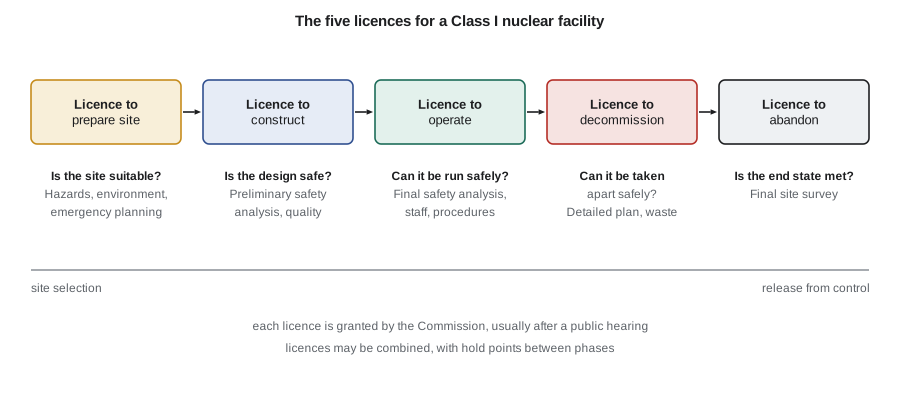
The Class I Nuclear Facilities Regulations list five licences that a facility may need over its life: a licence to prepare a site, a licence to construct, a licence to operate, a licence to decommission and a licence to abandon, which releases the site from regulatory control. Each has its own list of information the application must include. The Commission may combine licences, for example by authorizing site preparation and construction together, or may issue a single licence that covers several phases with hold points that need its approval before the next phase begins.
Site preparation
A licence to prepare a site allows the applicant to clear and grade the land, build access roads and do other preparatory work. To obtain it, the applicant must describe the site's characteristics and show that the site is suitable for the kind of facility planned. REGDOC-1.1.1 sets out the CNSC's expectations for site evaluation and site preparation. The applicant evaluates natural hazards such as earthquakes, flooding, extreme weather and ice, human-induced hazards such as nearby industry and transport routes, and the site's ability to disperse releases and support emergency plans. An environmental assessment is normally required, as lesson 5 describes. OPG received a licence to prepare a site for new reactors at Darlington in 2012, based on an environmental assessment that considered several reactor types, and the licence was renewed in 2021 so that it could later be used for a small modular reactor.
Siting decisions involve both safety and public acceptance. A good site has stable geology, a reliable source of cooling water, low population density in the immediate area and roads that allow evacuation if needed. It also has a community willing to host the plant. Many new projects are proposed at existing nuclear sites for exactly these reasons: the site has already been studied, the community is familiar with nuclear operations, and the infrastructure is in place.
Construction
A licence to construct is the major decision for a new reactor. The application must describe the design in enough detail for the CNSC to assess whether it will meet the regulatory requirements, including a preliminary safety analysis report, a probabilistic safety assessment, a description of the management system and quality assurance programme for construction, and plans for commissioning and eventual decommissioning. REGDOC-2.5.2 sets out the CNSC's design requirements for water-cooled power reactors. The Commission decides after a public hearing. During construction, CNSC staff inspect the work, check that changes to the design are controlled and confirm that hold points are met.
| Licence | Main purpose | Key information in the application |
|---|---|---|
| Prepare site | clear, grade and prepare the site | site evaluation, environmental assessment, preliminary plans |
| Construct | build the facility | preliminary safety analysis, design, construction quality programme |
| Operate | load fuel and run the facility | final safety analysis, operating procedures, staffing, emergency plans |
| Decommission | take the facility apart | detailed decommissioning plan, waste plans, end state |
| Abandon | release the site from licensing | final site survey showing the end state is met |
Commissioning and operation
A licence to operate allows the licensee to load fuel and run the reactor. The application includes the final safety analysis report, which reflects the as-built design, the operating policies and principles, the training and qualification of staff, the emergency plans, and the programmes for maintenance, radiation protection, environmental protection, security and safeguards. Commissioning is done in phases with regulatory hold points, typically before fuel load, before the first approach to criticality and before operation above a low power level, so that the CNSC can confirm that each phase was completed safely before the next begins. Canadian power reactor operating licences have been issued for terms of up to about ten years, though the Commission has granted longer terms in some cases, with a periodic safety review required every ten years.
Commissioning is where the paper plant meets the real one. Systems are tested individually, then together, then with fuel in the core. Each test checks that equipment performs as the safety analysis assumed. A failure during commissioning is not a disaster; it is the reason the tests are done. But the results must be documented, the cause understood and the fix verified before the regulator lets the plant proceed.
Planning the licensing schedule
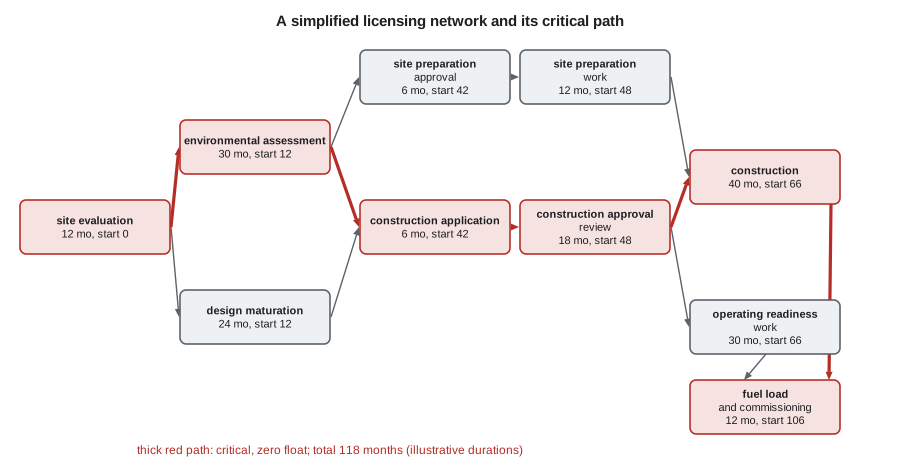
A licensing programme for a new reactor is a project in its own right, with hundreds of activities and dependencies. The environmental assessment must be far enough along before site preparation; the design must be mature enough before the construction application; the operating programmes must be ready before fuel load. Teodora uses the critical path method to find the chain of activities that sets the earliest finish date. Any delay to an activity on the critical path delays the whole project, while activities off the path have float that absorbs delay.
# Critical path through a simplified new-reactor licensing schedule (months, illustrative).
acts = {  # name: (duration, predecessors)
    "site evaluation": (12, []),
    "environmental assessment": (30, ["site evaluation"]),
    "site preparation licence": (6, ["environmental assessment"]),
    "design maturation": (24, ["site evaluation"]),
    "construction application": (6, ["design maturation", "environmental assessment"]),
    "construction licence review": (18, ["construction application"]),
    "site preparation work": (12, ["site preparation licence"]),
    "construction": (40, ["construction licence review", "site preparation work"]),
    "operating programmes": (30, ["construction licence review"]),
    "operating licence and commissioning": (12, ["construction", "operating programmes"]),
}
es, ef = {}, {}
for a in acts:  # dictionary is in topological order
    d, pre = acts[a]
    es[a] = max((ef[p] for p in pre), default=0); ef[a] = es[a] + d
end = max(ef.values())
ls, lf = {}, {}
for a in reversed(list(acts)):
    succ = [b for b in acts if a in acts[b][1]]
    lf[a] = min((ls[b] for b in succ), default=end); ls[a] = lf[a] - acts[a][0]
for a in acts:
    fl = ls[a] - es[a]
    print(f"{a:38s} ES {es[a]:3d} EF {ef[a]:3d} float {fl:3d}{'  critical' if fl == 0 else ''}")
print("project duration", end, "months")site evaluation ES 0 EF 12 float 0 critical environmental assessment ES 12 EF 42 float 0 critical site preparation licence ES 42 EF 48 float 6 design maturation ES 12 EF 36 float 6 construction application ES 42 EF 48 float 0 critical construction licence review ES 48 EF 66 float 0 critical site preparation work ES 48 EF 60 float 6 construction ES 66 EF 106 float 0 critical operating programmes ES 66 EF 96 float 10 operating licence and commissioning ES 106 EF 118 float 0 critical project duration 118 months
The output shows that the chain through the environmental assessment and the construction licence review is critical. Speeding up the design work, which has float, would not bring the date forward; speeding up the environmental review would. This is why many recent projects start the environmental assessment early, sometimes before a design is chosen, using a bounding envelope of plant parameters.
Long-term operation and renewal
Many Canadian reactors are now in long-term operation after refurbishment, in which pressure tubes, calandria tubes and feeders are replaced to give the reactor another 30 years or more of life. Refurbishment is licensed through the operating licence: the licensee submits an integrated safety review that compares the plant against modern standards, proposes an integrated implementation plan of improvements, and the Commission authorizes the work, often with hold points before restart. The licence is then renewed on the basis of periodic safety reviews, ageing management programmes and the licensee's performance. OPG's application to renew the Pickering licence and refurbish Units 5 to 8, heard by the Commission in 2026, is a current example.
Worked problem
Critical path float
An activity has an earliest start of month 14 and a latest start of month 20. How much float does it have, and is it on the critical path?
Show solution
- Float = latest start − earliest start = 20 − 14 = 6 months.
- Activities on the critical path have zero float.
Answer: Six months of float, so it is not on the critical path.
Choosing a licensing route
For a new project, the choice is less about which licences to obtain, since every reactor needs the same sequence, than about how to package them. An applicant can ask the Commission to issue a licence to construct alone, or to combine it with authority to operate later subject to hold points. It can draw on the CNSC's pre-licensing vendor design review, an optional service in which staff assess a design in three phases against Canadian requirements before any licence application. A vendor design review does not certify a design or bind the Commission, but it tells the vendor and future applicants where the design may need changes and where more evidence will be needed. Several small modular reactor designs have been through one or more phases.
Teodora sums up the trade-off for Hana with a simple rule. "Front-loading reduces risk later but costs time now. Leaving questions open saves time now but risks delay later, often at the worst moment, when the plant is half built and every month costs interest. The right answer depends on how mature the design is. A first-of-a-kind design rarely has every answer ready before construction, so you plan for change and keep the regulator informed."
Pre-application engagement
Long before a formal application, applicants meet CNSC staff to agree on the scope of the submission, the schedule for review and the topics that will need the most attention. The CNSC calls this pre-licensing engagement and encourages it strongly. A service agreement may set out the review plan and the fees. Early engagement does not reduce the evidence the applicant must provide, but it reduces surprises: staff can say early that a particular analysis will be needed or that a proposed approach is unlikely to be accepted. Indigenous Nations and communities whose rights may be affected should also be engaged early, as lesson 6 explains.
Operator licensing
The facility is not the only thing that needs a licence. Workers in certain positions at a power plant, such as authorized nuclear operators, shift supervisors and control room shift supervisors, must be certified by the CNSC under the Class I regulations. Certification requires the licensee's training programme to have prepared the candidate and the candidate to pass examinations, including simulator tests. Certifications must be renewed periodically, with requalification testing in between.
This dual approach, licensing both the plant and the people who run it, reflects a basic lesson from the earliest accidents: a well-designed plant can still be put at risk by operators who do not understand it. Lesson 4 shows how the safety case treats human actions as part of the plant's defence in depth.
When a stage goes wrong
Licensing stages also give the regulator natural points at which to stop a project that is not ready. If the environmental assessment finds significant adverse effects that cannot be mitigated, the site preparation licence will not be issued. If the design review finds open safety issues, the construction licence can be delayed until they are resolved, or issued with conditions that must be met before particular work starts. If commissioning tests show that a system does not perform as the safety analysis assumed, the hold point is not released. Each of these outcomes is costly for the applicant, but far less costly than discovering the problem after the plant is running.
History offers examples of both success and failure. Projects that moved through the stages with mature designs, experienced teams and early engagement have generally been licensed on schedule. Projects that started construction with incomplete designs, changed designs repeatedly during construction or lost the trust of their communities have faced long delays, cost overruns and, in some cases, cancellation. Teodora's advice to Hana is to treat each licensing stage as a chance to find problems while they are still cheap to fix, not as an obstacle to get past as quickly as possible.
Common mistakes
MistakeA licence to operate covers the whole life of the plant.
InsteadDecommissioning and abandonment need their own licences.
MistakeSpeeding up any activity speeds up the project.
InsteadOnly activities on the critical path set the finish date.
MistakeSite questions can be left until construction.
InsteadThey are answered first, before large sums are committed.
Summary and key terms
- A facility is licensed in stages that follow its life cycle.
- Site questions are answered first, design questions before construction and operational questions before fuel load.
- The Class I regulations define licences to prepare site, construct, operate, decommission and abandon.
- Commissioning proceeds through regulatory hold points.
- The critical path method identifies which activities set the schedule.
- Licence to prepare site
- Authorization to prepare a site for a nuclear facility.
- Licence to construct
- Authorization to build a facility.
- Hold point
- A step that needs regulatory approval before work continues.
- Periodic safety review
- A ten-yearly comparison of the plant with modern standards.
- Refurbishment
- Replacement of major components to extend reactor life.
- Critical path
- The chain of activities with zero float that sets the finish date.
Practice problems
Work each problem on paper first, then reveal the answer to check.
Name the five licences in the Class I regulations.
Show answer
Prepare site, construct, operate, decommission, abandon.
Why are site questions answered first?
Show answer
So that large sums are not spent on a site that proves unsuitable.
What is a hold point?
Show answer
A step needing regulatory approval before work continues.
An activity has earliest start 8 and latest start 8. Is it critical?
Show answer
Yes, its float is zero.
What review compares a plant with modern standards every ten years?
Show answer
The periodic safety review.
Lesson quiz · 5 questions
Score 60% or more to complete this lesson.
Create a free account to save your progress, take quizzes and earn a certificate.