
NUC-430 · Lesson 2 of 12 · 21 min
The Nuclear Safety and Control Act and the CNSC
Elena Marchetti keeps a printed copy of the Nuclear Safety and Control Act on her desk, its margins full of notes. "It is a short statute," she tells Hana, "barely eighty pages. But everything the CNSC does flows from it, and every licence condition you will ever read can be traced back to a section of this Act or to a regulation made under it." This lesson follows that chain: from the Act to the Commission it creates, the regulations it authorizes and the licences that bind each facility.
The Act
The Nuclear Safety and Control Act was passed by Parliament in 1997 and came into force on May 31, 2000, replacing the Atomic Energy Control Act of 1946. Its purpose, set out near the start, is to limit to a reasonable level the risks to national security, the health and safety of persons and the environment that are associated with the development, production and use of nuclear energy and nuclear substances, prescribed equipment and prescribed information, and to implement Canada's international commitments on the peaceful use of nuclear energy. The phrase "reasonable level" matters: the Act does not demand zero risk, which no activity can achieve, but it does demand that risk be kept as low as is reasonable.
The Act is short because it leaves most of the detail to regulations. Its main parts create the Commission and set its objects, prohibit anyone from carrying out a nuclear activity without a licence, give the Commission power to issue, renew, amend, suspend or revoke licences, provide for inspectors and designated officers, set out how hearings are held, and create offences and penalties. Section 26 is the core prohibition: no person may possess, use, produce, transfer, import or export nuclear substances, prescribed equipment or information, or prepare a site for, construct, operate, decommission or abandon a nuclear facility, except in accordance with a licence.
The Commission and its staff
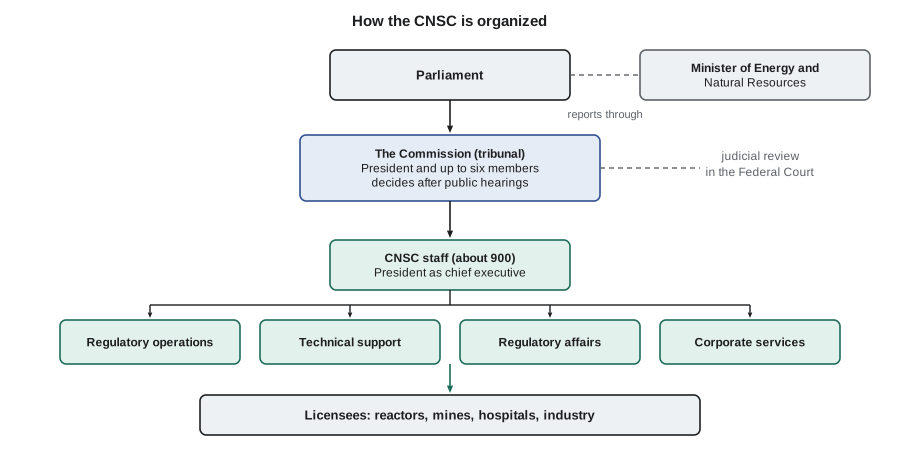
The Canadian Nuclear Safety Commission has two parts that are easy to confuse. The Commission itself is a quasi-judicial administrative tribunal of up to seven permanent members appointed by the Governor in Council, one of whom is the President. It makes the major licensing decisions, usually after a public hearing, and its decisions can be challenged only by judicial review in the Federal Court. The organization of about nine hundred staff that supports it, also called the CNSC, carries out technical review, inspection and compliance work and makes recommendations to the Commission. The President is both the chair of the tribunal and the chief executive of the staff organization. The CNSC reports to Parliament through the Minister of Energy and Natural Resources but is independent in its regulatory decisions.
The CNSC's mandate has four parts. It regulates the use of nuclear energy and materials to protect health, safety and the environment; implements Canada's international commitments on the peaceful use of nuclear energy; disseminates objective scientific, technical and regulatory information to the public; and, through the Nuclear Security Regulations, protects national security. It regulates every nuclear facility and activity in the country, from power plants and uranium mines to hospitals using radioisotopes and companies that use industrial gauges. There is no provincial nuclear regulator: nuclear energy is under federal jurisdiction, although provinces regulate electricity markets and some environmental matters.
Regulations under the Act
The Act authorizes the Commission, with the approval of the Governor in Council, to make regulations. About a dozen sets of regulations are in force. The General Nuclear Safety and Control Regulations apply to every licensee and cover licence applications, the obligations of licensees and workers, reporting and record keeping. The Class I Nuclear Facilities Regulations add requirements for reactors, large accelerators, fuel processing plants and waste facilities. Separate regulations cover radiation protection, uranium mines and mills, nuclear substances and radiation devices, Class II facilities and prescribed equipment, packaging and transport, nuclear security, non-proliferation import and export controls, administrative monetary penalties and cost recovery fees. The CNSC Rules of Procedure govern hearings.
# Which regulations under the Nuclear Safety and Control Act apply to each activity?
REGS = {
    "power reactor operation": ["General Nuclear Safety and Control", "Class I Nuclear Facilities",
                                "Radiation Protection", "Nuclear Security",
                                "Packaging and Transport of Nuclear Substances, 2015", "Cost Recovery Fees"],
    "hospital using a cyclotron": ["General Nuclear Safety and Control", "Class II Nuclear Facilities and Prescribed Equipment",
                                   "Radiation Protection", "Nuclear Substances and Radiation Devices"],
    "uranium mine": ["General Nuclear Safety and Control", "Uranium Mines and Mills",
                     "Radiation Protection", "Packaging and Transport of Nuclear Substances, 2015"],
    "portable gauge on a road crew": ["General Nuclear Safety and Control", "Nuclear Substances and Radiation Devices",
                                      "Radiation Protection", "Packaging and Transport of Nuclear Substances, 2015"],
}
for act, regs in REGS.items():
    print(f"{act:32s} {len(regs)} sets of regulations")
common = set.intersection(*(set(r) for r in REGS.values()))
print("apply to every licensee:", sorted(common))power reactor operation 6 sets of regulations hospital using a cyclotron 4 sets of regulations uranium mine 4 sets of regulations portable gauge on a road crew 4 sets of regulations apply to every licensee: ['General Nuclear Safety and Control', 'Radiation Protection']
Regulations set binding requirements, but they are written at a fairly high level. Detail comes from regulatory documents, known as REGDOCs, which the CNSC publishes in a numbered framework: series 1 on regulated facilities and activities, series 2 on safety and control areas, and series 3 on other regulatory areas such as reporting and public engagement. A REGDOC is not binding by itself. It becomes binding when the Commission makes it a condition of a licence or when the licence conditions handbook lists it as a compliance verification criterion. This is why the same document can be mandatory for one licensee and guidance for another.
Licences and their conditions
A CNSC licence is short. A power reactor operating licence is typically a few pages of conditions, many of which simply require the licensee to implement and maintain a programme in a given area. The detail sits in the licence conditions handbook, which the staff maintain and which lists for each condition the compliance verification criteria, the documents the licensee has committed to, and guidance. The handbook can be updated without a new Commission decision, so long as the change stays within the licensing basis that the Commission approved. Licences are organized around fourteen safety and control areas, such as management system, human performance, operating performance, safety analysis, physical design, fitness for service, radiation protection, conventional health and safety, environmental protection, emergency management, waste management, security, safeguards and packaging and transport.
| Safety and control area | Example topics |
|---|---|
| Management system | organization, quality, safety culture |
| Human performance management | training, staffing, fitness for duty |
| Operating performance | procedures, reporting, operating limits |
| Safety analysis | deterministic and probabilistic analysis |
| Physical design | design basis, pressure boundary |
| Fitness for service | maintenance, ageing, inspection |
| Radiation protection | dose control, ALARA |
| Environmental protection | effluents, monitoring |
| Emergency management and fire protection | on-site and off-site plans |
| Waste management | waste programmes, decommissioning plans |
| Security and safeguards | physical protection, material accountancy |
Hearings and decisions
Major licensing decisions, such as issuing or renewing a power reactor licence, are made by the Commission after a public hearing. A hearing is usually held in two parts some months apart. In Part 1 the applicant and CNSC staff present their submissions. In Part 2, held near the facility where possible, the public, Indigenous Nations and communities and other interveners present written and oral submissions and can be questioned by the members. The Commission then issues a decision with written reasons. Smaller matters can be decided on the record by a designated officer or by one member. Lesson 6 describes the participant funding programme that helps the public and Indigenous Nations take part.
Worked problem
Tracing a requirement
A station's licence requires it to implement a radiation protection programme. Trace the requirement to its legal sources.
Show solution
- Act: section 24 lets the Commission attach conditions to a licence; section 26 requires the licence.
- Regulations: the Radiation Protection Regulations set dose limits and require a radiation protection programme.
- Licence: a condition requires the licensee to implement and maintain the programme.
- Handbook: lists REGDOC-2.7.1 and the licensee's own programme documents as compliance verification criteria.
Answer: Each requirement sits in a chain from statute to regulation to licence to guidance.
Other laws and other agencies
The CNSC is the nuclear regulator, but it does not work alone. Several other federal laws apply to nuclear projects. The Impact Assessment Act governs the assessment of large new projects, including most new reactors, as lesson 5 explains. The Fisheries Act protects fish habitat, which matters for stations that draw cooling water from a lake. The Transportation of Dangerous Goods Act applies alongside the CNSC's own transport regulations, and Transport Canada and the CNSC divide responsibility for shipments of radioactive material. The Nuclear Liability and Compensation Act, in force since 2017, makes the operator of a nuclear installation absolutely and exclusively liable for damage caused by a nuclear incident, up to a limit that has risen in steps to one billion dollars for power plants, and requires the operator to carry financial security to cover it. The Nuclear Fuel Waste Act of 2002 requires the owners of used fuel to fund its long-term management through the Nuclear Waste Management Organization.
Provinces have a role too. They own most of the utilities, decide whether to build new generation, regulate electricity prices, and run off-site emergency plans. Ontario's Provincial Nuclear Emergency Response Plan, for example, sets out the province's response to an accident at a station on Lake Ontario, and the CNSC checks that licensees' on-site plans connect with it. Municipalities near stations distribute potassium iodide pills and run public alerting. None of these bodies can license a nuclear facility, but a station needs all of them to operate.
Enforcement powers in the Act
The Act gives inspectors wide powers. An inspector designated by the Commission may enter any place where a nuclear activity is carried out, examine records and equipment, take samples and require information. If an inspector believes that a situation poses an unreasonable risk, the inspector may make an order requiring the licensee to take measures, such as stopping an activity. Orders are reviewed by the Commission, which may confirm, amend or revoke them. The Act also makes it an offence to contravene the Act, the regulations, a licence or an order, with fines and, in serious cases, imprisonment on conviction. Since 2015 the CNSC has also been able to issue administrative monetary penalties for violations, without going to court. Lesson 7 describes how these tools are used.
Hana asks Elena which part of the Act matters most in daily work. "Section 24," Elena says without hesitating. "It is the section that lets the Commission attach conditions to a licence and lets it refuse a licence unless the applicant is qualified and will make adequate provision for health, safety, security and the environment. That phrase, adequate provision, is what every safety case has to show. You will see it again and again this term."
Recent changes
The CNSC has updated its framework in recent years to prepare for new kinds of reactors. It has published regulatory documents on licensing small modular reactors, clarified how it applies a graded approach, and offered a pre-licensing vendor design review that lets designers learn early whether their designs are likely to meet Canadian requirements. In 2025 it issued the first licence to construct a grid-scale small modular reactor in a G7 country, for a BWRX-300 at the Darlington site, as lesson 9 describes.
Where Hana fits in
At the end of the week Elena asks Hana to draw, on one sheet, every link between a single licence condition and the bodies that touch it. Hana picks the condition on emergency management. The arrows run from the Act, through the Class I Nuclear Facilities Regulations, to the licence and to REGDOC-2.10.1 in the handbook; out to the province, which runs the off-site plan; to the municipalities that distribute potassium iodide; to the CNSC inspectors who observe the station's drills; and back to the Commission, which hears about emergency preparedness at each licence renewal. "That diagram is the regulatory system in miniature," Elena says. "The Act gives the Commission its power, but safety depends on many organizations doing their parts and on the regulator checking that they connect." Hana pins the sheet above her desk, where it stays for the rest of the term.
Drawing such a map is a useful exercise for any engineer entering the industry. It shows which documents must change when a design changes, which organizations must be told, and who will check the result. It also shows why regulatory affairs staff spend so much of their time on correspondence: much of the system works through letters, submissions and responses that create a written record of every commitment.
Common mistakes
MistakeThe CNSC staff make the licensing decisions for power reactors.
InsteadThe Commission tribunal makes them after a public hearing; staff recommend.
MistakeA REGDOC is always binding.
InsteadIt becomes binding only when it is made part of a licence or its handbook.
MistakeProvinces license nuclear plants in their territory.
InsteadNuclear energy is federal; the CNSC licenses every nuclear facility.
Summary and key terms
- The Nuclear Safety and Control Act, in force since 2000, limits nuclear risks to a reasonable level and created the CNSC.
- The Commission tribunal decides; staff review, inspect and recommend.
- Regulations set binding requirements; REGDOCs add detail and become binding through licences.
- Licences are short; detail lies in the licence conditions handbook organized by fourteen safety and control areas.
- Major decisions follow two-part public hearings.
- NSCA
- Nuclear Safety and Control Act, the statute under which the CNSC operates.
- Commission
- The tribunal of up to seven members that makes licensing decisions.
- REGDOC
- A CNSC regulatory document setting out requirements and guidance.
- Licence conditions handbook
- The document listing compliance criteria for each licence condition.
- Safety and control area
- One of fourteen topic areas used to organize licensing and oversight.
- Designated officer
- A staff member authorized to make certain decisions under the Act.
Practice problems
Work each problem on paper first, then reveal the answer to check.
When did the NSCA come into force?
Show answer
May 31, 2000.
Who makes the decision to renew a power reactor licence?
Show answer
The Commission tribunal, after a public hearing.
How does a REGDOC become binding?
Show answer
By being made a licence condition or listed in the handbook.
Name four safety and control areas.
Show answer
For example management system, safety analysis, radiation protection, security.
Where are CNSC decisions challenged?
Show answer
By judicial review in the Federal Court.
Lesson quiz · 5 questions
Score 60% or more to complete this lesson.
Create a free account to save your progress, take quizzes and earn a certificate.