
NUC-420 · Lesson 11 of 12 · 22 min
US policy after Yucca Mountain
Amara spent eight years in the DOE's used fuel program before joining Meridian. She shows Hana a photograph of the north portal of the Exploratory Studies Facility at Yucca Mountain, Nevada, a tunnel bored into the mountain in the 1990s and sealed after the project lost its funding. "The United States spent more than 15 billion dollars studying that mountain," she says, "and the fuel is still sitting at more than 70 sites. The science was not the main problem. The politics were."
The Nuclear Waste Policy Act
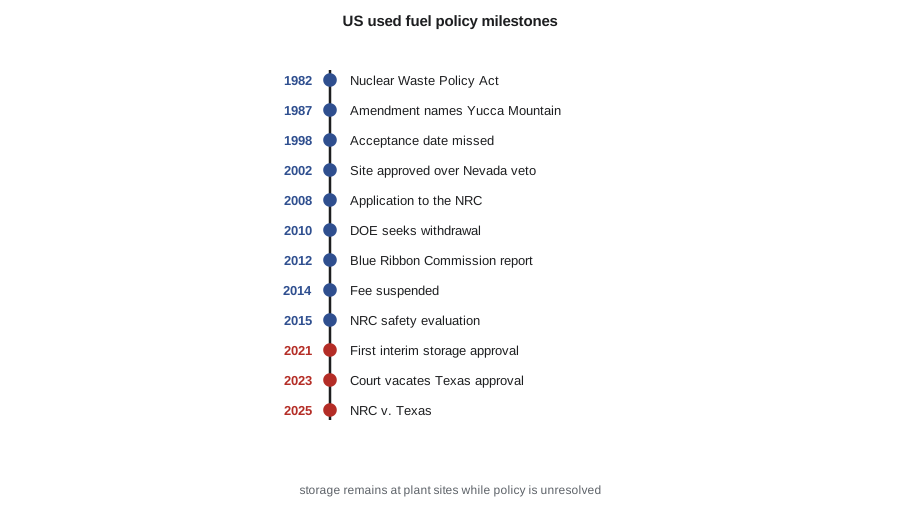
In the Nuclear Waste Policy Act of 1982, Congress made the federal government responsible for disposing of commercial used fuel and high-level waste, and created a process to select sites for two repositories, one in the West and one in the East. Utilities signed standard contracts with the DOE, under which the department would begin accepting used fuel by 31 January 1998, in return for a fee of one mill per kilowatt-hour of nuclear electricity, paid into a Nuclear Waste Fund.
In 1987, Congress amended the act to stop the search for other sites and direct the DOE to study only Yucca Mountain, a ridge of volcanic tuff on federal land next to the Nevada Test Site. Nevadans called the amendment the "Screw Nevada bill", and the state opposed the project for the next three decades. After extensive site characterization, the DOE recommended the site in 2002. Nevada's governor vetoed it under the act's procedures, Congress overrode the veto, and the DOE submitted a license application to the NRC in 2008.
The end of Yucca Mountain
In 2009 and 2010, the Obama administration decided that Yucca Mountain was "not a workable option" and the DOE asked the NRC to withdraw its license application. The NRC's licensing board refused, ruling that the act did not allow withdrawal, but the commission stopped its review for lack of funds. In 2013, the D.C. Circuit Court of Appeals ordered the NRC to continue the review with the money it had left, and in 2015 the NRC staff published its safety evaluation, finding that the design met the NRC's long-term safety requirements but that the DOE did not hold the land and water rights it would need. Congress has provided no further funding for the licensing process since then, and the application remains suspended.
The fee was suspended in 2014 after a federal court agreed with utilities and state regulators that the DOE had no basis for continuing to collect it while it had no active disposal program. The Nuclear Waste Fund, with interest, holds more than 40 billion dollars, but it can be spent only when Congress appropriates the money. Because the DOE did not begin accepting fuel in 1998, utilities successfully sued for breach of contract, and the government has paid more than 10 billion dollars in damages from the Treasury's Judgment Fund, with tens of billions more expected in future liabilities.
The Blue Ribbon Commission and consent-based siting
In 2010 the Obama administration set up the Blue Ribbon Commission on America's Nuclear Future. Its 2012 report recommended a new, consent-based approach to siting; a new organization, independent of the DOE, to manage used fuel; access to the money in the Nuclear Waste Fund; prompt efforts to develop one or more consolidated interim storage facilities; and prompt efforts to develop one or more geological repositories. Many of these recommendations need legislation, and several bills to implement them have been introduced in Congress without being passed.
Since 2021 the DOE has pursued consent-based siting for federal consolidated interim storage. After a public request for information, it funded consortia of universities, nonprofit groups and companies in 2023 to work with communities interested in learning about storage and the fuel cycle, and it has published guidance on how consent-based siting would work. Under current law, however, the DOE cannot build a federal interim storage facility until a repository is licensed, and Yucca Mountain remains the only site the law names for a repository.
Private interim storage and the courts
With no federal storage, private companies proposed consolidated interim storage facilities. The NRC licensed Interim Storage Partners in Andrews County, Texas, in 2021 and Holtec International in Lea County, New Mexico, in 2023. Both states opposed the projects and passed laws to block them. In 2023 the Fifth Circuit Court of Appeals vacated the Texas license, holding that the NRC lacked authority to license such a facility. In June 2025, in NRC v. Texas, the Supreme Court reversed that decision on the procedural ground that Texas and the other challengers had not been parties to the licensing case, without deciding the question of authority. Even with valid licenses, the companies would need customers and, for DOE-owned fuel, federal funding and legislation, so neither facility is close to operation.
# The size of the task: used fuel inventories and the containers a repository would need.
# Inventories are rounded public figures; check the latest national reports for current values.
inventories = [("Canada, CANDU bundles", 3.3e6, 0.0192),
               ("United States, LWR assemblies", 2.9e5, 0.32)]
for name, units, tHM_each in inventories:
    print(f"{name:32s} about {units:,.0f} units = {units*tHM_each:,.0f} t of heavy metal")
bundles_per_container = 48
print(f"Canadian used fuel containers needed: about {3.3e6/bundles_per_container:,.0f}")
fee_dollars_per_MWh = 1.0          # the US fee was one mill (0.1 cent) per kWh, i.e. 1 dollar per MWh
TWh_per_year = 780
print(f"a fee of {fee_dollars_per_MWh:.0f} dollar per MWh on {TWh_per_year} TWh collects about "
f"{fee_dollars_per_MWh*TWh_per_year*1e6/1e6:,.0f} million dollars a year")Canada, CANDU bundles about 3,300,000 units = 63,360 t of heavy metal United States, LWR assemblies about 290,000 units = 92,800 t of heavy metal Canadian used fuel containers needed: about 68,750 a fee of 1 dollar per MWh on 780 TWh collects about 780 million dollars a year
The output shows that the US inventory of about 290 000 assemblies contains about 93 000 t of heavy metal, while Canada's existing inventory of about 3.3 million bundles contains about 63 000 t. The fee line shows the scale of funding the suspended fee raised: at one dollar per megawatt-hour on US nuclear output of about 780 TWh, about 780 million dollars a year, collected from 1983 until 2014.
Lessons from the two countries
The Canadian and US experiences are often compared. Canada's process was slow and expensive, but it kept the support of the parties needed for success, by separating the waste program from the utilities, giving communities and Indigenous nations a real choice and proceeding step by step. The US program was faster at first and made major technical progress at Yucca Mountain, but the decision to name a single site by law, without the consent of the host state, created opposition that eventually stopped the project. Most international programs, including those in Finland, Sweden, France and Switzerland, now follow consent-based approaches similar in spirit to Canada's.
Most experts agree on the elements of a way forward, many of them in the Blue Ribbon Commission's report: amend the Nuclear Waste Policy Act to allow consent-based siting and federal interim storage; give a dedicated organization access to the Nuclear Waste Fund; and begin siting a repository again. Some also propose resolving Yucca Mountain's license application on its merits. Until Congress acts, used fuel will remain in dry storage at reactor sites, many of them closed plants.
Worked problem
Liability from delay
Suppose damages paid to utilities average 800 million dollars a year for each year the government fails to accept fuel. What is the cost of a further 10 years of delay?
Show solution
- Cost = 800 million × 10 = 8 billion dollars.
Answer: About 8 billion dollars, paid by taxpayers, in addition to the cost of eventually disposing of the fuel.
Comparing the US approach with other countries
International experience helps explain why some repository programs succeed and others stall. Finland chose Olkiluoto in 2000 after a national process in which the host municipality, Eurajoki, voted to accept the project and parliament then approved it. Sweden's SKB compared two volunteer municipalities, Östhammar and Oskarshamn, both of which already hosted nuclear facilities, and selected Forsmark in Östhammar in 2009. France's Andra developed its underground research laboratory at Bure, in a region that accepted it, and is now seeking a license for the Cigéo repository nearby. Switzerland compared three regions before choosing Nördlich Lägern in 2022. In each case, a long period of research, transparency, independent review and local consent preceded the decision.
The cases where programs stalled share some features too. Germany's Gorleben salt dome, chosen in 1977 with little consultation, faced decades of protest and was ruled out in 2020 when Germany restarted its search on a new, consent-oriented basis. The United Kingdom's attempt to site a repository in Cumbria ended in 2013 when the county council voted against moving to the next stage, and the UK has since begun a new process with volunteer communities. The lesson most programs have drawn is that technical suitability is necessary but not sufficient: a repository also needs a willing host and lasting trust.
The US experience with Yucca Mountain, a site chosen by Congress over the opposition of the host state, contrasts with these consent-based processes. By contrast, WIPP in New Mexico, though it faced opposition, gained the support of the local community of Carlsbad and eventually reached agreements with the state, which helped it open and operate. Many observers see WIPP as evidence that consent, local benefits and state agreements can work in the United States.
| Country | Site | How the site was chosen | Status |
|---|---|---|---|
| Finland | Olkiluoto, Eurajoki | municipal acceptance, parliamentary approval | operating license granted 2026 |
| Sweden | Forsmark, Östhammar | two volunteer municipalities compared | under construction |
| France | Cigéo, near Bure | research laboratory in an accepting region | license application under review |
| Switzerland | Nördlich Lägern | comparison of three regions | license application in preparation |
| Canada | Revell site, Ignace and WLON area | volunteer communities and willingness | impact assessment under way |
| United States | Yucca Mountain | named by Congress in 1987 | licensing suspended |
Funding long-lived programs
Repository programs last longer than the careers of the people who start them and longer than most institutions. Their funding must be secure, protected from being used for other purposes and large enough to cover costs that will continue for a century or more. Most countries use dedicated funds paid by waste producers, often with periodic cost estimates and adjustments to the contributions. The design of these funds, including who controls them and how they are invested, has a large influence on whether programs can proceed steadily.
The US fund, by contrast, is part of the federal budget, so it can be spent only when Congress appropriates the money, and its balance counts toward federal budget totals. Many reform proposals would move the fund outside the annual budget process, so that a new waste management organization could use it as needed, as Canada's NWMO and Finland's Posiva can.
Worked problem
Fee needed for a repository
A repository program is estimated to cost 26 billion dollars in total. A fleet produces 90 TWh of nuclear electricity a year and will operate for 40 more years. Ignoring interest, what charge per megawatt-hour would be needed to collect the full cost from future generation alone?
Show solution
- Total future generation = 90 TWh × 40 = 3600 TWh = 3.6 × 10⁹ MWh.
- Charge = 2.6 × 10¹⁰ ÷ 3.6 × 10⁹ = 7.2 dollars per MWh.
Answer: About 7 dollars per megawatt-hour, a small fraction of the price of electricity. In practice, funds already collected and investment returns reduce the charge needed.
Common mistakes
MistakeYucca Mountain was rejected because the science showed it was unsafe.
InsteadThe NRC staff found it met long-term safety requirements; its end was mainly political.
MistakeThe Nuclear Waste Fund can be spent by the DOE as needed.
InsteadSpending requires annual appropriations from Congress.
MistakeThe Supreme Court ruled that interim storage is legal.
InsteadIt ruled on procedural standing and did not decide the NRC's authority.
Summary and key terms
- The Nuclear Waste Policy Act of 1982 made the federal government responsible for disposal, funded by a fee.
- The 1987 amendment named Yucca Mountain as the only site, provoking lasting opposition from Nevada.
- Funding for licensing ended in 2010; the application remains suspended.
- The Blue Ribbon Commission recommended consent-based siting and a new organization.
- Private interim storage licenses face state opposition and legal uncertainty.
- Nuclear Waste Policy Act
- The 1982 law setting US policy for used fuel disposal.
- Yucca Mountain
- The Nevada site named in 1987 as the only candidate repository.
- Nuclear Waste Fund
- The fund that holds the fees paid by nuclear electricity consumers.
- Standard contract
- The agreement under which the DOE was to accept used fuel from 1998.
- Consent-based siting
- Siting a facility only with the agreement of the host community and state.
- Consolidated interim storage
- Central storage of used fuel from many plants before disposal.
Practice problems
Work each problem on paper first, then reveal the answer to check.
What did the 1987 amendment do?
Show answer
It directed the DOE to study only Yucca Mountain.
What did the NRC staff's 2015 safety evaluation conclude?
Show answer
The design met long-term safety requirements, but the DOE lacked necessary land and water rights.
Why was the fee suspended in 2014?
Show answer
A court found no basis for collecting it while there was no active disposal program.
At 1 dollar per MWh on 800 TWh, what fee income results?
Show answer
About 800 million dollars a year.
What did the Supreme Court decide in NRC v. Texas?
Show answer
That the challengers could not seek judicial review because they had not been parties; it did not rule on authority.
Lesson quiz · 5 questions
Score 60% or more to complete this lesson.
Create a free account to save your progress, take quizzes and earn a certificate.