
NUC-420 · Lesson 11 of 12 · 22 min
Canada's Adaptive Phased Management and the NWMO
Amara spent eight years at the Nuclear Waste Management Organization before joining Meridian. She shows Hana a photograph taken in November 2024 in Ignace, a township of about 1200 people in northwestern Ontario, the day the NWMO announced that the area shared by Ignace and the Wabigoon Lake Ojibway Nation had been selected for Canada's deep geological repository. "That decision took fourteen years of siting work," she says, "and twenty-two communities that first raised their hands. It happened because the process was designed so that no community could be forced to accept the project."
The Nuclear Fuel Waste Act and the NWMO
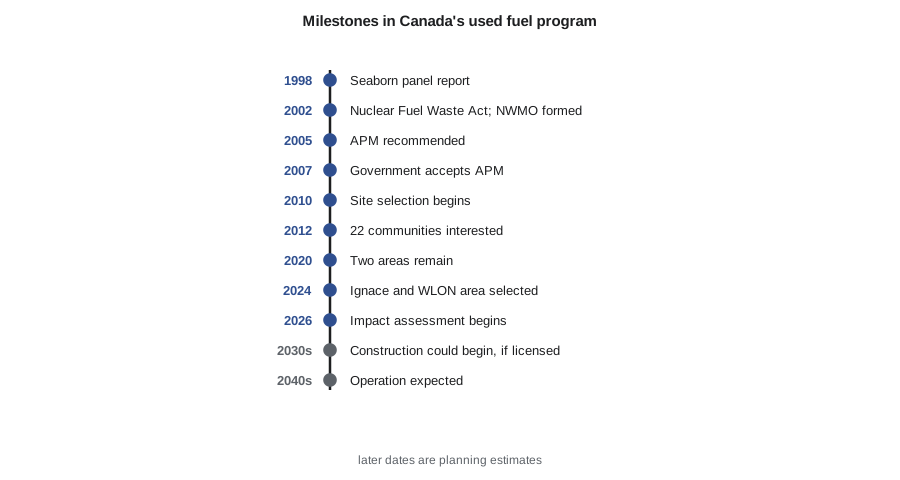
Canada's approach was shaped by the failure of an earlier one. In the 1980s and 1990s, AECL developed a concept for disposal in the granite of the Canadian Shield, and a federal environmental assessment panel chaired by Blair Seaborn reviewed it. The panel's 1998 report concluded that the concept was technically safe but had not been shown to be broadly acceptable to Canadians. It recommended a new organisation, at arm's length from the nuclear utilities, with a mandate to find an approach with public support.
The Nuclear Fuel Waste Act of 2002 did this. It required the owners of used fuel, OPG, Hydro-Québec, NB Power and AECL, to create the Nuclear Waste Management Organization, to fund it and to set up trust funds to pay for long-term management. It required the NWMO to study options and recommend one to the federal government. From 2002 to 2005, the NWMO carried out a national dialogue involving thousands of Canadians, Indigenous peoples and experts. It studied deep geological disposal, storage at the reactor sites and centralised storage, and recommended a fourth option that combined their strengths: Adaptive Phased Management. The federal government accepted the recommendation in 2007.
What Adaptive Phased Management means
Adaptive Phased Management is both a technical method and a management approach. Technically, its end point is centralised containment and isolation of used fuel in a deep geological repository in a suitable rock formation, with monitoring and the possibility of retrieval for an extended period. As a management approach, it proceeds in phases, each with clear decision points, so that it can adapt to new knowledge, technical advances and changing social values. It includes an optional step of shallow underground storage at the repository site, and it commits to seeking an informed and willing host community.
The phasing reflects the long timescales. Siting, licensing, construction, operation and closure will take well over a century, so APM is designed so that each generation can review progress, benefit from new knowledge and make its own decisions while still moving towards the end point. Retrievability during the long operating and monitoring period gives future generations choices, for example if a better use for the fuel is found.
The site selection process
The NWMO launched its site selection process in 2010. Communities volunteered to learn about the project; twenty-two did so, mostly in Ontario and Saskatchewan. Through a series of steps, the NWMO studied the geology, environment and social conditions of each area, held thousands of meetings, and gradually narrowed the list. By 2020, two areas remained: the Wabigoon Lake Ojibway Nation and Ignace area in northwestern Ontario, in crystalline rock, and the South Bruce area in southwestern Ontario, in sedimentary rock. Both had extensive borehole and field programs. In October 2024, South Bruce residents voted narrowly in favour of continuing. In November 2024, after the Ignace council and the Wabigoon Lake Ojibway Nation both confirmed their willingness, the NWMO selected the northwestern site.
The repository site lies about 43 km northwest of Ignace and 21 km southeast of the Wabigoon Lake Ojibway Nation, in granitic rock of the Revell batholith. The NWMO entered the federal impact assessment process in January 2026, with the Impact Assessment Agency of Canada and the CNSC conducting an integrated review, and the NWMO is now preparing its impact statement. If approved and licensed, construction could begin in the 2030s and operation in the early 2040s, with used fuel transported from the reactor sites over several decades.
Partnership, reconciliation and funding
The NWMO's approach puts strong weight on partnership with Indigenous peoples. It adopted a Reconciliation Policy in 2019 and recognises Indigenous Knowledge alongside Western science in its work. The Wabigoon Lake Ojibway Nation carried out its own assessment and engagement process before agreeing to continue, and the NWMO has hosting agreements with both Ignace and the First Nation. These include commitments to jobs, training and community infrastructure, and to a Centre of Expertise in the area. The project's estimated cost, more than 20 billion dollars over its lifetime, is funded by the waste owners through trust funds that now hold several billion dollars and are reviewed by Natural Resources Canada.
# The size of the task: used fuel inventories and the containers a repository would need.
# Inventories are rounded public figures; check the latest national reports for current values.
inventories = [("Canada, CANDU bundles", 3.3e6, 0.0192),
               ("United States, LWR assemblies", 2.9e5, 0.32)]
for name, units, tHM_each in inventories:
    print(f"{name:32s} about {units:,.0f} units = {units*tHM_each:,.0f} t of heavy metal")
bundles_per_container = 48
print(f"Canadian used fuel containers needed: about {3.3e6/bundles_per_container:,.0f}")
fee_dollars_per_MWh = 1.0          # the US fee was one mill (0.1 cent) per kWh, i.e. 1 dollar per MWh
TWh_per_year = 780
print(f"a fee of {fee_dollars_per_MWh:.0f} dollar per MWh on {TWh_per_year} TWh collects about "
f"{fee_dollars_per_MWh*TWh_per_year*1e6/1e6:,.0f} million dollars a year")Canada, CANDU bundles about 3,300,000 units = 63,360 t of heavy metal United States, LWR assemblies about 290,000 units = 92,800 t of heavy metal Canadian used fuel containers needed: about 68,750 a fee of 1 dollar per MWh on 780 TWh collects about 780 million dollars a year
The output shows that Canada's existing inventory, about 3.3 million bundles, contains about 63 000 t of heavy metal, while the US inventory of about 290 000 assemblies contains about 93 000 t. Canada would need about 69 000 containers for its present inventory alone. The fee line shows the scale of funding a small charge on nuclear electricity can raise: at one dollar per megawatt-hour on the US output of about 780 TWh, about 780 million dollars a year.
Lessons from the two countries
The Canadian and US experiences are often compared. Canada's process was slow and expensive, but it kept the support of the parties needed for success, by separating the waste program from the utilities, giving communities and Indigenous nations a real choice and proceeding step by step. The US program was faster at first and made major technical progress at Yucca Mountain, but the decision to name a single site by law, without the consent of the host state, created opposition that eventually stopped the project. Most international programs, including those in Finland, Sweden, France and Switzerland, now follow consent-based approaches similar in spirit to Canada's.
Challenges remain for Canada. The impact assessment and licensing have yet to be completed, transportation routes must be planned and accepted, and some Indigenous nations and groups along possible routes and near the site remain opposed. The NWMO also has new responsibilities for intermediate-level and non-fuel high-level waste, as lesson 9 described.
Worked problem
Trust fund growth
A trust fund holds 6 billion dollars and earns a real return of 3 % a year. Ignoring further contributions and spending, what will it hold in real terms after 20 years?
Show solution
- Future value = 6 × 1.03²⁰ billion dollars.
- 1.03²⁰ = 1.806, so the fund holds about 10.8 billion dollars.
Answer: About 10.8 billion dollars in real terms, which is why early, steady contributions matter for a project that runs for more than a century.
Comparing Canada's approach with other countries
International experience helps explain why some repository programs succeed and others stall. Finland chose Olkiluoto in 2000 after a national process in which the host municipality, Eurajoki, voted to accept the project and parliament then approved it. Sweden's SKB compared two volunteer municipalities, Östhammar and Oskarshamn, both of which already hosted nuclear facilities, and selected Forsmark in Östhammar in 2009. France's Andra developed its underground research laboratory at Bure, in a region that accepted it, and is now seeking a licence for the Cigéo repository nearby. Switzerland compared three regions before choosing Nördlich Lägern in 2022. In each case, a long period of research, transparency, independent review and local consent preceded the decision.
The cases where programs stalled share some features too. Germany's Gorleben salt dome, chosen in 1977 with little consultation, faced decades of protest and was ruled out in 2020 when Germany restarted its search on a new, consent-oriented basis. The United Kingdom's attempt to site a repository in Cumbria ended in 2013 when the county council voted against moving to the next stage, and the UK has since begun a new process with volunteer communities. The lesson most programs have drawn is that technical suitability is necessary but not sufficient: a repository also needs a willing host and lasting trust.
Canada's experience fits this pattern. AECL's concept failed to gain acceptance in the 1990s even though it was technically sound, while the NWMO's process, slower and focused on willingness, reached a site decision. The NWMO's approach drew directly on the Finnish and Swedish experience, and the NWMO collaborates with Posiva, SKB and other organisations on repository science through international programs.
| Country | Site | How the site was chosen | Status |
|---|---|---|---|
| Finland | Olkiluoto, Eurajoki | municipal acceptance, parliamentary approval | operating licence granted 2026 |
| Sweden | Forsmark, Östhammar | two volunteer municipalities compared | under construction |
| France | Cigéo, near Bure | research laboratory in an accepting region | licence application under review |
| Switzerland | Nördlich Lägern | comparison of three regions | licence application in preparation |
| Canada | Revell site, Ignace and WLON area | volunteer communities and willingness | impact assessment under way |
| United States | Yucca Mountain | named by Congress in 1987 | licensing suspended |
Funding long-lived programs
Repository programs last longer than the careers of the people who start them and longer than most institutions. Their funding must be secure, protected from being used for other purposes and large enough to cover costs that will continue for a century or more. Most countries use dedicated funds paid by waste producers, often with periodic cost estimates and adjustments to the contributions. The design of these funds, including who controls them and how they are invested, has a large influence on whether programs can proceed steadily.
Canada's approach puts the funds in trusts controlled by the waste owners, with deposits set according to the NWMO's cost estimates and approved by the Minister of Natural Resources. The trusts can be used only for long-term management of used fuel, so the money is protected from other uses. This arrangement has allowed the NWMO to spend on research, siting and engagement without annual government appropriations.
Worked problem
Fee needed for a repository
A repository program is estimated to cost 26 billion dollars in total. A fleet produces 90 TWh of nuclear electricity a year and will operate for 40 more years. Ignoring interest, what charge per megawatt-hour would be needed to collect the full cost from future generation alone?
Show solution
- Total future generation = 90 TWh × 40 = 3600 TWh = 3.6 × 10⁹ MWh.
- Charge = 2.6 × 10¹⁰ ÷ 3.6 × 10⁹ = 7.2 dollars per MWh.
Answer: About 7 dollars per megawatt-hour, a small fraction of the price of electricity. In practice, funds already collected and investment returns reduce the charge needed.
Common mistakes
MistakeThe NWMO can choose any site it considers technically suitable.
InsteadThe process requires an informed and willing host, including Indigenous nations in the area.
MistakeAdaptive Phased Management means storing fuel at reactor sites indefinitely.
InsteadIts end point is a deep geological repository; it proceeds in phases with decision points.
MistakeCanada's repository is already operating.
InsteadThe site was selected in 2024; the impact assessment began in 2026 and operation is expected in the 2040s.
Summary and key terms
- The Seaborn panel found AECL's concept technically sound but not broadly accepted, leading to the Nuclear Fuel Waste Act of 2002.
- The NWMO recommended Adaptive Phased Management, accepted by the government in 2007.
- APM is phased and adaptive and leads to a deep geological repository with retrievability.
- After a 14-year process, the Wabigoon Lake Ojibway Nation and Ignace area was selected in 2024.
- The impact assessment began in 2026; operation is expected in the 2040s.
- NWMO
- The Nuclear Waste Management Organization, responsible for Canada's long-term used fuel management.
- Adaptive Phased Management
- Canada's approach: phased, adaptive progress towards a deep geological repository.
- Nuclear Fuel Waste Act
- The 2002 federal law that created the NWMO and required trust funds.
- Willing host
- A community and Indigenous nation that have agreed to host the facility.
- Retrievability
- The ability to recover used fuel from a repository for a period after emplacement.
- Reconciliation
- Restoring a respectful relationship with Indigenous peoples, a core NWMO commitment.
Practice problems
Work each problem on paper first, then reveal the answer to check.
What did the Seaborn panel conclude?
Show answer
AECL's concept was technically safe but lacked broad public acceptance.
Name the four original waste owners required to form the NWMO.
Show answer
OPG, Hydro-Québec, NB Power and AECL.
What is the optional step in APM before the repository?
Show answer
Shallow underground storage at the repository site.
A 4 billion dollar fund grows at a real 3 % a year for 30 years. What does it reach?
Show answer
About 4 × 2.43 = 9.7 billion dollars.
Why was South Bruce not selected?
Show answer
The NWMO chose the northwestern site after both Ignace and the Wabigoon Lake Ojibway Nation confirmed willingness; both sites had been studied.
Lesson quiz · 5 questions
Score 60% or more to complete this lesson.
Create a free account to save your progress, take quizzes and earn a certificate.