
NUC-420 · Lesson 6 of 12 · 23 min
Interim storage
Beside the TVA plant, on a thick concrete pad inside a security fence, stands a row of tall cylindrical casks, each holding dozens of assemblies sealed in a welded steel canister. "This is an independent spent fuel storage installation," Amara tells Hana. "Nearly every operating plant in the country has one, because there is nowhere else for the fuel to go. They need no power, no water and no pumps. The question is not whether they work. It is how long the country intends to rely on them."
Pool storage
Freshly discharged fuel goes first into a storage pool, a deep, lined concrete basin filled with purified water. The water removes decay heat, which is transferred through heat exchangers to the plant's cooling systems, and it shields workers: a few meters of water reduce the radiation from the fuel to levels at which people can work on the pool deck. Racks hold the fuel in a geometry that keeps it subcritical, using spacing or neutron-absorbing materials such as borated stainless steel, and in light water reactor pools the water itself contains dissolved boron.
Pools are robust but active systems: they depend on cooling, water chemistry control and makeup water. The Fukushima accident drew attention to pool safety because the loss of power stopped pool cooling at several units. Later reviews showed that the pools had kept their fuel covered, but regulators in both countries required improvements, including reliable pool level instruments and means to add water from outside sources, as lesson 11 of the nuclear safety course described. Pools are also limited in capacity. Plants originally expected used fuel to leave for reprocessing or disposal within a few years, and most pools have been re-racked to hold more fuel, then supplemented by dry storage.
Dry storage
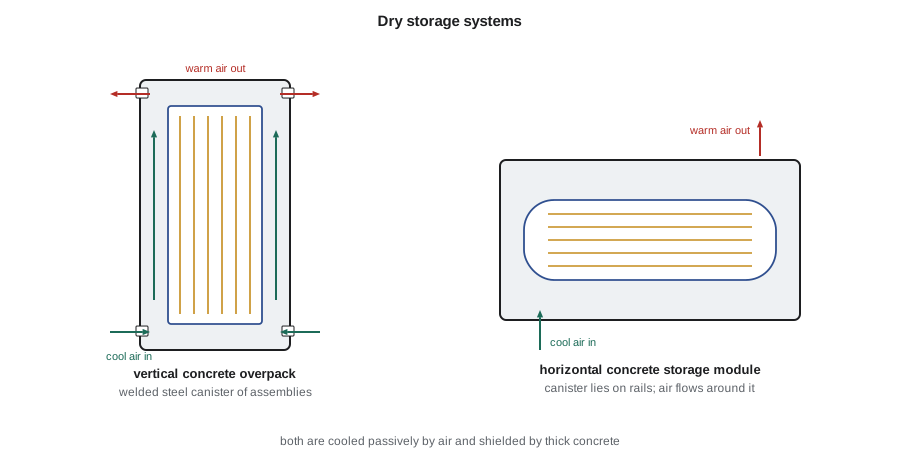
After several years in the pool, fuel has cooled enough to be stored dry. In dry storage, fuel is sealed inside a metal canister or cask filled with an inert gas, usually helium, and cooled by natural air circulation around the outside. Thick concrete or steel shields the radiation. The systems are passive: they need no power, pumps or operators to keep the fuel safe, though they are inspected and monitored. Dry storage has been used in North America since the 1980s with an excellent safety record, and it is now the main way used fuel is stored once pools are full.
US plants use a variety of dry storage systems licensed by the NRC under 10 CFR Part 72. The most common type places a welded stainless steel canister holding up to about 30 to 40 PWR assemblies, or more BWR assemblies, inside a ventilated concrete overpack standing vertically on a pad or lying horizontally in a concrete module. Others use thick-walled bolted metal casks. Main vendors include Holtec International, Orano TN and NAC International. Plants may store fuel under a general license that covers any NRC-certified cask design or under a site-specific license. At decommissioned plants, the dry storage pad may be the only part of the facility left.
| Feature | Pool storage | Dry storage |
|---|---|---|
| Cooling | forced water circulation and heat exchangers | natural air convection around the canister |
| Shielding | several meters of water | concrete or steel walls |
| Needs power and water | yes | no |
| When used | first several years after discharge | after the fuel has cooled enough |
| Capacity limit | set by the pool size and racks | expandable by adding casks |
| Main hazards | loss of cooling or water inventory | handling drops, long-term aging of materials |
Heat limits and cooling time
The main design limit for a dry storage system is heat. The cask must keep the cladding below a temperature limit, typically about 400 °C, to avoid creep and hydride reorientation in the cladding, and must keep the concrete below its own temperature limits. The total heat a cask can accept therefore sets how long fuel must cool in the pool before loading and how many assemblies of what burnup go into each canister. Utilities plan loading campaigns by combining hotter and cooler assemblies so that each canister stays within its licensed heat load.
# Dry storage: how long must fuel cool before a cask is within its heat limit?
# Decay heat per metric ton after long cooling is approximated by a fitted power law (illustrative).
def kw_per_tHM(years, burnup_GWd):
    return 1.6 * (burnup_GWd / 45.0) * (years / 10.0) ** -0.55
cases = [("LWR assembly cask, 32 assemblies", 32 * 0.46, 50, 35.0),
         ("CANDU dry storage container, 384 bundles", 384 * 0.0192, 7.5, 3.0)]
for name, tHM, bu, limit_kW in cases:
    for yr in range(1, 41):
        if tHM * kw_per_tHM(yr, bu) <= limit_kW:
            print(f"{name:42s} meets {limit_kW:4.1f} kW after about {yr} years ({tHM*kw_per_tHM(yr,bu):.1f} kW)")
            break
print("high-burnup fuel and larger casks need longer cooling in the pool")LWR assembly cask, 32 assemblies meets 35.0 kW after about 6 years (34.7 kW) CANDU dry storage container, 384 bundles meets 3.0 kW after about 5 years (2.9 kW) high-burnup fuel and larger casks need longer cooling in the pool
The output shows that, with these illustrative numbers, both the light water reactor canister and the CANDU container can be loaded after about five or six years in the pool. In practice the time depends on the specific design and license; high-burnup fuel and large canisters often need longer, and loading patterns put the hottest assemblies in the center and cooler ones at the edges. The calculation also shows why dry storage is easier for CANDU fuel: each bundle produces little heat, so the limiting factor is often handling time rather than temperature.
Safety and security of storage
Dry storage systems are designed to withstand earthquakes, floods, tornadoes and missiles driven by high winds, and to resist drops during handling. Their safety cases also consider fire and the long-term behavior of the canister and concrete. Security measures protect the sites against theft and sabotage, under requirements set by the national regulators. Monitoring includes radiation surveys, temperature or air-flow checks on vented systems, and periodic inspections. For welded stainless steel canisters near the sea or in other chloride-rich air, chloride-induced stress corrosion cracking of the canister welds is an aging mechanism that operators now inspect for.
In the United States, NRC certificates of compliance and site-specific licenses for dry storage are issued for initial terms of up to 40 years and can be renewed, with aging management programs, for further periods of up to 40 years. Because the country has no repository and no operating consolidated storage site, used fuel is likely to stay at plant sites for decades. Lesson 11 describes the policy situation.
Consolidated interim storage
Consolidated interim storage means collecting used fuel from many plants at one or two central sites until a repository is available. The NRC licensed two such facilities, Interim Storage Partners in Andrews County, Texas, in 2021, and Holtec International's facility in Lea County, New Mexico, in 2023. Both faced strong opposition from state governments. A federal appeals court vacated the Texas license in 2023, but in June 2025 the Supreme Court, in NRC v. Texas, held that Texas and the other challengers had not been parties to the licensing proceeding and so could not seek review; it did not decide whether the NRC may license such sites. Both states have also passed laws to block the facilities, so whether either will be built remains uncertain.
Worked problem
Number of storage units for one year of discharges
A CANDU station discharges 22 000 bundles a year, and each dry storage container holds 384 bundles. How many containers are needed per year?
Show solution
- Containers = 22 000 ÷ 384 = 57.3.
- Round up: 58 containers a year.
Answer: About 58 containers a year, each weighing about 70 metric tons when loaded.
Transport of used fuel
Used fuel must eventually be moved from reactor sites to a repository or a central storage site, and it is already moved between sites in some cases. Transport packages are designed to the IAEA's Regulations for the Safe Transport of Radioactive Material, which national regulators adopt. Packages for used fuel are Type B packages, which must survive a sequence of tests representing severe accidents: a 9 m drop onto an unyielding surface, a 1 m drop onto a steel bar, a fully engulfing fire at 800 °C for 30 minutes and immersion in water. Full-scale tests in the 1970s and 1980s, in which casks were hit by locomotives and rocket-propelled trucks, showed that they would remain intact in extreme crashes.
In the United States, the NRC certifies packages and the Department of Transportation regulates shipments. Thousands of shipments of used fuel and high-level waste have been made since the 1960s without a release of radioactive material, including shipments of research reactor fuel and of defense waste. Any national program would involve large numbers of rail and truck shipments, and the DOE has studied rail routes and the training of emergency responders in states along them.
Storage after plant shutdown
When a reactor shuts down permanently, its used fuel remains. Operators usually move the remaining fuel from the pool to dry storage within several years so that the pool and the rest of the plant can be decommissioned. The site then contains only the storage facility, its security systems and a small staff. Such sites are sometimes called stranded fuel sites, because the fuel cannot leave until a disposal or central storage facility is available. The cost of operating them, typically several million dollars a year each, continues for as long as the fuel remains.
In the United States, about twenty sites hold used fuel at reactors that have shut down permanently, including Maine Yankee, Yankee Rowe, Connecticut Yankee, Rancho Seco, Humboldt Bay, Zion, Kewaunee and San Onofre. These sites are a major reason for the interest in consolidated interim storage, since moving their fuel would allow the land to be released and end the costs of guarding the casks.
Long-term storage research
Interim storage was originally expected to last a few decades. With repositories delayed, storage for a century or more has to be considered. Research programs in both countries are studying how fuel, cladding, canisters, bolted seals and concrete age over such periods. Key questions include whether cladding embrittlement from hydrides could affect later handling, how quickly stress corrosion cracks could grow in canister welds, and how concrete overpacks and storage buildings weather. The results support license renewals and help design the inspections needed to show that stored fuel remains safe and retrievable when it is finally moved.
Worked problem
Cost of storage at a shut-down site
A shut-down site with an independent storage facility costs 8 million dollars a year to operate and guard. What is the total cost if the fuel remains for 40 years, ignoring inflation and discounting?
Show solution
- Total = 8 × 40 = 320 million dollars.
Answer: About 320 million dollars for one site. Across many sites, delay in providing disposal or central storage becomes very costly.
Choosing between storage options
Utilities choose among storage options by weighing cost, flexibility and licensing. Re-racking a pool to hold more fuel is cheap but limited, and it increases the heat load and the consequences of a loss of cooling. Dry storage has higher costs at the start, for the pad or building and the handling equipment, but each additional cask or container adds capacity at a predictable cost. Some systems are designed so that the canister can later be placed in a transport overpack and shipped without reopening it, which simplifies the eventual move to a repository or central site. Others, including the CANDU dry storage containers, will need their fuel to be transferred to a different package for transport.
Storage also interacts with the design of the repository. If the repository will use a different container from the storage system, as both the NWMO and most other programs plan, the fuel will have to be handled again at the repository site, in a facility that receives the transport packages, removes the fuel and loads it into disposal containers. The NWMO's design includes such a used fuel packaging plant, where bundles will be placed in the 48-bundle containers and sealed before being taken underground. Planning storage, transport and disposal together reduces the number of times the fuel is handled and the dose to workers.
| Option | Advantages | Disadvantages |
|---|---|---|
| Re-racking the pool | low cost, no new structures | limited capacity, higher pool heat load |
| Dry storage at the site | passive, expandable, proven | land and security costs, fuel stays at many sites |
| Consolidated storage | fewer sites to guard, frees plant land | transport, siting and legal challenges |
| Storage at the repository site | fuel moved only once | needs a repository site to be chosen |
Common mistakes
MistakeDry storage needs cooling water.
InsteadIt is cooled by natural air convection; no water, power or pumps are needed.
MistakeFuel can be moved to dry storage immediately after discharge.
InsteadIt must cool in the pool for several years until its heat is within the cask limit.
MistakeInterim storage is a permanent solution.
InsteadIt is designed and licensed for decades while disposal is prepared; a repository is still needed.
Summary and key terms
- Pools cool and shield fresh used fuel but are active systems with limited capacity.
- Dry storage casks and containers are passive, cooled by air and shielded by concrete or steel.
- Heat limits set the cooling time before loading and the loading pattern.
- Storage facilities are licensed and monitored for decades and protected by security measures.
- Interim storage bridges the gap until a repository is available.
- Spent fuel pool
- A water-filled basin that cools and shields fuel after discharge.
- Dry storage
- Storage of used fuel in sealed, air-cooled casks or containers.
- Canister
- A welded or bolted metal vessel holding used fuel in an inert gas.
- Overpack
- The concrete or steel shell that shields and protects a canister.
- Heat load
- The total decay heat a storage unit is licensed to accept.
- Consolidated interim storage
- Storage of fuel from many reactors at a central site before disposal.
Practice problems
Work each problem on paper first, then reveal the answer to check.
Why is dry storage described as passive?
Show answer
It needs no power, pumps or water; cooling is by natural air flow.
What limits how soon fuel can be loaded into a dry cask?
Show answer
Its decay heat must be below the cask's heat limit so cladding and concrete stay within temperature limits.
Name one aging mechanism monitored in dry storage.
Show answer
Chloride-induced stress corrosion cracking of canister welds, or concrete degradation.
How many 384-bundle containers hold 1.5 million bundles?
Show answer
About 3900 containers.
Why did Fukushima lead to changes in pool safety?
Show answer
Loss of power stopped pool cooling, prompting requirements for level instruments and external makeup water.
Lesson quiz · 5 questions
Score 60% or more to complete this lesson.
Create a free account to save your progress, take quizzes and earn a certificate.