
NUC-420 · Lesson 10 of 12 · 22 min
Deep geological repositories
Amara pins a cross-section of a generic repository design on the wall: a network of tunnels several hundred meters below the surface, reached by shafts or ramps, with metal waste packages surrounded by a clay buffer. "Everything in this course leads here," she says. "Whatever the United States finally decides, the scientific consensus is the same as in every other country: deep geological disposal. It has to isolate the fuel for hundreds of thousands of years, and it has to do that without anyone looking after it."
Why deep geological disposal
For more than half a century, international scientific bodies, including the US National Academy of Sciences in 1957 and the IAEA and OECD Nuclear Energy Agency since, have concluded that deep geological disposal is the best long-term solution for used fuel and high-level waste. The idea is to place the waste in a stable rock formation, several hundred meters below ground, where groundwater moves very slowly and conditions have been stable for millions of years. The repository does not rely on people to maintain it. Other options have been studied, including disposal under the seabed, in ice sheets, in space and by transmutation, but have been rejected or prohibited as impractical, unsafe or contrary to international agreements, or are not yet available at scale.
A repository is a passive system. Once it is closed, its safety depends on the properties of the waste form, the engineered barriers and the rock, not on monitoring or maintenance. This is a deliberate choice: it would be unwise to rely on future societies to look after waste for tens or hundreds of thousands of years. Countries may choose to monitor the repository for a long period after closure and to keep it retrievable for some time, but the safety case must show that it is safe without these measures.
The multiple-barrier system
Safety comes from several barriers that work together, so that if one is less effective than expected, the others still provide protection. The first barrier is the fuel itself: uranium dioxide is a ceramic that dissolves very slowly in the chemically reducing groundwater found at depth, and most of the radionuclides are locked inside its grains. The second is the container, which in many designs is made of or coated with copper, a metal that is very stable in oxygen-free groundwater, so it is expected to remain intact for hundreds of thousands of years. The third is the buffer of compacted bentonite clay around the container, which swells when wet to seal gaps, keeps water from flowing past the container and strongly slows the movement of most radionuclides. The fourth is the host rock, which isolates the waste from the surface, protects it from disturbance and provides a long, slow path for any radionuclides that might eventually escape.
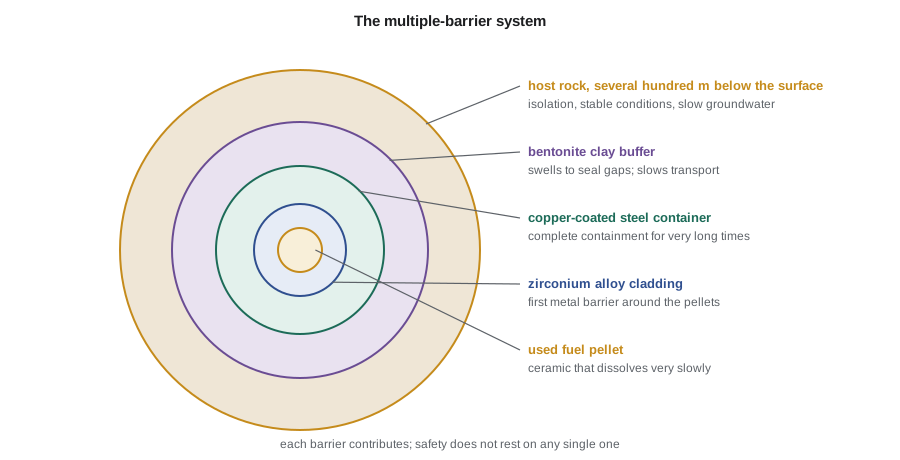
The Finnish and Swedish designs, known as KBS-3, use a copper canister about 5 cm thick with a cast iron insert holding light water reactor assemblies. Each canister is placed in a vertical hole in the floor of a tunnel, surrounded by compacted bentonite. The Yucca Mountain design, which lesson 11 describes, was different: it was above the water table in volcanic tuff, used corrosion-resistant nickel alloy waste packages and relied on titanium drip shields. Any future US repository would need a new design suited to its site.
The safety case
A repository's safety case brings together the evidence and arguments that it will be safe. It describes the site and the design, identifies features, events and processes that could affect performance, such as corrosion, earthquakes, glaciation and human intrusion, and uses computer models to estimate possible future doses to people. Regulators set dose or risk limits for the long-term period. Because the timescales are so long, the safety case also uses natural analogs, such as the Cigar Lake uranium deposit in Saskatchewan, where very rich uranium ore has stayed in place underground for more than a billion years, surrounded by clay, with no sign at the surface.
# A simple advection-decay estimate: how much of a long-lived nuclide survives a slow path to the surface.
# Illustrative only; real safety cases use detailed models and many barriers.
import math
path_m, darcy_m_per_y, porosity = 500.0, 1e-5, 0.005
v = darcy_m_per_y / porosity             # average groundwater velocity in the rock, m per year
for name, hl, retard in [("I-129 (not sorbed)", 1.57e7, 1.0),
                         ("Cs-135 (sorbed)", 2.3e6, 100.0),
                         ("Tc-99 (reducing rock)", 2.1e5, 50.0)]:
    t = path_m / v * retard               # travel time with retardation
    surv = math.exp(-math.log(2) * t / hl)
    print(f"{name:24s} travel time {t:10.2e} y   fraction surviving {surv:9.2e}")
print("container and clay buffer delay release further; this toy ignores them")I-129 (not sorbed) travel time 2.50e+05 y fraction surviving 9.89e-01 Cs-135 (sorbed) travel time 2.50e+07 y fraction surviving 5.34e-04 Tc-99 (reducing rock) travel time 1.25e+07 y fraction surviving 1.21e-18 container and clay buffer delay release further; this toy ignores them
The output shows the importance of sorption and slow groundwater movement. Technetium-99 and cesium-135, which are held back by the rock, decay almost completely before they could travel 500 m. Iodine-129, which is hardly sorbed and has a very long half-life, survives the journey in this toy model. This is why iodine-129 and similar mobile, long-lived nuclides such as chlorine-36 often dominate the very small calculated doses in safety assessments, and why the container and buffer, which this simple model ignores, are so important. Even then, calculated doses from well-sited repositories are small fractions of natural background.
| Barrier | Main function | Expected performance |
|---|---|---|
| Used fuel | slow dissolution of radionuclides | UO₂ dissolves very slowly in reducing water |
| Container | complete containment | intact for hundreds of thousands of years in design conditions |
| Bentonite buffer | limits water flow and slows radionuclide transport | swells to seal gaps; sorbs many nuclides |
| Host rock | isolation, stability and slow transport | slow groundwater, stable for millions of years |
Repositories around the world
Finland is the first country to approach operation of a used fuel repository. Posiva's ONKALO facility at Olkiluoto, about 430 m deep in crystalline rock, received its operating license from the Finnish government in October 2026, after more than four decades of research and site work; the start of disposal awaits final readiness checks by the regulator, STUK. Sweden's SKB received government approval in 2022 for a similar repository at Forsmark and began construction in 2025. France's Andra has applied for a license for the Cigéo repository in clay rock in eastern France, and Switzerland has chosen a site in the Nördlich Lägern region for its repository. These programs share the multiple-barrier approach and, increasingly, a commitment to consent-based siting.
The United States has an operating repository for defense transuranic waste, the Waste Isolation Pilot Plant, but no repository for used fuel. Lesson 11 describes the policy history and options.
Worked problem
Number of containers for an inventory
Canada's used fuel inventory is projected to reach about 5.5 million bundles. If each container holds 48 bundles, how many containers are needed?
Show solution
- Containers = 5 500 000 ÷ 48 = 114 600.
Answer: About 115 000 containers. At a placement rate of a few thousand a year, emplacement would take several decades.
Site characterization
Before a repository can be licensed, its site must be understood in great detail. Site characterization combines surface mapping, airborne and ground geophysical surveys, deep boreholes, hydrogeological testing, rock mechanics studies and long-term monitoring of groundwater pressure and chemistry. Investigators want to know the structure of the rock, including fractures and faults; how groundwater moves and how old it is; its chemistry, which affects corrosion and the mobility of radionuclides; the stresses in the rock; and the history of the region, including past glaciations and earthquakes. Very old, salty groundwater at depth is a good sign, because it shows that water has hardly moved for a very long time.
At Yucca Mountain, the DOE carried out decades of site characterization, including an 8 km exploratory tunnel and many boreholes, and studied the unsaturated zone above the water table in great detail. The site was unusual because the repository would have been above the water table, in rock that is not saturated with water. Any new US site would need similar, though perhaps better targeted, investigations.
Long-term events: glaciation, earthquakes and human intrusion
Over a million years, the climate will change dramatically. Northern North America has been covered by ice sheets more than two kilometers thick many times in the past two million years, and safety cases for Canadian and Nordic repositories assume that future glaciations will occur. Ice sheets change groundwater flow, can push oxygen-rich meltwater to depth and increase stresses in the rock. Repository designs place the waste deep enough that these effects are limited, and safety cases show that the barriers would remain effective through several glacial cycles.
Earthquakes are less damaging underground than at the surface, because the shaking is weaker at depth. The main concern is movement on a fracture intersecting a container, which designs address by avoiding major fractures when locating placement rooms or deposition holes. Human intrusion, in which a future society drills into the repository without knowing what it is, is treated as a special case: it cannot be ruled out, but the depth of the repository, the choice of a site without valuable resources, and markers and records reduce its likelihood, and its consequences are assessed separately.
| Feature, event or process | Effect considered | How the design responds |
|---|---|---|
| Glaciation | changed groundwater flow and chemistry, higher rock stresses | great depth, durable containers, robust buffer |
| Earthquakes and fault movement | shear on fractures near containers | avoid major fractures; buffer cushions small movements |
| Container corrosion | eventual loss of containment | thick copper, oxygen-free conditions |
| Buffer erosion | loss of clay around a container | design of buffer density and placement |
| Human intrusion | drilling into the repository | site without resources, depth, markers and records |
Monitoring, retrievability and closure
A repository will operate for decades, and during that time it will be monitored to confirm that it behaves as expected. Monitoring includes temperatures, groundwater pressures and chemistry, rock movements and, in demonstration areas, the swelling of the buffer around test containers. Many programs also keep used fuel retrievable for an extended period, so that future generations could recover it if new information or technology made that desirable. Retrievability is a policy choice: it must not compromise the long-term safety of the repository, which is why it is usually limited to the operating and monitoring period. When society decides to close the repository, the tunnels and shafts are backfilled and sealed, and the site enters a period of post-closure monitoring and institutional control before it is left to its passive safety.
Worked problem
Groundwater travel time
Groundwater moves through a fractured rock at an average velocity of 0.002 m per year. How long does it take to travel 500 m, and how many half-lives of plutonium-239 (24 100 years) is that?
Show solution
- Travel time = 500 ÷ 0.002 = 250 000 years.
- Number of half-lives = 250 000 ÷ 24 100 = 10.4.
Answer: About 250 000 years, more than ten half-lives, so less than a thousandth of any plutonium-239 released would remain by the time water reached the surface, even before allowing for sorption, which slows plutonium far more than the water itself.
Engineers also test repository components at full scale in underground laboratories before construction. Canada's Underground Research Laboratory near Pinawa, Manitoba, operated by AECL from the 1980s to 2010, studied the behavior of granite, buffer materials and seals at depths of up to 420 m. Sweden's Äspö Hard Rock Laboratory, Finland's ONKALO characterization tunnels, France's Bure laboratory and Switzerland's Grimsel and Mont Terri laboratories have tested emplacement methods, buffer swelling and container handling. The NWMO has also built a proof test facility in Oakville, Ontario, where it tests container manufacturing, buffer box production and emplacement equipment.
Common mistakes
MistakeThe repository is safe only as long as it is monitored.
InsteadIt is designed to be passively safe after closure without monitoring.
MistakeSafety depends on the container alone.
InsteadMultiple barriers work together, so safety does not rest on any single one.
MistakeNo country has licensed a used fuel repository.
InsteadFinland's ONKALO has received an operating license; Sweden is building one.
Summary and key terms
- Deep geological disposal is the international consensus solution for used fuel and high-level waste.
- Safety relies on multiple barriers: the waste form, container, buffer and host rock.
- The safety case uses site data, models and natural analogs over timescales of a million years.
- Mobile, long-lived nuclides such as iodine-129 often dominate calculated doses, which remain very small.
- Finland, Sweden, France, Switzerland and Canada have advanced repository programs.
- Deep geological repository
- An engineered facility in stable rock hundreds of meters underground for long-lived waste.
- Multiple-barrier system
- A combination of engineered and natural barriers that together isolate waste.
- Bentonite
- A clay that swells when wet, used as a buffer around containers.
- Safety case
- The body of evidence and arguments showing that a facility will be safe.
- Natural analog
- A natural system that shows how materials behave over geological time.
- Sorption
- The attachment of radionuclides to mineral surfaces, slowing their movement.
Practice problems
Work each problem on paper first, then reveal the answer to check.
Name the four main barriers in a repository.
Show answer
The used fuel, the container, the bentonite buffer and the host rock.
Why is copper used for containers?
Show answer
It is very stable in oxygen-free groundwater at depth.
Why does iodine-129 often dominate long-term dose calculations?
Show answer
It is mobile, poorly sorbed and very long-lived.
How many 48-bundle containers hold 3.3 million bundles?
Show answer
About 68 750 containers.
What is a natural analog? Give an example.
Show answer
A natural system showing long-term behavior, such as the Cigar Lake uranium deposit.
Lesson quiz · 5 questions
Score 60% or more to complete this lesson.
Create a free account to save your progress, take quizzes and earn a certificate.