
NUC-420 · Lesson 2 of 12 · 23 min
Uranium mining and milling
Amara's first assignment for Hana is a review of environmental monitoring reports for a uranium recovery operation in Wyoming that sells to TVA's fuel buyers. "Before you look at a single number," Amara says, "understand that most uranium produced in the United States today is not mined with shovels and trucks at all. It is dissolved in place underground and pumped to the surface. That changes the engineering, the radiation protection and the environmental questions completely."
Where uranium comes from
Uranium is a common element in the Earth's crust, about as abundant as tin, but it is usually spread too thinly to recover economically. Ore deposits form where geological processes have concentrated it, typically where oxidizing groundwater carried dissolved uranium until it met a reducing environment and precipitated. The main deposit types include unconformity-related deposits, where uranium collected at the boundary between ancient sandstones and the older basement rock beneath; sandstone-hosted deposits, where it is spread through porous sandstone along old groundwater fronts; breccia complexes such as Olympic Dam in Australia, where uranium is a by-product of copper and gold; and others found in volcanic and granitic rocks.
World production is concentrated in a few countries. Kazakhstan, Canada, Namibia and Australia have together produced most of the world's uranium in recent years, with Uzbekistan, Russia, Niger and China also significant. Uranium is traded internationally, so a reactor in Ontario or Tennessee may burn fuel made from uranium mined on another continent. The grade of an ore, the fraction of uranium it contains, varies by more than a thousand times between deposits, and grade is the single most important factor in the economics and environmental footprint of a mine.
| Deposit type | Typical grade | Main mining method | Example regions |
|---|---|---|---|
| Unconformity-related | from about 1 percent to over 15 percent uranium | underground, with freezing and remote methods | Athabasca Basin, Saskatchewan; Northern Territory, Australia |
| Sandstone-hosted | about 0.05 to 0.5 percent | in-situ recovery or open pit | Wyoming, Texas, Kazakhstan |
| Breccia complex | a few hundredths of a percent | underground, by-product | Olympic Dam, South Australia |
| Intrusive and other | about 0.01 to 0.1 percent | open pit | Namibia |
# From ore to yellowcake: how much rock is moved for one metric ton of uranium.
# Grades are illustrative of the ranges reported for different deposit types.
deposits = [("very high grade (Athabasca-type)", 0.15),
            ("high grade", 0.02),
            ("typical conventional", 0.002),
            ("low grade", 0.0005)]
recovery = 0.95          # fraction of uranium recovered in the mill
for name, grade in deposits:
    ore_t = 1.0 / (grade * recovery)
    print(f"{name:34s} grade {grade*100:6.2f} % U   ore per metric ton U: {ore_t:9.0f} t")
U3O8_per_U = 842.08 / (3 * 238.03)      # mass ratio of U3O8 to the uranium it contains
print(f"one metric ton of uranium is shipped as about {U3O8_per_U:.3f} t of U3O8 concentrate")
lb_per_kg = 2.20462
print(f"which is {U3O8_per_U*1000*lb_per_kg:,.0f} lb of U3O8")very high grade (Athabasca-type) grade 15.00 % U ore per metric ton U: 7 t high grade grade 2.00 % U ore per metric ton U: 53 t typical conventional grade 0.20 % U ore per metric ton U: 526 t low grade grade 0.05 % U ore per metric ton U: 2105 t one metric ton of uranium is shipped as about 1.179 t of U3O8 concentrate which is 2,600 lb of U3O8
The program makes the scale difference concrete. A very high grade Athabasca ore needs only a few metric tons of rock for a metric ton of uranium; a conventional ore at 0.2 percent needs more than five hundred metric tons, with all the energy, water and waste rock that implies. The high grades bring their own challenge, however: the ore is intensely radioactive, so it cannot be handled by workers in the usual way, and the radon it releases must be controlled carefully.
Mining in Saskatchewan's Athabasca Basin
Canada's Athabasca Basin in northern Saskatchewan holds the world's richest uranium mines, and much of the uranium burned in US reactors comes from Canada, Kazakhstan and Australia. At McArthur River and Cigar Lake, average grades are several percent and in places much higher. In 2025 the two mines together produced more than 30 million pounds of uranium oxide concentrate, according to the operators' reports.
The high grade and difficult ground have led to unusual mining methods. At Cigar Lake the ore lies in water-saturated sandstone, so the ground around it is frozen with brine pipes to keep water out and to stabilize the rock. The ore is then cut by high-pressure water jets directed remotely from inside a shielded tunnel, so that miners never approach the ore face. The slurry is pumped to the surface, thickened and trucked in shielded containers to the mill. At McArthur River, freezing and raise boring are used for similar reasons. Ventilation is very high to keep radon progeny concentrations low, and workers wear dosimeters that track exposure to both gamma radiation and radon decay products.
In-situ recovery
In the United States most recent uranium production has come from in-situ recovery operations in Wyoming and Texas. A solution of water with added oxygen and carbon dioxide or bicarbonate is pumped down injection wells into a permeable sandstone ore body, where it dissolves the uranium, and is pumped back up through recovery wells in a pattern around each injector. Monitoring wells in a ring outside the wellfield and in the aquifers above and below detect any solution that escapes. The uranium is taken out of solution by ion exchange at a surface plant and dried into concentrate. The method produces little waste rock and no tailings pile, but the operator must restore the aquifer's water quality when mining ends, under licenses from the NRC or from an Agreement State such as Wyoming or Texas.
Milling: from ore to concentrate
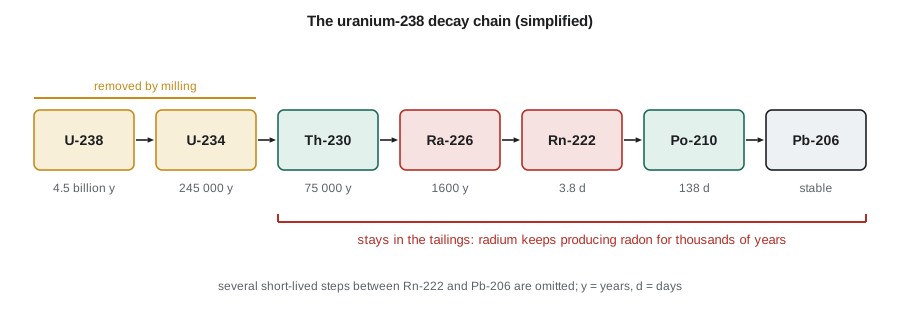
A uranium mill crushes and grinds the ore, then dissolves the uranium in an acid or alkaline leach. The uranium is separated from the leach solution by solvent extraction or ion exchange, precipitated, and dried and calcined to a concentrate called yellowcake, a mixture of uranium oxides usually reported as U₃O₈. The concentrate is packed in steel drums and shipped to a refinery. Almost everything else in the ore, more than 99 percent of the mass for conventional ores, remains as tailings: finely ground rock and process residue that still contains most of the original radioactivity, because the long decay chain of uranium-238 includes radium-226 and thorium-230, which are not removed with the uranium.
Tailings management is the main long-term environmental issue of conventional milling. The Uranium Mill Tailings Radiation Control Act of 1978 set up programs for the cleanup of abandoned mill sites and gave the NRC and the EPA authority over active and future sites, with requirements for covers that limit radon release and groundwater protection. The White Mesa mill in Utah is the only conventional uranium mill currently licensed in the United States. Legacy contamination on Navajo Nation lands, from mining in the mid-twentieth century, remains a major cleanup program for federal agencies.
Radiation protection in mines and mills
Uranium miners face three main radiation pathways: external gamma radiation from the ore, inhalation of radon progeny, and inhalation or ingestion of long-lived dust. Historically, radon was the most serious, and miners in the mid-twentieth century who worked in poorly ventilated mines had greatly increased rates of lung cancer. Modern mines control radon with high ventilation rates, sealing of exposed ore, and monitoring of the working level, a measure of the potential alpha energy of short-lived radon progeny in air. Dose limits for workers are the same as in other nuclear facilities, and typical modern doses in well-run mines are a small fraction of the limit.
Worked problem
Concentrate shipped from a mill
A mill processes 150 000 t of ore a year at an average grade of 1.5 percent uranium with 97 percent recovery. How much uranium, and how much U₃O₈, does it produce?
Show solution
- Uranium in ore: 150 000 t × 0.015 = 2250 t.
- Uranium recovered: 2250 × 0.97 = 2183 t.
- U₃O₈ is 1.179 times the uranium mass, so concentrate = 2183 × 1.179 = 2574 t, about 5.7 million pounds.
Answer: About 2200 metric tons of uranium, shipped as roughly 2600 metric tons of concentrate.
Environmental monitoring and closure
Every operating mine and mill runs an environmental monitoring program that samples air, surface water, groundwater, sediments, fish and vegetation around the site, and compares the results with predictions and with regulatory limits. The results are reported to regulators and, increasingly, published. Closure planning starts before the mine opens: the operator must describe how the site will be decommissioned, how tailings and waste rock will be stabilized, and how long monitoring will continue, and must post financial assurance large enough for the work to be done even if the company no longer exists. The aim is a site that can be released for other uses or left in a stable condition needing minimal care.
Engagement with nearby communities, including Indigenous communities whose traditional territory includes the mine sites, has become a central part of uranium mining. Agreements on employment, business opportunities, environmental monitoring and benefit sharing are now common, and communities increasingly take part in monitoring directly. These relationships matter to regulators as well as to operators, because trust in the monitoring results depends on the people who live nearby being able to see and question them.
Environmental assessment and closure of mines
A modern uranium mine is planned from the start with its closure in mind. Before a mine is licensed, an environmental assessment examines its effects on water, air, wildlife and people, including Indigenous communities whose lands and traditional uses may be affected. The operator must prepare a decommissioning plan and provide a financial guarantee large enough to pay for closure if the company cannot. During operation, the operator monitors water quality in nearby lakes and streams, radon and dust levels, and the radiation doses received by workers. After mining ends, pits are backfilled or flooded, buildings are removed, tailings are covered and the site is monitored until it can be returned to public use or placed under long-term institutional control.
In the United States, uranium mills and in-situ recovery facilities are licensed by the NRC or by Agreement States such as Texas, Colorado and Utah. Environmental reviews are carried out under the National Environmental Policy Act. After closure, mill tailings sites are transferred to the DOE's Office of Legacy Management, which looks after them in perpetuity, with funding from a charge paid by the licensee. In-situ recovery operators must restore groundwater in the wellfield to background or to an approved standard before the license is ended, a process that can take several years.
Worker protection in mines and mills
The main radiation risks for uranium miners are inhalation of radon progeny and of long-lived dust, together with external gamma radiation near high-grade ore. Early miners in the 1940s and 1950s worked in poorly ventilated mines and suffered high rates of lung cancer, which led to modern radiation protection standards for mining. Today, mines control radon with powerful ventilation systems, monitor every worker's exposure with personal dosimeters and air samplers, and use remote equipment for the richest ores. In the very high-grade deposits of the Athabasca Basin, ore is mined by methods in which no person enters the ore body: at Cigar Lake, the ground is frozen and the ore is cut by high-pressure water jets controlled from a distance, then pumped as a slurry to the surface.
As a result, average doses to uranium miners in North America are now a few millisieverts a year, well below the regulatory limit of 50 mSv in any one year and 100 mSv over five years for nuclear energy workers in Canada, and the corresponding occupational limits in the United States. Mill workers are protected from dust and from the yellowcake product, which is mainly a chemical rather than a radiological hazard, by enclosed processes, ventilation and protective equipment.
Worked problem
Ore throughput for a mill
A mill processes ore with an average grade of 1.5 % U₃O₈ and recovers 98 % of the uranium. How much ore must it process to produce 7000 t of U₃O₈ a year?
Show solution
- U₃O₈ in ore needed = 7000 ÷ 0.98 = 7143 t.
- Ore = 7143 ÷ 0.015 = 476 000 t.
Answer: About 476 000 t of ore a year, or about 1300 t a day. The same production from 0.1 % ore would need fifteen times as much.
Common mistakes
MistakeHigher-grade ore is easier to mine in every respect.
InsteadIt needs less rock moved, but its intense radioactivity requires remote mining, shielding and strict radon control.
MistakeMilling removes most of the radioactivity from the ore.
InsteadIt removes the uranium; most of the radioactivity in the decay chain stays with the tailings.
MistakeIn-situ recovery has no environmental effects.
InsteadIt avoids waste rock and tailings but needs groundwater monitoring and aquifer restoration.
Summary and key terms
- Ore grade varies by more than a thousand times and drives the economics and footprint of mining.
- Athabasca Basin deposits are very high grade and need remote and frozen-ground mining methods.
- In-situ recovery dissolves uranium underground and is common in Wyoming, Texas and Kazakhstan.
- Milling produces U₃O₈ concentrate and tailings that keep most of the decay-chain radioactivity.
- Radon progeny control is central to miner radiation protection.
- Grade
- The fraction of uranium in an ore.
- Yellowcake
- Uranium oxide concentrate produced by a mill, reported as U₃O₈.
- Tailings
- The ground rock and residues left after uranium is extracted from ore.
- In-situ recovery
- Dissolving uranium in place underground and pumping the solution to the surface.
- Radon progeny
- Short-lived decay products of radon that deliver most of the dose from radon.
- Unconformity deposit
- An ore body at the boundary between overlying sandstone and older basement rock.
Practice problems
Work each problem on paper first, then reveal the answer to check.
Why does milling leave most of the radioactivity in the tailings?
Show answer
Long-lived decay products such as thorium-230 and radium-226 are not removed with the uranium.
How much ore at 0.2 percent grade is needed per metric ton of uranium with 95 percent recovery?
Show answer
About 526 metric tons.
What keeps the leaching solution contained in in-situ recovery?
Show answer
Impermeable layers above and below the ore-bearing aquifer, confirmed by monitoring wells.
Why is the ground frozen at Cigar Lake?
Show answer
To keep water out of the workings and stabilize weak, water-saturated rock.
What is the mass ratio of U₃O₈ to the uranium it contains?
Show answer
About 1.18.
Lesson quiz · 5 questions
Score 60% or more to complete this lesson.
Create a free account to save your progress, take quizzes and earn a certificate.