
NUC-420 · Lesson 7 of 12 · 20 min
Reprocessing and recycling
A congressional staffer has asked Meridian for a short briefing on whether the United States should revisit recycling used fuel, an idea that resurfaces every few years with interest in advanced reactors. Amara hands Hana a folder of public reports from the World Nuclear Association, the OECD Nuclear Energy Agency, the DOE and the National Academies. "The country decided against commercial reprocessing in the 1970s and has never reversed that in practice," she says. "We need to understand why, and what has changed."
Open and closed fuel cycles
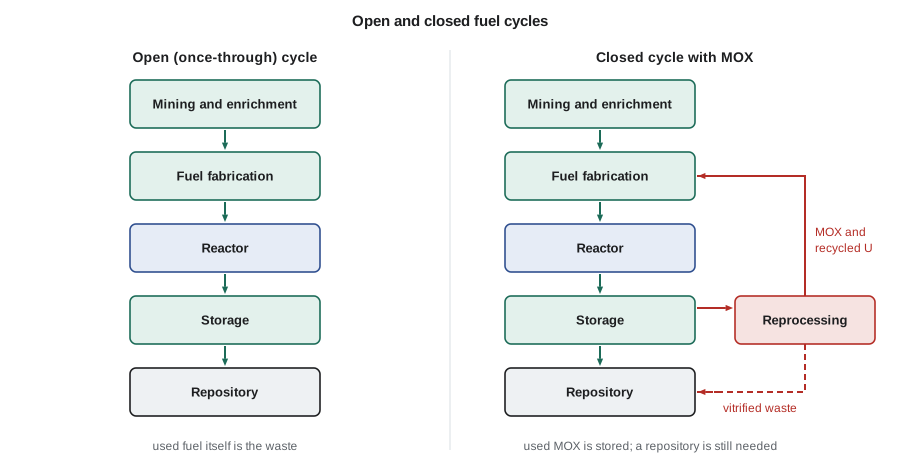
In an open, or once-through, fuel cycle, used fuel is stored and then disposed of directly in a repository. Canada, the United States, Finland and Sweden follow this policy. In a closed fuel cycle, used fuel is reprocessed to recover the uranium and plutonium it still contains, and these are recycled into new fuel, while the remaining fission products and minor actinides are immobilized as high-level waste. France has followed this policy for decades; the United Kingdom reprocessed for many years and has now stopped; Japan has built a reprocessing plant at Rokkasho; Russia and China operate or are building reprocessing facilities.
Recycling in today's reactors is partial. Recovered plutonium is made into mixed oxide (MOX) fuel and used once in light water reactors; the used MOX fuel is then stored, because recycling it again in thermal reactors gives diminishing returns. A fully closed cycle, in which plutonium and some of the minor actinides are recycled repeatedly, would need fast reactors, which are discussed in the advanced reactors course.
What reprocessing does
Used light water reactor fuel is about 95 % uranium, about 1 % plutonium, and about 4 % fission products and minor actinides, as lesson 5 described. Commercial reprocessing uses a solvent-extraction process called PUREX, short for plutonium uranium reduction extraction, to separate reusable uranium and plutonium from the rest. The process has been used on an industrial scale for more than half a century. At the level of a policy briefing, three points matter: the uranium and plutonium recovered can be made into new fuel; the remaining fission products and minor actinides are turned into glass for disposal; and the plant handles intensely radioactive material, so it operates remotely behind heavy shielding and under strict international safeguards.
The largest commercial plant is Orano's La Hague facility in Normandy, France, which reprocesses used fuel from French reactors. The recovered plutonium is made into MOX fuel at Orano's Melox plant. The United Kingdom's Sellafield site reprocessed fuel until 2022 and is now focused on cleanup. In the United States, a small commercial reprocessing plant operated at West Valley, New York, from 1966 to 1972; its cleanup, under a DOE demonstration project, has taken decades. A larger plant at Barnwell, South Carolina, was built but never operated.
The waste argument
Supporters of recycling argue that it reduces the volume and long-term radiotoxicity of the waste that must go to a repository. Vitrified high-level waste from reprocessing takes up much less volume than the used fuel it came from, and, because most of the plutonium has been removed, its long-term radiotoxicity falls faster. Critics answer that the reduction in the volume of high-level waste is partly offset by intermediate-level wastes from the plant itself, including the metal hulls and end fittings of the fuel, process wastes and decommissioning wastes; that the used MOX fuel still has to be stored or disposed of, and it produces more heat than ordinary used fuel; and that the size of a repository is set mainly by heat rather than volume.
# Waste volumes per terawatt-hour for an open and a recycling fuel cycle (illustrative public figures).
# The point is the relative size of the streams, not exact values.
twh = 1.0
open_cycle = {"spent fuel (packaged for disposal)": 2.5}
recycle = {"vitrified high-level waste": 0.35, "compacted hulls and end fittings": 0.5,
           "spent MOX (stored for later use or disposal)": 0.3}
print("cubic meters per TWh")
for name, v in open_cycle.items():
    print(f"  open cycle   {name:44s} {v*twh:4.2f}")
for name, v in recycle.items():
    print(f"  recycling    {name:44s} {v*twh:4.2f}")
saving = 1 - sum(recycle.values()) / sum(open_cycle.values())
print(f"high-level waste volume reduction with recycling: about {saving*100:.0f} %")
print("uranium savings from MOX and recycled uranium are commonly quoted at 10 to 25 %")cubic meters per TWh open cycle spent fuel (packaged for disposal) 2.50 recycling vitrified high-level waste 0.35 recycling compacted hulls and end fittings 0.50 recycling spent MOX (stored for later use or disposal) 0.30 high-level waste volume reduction with recycling: about 54 % uranium savings from MOX and recycled uranium are commonly quoted at 10 to 25 %
The output shows a large reduction in the volume of the most active waste, about half when the hulls and used MOX are included, but not an elimination of the need for a repository. Studies by the OECD Nuclear Energy Agency and others have found that recycling in light water reactors alone gives modest benefits for repository size, because the fission products that dominate heat in the first centuries are still there. Larger reductions in heat and radiotoxicity need repeated recycling of plutonium and minor actinides in fast reactors, which is the subject of continued research rather than current commercial practice.
The resource argument
Recycling also recovers energy. Recovered plutonium in MOX fuel and recycled uranium re-enriched for further use can replace a share of the natural uranium a reactor fleet needs. Public estimates commonly quote savings of 10 to 25 % of the uranium requirement. Whether this is worth the cost depends on uranium prices. When uranium is cheap, as it has been for most of the past four decades, the cost of reprocessing and MOX fabrication is higher than the cost of the uranium saved, so the once-through cycle is cheaper. Studies by MIT, the OECD and others have concluded that, at current and projected uranium prices, the open cycle is likely to remain the lower-cost option for some time.
| Factor | Open cycle | Closed cycle with MOX |
|---|---|---|
| Uranium use | baseline | about 10 to 25 % lower |
| Cost | lower at current uranium prices | higher; adds reprocessing and MOX fabrication |
| High-level waste volume | used fuel itself | smaller volume of vitrified glass |
| Other wastes | few | intermediate-level wastes from reprocessing |
| Separated plutonium | none | present in the fuel cycle; needs strict safeguards |
| Repository needed | yes | yes |
The proliferation argument
The most important objection to reprocessing is that it separates plutonium from the highly radioactive fission products that otherwise make used fuel hard to handle. Although plutonium from commercial used fuel is not well suited to weapons, separated plutonium of any kind is treated by the IAEA as direct-use material and must be protected and safeguarded to the highest standard. Stocks of separated civil plutonium in several countries are large, and their security and safeguarding is a continuing international concern. Lesson 12 describes the safeguards system.
In 1977, President Carter deferred commercial reprocessing in the United States indefinitely, mainly because of proliferation concerns after India's 1974 nuclear test, which had used plutonium from a research reactor. President Reagan lifted the ban in 1981, but no company was willing to invest in reprocessing without government support, and the open cycle has remained the de facto policy. A plan to use surplus weapons plutonium as MOX fuel led to the construction of a MOX fuel fabrication facility at the Savannah River Site, but the DOE terminated the project in 2018 because of cost overruns; the department is now pursuing dilution and disposal of that plutonium at the Waste Isolation Pilot Plant instead.
Recent developments
Interest in recycling has returned with advanced reactor designs. Some proposed reactors would use fuels made from recycled used fuel, and some developers have proposed processes that do not separate pure plutonium. Several companies have announced plans for US recycling facilities, and the DOE has funded research on advanced separations and waste forms. Any commercial facility would need an NRC license, and its economics and safeguards would face close scrutiny from Congress and the public.
Worked problem
Effect of a uranium price on the value of recycling
Suppose recycling saves 20 % of the natural uranium a reactor needs. If the reactor uses 180 t of natural uranium a year and uranium costs 200 dollars per kilogram, how much is the uranium saving worth each year?
Show solution
- Uranium saved = 0.20 × 180 t = 36 t = 36 000 kg.
- Value = 36 000 × 200 = 7.2 million dollars a year.
Answer: About 7.2 million dollars a year. If the extra cost of reprocessing and MOX fabrication is larger than this, recycling costs more than the open cycle at that uranium price.
Vitrified waste
The high-level waste from reprocessing contains most of the fission products and minor actinides from the used fuel. It is turned into glass, a process called vitrification, by mixing it with glass-forming materials and melting the mixture at high temperature. The molten glass is poured into stainless steel canisters, where it solidifies, and the canisters are sealed by welding. Borosilicate glass is used because it can hold a wide range of elements in its structure and dissolves very slowly in water. Each standard canister from La Hague holds about 400 kg of glass and is about 1.3 m tall. The canisters are stored in ventilated vaults to cool for several decades before disposal.
Vitrification is also used for defense waste. In the United States, the Defense Waste Processing Facility at the Savannah River Site has vitrified high-level waste since 1996, and the Waste Treatment and Immobilization Plant at Hanford has started up a facility to vitrify low-activity tank waste. These programs show that the technology is mature, though large and costly, and that the waste form is suitable for geological disposal.
Comparing studies of fuel cycle options
Many national and international studies have compared fuel cycle options. Their conclusions are broadly consistent. Direct disposal of used fuel in a geological repository is technically feasible and safe, and is currently the least expensive option. Recycling in thermal reactors reduces the use of uranium and the volume of high-level waste, but costs more and adds separated plutonium to the cycle. Multi-recycling in fast reactors could greatly increase the energy obtained from uranium and reduce long-term radiotoxicity, but would need a large fleet of fast reactors and reprocessing plants, decades of development and strong safeguards. None of the options removes the need for a repository.
For the United States, studies by MIT, the National Academies and the DOE's advisory committees have generally concluded that there is no urgent need to choose a closed fuel cycle, and that a repository is needed in any case. Advocates of recycling argue that advanced reactors and new separation technologies change the balance; critics point to the cost and proliferation risks of earlier programs. The policy question is likely to return as advanced reactor deployment grows.
| Option | Uranium use | Repository needs | Main challenges |
|---|---|---|---|
| Direct disposal | baseline | used fuel; heat-limited repository | repository siting |
| Single recycling as MOX | 10 to 25 % lower | vitrified waste plus used MOX | cost, separated plutonium |
| Multi-recycling in fast reactors | much lower | smaller long-term radiotoxicity | cost, technology readiness, safeguards |
Thorium and other alternative cycles
Some proposals for closed cycles use thorium rather than uranium. Thorium-232 is not fissile, but it absorbs neutrons to form uranium-233, which is. Thorium is about three times as abundant as uranium in the Earth's crust, and India, which has large thorium reserves and limited uranium, has made a three-stage program based on thorium a long-term national goal. Thorium cycles produce much less plutonium and fewer minor actinides, but they need fissile material to start, they produce uranium-233, which must itself be safeguarded, and they need reprocessing to recover the uranium-233 for reuse. CANDU reactors, with their high neutron economy, have been studied as thorium burners, and AECL and international partners carried out research on thorium fuels over several decades.
For now, these alternative cycles remain topics of research and development rather than commercial practice. They illustrate an important point for policy: the choice of fuel cycle is not only a technical one but also an economic, environmental and security decision, made by governments over decades with input from industry, regulators and the public.
Common mistakes
MistakeReprocessing eliminates the need for a repository.
InsteadVitrified high-level waste and other long-lived wastes still need geological disposal.
MistakeAll the used fuel is recycled indefinitely.
InsteadIn light water reactors, MOX is normally used once; the used MOX is stored.
MistakeReprocessing is always cheaper because it saves uranium.
InsteadAt current uranium prices the open cycle is usually cheaper.
Summary and key terms
- Canada and the United States follow an open fuel cycle; France reprocesses and makes MOX fuel.
- PUREX is a solvent-extraction process used commercially, for example at La Hague, to separate reusable uranium and plutonium.
- Recycling reduces the volume of high-level waste and saves some uranium, but adds other wastes and costs.
- Separated plutonium raises proliferation and security concerns and needs strict safeguards.
- A repository is still needed with or without recycling.
- Open fuel cycle
- Used fuel is disposed of directly without reprocessing.
- Closed fuel cycle
- Used fuel is reprocessed and the recovered material recycled.
- Reprocessing
- Chemical separation of reusable uranium and plutonium from used fuel.
- PUREX
- The solvent-extraction process used in commercial reprocessing.
- MOX fuel
- Mixed oxide fuel containing plutonium and uranium oxides.
- Vitrification
- Turning high-level liquid waste into a stable glass.
Practice problems
Work each problem on paper first, then reveal the answer to check.
Name the two materials recovered for reuse in commercial reprocessing.
Show answer
Uranium and plutonium.
Why does recycling in light water reactors give only modest repository benefits?
Show answer
Fission products that dominate early heat remain, and used MOX must still be stored or disposed of.
What is the main non-proliferation concern with reprocessing?
Show answer
It separates plutonium from the fission products that otherwise protect it.
If recycling saves 15 % of 200 t of uranium a year at 150 dollars per kilogram, what is the saving?
Show answer
30 t × 150 dollars per kg = 4.5 million dollars a year.
Why might advanced reactors renew interest in recycling?
Show answer
Some designs could use recycled material and burn long-lived actinides.
Lesson quiz · 5 questions
Score 60% or more to complete this lesson.
Create a free account to save your progress, take quizzes and earn a certificate.