
NUC-420 · Lesson 9 of 12 · 24 min
Low- and intermediate-level waste
Amara takes Hana to see where the plant's low-level waste goes. In the radwaste building, bags of protective clothing are sorted, compacted into drums and loaded into a shipping container bound for a processor in Tennessee and then a disposal site in Utah. "Most of what we handle is like this," Amara says. "Very little activity, a lot of volume. The craft is in reducing the volume, packaging it properly and knowing exactly what is in each package."
Where the waste comes from
Nuclear power plants produce low- and intermediate-level waste during normal operation and maintenance, and in much larger amounts during refurbishment and decommissioning. Operational wastes include protective clothing, rags, tools and plastic sheeting; filters and ion-exchange resins that clean the reactor coolant, moderator and pool water; and contaminated equipment. Refurbishment and decommissioning add activated components such as pressure tubes, calandria tubes, reactor vessel internals and steam generators, as well as large volumes of slightly contaminated concrete and metal. Hospitals, universities, research laboratories and industry produce smaller amounts.
Activation and contamination are the two ways material becomes radioactive. Activation happens when neutrons are absorbed by stable nuclei in reactor components, turning, for example, cobalt-59 in steel into cobalt-60. Contamination happens when radioactive material from the coolant or fuel is deposited on a surface. Contamination can often be removed by cleaning; activation is in the material itself and cannot.
Treatment and conditioning
Treatment reduces the volume of waste or changes it into a more suitable form; conditioning puts it into a stable form inside a container suitable for storage and disposal. Common treatment methods include compaction, in which dry waste is pressed into drums or the drums themselves are crushed by a supercompactor; incineration, which can reduce the volume of combustible waste by a factor of 50 or more, leaving ash to be conditioned; and decontamination of metals, which can allow them to be melted and recycled. Conditioning methods include cementation, in which resins, sludges or ash are mixed with cement, and drying or polymer encapsulation of resins.
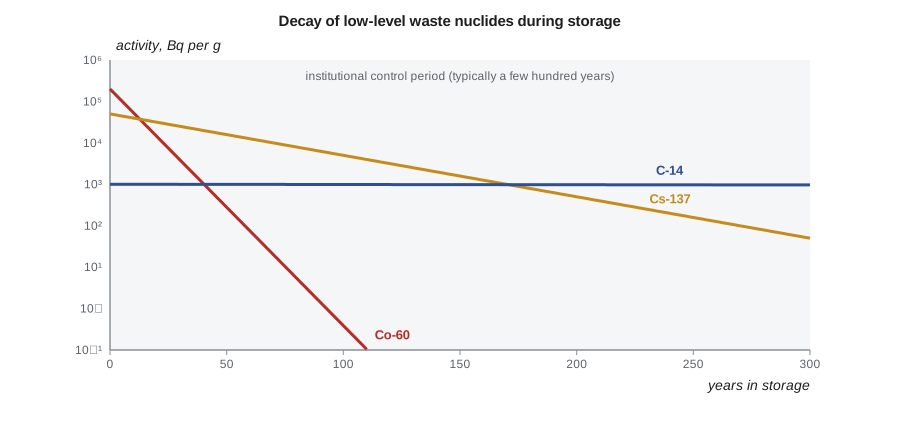
# Low-level waste: decay of short-lived nuclides during storage and the effect of compaction.
import math
nuclides = [("Co-60", 5.27, 2.0e5), ("Cs-137", 30.1, 5.0e4), ("C-14", 5700.0, 1.0e3)]   # half-life y, Bq/g
for years in (0, 10, 50, 100):
    tot = 0.0; parts = []
    for n, hl, a0 in nuclides:
        a = a0 * math.exp(-math.log(2) * years / hl); tot += a; parts.append(f"{n} {a:9.2e}")
    print(f"after {years:3d} y: " + "  ".join(parts) + f"   total {tot:9.2e} Bq/g")
drums, factor = 1000, 5.0
print(f"compacting {drums} drums at a volume reduction factor of {factor:.0f} leaves the volume of {drums/factor:.0f} drums")after 0 y: Co-60 2.00e+05 Cs-137 5.00e+04 C-14 1.00e+03 total 2.51e+05 Bq/g after 10 y: Co-60 5.37e+04 Cs-137 3.97e+04 C-14 9.99e+02 total 9.44e+04 Bq/g after 50 y: Co-60 2.79e+02 Cs-137 1.58e+04 C-14 9.94e+02 total 1.71e+04 Bq/g after 100 y: Co-60 3.88e-01 Cs-137 5.00e+03 C-14 9.88e+02 total 5.99e+03 Bq/g compacting 1000 drums at a volume reduction factor of 5 leaves the volume of 200 drums
The output shows that cobalt-60, with a half-life of 5.3 years, decays by more than a factor of 700 in 50 years and essentially disappears in a century, while cesium-137 falls only by a factor of three in 50 years and carbon-14 hardly changes. This is the logic of near-surface disposal: the short-lived nuclides that dominate the early activity decay within the few hundred years of institutional control the site is designed for, but long-lived nuclides such as carbon-14 must be limited in the waste accepted. The compaction line shows how volume reduction lowers storage and disposal costs.
Storage and disposal
In the United States, commercial low-level waste is disposed of in near-surface facilities licensed by the NRC or by Agreement States that have taken on that role. Four sites accept waste: Barnwell, South Carolina; Clive, Utah, operated by EnergySolutions; Richland, Washington, operated by US Ecology; and Waste Control Specialists in Andrews County, Texas. Access depends on the regional compact a generator belongs to. Waste processors in Tennessee and elsewhere compact, incinerate, melt and package waste before disposal. Greater-than-Class C waste has no disposal site yet; the DOE has studied options including WIPP and borehole or near-surface designs.
The Waste Isolation Pilot Plant, near Carlsbad, New Mexico, is the country's only deep geological repository. It disposes of defense transuranic waste in rooms mined in a salt formation about 650 m below ground. It began operating in 1999, was closed from 2014 to 2017 after a drum of waste reacted and released a small amount of radioactive material, and has since resumed operations under improved safety and ventilation arrangements. Its operating record shows that a geological repository can be licensed, built and run, though its waste is not used fuel.
| Method | Applies to | Effect |
|---|---|---|
| Compaction and supercompaction | dry solid waste | volume reduction by a factor of 3 to 10 |
| Incineration | combustible waste, some resins | volume reduction by 50 or more; ash is conditioned |
| Metal melting | contaminated steel | recycling of most metal, small slag volume |
| Cementation | resins, sludges, ash | stable solid waste form |
| Decay storage | short-lived waste | activity falls before clearance or disposal |
| Near-surface disposal | low-level waste | isolation for several hundred years |
| Intermediate-depth or deep disposal | intermediate-level waste | isolation for long-lived nuclides |
Decommissioning waste
Decommissioning a power reactor produces large volumes of waste, most of it very low-level or low-level. Activated components near the core, such as reactor vessel internals or, in a CANDU, pressure tubes and calandria tubes, are the main intermediate-level wastes. Careful characterization, segmentation and sorting are essential, because the cost of disposing of slightly radioactive concrete as low-level waste is far higher than recycling or disposing of it as cleared material if it meets clearance levels.
Many US plants have been decommissioned, including Maine Yankee, Connecticut Yankee, Trojan, Rancho Seco and Zion, giving industry experience in handling large volumes of decommissioning waste. Several decommissioning companies now buy shut-down plants and their decommissioning funds and carry out the work.
Worked problem
Volume saved by incineration
A station produces 300 m³ of combustible low-level waste a year. Incineration reduces it by a factor of 60. What volume of ash is left?
Show solution
- Ash volume = 300 ÷ 60 = 5 m³ a year.
Answer: About 5 m³ of ash, which is then conditioned and stored. The volume saving is 295 m³ a year.
Packaging and storage of intermediate-level waste
Intermediate-level waste needs shielding, so it is stored in thick concrete or steel containers, in in-ground structures or in shielded buildings. Activated components removed during refurbishment, such as CANDU pressure tubes and calandria tubes, are cut into sections, placed in shielded containers and transferred by remote handling. Ion-exchange resins with high activity are stored in tanks or dewatered into high-integrity containers. Because these wastes contain long-lived nuclides such as carbon-14, chlorine-36 and nickel-59, they must eventually go to a facility deeper than a near-surface trench.
US plants package Class B and C wastes, such as high-activity resins and filters, in high-integrity containers that meet the stability requirement, and ship them to licensed disposal sites, mainly the Waste Control Specialists site in Texas, which accepts Classes A, B and C from compact states and others. Greater-than-Class C waste, such as activated reactor internals cut up during decommissioning, is stored at the plant sites, often in dry storage casks alongside the used fuel, until a disposal route is available.
Design of near-surface facilities
A modern near-surface disposal facility is far more than a trench in the ground. It is an engineered structure with several barriers: a durable waste package, cement or grout filling the spaces between packages, a concrete vault or a carefully designed cell with a low-permeability liner, a drainage system to collect any water that enters during operation, and a multi-layer cover that sheds rainwater, resists erosion and deters intrusion by plants, animals or people. Monitoring wells around the site check that nothing leaks into groundwater. After closure, the site is kept under institutional control, typically for 100 to 300 years, during which access is restricted and monitoring continues.
The safety assessment of a near-surface facility considers both expected evolution, such as slow degradation of the cover and concrete, and less likely events, such as a person drilling a well or building a house on the site after institutional control ends. Inventory limits for long-lived nuclides are set so that even such an intrusion would not cause unacceptable doses. Examples of well-regarded facilities include El Cabril in Spain, the Center de l'Aube in France and the Vaalputs facility in South Africa.
Repositories for intermediate-level waste
Several countries already operate repositories for low- and intermediate-level waste at depth. Sweden's SFR facility at Forsmark, operating since 1988, lies about 60 m under the Baltic Sea floor in crystalline rock and is being extended. Finland has operated similar repositories at Olkiluoto and Loviisa since the 1990s. Hungary operates the Bátaapáti repository in granite. Germany is converting the former Konrad iron mine into a repository for low- and intermediate-level waste. These facilities demonstrate the technology for disposing of intermediate-level waste at depths from tens to hundreds of meters.
| Facility | Country | Type | Depth |
|---|---|---|---|
| SFR, Forsmark | Sweden | rock caverns under the sea floor | about 60 m |
| VLJ repositories, Olkiluoto and Loviisa | Finland | rock silos and caverns | about 60 to 110 m |
| El Cabril | Spain | engineered near-surface vaults | surface |
| Center de l'Aube | France | engineered near-surface vaults | surface |
| WIPP | United States | rooms in bedded salt, transuranic waste | about 650 m |
Worked problem
Volume of refurbishment waste
A CANDU unit has 480 fuel channels. If each pressure tube and calandria tube pair, after cutting, fills 0.05 m³ of packaged volume, what packaged volume of these components does one unit's refurbishment produce?
Show solution
- Volume = 480 × 0.05 = 24 m³.
Answer: About 24 m³ of packaged intermediate-level waste from these components per unit, small in volume but highly activated, needing shielded containers.
Records and knowledge management
Waste management lasts for generations, so records are essential. For each package, the generator records its origin, contents, nuclide inventory, dose rate, treatment, container type and storage location. These records support acceptance at disposal facilities, safety assessments and inspections, and must be kept long after the people who created them have retired. Modern waste tracking systems use bar codes or radio-frequency tags on each package and databases that link to measurement data. For historic waste with poor records, characterization campaigns may be needed to rebuild the inventory before the waste can be disposed of, which is one of the main costs of legacy cleanup programs.
Knowledge management goes beyond records. Waste organizations must keep the skills and understanding needed to manage waste over decades, through training, documentation of the reasons for decisions and links with universities and research centers. International bodies such as the IAEA and the OECD Nuclear Energy Agency run programs on preserving records and knowledge across generations, including for the very long periods after a repository is closed.
Costs of low- and intermediate-level waste management
The cost of managing low-level waste depends strongly on its volume, which is why volume reduction pays. Disposal charges at commercial sites are quoted per cubic meter or per cubic foot, with surcharges for higher activity, so compaction, incineration and segregation of clean material can save large sums. Intermediate-level waste is far more expensive per unit volume, because of the shielding, remote handling and deeper disposal it needs, but its volume is much smaller. Over the life of a power station, including decommissioning, these costs are a small but important part of the total cost of electricity, and they are included in the decommissioning and waste funds that operators must maintain.
Worked problem
Savings from segregation
A decommissioning project has 5000 m³ of concrete. Characterization shows that 80 % of it meets clearance levels. Disposal as low-level waste costs 3000 dollars per cubic meter; cleared concrete costs 100 dollars per cubic meter to dispose of conventionally. What is the saving from segregation?
Show solution
- Without segregation: 5000 × 3000 = 15 million dollars.
- With segregation: 1000 × 3000 + 4000 × 100 = 3.0 + 0.4 = 3.4 million dollars.
- Saving = 15 − 3.4 = 11.6 million dollars.
Answer: About 11.6 million dollars, less the cost of the characterization needed to show that the cleared concrete meets the criteria.
Common mistakes
MistakeAll low-level waste must be kept for thousands of years.
InsteadMuch of its activity is short-lived and decays within decades; long-lived content is limited.
MistakeActivated steel can be decontaminated by washing.
InsteadActivation is inside the material; only surface contamination can be removed.
MistakeDecommissioning waste is mostly high-level.
InsteadMost of it is very low-level or low-level by volume.
Summary and key terms
- Low- and intermediate-level waste comes from operation, maintenance, refurbishment and decommissioning, as well as medicine and industry.
- Activation creates radioactivity inside material; contamination is on surfaces.
- Compaction, incineration, melting and cementation reduce volume and stabilize the waste.
- Near-surface facilities isolate short-lived waste; intermediate-level waste needs greater depth.
- Characterization and sorting greatly reduce decommissioning costs.
- Activation
- Production of radioactivity by neutron absorption in a material.
- Contamination
- Radioactive material deposited on surfaces.
- Conditioning
- Putting waste into a stable form in a suitable container.
- Supercompactor
- A high-force press that crushes waste drums to reduce volume.
- Near-surface disposal
- Disposal in engineered facilities at or just below ground level.
- Institutional control
- The period during which a disposal site is monitored and access restricted.
Practice problems
Work each problem on paper first, then reveal the answer to check.
Give two sources of intermediate-level waste at a power reactor.
Show answer
Activated core components such as pressure tubes, and some spent ion-exchange resins or filters.
What is the difference between activation and contamination?
Show answer
Activation is radioactivity created inside a material by neutrons; contamination is radioactive material on surfaces.
By what factor does Co-60 decay in 26.35 years (five half-lives)?
Show answer
2⁵ = 32.
Why must carbon-14 be limited in near-surface disposal?
Show answer
Its 5700-year half-life is far longer than the period of institutional control.
Name one treatment method and its typical volume reduction.
Show answer
Incineration, about 50 or more; or compaction, about 3 to 10.
Lesson quiz · 5 questions
Score 60% or more to complete this lesson.
Create a free account to save your progress, take quizzes and earn a certificate.