
NUC-420 · Lesson 1 of 12 · 21 min
The fuel cycle
Hana Okoye's last placement at Meridian Nuclear Engineering is with a small group that most new engineers never think about: the fuel cycle and waste team. Its lead, Dr. Amara Nwosu, worked for years on the Department of Energy's used fuel program before joining Meridian. On Hana's first morning Amara spreads a map on the table and puts pins at a uranium recovery site in Wyoming, a conversion plant in Illinois, an enrichment plant in New Mexico, a fuel factory in South Carolina, a TVA plant on the Tennessee River and a dry storage pad beside it. "A reactor is the middle of a very long story," she says. "Uranium is mined, turned into fuel, burned for a few years, and then cooled and stored for decades while the country decides where it will finally go. This course is that whole story."
What the fuel cycle is
The nuclear fuel cycle is the chain of industrial steps that takes uranium from the ground, makes it into fuel, uses it in a reactor and manages what is left. Engineers divide it into three parts. The front end covers everything before the fuel enters the reactor: exploration, mining, milling, conversion, enrichment where it is needed, and fuel fabrication. The service period is the time the fuel spends in the reactor producing heat. The back end covers everything afterwards: cooling in pools, interim storage, transport, recycling in countries that do it, and final disposal. Each step is a separate business, often in a different country, and each has its own regulator, its own hazards and its own costs.
Two broad strategies exist for the back end. In an open or once-through cycle, used fuel is treated as waste after one pass through a reactor and is eventually placed in a deep geological repository. Canada and the United States both follow this approach today. In a closed or partly closed cycle, used fuel is recycled: the uranium and plutonium that remain are recovered and some of it is made into new fuel, while the remaining fission products are made into a stable glass for disposal. France has done this on an industrial scale for decades. Both strategies still need a repository; recycling changes the volume, heat and long-term character of what goes into it, as lesson 7 explains.
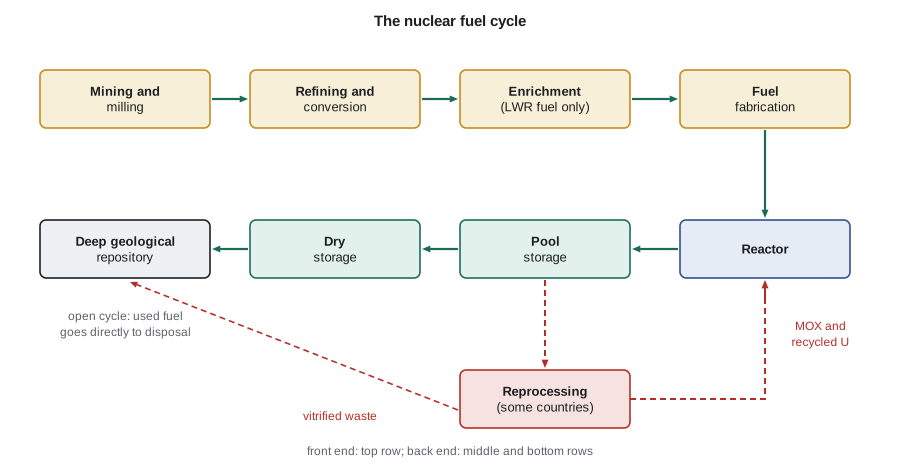
Why the front end looks different for CANDU and light water reactors
Light water reactors, the type used throughout the US fleet, need fuel enriched to roughly three to five percent uranium-235, because ordinary water absorbs too many neutrons for natural uranium to sustain a chain reaction. The US front end therefore includes an extra step: conversion of uranium to uranium hexafluoride and enrichment in a commercial plant. Enriched fuel costs more per kilogram but stays in the reactor much longer and produces far more energy per kilogram, so the mass of used fuel per unit of electricity is several times smaller than for a natural uranium reactor. Canada's CANDU reactors make the opposite trade, and comparing the two is a good way to see how fuel cycle choices interact.
| Stage | CANDU (natural uranium) | Light water reactor (enriched) |
|---|---|---|
| Mining and milling | yes | yes |
| Conversion | to uranium dioxide powder | to uranium hexafluoride for enrichment |
| Enrichment | not needed | to about 3 to 5 percent uranium-235 |
| Fabrication | 37-element bundles, about 19 kg uranium each | assemblies, about 0.4 to 0.5 t uranium each |
| Discharge burnup | about 7 to 8 GWd per metric ton | about 45 to 60 GWd per metric ton |
| Refueling | on power, a few bundles a day | every 18 to 24 months, a third of the core |
# Mass flow through a once-through fuel cycle for one gigawatt-year of electricity.
# All values are rounded, illustrative figures for teaching.
GWe_year_MWh = 1000 * 8760 * 0.90        # 1000 MWe at a 90 % capacity factor
eff = 0.33                               # thermal efficiency
thermal_MWd = GWe_year_MWh / eff / 24    # megawatt-days of heat
for name, burnup, assay in [("LWR, low-enriched fuel", 50000, "about 4.5 %"),
                            ("CANDU, natural uranium", 7500, "0.71 %")]:
    heavy_metal_t = thermal_MWd / burnup   # burnup in MWd per metric ton of uranium
    print(f"{name:26s} fuel assay {assay:11s} fuel used {heavy_metal_t:6.1f} t U per year")
print(f"electricity produced: {GWe_year_MWh/1e6:.2f} TWh")
print("natural uranium needed for the LWR fuel is roughly 8 to 9 times the fuel mass")
print("the CANDU uses natural uranium directly, so its fuel mass and ore mass are the same")LWR, low-enriched fuel fuel assay about 4.5 % fuel used 19.9 t U per year CANDU, natural uranium fuel assay 0.71 % fuel used 132.7 t U per year electricity produced: 7.88 TWh natural uranium needed for the LWR fuel is roughly 8 to 9 times the fuel mass the CANDU uses natural uranium directly, so its fuel mass and ore mass are the same
The program shows the main consequence of burnup. A one-gigawatt light water reactor uses about twenty metric tons of fuel uranium a year, but that fuel needed eight or nine times as much natural uranium to make, because most of the uranium-235 went into the product and the rest left as depleted uranium tails. A CANDU of the same output uses more than six times as much fuel, but all of it is natural uranium, so the mass of uranium mined is similar. The fuel cycle trade-offs show up in different places: more enrichment work in one case, more used fuel bundles in the other.
Mass balance thinking
A good habit for fuel cycle work is to follow the mass of heavy metal through every step. Heavy metal here means uranium and any heavier elements formed in the reactor. A kilogram of uranium in the ore becomes slightly less than a kilogram in the mill concentrate, because recovery is not perfect. Conversion and fabrication lose very little. In the reactor, only a few percent of the heavy metal is actually fissioned; the rest comes out still as uranium, with small amounts of plutonium and other heavy elements and a few percent of fission products. A mass balance therefore shows that used fuel is still mostly uranium, which is why some countries regard it as a resource rather than waste.
The equation is the simplest and most useful relationship in the whole cycle. Thermal energy is set by the reactor's power and capacity factor. Burnup, the energy extracted per metric ton of heavy metal, is set by the fuel design and the reactor type. Doubling the burnup halves the mass of fuel that must be made and the mass of used fuel that must be stored, though each metric ton of high-burnup used fuel is hotter and more radioactive. Much of the engineering of the back end is about this trade between fewer, hotter fuel units and more, cooler ones.
Worked problem
Fuel use for a natural uranium unit
A CANDU unit produces 880 MW of electricity at a capacity factor of 0.85 and a thermal efficiency of 0.30. Its fuel reaches 7.5 GWd per metric ton of uranium. Estimate the uranium used per year and the number of bundles, taking 19.2 kg of uranium per bundle.
Show solution
- Electrical energy: 880 MW × 8760 h × 0.85 = 6.55 × 10⁶ MWh.
- Thermal energy: 6.55 × 10⁶ / 0.30 = 2.18 × 10⁷ MWh = 9.10 × 10⁵ MWd.
- Uranium used: 9.10 × 10⁵ MWd ÷ 7500 MWd per metric ton = 121 t.
- Bundles: 121 000 kg ÷ 19.2 kg = about 6300 bundles per year.
Answer: About 120 metric tons of uranium, or roughly 6000 bundles, per year for one unit; a four-unit station discharges more than 20 000 bundles a year.
Economics and the fuel cycle
Fuel is a small part of the cost of nuclear electricity compared with coal or gas. The capital cost of the plant dominates, and the fuel cycle, front end and back end together, typically adds only a modest share. That share matters in practice, though, because it is paid every year for the life of the plant and because some back-end costs fall decades after the electricity was sold. To keep that fair, both countries require utilities to set aside money for future used fuel management and decommissioning while the plant is running. Lesson 11 describes how each country does this.
In the United States, the Nuclear Waste Policy Act of 1982 made the federal government responsible for disposing of commercial used fuel and created the Nuclear Waste Fund, paid for by a fee of one tenth of a cent per kilowatt-hour on nuclear electricity. The fee was suspended in 2014 after a court ruled that the government was not using the money for its intended purpose. Utilities also maintain decommissioning trust funds under NRC rules.
Hazards across the cycle
The kinds of hazard change along the cycle. At the mine and mill, the main concerns are conventional mining safety, radon gas, dust and the long-term management of tailings. Conversion and enrichment plants handle chemically hazardous materials, notably uranium hexafluoride, which releases toxic hydrogen fluoride if it escapes and reacts with moist air. Fresh fuel is only mildly radioactive and can be handled with gloves. Used fuel is intensely radioactive and hot, and must be shielded and cooled for decades. Repository safety is about very slow processes over very long times. A fuel cycle engineer needs to understand all of these, because decisions at one step change the hazards at others.
Security and non-proliferation run through the whole cycle as well. Enrichment and reprocessing are the two steps that, in principle, could be misused to produce material for weapons, which is why they are tightly controlled internationally and why both Canada and the United States, as parties to the Treaty on the Non-Proliferation of Nuclear Weapons, place all their civilian nuclear material under International Atomic Energy Agency safeguards. Lesson 12 describes how those safeguards work. In this course the technical treatment of those steps stays at the level of what the public reports of the IAEA and national agencies describe.
Time scales across the cycle
One of the most distinctive features of the nuclear fuel cycle is the range of time scales it spans. Buying fuel for a reactor begins about two years before it is loaded: uranium must be bought, converted, enriched where needed and fabricated, and each step has its own lead time and contracts. The fuel then spends one to two years in a CANDU core or four to six years in a light water reactor core. After discharge it spends a decade or more in a pool and then several decades in dry storage. Disposal in a repository may begin half a century or more after the fuel left the reactor, and the repository must then isolate it for hundreds of thousands of years. Few other industries plan across so many generations at once.
These long time scales affect almost every decision. A utility signing a uranium contract is thinking about the next five to ten years; a regulator licensing a dry storage facility is thinking about the next forty to eighty; a repository designer is thinking about the next ice age. The financial arrangements must also span generations, so that the people who benefit from nuclear electricity today pay for managing its waste in the future. This is why both countries require funds to be set aside from electricity revenues, as described earlier in this lesson.
| Stage | Typical duration |
|---|---|
| Procurement and fabrication before loading | about 2 years |
| Residence in the core | about 4 to 6 years |
| Pool storage | about 6 to 10 years or more |
| Dry storage before disposal | several decades |
| Repository operation | several decades to a century |
| Isolation after closure | hundreds of thousands of years |
The environmental footprint of the cycle
Life-cycle assessments, which add up the emissions and resource use of every stage from mining to disposal, show that nuclear electricity has one of the lowest carbon footprints of any source. Studies reviewed by the Intergovernmental Panel on Climate Change and by the United Nations Economic Commission for Europe give values of roughly 5 to 15 grams of carbon dioxide equivalent per kilowatt-hour, similar to wind and lower than solar photovoltaics, and far below coal at about 800 to 1000 grams. Most of the nuclear figure comes from mining, milling, enrichment and plant construction. Enrichment by gas centrifuge uses much less electricity than the older gaseous diffusion process, which has reduced the footprint of light water reactor fuel considerably. CANDU fuel avoids enrichment altogether.
The land used by the fuel cycle is also small for the energy produced, and the volume of high-level waste is small: all the used fuel ever produced in Canada would fit into a space about the size of seven hockey rinks stacked to the height of the boards. The challenge of the back end is therefore not the quantity of waste but its long-lived hazard, which is why the rest of this course devotes so much attention to storage, disposal and the institutions that manage them.
Common mistakes
MistakeUsed fuel is mostly fission products.
InsteadBy mass it is still about 95 percent uranium; fission products and heavier elements make up only a few percent.
MistakeRecycling removes the need for a repository.
InsteadRecycling changes the volume and heat of the waste but high-level waste still needs geological disposal.
MistakeCANDU fuel uses less uranium because it is not enriched.
InsteadIt uses more fuel mass per unit of energy; the mined uranium is similar because enrichment discards most of the feed as tails.
Summary and key terms
- The fuel cycle has a front end, a service period and a back end.
- Open cycles dispose of used fuel; closed cycles recycle part of it.
- CANDU reactors use natural uranium; light water reactors need enriched fuel.
- Fuel mass per year equals thermal energy divided by burnup.
- Both countries require utilities to fund future waste management while plants operate.
- Front end
- The steps from mining to fuel fabrication.
- Back end
- The steps after fuel leaves the reactor: storage, transport, recycling and disposal.
- Burnup
- The thermal energy extracted per unit mass of heavy metal, often in GWd per metric ton.
- Open cycle
- A fuel cycle in which used fuel is disposed of after one use.
- Heavy metal
- Uranium and heavier elements in fuel, used as the basis for mass accounting.
- Tails
- Depleted uranium left over after enrichment.
Practice problems
Work each problem on paper first, then reveal the answer to check.
Name the three parts of the fuel cycle.
Show answer
The front end, the service period in the reactor and the back end.
Why does a CANDU reactor not need enriched fuel?
Show answer
Its heavy water moderator absorbs few neutrons, so natural uranium can sustain the chain reaction.
A reactor produces 9 × 10⁵ MWd of heat a year with fuel at 45 000 MWd per metric ton. How much fuel does it use?
Show answer
20 metric tons of heavy metal per year.
What fraction of used fuel mass is still uranium?
Show answer
Roughly 95 percent.
Which two fuel cycle steps are most sensitive for non-proliferation?
Show answer
Enrichment and reprocessing.
Lesson quiz · 5 questions
Score 60% or more to complete this lesson.
Create a free account to save your progress, take quizzes and earn a certificate.